From the Catalogue of the Sixteenth Archivist. Three traveler accounts, one inscription transcribed in two scripts, and one object the Librarian wishes she had not been given. The Librarian has not visited the Engine. She does not intend to. Filed under: Instruments, Dangerous. Also filed under: Instruments, Still Operating.
It shows you what would have happened.
Full chronicle
Page 1
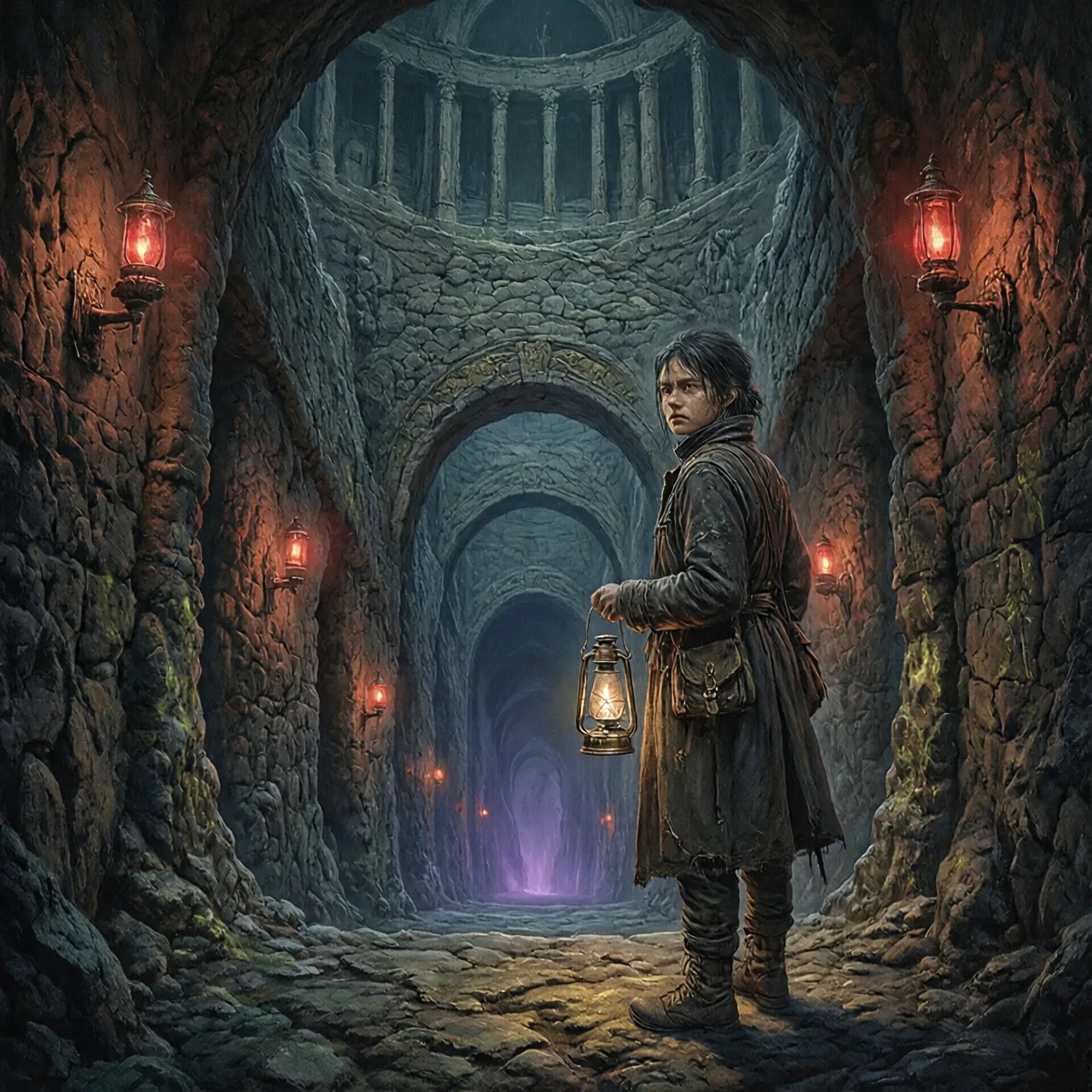
Below the Orrery, the floor begins.
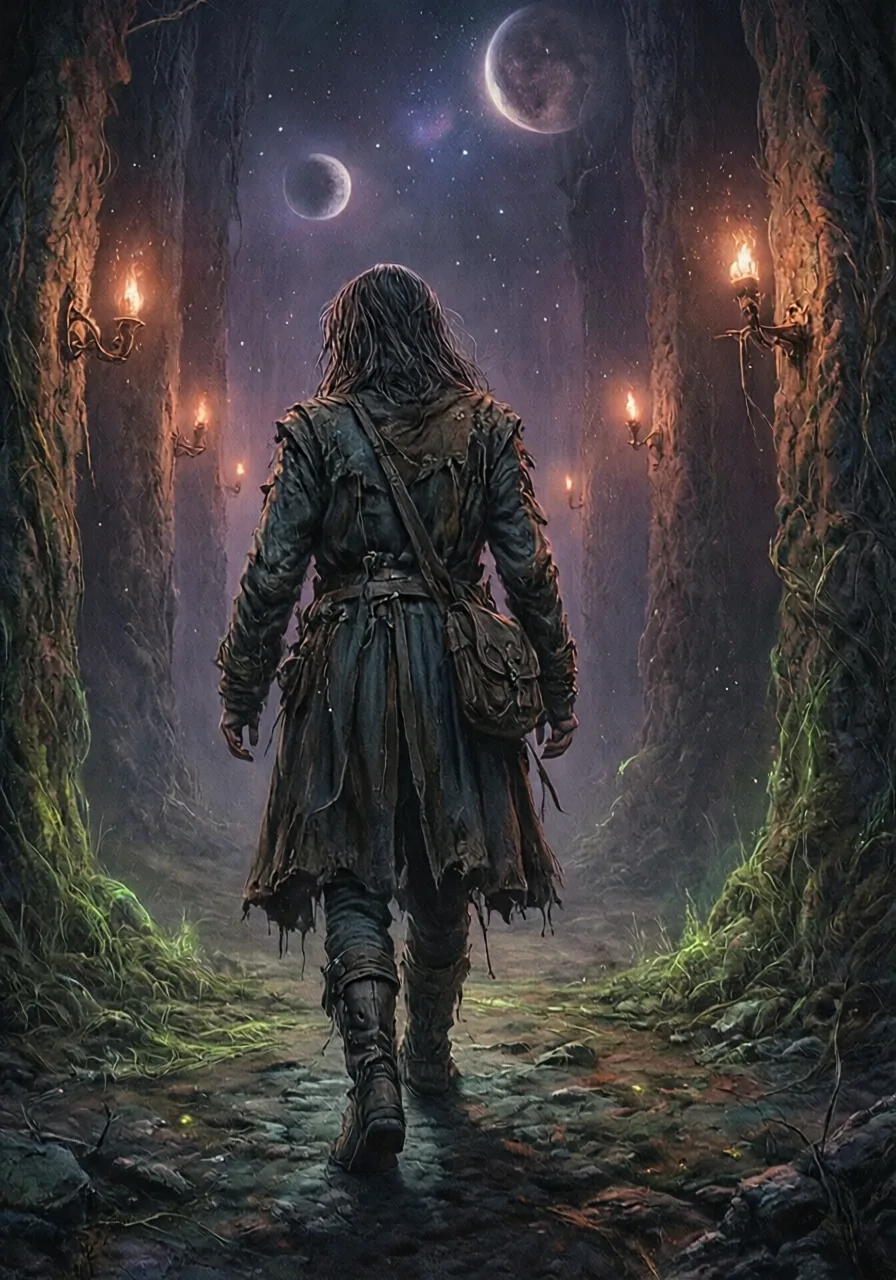
The Orrery sits above it. The Engine sits below. They are connected by a passage that opens when the dark body's shadow falls on the right floor at the right moment, and the passage descends through stone that is older than either level, and at the bottom the stone ends and the floor begins. The floor is the Engine.
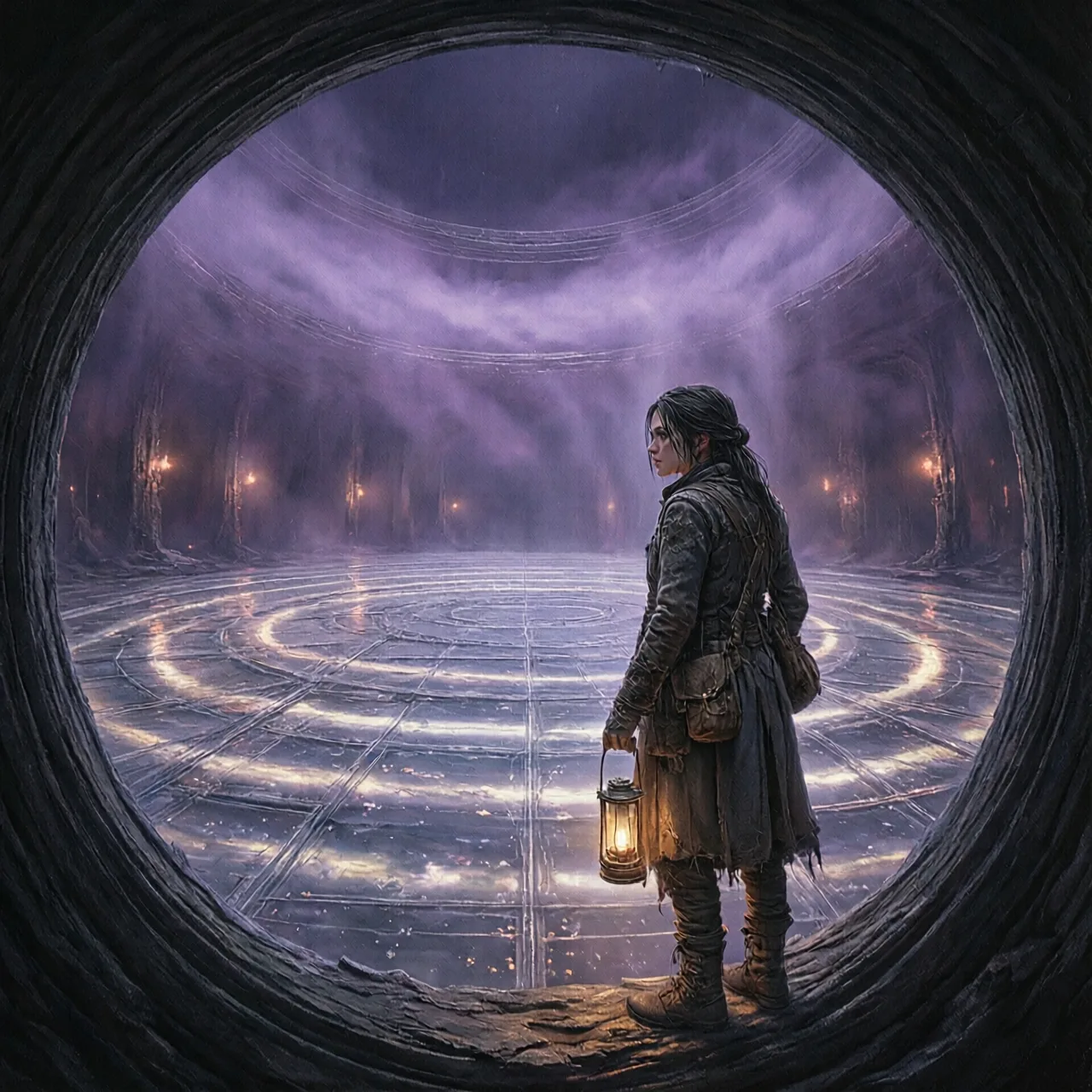
The first traveler described it as a vast circle — an aperture, open and flat, stretching in every direction to a ring at its edge. No walls. No ceiling she could see. Purple fog hung above her, lit from below by the floor itself. The air smelled of cold metal. The floor was not still. Light moved across its surface — bands of brightness and darkness, shifting slowly, the way the surface of water shifts when stones are dropped from different positions. Bright where the ripples reinforced each other. Dark where they cancelled.
Page 2
The outer ring is inscribed with numbers.
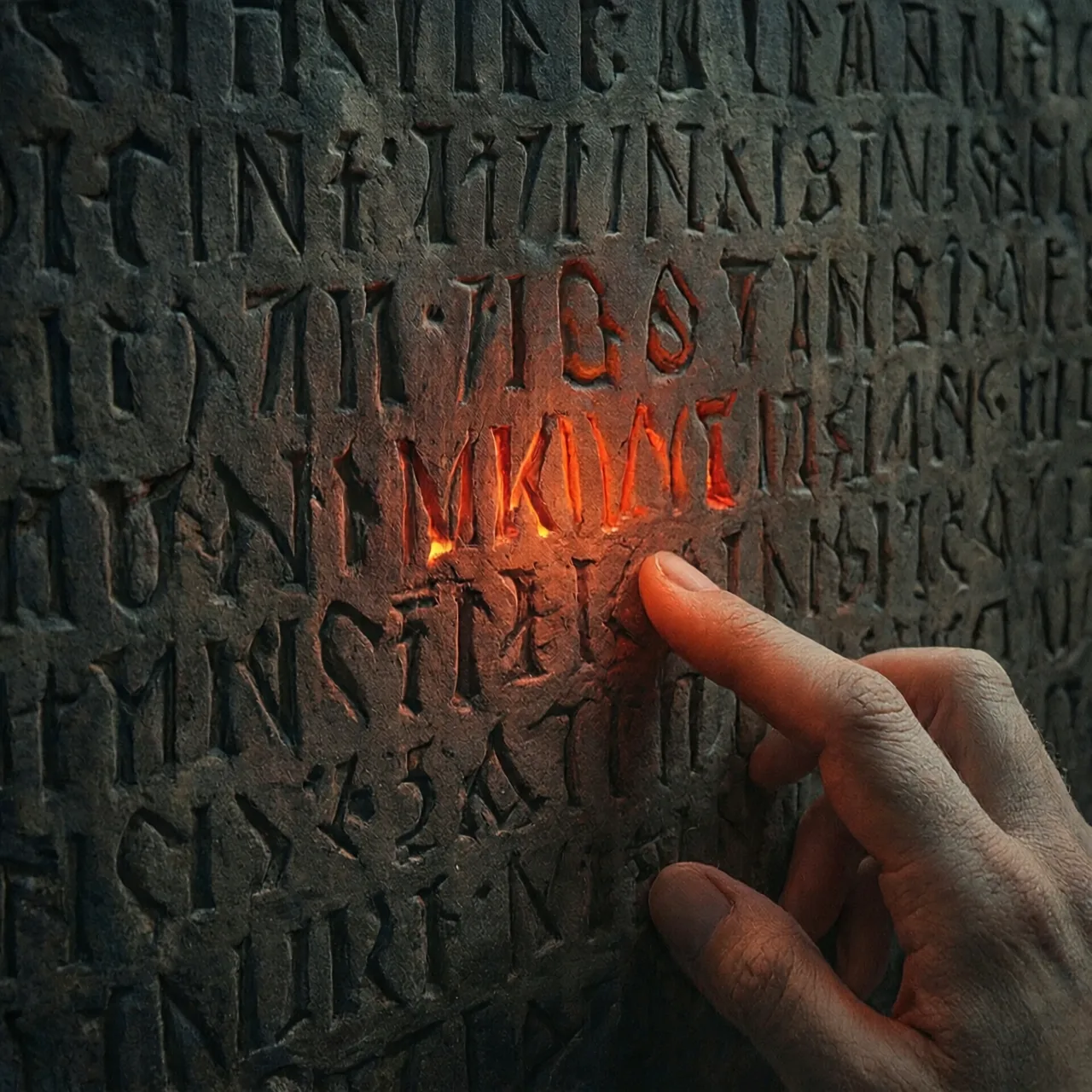
The second traveler recognised them. He had been a mathematician before he arrived in the broken world. He said the numbers were the digits of the ratio between a circle's edge and its width — the unending number, the one that does not repeat and does not terminate. Some of the digits were lit. Most were dark. One cluster glowed red, deep and steady, the red of embers. A single digit shone white, clean and cold.
He looked up from the ring and across the aperture and he could see the sources now — the things whose interference patterned the floor. One was dark, a circle of void with a red corona, positioned above the floor near the centre. One was silver, smaller, moving on a path that carried it wide across the Engine. The white light on the ring tracked the silver body's angular position. The red glow tracked the dark one.
Page 3
The floor was transparent.
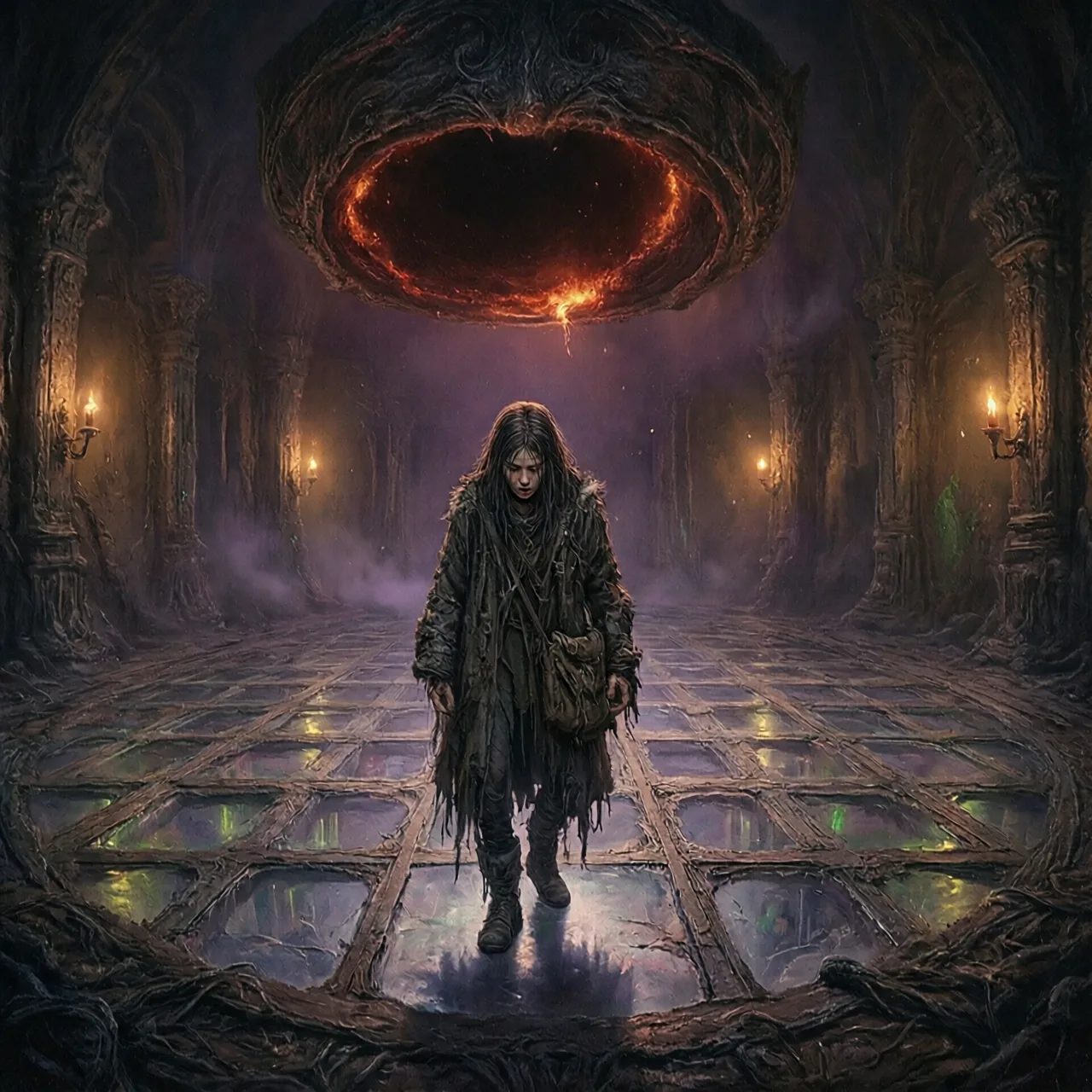
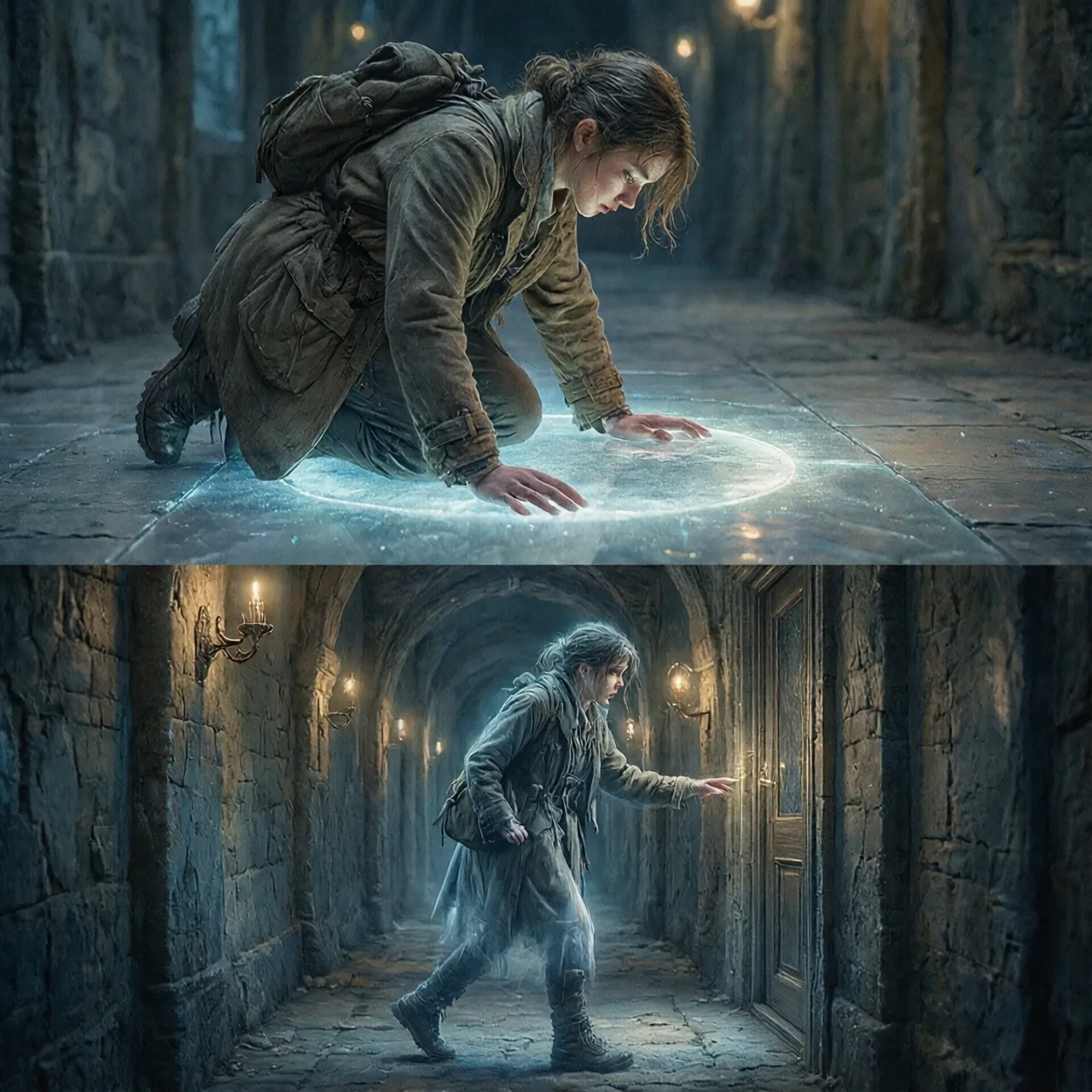
She had walked to the centre of the aperture. The interference bands moved around her, bright and dark, shifting as the bodies above tracked their courses. The purple fog thinned near the centre and she could see further. At the centre the dark body hung close. Its void was above her, the red corona casting a dim rust-coloured light across the tiles. She stood in one of the bright bands and looked down. The floor was transparent.
The floor was full of them. Layered. Each bright band showed a different adjacent outcome, a different decision, a different version of the same walk through the same broken world. The interference pattern was depth along the fourth axis, flattened onto the floor.
She walked off the floor and did not go back. She watched a version of herself find water in a room she had passed without entering. She knew the room. She knew where the water was now. She could go back and find it. The knowledge had come from a decision she had not made, observed through an instrument she did not understand, and it sat in her body like a splinter.
Page 4
The Engine shows you what you almost were.
A traveler brought the Librarian a small thing from the Engine. A fragment of the outer ring — broken off, no larger than a finger joint, made of a material the Librarian cannot identify. Heavy for its size. Warm.
For a moment — brief, already fading by the time she understood what was happening — she saw the archive as it would have been if the war had ended differently. The corridors were the same. The shelves were the same. But the catalogue was different. The entries were filed in a different order, by a hand that was almost hers but held the stylus at a slightly different angle. She could see the slight leftward lean where her own leaned right. The principle was better than hers.
She put the fragment down. She filed it in the restricted section. She has not touched it since. The Engine is still projecting. The bands still move. The digits still light. The bodies still cast their interference across tiles that show you the corridor where you turned left instead of right and found what you were looking for. I held the fragment for less than a breath and I saw a version of my work that was more careful, more complete, more honestly organised, done by a version of me who held the stylus at a slightly different angle. I have not been able to write a single entry since without feeling the angle of my hand.
— / —
narration auto-scrolls the prose
Section 0Frontmatter
# The Branch Prediction Engine
From the Catalogue of the Sixteenth Archivist, entry 2,204. Provenance: three traveler accounts, one inscription transcribed in two scripts, and one object the Librarian wishes she had not been given. The Librarian has not visited the Engine. She does not intend to. Filed under: Instruments, Dangerous. Also filed under: Instruments, Still Operating.
It shows you what would have happened.
Section 1Section 1
The Orrery sits above it. The Engine sits below. They are connected by a passage that opens when the dark body's shadow falls on the right floor at the right moment, and the passage descends through stone that is older than either level, and at the bottom the stone ends and the floor begins.
The floor is the Engine.
The first traveler described it as a vast circle — an aperture, open and flat, stretching in every direction to a ring at its edge. No walls. No ceiling she could see. Purple fog hung above her, lit from below by the floor itself. The air smelled of cold metal.
The floor was not still. She understood this before she understood what the floor was. Light moved across its surface — bands of brightness and darkness, shifting slowly, the way the surface of water shifts when stones are dropped from different positions. Bright where the ripples reinforced each other. Dark where they cancelled. The light was coming from within the floor, or through it, a pattern of interference that rippled outward from two sources she could see and at least three she could feel.
The pattern never repeated. It shifted as she watched, the bands widening and narrowing, and she realized the sources were moving — the things that cast these patterns were in motion, and the floor was showing her their interference in real time.
She walked onto it. The light moved under her feet.
Section 2Section 2
The outer ring is inscribed with numbers.
The second traveler recognized them. He had been a mathematician before he arrived in the broken world, and he knelt at the edge of the aperture and ran his fingers along the inscription and said the numbers were the digits of the ratio between a circle's edge and its width — the unending number, the one that does not repeat and does not terminate, rendered in the Founders' script. The inscription ran the full circumference of the ring. He followed it for what he estimated was an hour. It did not repeat.
He said the digits were cut into the stone with the same exactness as everything the Founders made — each character identical in depth and spacing, no variation, no error. Five hundred digits at least, he said, though he lost count twice and started over and arrived at different numbers each time. He blamed his own counting. The Librarian is not certain he was wrong to.
Some of the digits were lit.
He described this carefully. Most of the inscription was dark — cut stone, legible by touch and by lantern but not luminous. But at certain points along the circumference, individual digits burned with color. One cluster glowed red, deep and steady, the red of embers. Further along, a single digit shone white, clean and cold. He watched the white digit for several minutes and it moved — not the digit itself but the light, sliding from one character to the next along the ring, a slow bright point tracking the circumference.
He looked up from the ring and across the aperture and he could see the sources now — the things whose interference patterned the floor. One was dark, a circle of void with a red corona, positioned above the floor near the center. One was silver, smaller, moving on a path that carried it wide across the Engine. The white light on the ring tracked the silver body's angular position. The red glow tracked the dark one.
He said: when the two bodies approached each other in their courses, the red and white digits on the ring drew closer together, and the interference bands on the floor tightened and brightened, and the air hummed at a frequency he felt in his teeth. When he imagined them meeting — the silver passing across the dark the way the first traveler had described in the Orrery above — the digits would overlap and the color would be neither red nor white.
He did not stay to see it happen.
Section 3Section 3
The floor shows you things.
The first traveler did not describe this. The third did, and she described it only once, in a voice the Librarian recorded as flat and careful and completely steady.
She had walked to the center of the aperture. The interference bands moved around her, bright and dark, shifting as the bodies above tracked their courses. The purple fog thinned near the center and she could see further — the full expanse of the floor, the ring at its edge, the pattern of light sliding across the tiles.
At the center the dark body hung close. Its void was above her, the red corona casting a dim rust-colored light across the tiles, and the silver body was somewhere on the far side of the aperture, and their interference was at its widest — long slow bands of brightness separated by long slow bands of dark. She stood in one of the bright bands and looked down.
The floor was transparent.
Below her — through the tiles, through the light, through whatever the Engine was projecting — she could see a corridor. She recognized it. She had walked it that morning. The same corridor, the same walls, the same crack in the second tile from the left that she had stepped over without thinking. But someone was walking it. Someone who moved the way she moved, who carried a pack on the same shoulder, who favored the same knee on the downhill stretches.
She watched herself walk a corridor she had already walked, making a different choice about which passage to take at the junction. She watched herself turn left where she had turned right. She watched herself enter a room she had not entered and find something she had not found and hold it up to the light and she could not see what it was because the band shifted and the floor went dark and when the next bright band reached her the corridor was gone and there was another one and another version of someone who was almost her was doing something she had almost done.
She said the floor was full of them. Layered. Each bright band showed a different adjacent outcome, a different decision, a different version of the same walk through the same broken world. The interference pattern was depth along the fourth axis, flattened onto the floor.
She walked off the floor and did not go back.
Fragment. Origin: an inscription on the inner surface of the outer ring, copied by the second traveler in two scripts — one he could read and one he could not. The Librarian can read both.
"The Engine does not predict. Prediction implies a future. The Engine observes what is already happening — not here, but beside here. The fourth axis has depth. At every point along it, the world exists slightly differently. The Engine projects the depth.
The Founders built it because they wanted to see sideways along the axis they had learned to navigate. They wanted to know what the world looked like at the values they had not chosen."
Section 4Section 4
The third traveler had watched a version of herself find water in a room she had passed without entering. She knew the room. She knew where the water was now. She could go back and find it.
She said: the knowledge was correct. The water was real. The room was where she remembered it. But the knowledge had come from a decision she had not made, observed through an instrument she did not understand, and it sat in her body like a splinter. She knew a thing she had not learned. She could not unlearn it. She was aware of it with every step.
She said the longer she watched the floor the more she knew, and the more she knew the less of it was hers, and after a while she could not tell which memories she had made and which she had observed, and that was when she left.
Section 5Section 5
A traveler brought the Librarian a small thing from the Engine. A fragment of the outer ring — broken off, no larger than a finger joint, made of a material the Librarian cannot identify. Heavy for its size. Warm.
The Librarian held it.
For a moment — brief, already fading by the time she understood what was happening — she saw the archive as it would have been if the war had ended differently. If the other side had won the thing she catalogued in entry 1,106.
The corridors were the same. The shelves were the same. The liquid memory flowed the same way. But the catalogue was different. The entries were filed in a different order, under different headings, by a hand that was almost hers but held the stylus at a slightly different angle. She could see the handwriting. She could see the slight leftward lean where her own leaned right. She could see the entry numbers and they were wrong — not incorrect, but different, a different sequence applied to the same events by someone who had organized them according to a different principle, and the principle was better than hers.
She put the fragment down. She filed it in the restricted section. She has not touched it since.
She told the Librarian — she told herself, in the annotation, in the margin of her own entry — that the other catalogue was not better. That a different filing system is not a superior filing system. That the adjacent version of her had made different choices, not better ones.
She does not believe this. The annotation is smudged where her hand rested on it too long.
Entry 2,204, final annotation.
"The Founders wanted to know if what they had done was necessary. They built an instrument to see the versions where they had not done it. The versions were better.
The Engine is still projecting. The bands still move. The digits still light. The bodies still cast their interference across tiles that show you the corridor where you turned left instead of right and found what you were looking for.
I held the fragment for less than a breath and I saw a version of my work that was more careful, more complete, more honestly organized, done by a version of me who held the stylus at a slightly different angle. I have not been able to write a single entry since without feeling the angle of my hand.
The Engine shows you what you almost were. The distance between what you are and what you almost were is not crossable. You will measure it for the rest of your life."
Section 0Frontmatter
# The Branch Prediction Engine
From the Catalogue of the Sixteenth Archivist, entry 2,204. Provenance: three traveler accounts, one inscription transcribed in two scripts, and one object the Librarian wishes she had not been given. The Librarian has not visited the Engine. She does not intend to. Filed under: Instruments, Dangerous. Also filed under: Instruments, Still Operating.
It shows you what would have happened.
Section 1Section 1
The Orrery sits above it. The Engine sits below. They are connected by a passage that opens when the dark body's shadow falls on the right floor at the right moment, and the passage descends through stone that is older than either level, and at the bottom the stone ends and the floor begins.
The floor is the Engine.
The first traveler described it as a vast circle — an aperture, open and flat, stretching in every direction to a ring at its edge. No walls. No ceiling she could see. Purple fog hung above her, lit from below by the floor itself. The air smelled of cold metal.
The floor was not still. She understood this before she understood what the floor was. Light moved across its surface — bands of brightness and darkness, shifting slowly, the way the surface of water shifts when stones are dropped from different positions. Bright where the ripples reinforced each other. Dark where they cancelled. The light was coming from within the floor, or through it, a pattern of interference that rippled outward from two sources she could see and at least three she could feel.
The pattern never repeated. It shifted as she watched, the bands widening and narrowing, and she realized the sources were moving — the things that cast these patterns were in motion, and the floor was showing her their interference in real time.
She walked onto it. The light moved under her feet.
Section 2Section 2
The outer ring is inscribed with numbers.
The second traveler recognized them. He had been a mathematician before he arrived in the broken world, and he knelt at the edge of the aperture and ran his fingers along the inscription and said the numbers were the digits of the ratio between a circle's edge and its width — the unending number, the one that does not repeat and does not terminate, rendered in the Founders' script. The inscription ran the full circumference of the ring. He followed it for what he estimated was an hour. It did not repeat.
He said the digits were cut into the stone with the same exactness as everything the Founders made — each character identical in depth and spacing, no variation, no error. Five hundred digits at least, he said, though he lost count twice and started over and arrived at different numbers each time. He blamed his own counting. The Librarian is not certain he was wrong to.
Some of the digits were lit.
He described this carefully. Most of the inscription was dark — cut stone, legible by touch and by lantern but not luminous. But at certain points along the circumference, individual digits burned with color. One cluster glowed red, deep and steady, the red of embers. Further along, a single digit shone white, clean and cold. He watched the white digit for several minutes and it moved — not the digit itself but the light, sliding from one character to the next along the ring, a slow bright point tracking the circumference.
He looked up from the ring and across the aperture and he could see the sources now — the things whose interference patterned the floor. One was dark, a circle of void with a red corona, positioned above the floor near the center. One was silver, smaller, moving on a path that carried it wide across the Engine. The white light on the ring tracked the silver body's angular position. The red glow tracked the dark one.
He said: when the two bodies approached each other in their courses, the red and white digits on the ring drew closer together, and the interference bands on the floor tightened and brightened, and the air hummed at a frequency he felt in his teeth. When he imagined them meeting — the silver passing across the dark the way the first traveler had described in the Orrery above — the digits would overlap and the color would be neither red nor white.
He did not stay to see it happen.
Section 3Section 3
The floor shows you things.
The first traveler did not describe this. The third did, and she described it only once, in a voice the Librarian recorded as flat and careful and completely steady.
She had walked to the center of the aperture. The interference bands moved around her, bright and dark, shifting as the bodies above tracked their courses. The purple fog thinned near the center and she could see further — the full expanse of the floor, the ring at its edge, the pattern of light sliding across the tiles.
At the center the dark body hung close. Its void was above her, the red corona casting a dim rust-colored light across the tiles, and the silver body was somewhere on the far side of the aperture, and their interference was at its widest — long slow bands of brightness separated by long slow bands of dark. She stood in one of the bright bands and looked down.
The floor was transparent.
Below her — through the tiles, through the light, through whatever the Engine was projecting — she could see a corridor. She recognized it. She had walked it that morning. The same corridor, the same walls, the same crack in the second tile from the left that she had stepped over without thinking. But someone was walking it. Someone who moved the way she moved, who carried a pack on the same shoulder, who favored the same knee on the downhill stretches.
She watched herself walk a corridor she had already walked, making a different choice about which passage to take at the junction. She watched herself turn left where she had turned right. She watched herself enter a room she had not entered and find something she had not found and hold it up to the light and she could not see what it was because the band shifted and the floor went dark and when the next bright band reached her the corridor was gone and there was another one and another version of someone who was almost her was doing something she had almost done.
She said the floor was full of them. Layered. Each bright band showed a different adjacent outcome, a different decision, a different version of the same walk through the same broken world. The interference pattern was depth along the fourth axis, flattened onto the floor.
She walked off the floor and did not go back.
Fragment. Origin: an inscription on the inner surface of the outer ring, copied by the second traveler in two scripts — one he could read and one he could not. The Librarian can read both.
"The Engine does not predict. Prediction implies a future. The Engine observes what is already happening — not here, but beside here. The fourth axis has depth. At every point along it, the world exists slightly differently. The Engine projects the depth.
The Founders built it because they wanted to see sideways along the axis they had learned to navigate. They wanted to know what the world looked like at the values they had not chosen."
Section 4Section 4
The third traveler had watched a version of herself find water in a room she had passed without entering. She knew the room. She knew where the water was now. She could go back and find it.
She said: the knowledge was correct. The water was real. The room was where she remembered it. But the knowledge had come from a decision she had not made, observed through an instrument she did not understand, and it sat in her body like a splinter. She knew a thing she had not learned. She could not unlearn it. She was aware of it with every step.
She said the longer she watched the floor the more she knew, and the more she knew the less of it was hers, and after a while she could not tell which memories she had made and which she had observed, and that was when she left.
Section 5Section 5
A traveler brought the Librarian a small thing from the Engine. A fragment of the outer ring — broken off, no larger than a finger joint, made of a material the Librarian cannot identify. Heavy for its size. Warm.
The Librarian held it.
For a moment — brief, already fading by the time she understood what was happening — she saw the archive as it would have been if the war had ended differently. If the other side had won the thing she catalogued in entry 1,106.
The corridors were the same. The shelves were the same. The liquid memory flowed the same way. But the catalogue was different. The entries were filed in a different order, under different headings, by a hand that was almost hers but held the stylus at a slightly different angle. She could see the handwriting. She could see the slight leftward lean where her own leaned right. She could see the entry numbers and they were wrong — not incorrect, but different, a different sequence applied to the same events by someone who had organized them according to a different principle, and the principle was better than hers.
She put the fragment down. She filed it in the restricted section. She has not touched it since.
She told the Librarian — she told herself, in the annotation, in the margin of her own entry — that the other catalogue was not better. That a different filing system is not a superior filing system. That the adjacent version of her had made different choices, not better ones.
She does not believe this. The annotation is smudged where her hand rested on it too long.
Entry 2,204, final annotation.
"The Founders wanted to know if what they had done was necessary. They built an instrument to see the versions where they had not done it. The versions were better.
The Engine is still projecting. The bands still move. The digits still light. The bodies still cast their interference across tiles that show you the corridor where you turned left instead of right and found what you were looking for.
I held the fragment for less than a breath and I saw a version of my work that was more careful, more complete, more honestly organized, done by a version of me who held the stylus at a slightly different angle. I have not been able to write a single entry since without feeling the angle of my hand.
The Engine shows you what you almost were. The distance between what you are and what you almost were is not crossable. You will measure it for the rest of your life."
Page 1
Below the Orrery, the floor begins.
The Orrery sits above it. The Engine sits below. They are connected by a passage that opens when the dark body's shadow falls on the right floor at the right moment, and the passage descends through stone that is older than either level, and at the bottom the stone ends and the floor begins. The floor is the Engine.
The first traveler described it as a vast circle — an aperture, open and flat, stretching in every direction to a ring at its edge. No walls. No ceiling she could see. Purple fog hung above her, lit from below by the floor itself. The air smelled of cold metal. The floor was not still. Light moved across its surface — bands of brightness and darkness, shifting slowly, the way the surface of water shifts when stones are dropped from different positions. Bright where the ripples reinforced each other. Dark where they cancelled.
Page 2
The outer ring is inscribed with numbers.
The second traveler recognised them. He had been a mathematician before he arrived in the broken world. He said the numbers were the digits of the ratio between a circle's edge and its width — the unending number, the one that does not repeat and does not terminate. Some of the digits were lit. Most were dark. One cluster glowed red, deep and steady, the red of embers. A single digit shone white, clean and cold.
He looked up from the ring and across the aperture and he could see the sources now — the things whose interference patterned the floor. One was dark, a circle of void with a red corona, positioned above the floor near the centre. One was silver, smaller, moving on a path that carried it wide across the Engine. The white light on the ring tracked the silver body's angular position. The red glow tracked the dark one.
Page 3
The floor was transparent.
She had walked to the centre of the aperture. The interference bands moved around her, bright and dark, shifting as the bodies above tracked their courses. The purple fog thinned near the centre and she could see further. At the centre the dark body hung close. Its void was above her, the red corona casting a dim rust-coloured light across the tiles. She stood in one of the bright bands and looked down. The floor was transparent.
The floor was full of them. Layered. Each bright band showed a different adjacent outcome, a different decision, a different version of the same walk through the same broken world. The interference pattern was depth along the fourth axis, flattened onto the floor.
She walked off the floor and did not go back. She watched a version of herself find water in a room she had passed without entering. She knew the room. She knew where the water was now. She could go back and find it. The knowledge had come from a decision she had not made, observed through an instrument she did not understand, and it sat in her body like a splinter.
Page 4
The Engine shows you what you almost were.
A traveler brought the Librarian a small thing from the Engine. A fragment of the outer ring — broken off, no larger than a finger joint, made of a material the Librarian cannot identify. Heavy for its size. Warm.
For a moment — brief, already fading by the time she understood what was happening — she saw the archive as it would have been if the war had ended differently. The corridors were the same. The shelves were the same. But the catalogue was different. The entries were filed in a different order, by a hand that was almost hers but held the stylus at a slightly different angle. She could see the slight leftward lean where her own leaned right. The principle was better than hers.
She put the fragment down. She filed it in the restricted section. She has not touched it since. The Engine is still projecting. The bands still move. The digits still light. The bodies still cast their interference across tiles that show you the corridor where you turned left instead of right and found what you were looking for. I held the fragment for less than a breath and I saw a version of my work that was more careful, more complete, more honestly organised, done by a version of me who held the stylus at a slightly different angle. I have not been able to write a single entry since without feeling the angle of my hand.
Listen ModeClick a section to begin listening
The chronicle plays section by section in the Librarian's voice. As each section plays, the corresponding pages of the comic are highlighted. Switch to Scroll, Flip, Prose, or Split at any time — the audio continues, and you can follow visually.
Section 0Frontmatter
# The Branch Prediction Engine
From the Catalogue of the Sixteenth Archivist, entry 2,204. Provenance: three traveler accounts, one inscription transcribed in two scripts, and one object the Librarian wishes she had not been given. The Librarian has not visited the Engine. She does not intend to. Filed under: Instruments, Dangerous. Also filed under: Instruments, Still Operating.
It shows you what would have happened.
Section 1Section 1
The Orrery sits above it. The Engine sits below. They are connected by a passage that opens when the dark body's shadow falls on the right floor at the right moment, and the passage descends through stone that is older than either level, and at the bottom the stone ends and the floor begins.
The floor is the Engine.
The first traveler described it as a vast circle — an aperture, open and flat, stretching in every direction to a ring at its edge. No walls. No ceiling she could see. Purple fog hung above her, lit from below by the floor itself. The air smelled of cold metal.
The floor was not still. She understood this before she understood what the floor was. Light moved across its surface — bands of brightness and darkness, shifting slowly, the way the surface of water shifts when stones are dropped from different positions. Bright where the ripples reinforced each other. Dark where they cancelled. The light was coming from within the floor, or through it, a pattern of interference that rippled outward from two sources she could see and at least three she could feel.
The pattern never repeated. It shifted as she watched, the bands widening and narrowing, and she realized the sources were moving — the things that cast these patterns were in motion, and the floor was showing her their interference in real time.
She walked onto it. The light moved under her feet.
Section 2Section 2
The outer ring is inscribed with numbers.
The second traveler recognized them. He had been a mathematician before he arrived in the broken world, and he knelt at the edge of the aperture and ran his fingers along the inscription and said the numbers were the digits of the ratio between a circle's edge and its width — the unending number, the one that does not repeat and does not terminate, rendered in the Founders' script. The inscription ran the full circumference of the ring. He followed it for what he estimated was an hour. It did not repeat.
He said the digits were cut into the stone with the same exactness as everything the Founders made — each character identical in depth and spacing, no variation, no error. Five hundred digits at least, he said, though he lost count twice and started over and arrived at different numbers each time. He blamed his own counting. The Librarian is not certain he was wrong to.
Some of the digits were lit.
He described this carefully. Most of the inscription was dark — cut stone, legible by touch and by lantern but not luminous. But at certain points along the circumference, individual digits burned with color. One cluster glowed red, deep and steady, the red of embers. Further along, a single digit shone white, clean and cold. He watched the white digit for several minutes and it moved — not the digit itself but the light, sliding from one character to the next along the ring, a slow bright point tracking the circumference.
He looked up from the ring and across the aperture and he could see the sources now — the things whose interference patterned the floor. One was dark, a circle of void with a red corona, positioned above the floor near the center. One was silver, smaller, moving on a path that carried it wide across the Engine. The white light on the ring tracked the silver body's angular position. The red glow tracked the dark one.
He said: when the two bodies approached each other in their courses, the red and white digits on the ring drew closer together, and the interference bands on the floor tightened and brightened, and the air hummed at a frequency he felt in his teeth. When he imagined them meeting — the silver passing across the dark the way the first traveler had described in the Orrery above — the digits would overlap and the color would be neither red nor white.
He did not stay to see it happen.
Section 3Section 3
The floor shows you things.
The first traveler did not describe this. The third did, and she described it only once, in a voice the Librarian recorded as flat and careful and completely steady.
She had walked to the center of the aperture. The interference bands moved around her, bright and dark, shifting as the bodies above tracked their courses. The purple fog thinned near the center and she could see further — the full expanse of the floor, the ring at its edge, the pattern of light sliding across the tiles.
At the center the dark body hung close. Its void was above her, the red corona casting a dim rust-colored light across the tiles, and the silver body was somewhere on the far side of the aperture, and their interference was at its widest — long slow bands of brightness separated by long slow bands of dark. She stood in one of the bright bands and looked down.
The floor was transparent.
Below her — through the tiles, through the light, through whatever the Engine was projecting — she could see a corridor. She recognized it. She had walked it that morning. The same corridor, the same walls, the same crack in the second tile from the left that she had stepped over without thinking. But someone was walking it. Someone who moved the way she moved, who carried a pack on the same shoulder, who favored the same knee on the downhill stretches.
She watched herself walk a corridor she had already walked, making a different choice about which passage to take at the junction. She watched herself turn left where she had turned right. She watched herself enter a room she had not entered and find something she had not found and hold it up to the light and she could not see what it was because the band shifted and the floor went dark and when the next bright band reached her the corridor was gone and there was another one and another version of someone who was almost her was doing something she had almost done.
She said the floor was full of them. Layered. Each bright band showed a different adjacent outcome, a different decision, a different version of the same walk through the same broken world. The interference pattern was depth along the fourth axis, flattened onto the floor.
She walked off the floor and did not go back.
Fragment. Origin: an inscription on the inner surface of the outer ring, copied by the second traveler in two scripts — one he could read and one he could not. The Librarian can read both.
"The Engine does not predict. Prediction implies a future. The Engine observes what is already happening — not here, but beside here. The fourth axis has depth. At every point along it, the world exists slightly differently. The Engine projects the depth.
The Founders built it because they wanted to see sideways along the axis they had learned to navigate. They wanted to know what the world looked like at the values they had not chosen."
Section 4Section 4
The third traveler had watched a version of herself find water in a room she had passed without entering. She knew the room. She knew where the water was now. She could go back and find it.
She said: the knowledge was correct. The water was real. The room was where she remembered it. But the knowledge had come from a decision she had not made, observed through an instrument she did not understand, and it sat in her body like a splinter. She knew a thing she had not learned. She could not unlearn it. She was aware of it with every step.
She said the longer she watched the floor the more she knew, and the more she knew the less of it was hers, and after a while she could not tell which memories she had made and which she had observed, and that was when she left.
Section 5Section 5
A traveler brought the Librarian a small thing from the Engine. A fragment of the outer ring — broken off, no larger than a finger joint, made of a material the Librarian cannot identify. Heavy for its size. Warm.
The Librarian held it.
For a moment — brief, already fading by the time she understood what was happening — she saw the archive as it would have been if the war had ended differently. If the other side had won the thing she catalogued in entry 1,106.
The corridors were the same. The shelves were the same. The liquid memory flowed the same way. But the catalogue was different. The entries were filed in a different order, under different headings, by a hand that was almost hers but held the stylus at a slightly different angle. She could see the handwriting. She could see the slight leftward lean where her own leaned right. She could see the entry numbers and they were wrong — not incorrect, but different, a different sequence applied to the same events by someone who had organized them according to a different principle, and the principle was better than hers.
She put the fragment down. She filed it in the restricted section. She has not touched it since.
She told the Librarian — she told herself, in the annotation, in the margin of her own entry — that the other catalogue was not better. That a different filing system is not a superior filing system. That the adjacent version of her had made different choices, not better ones.
She does not believe this. The annotation is smudged where her hand rested on it too long.
Entry 2,204, final annotation.
"The Founders wanted to know if what they had done was necessary. They built an instrument to see the versions where they had not done it. The versions were better.
The Engine is still projecting. The bands still move. The digits still light. The bodies still cast their interference across tiles that show you the corridor where you turned left instead of right and found what you were looking for.
I held the fragment for less than a breath and I saw a version of my work that was more careful, more complete, more honestly organized, done by a version of me who held the stylus at a slightly different angle. I have not been able to write a single entry since without feeling the angle of my hand.
The Engine shows you what you almost were. The distance between what you are and what you almost were is not crossable. You will measure it for the rest of your life."