Provenance: the Librarian's own survey, conducted over a period she initially recorded as nine days and later corrected to four. Supplementary material: one rubbing taken from a column base, one measurement log she found already open on her desk when she returned, and a single memory crystal recovered from the ambulatory floor, cracked but still readable on one side.
She walked for a long time before she understood that the building had no end.
Full chronicle
Page 1
She walked for a long time before she understood that the building had no end.
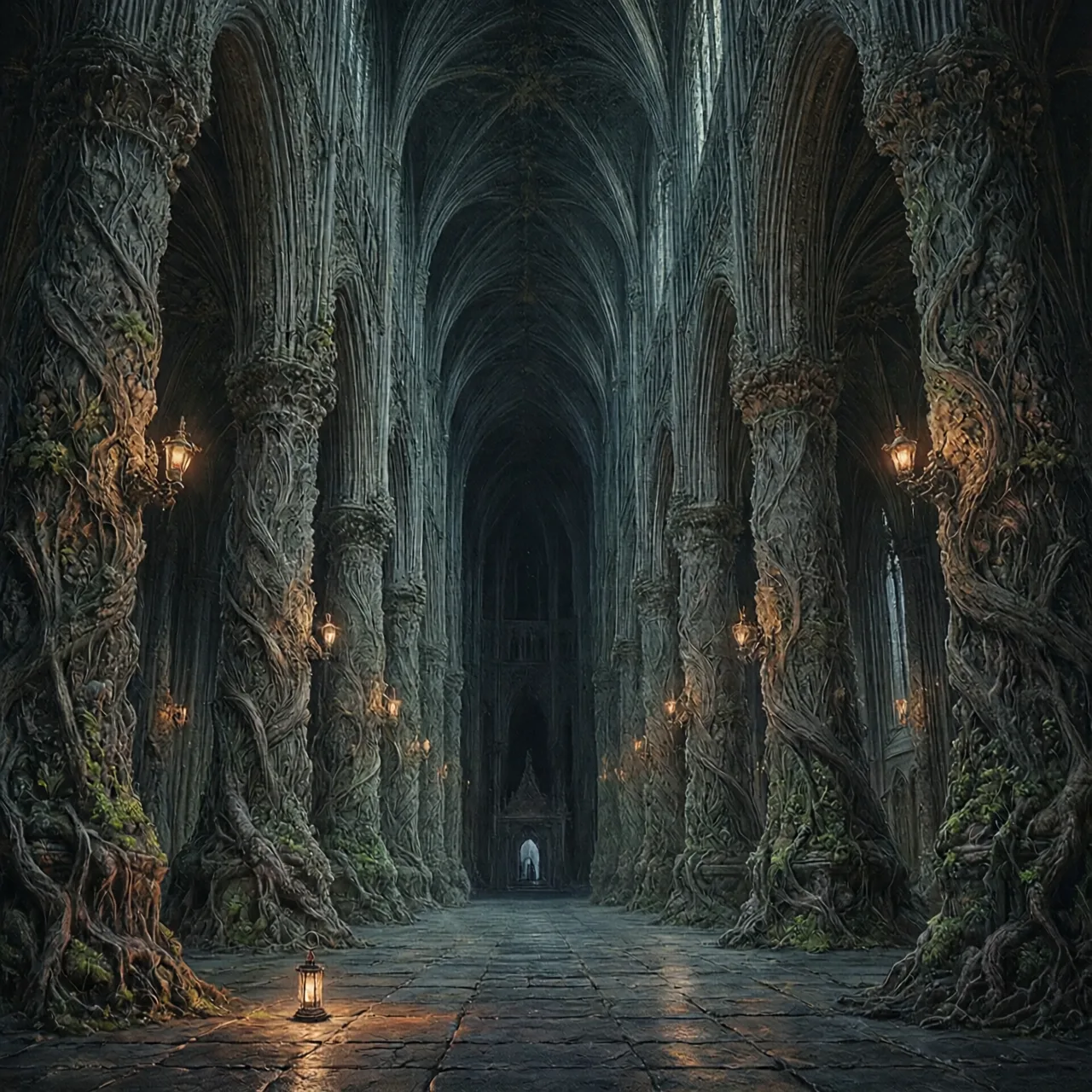
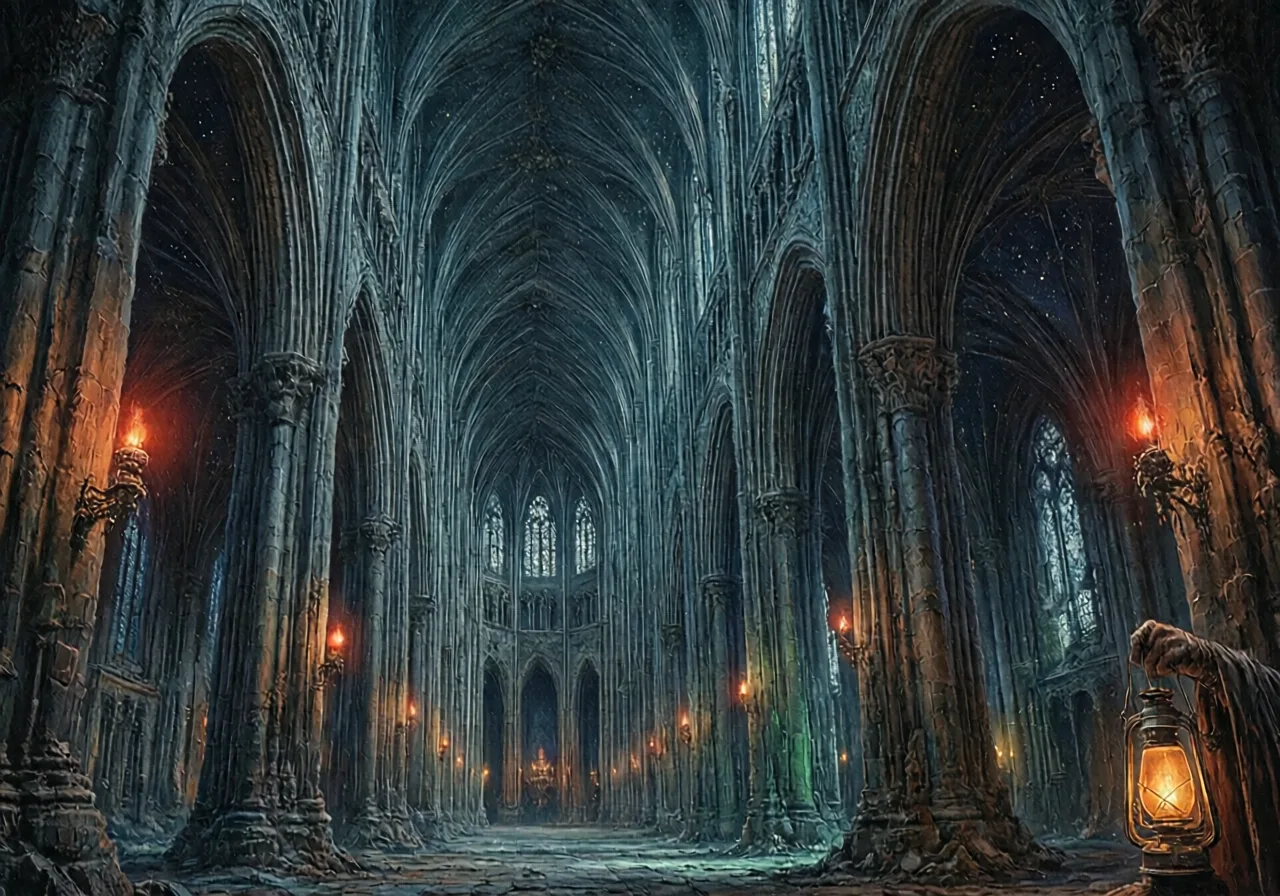
She walked for a long time before she understood that the building had no end. The nave ran north. She counted the columns as she went — thirty-eight on the east side, each one thick enough that her lantern's glow did not reach around the far side when she pressed it against the stone. She counted her paces along the wall. Four hundred and twelve.
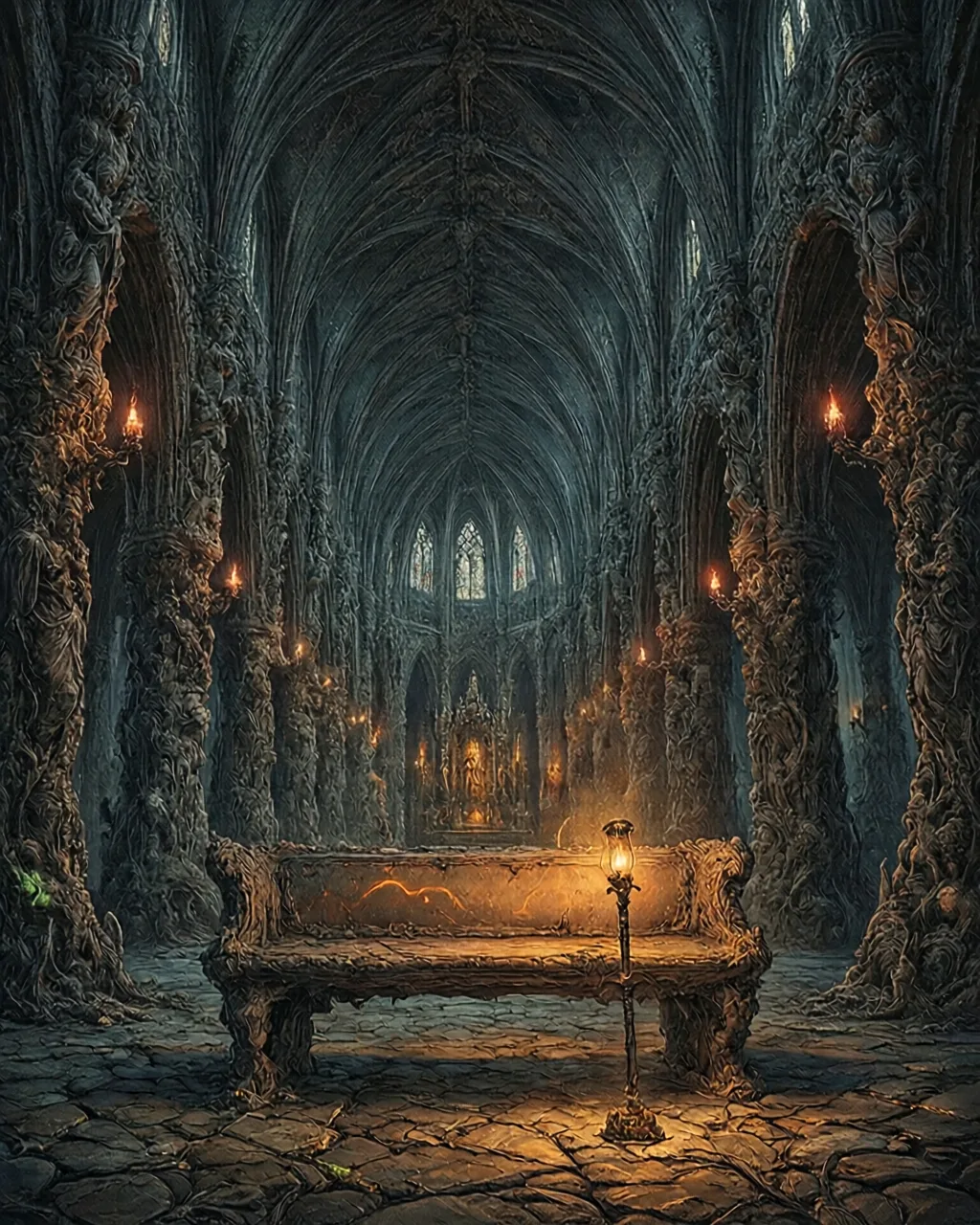
She slept in a side chapel that night, on a bench that fit her exactly. She did not remember the bench fitting her when she had first examined the chapel. She had noted its dimensions in her log. She checked. The dimensions had not changed. In the morning she measured the nave again, same wall, same stride. Three hundred and ninety-one paces. Twenty-one fewer than the day before. The columns were still thirty-eight. She stood at the last column and looked back the way she had come. The entrance was a gray rectangle, distant and small. It had been larger yesterday.
The bench fit her exactly. The dimensions had not changed.
Page 2
Something took the word out of the air.
The ceiling was not visible. She tilted her lantern upward and the light went up into the dark and did not come back.
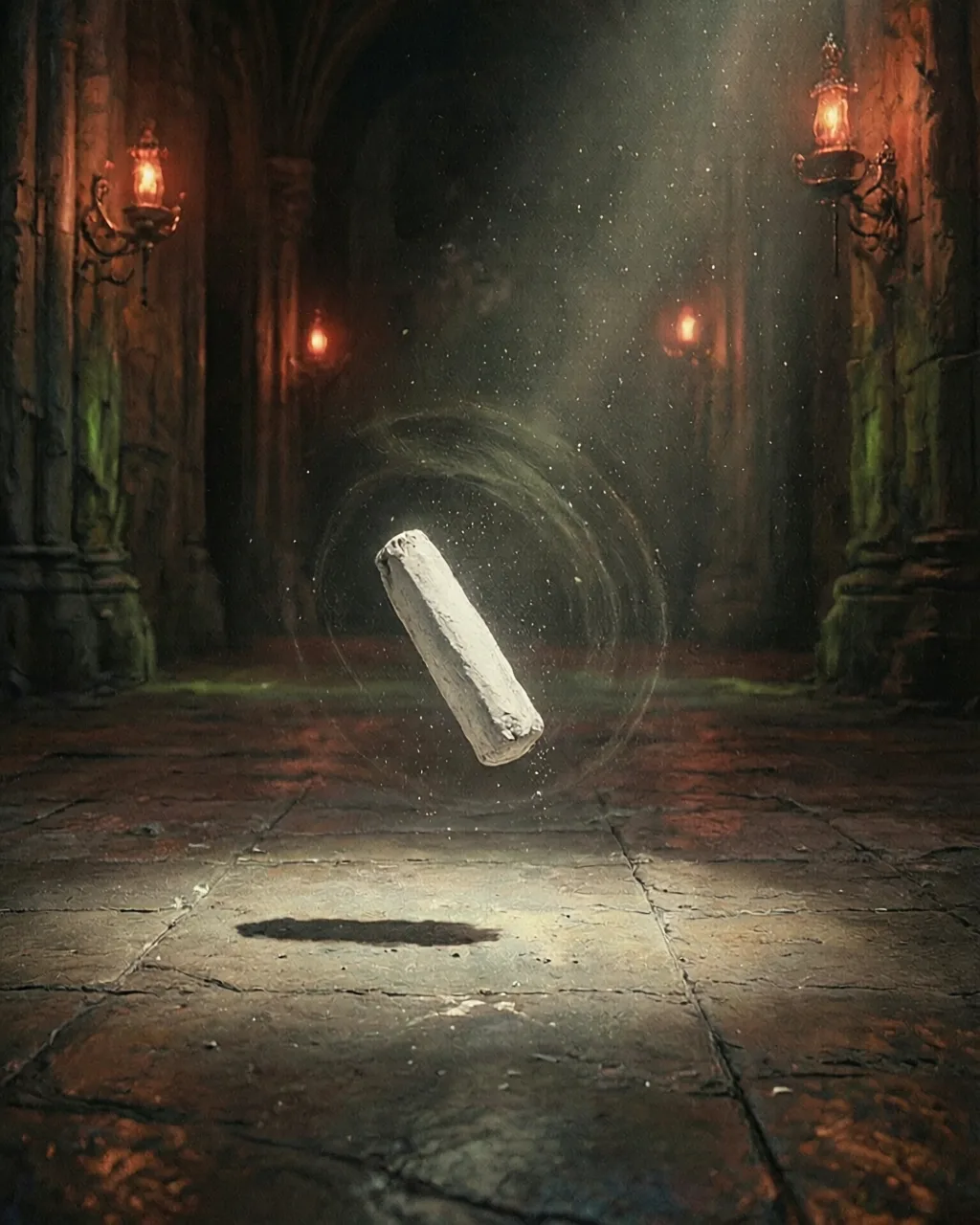
She dropped a piece of chalk and listened. The chalk struck the floor beside her foot. The sound of the impact existed for its duration and was gone. No echo. No resonance. The sound went up the way the light did.
She spoke once, a single word, to test the acoustics. The word left her mouth and something took it. Not the architecture. Not distance or dampness or the geometry of vaulted stone. Something took the word out of the air the way a hand lifts a coin from a table. She felt the absence where the sound should have continued. A space shaped exactly like her voice. She did not speak again.
Page 3
The chain was warm. The bench was warm.
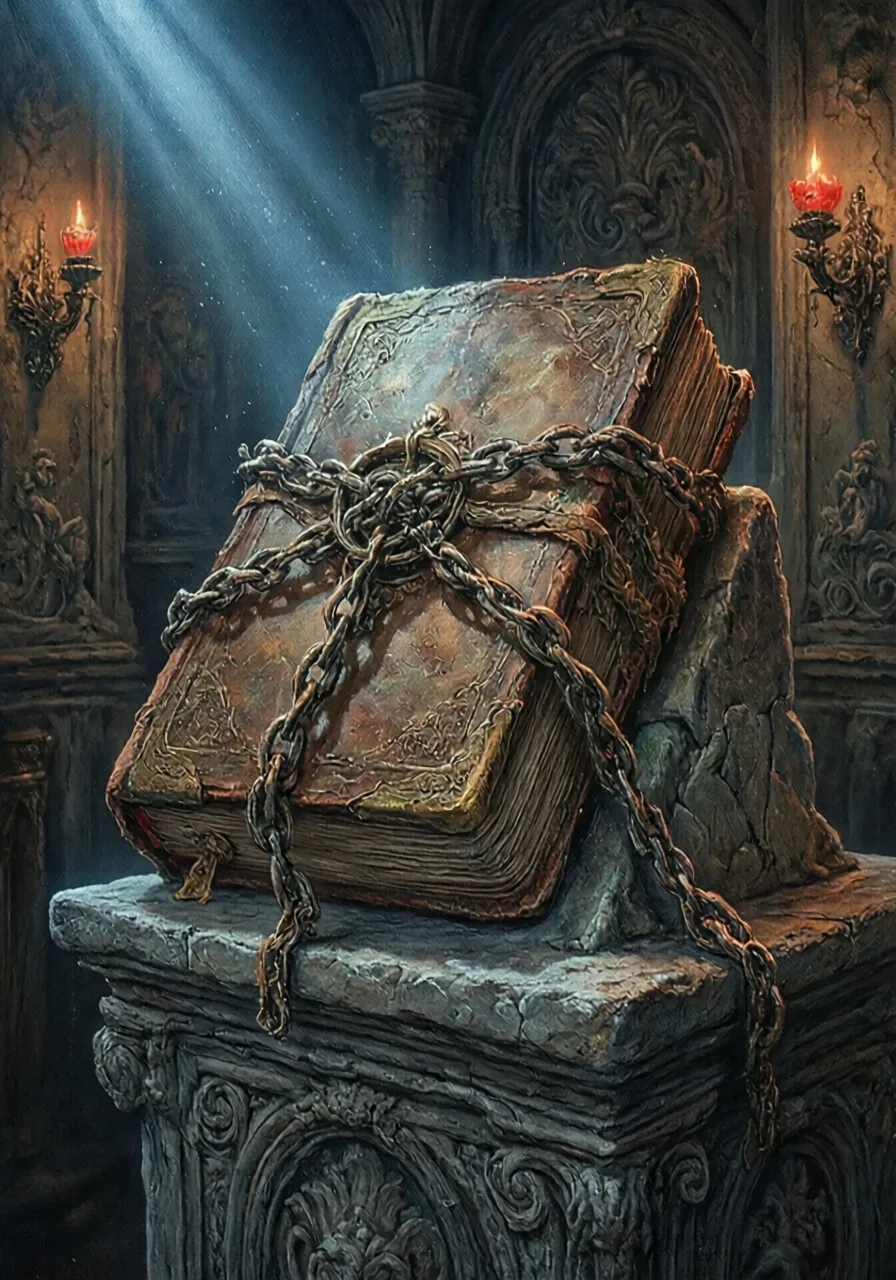
In the fourth chapel she found a lectern with a book chained to it. The book was closed. The chain was warm. She placed her hand on it and the warmth was steady, even, the temperature of a wrist. She did not open the book. She recorded its dimensions and the length of the chain and the fact that the chain was warm and moved to the next chapel.
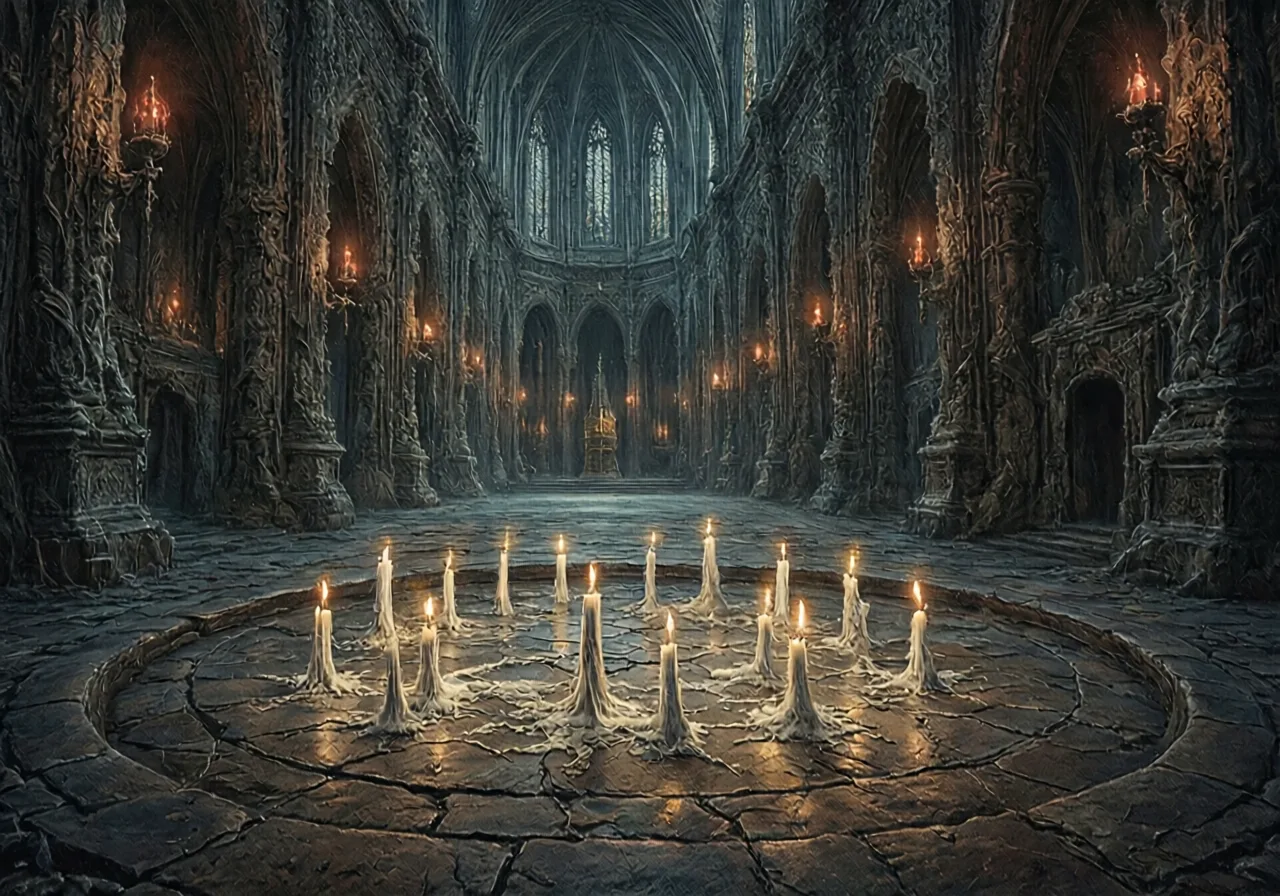
In the seventh chapel she found candle stubs melted flat against the stone. Old wax, white and fractured, pooled into the grain of the floor. Someone had sat here burning candles down to nothing. She counted the stubs. Fourteen. She knelt and examined the floor around them. The stone was worn smooth in a half-circle — the arc a seated person's feet would make, shifting weight through hours of stillness.
In the eleventh chapel the bench was warm. She recorded this. She moved to the twelfth.
Page 4
On the third day she found the void.
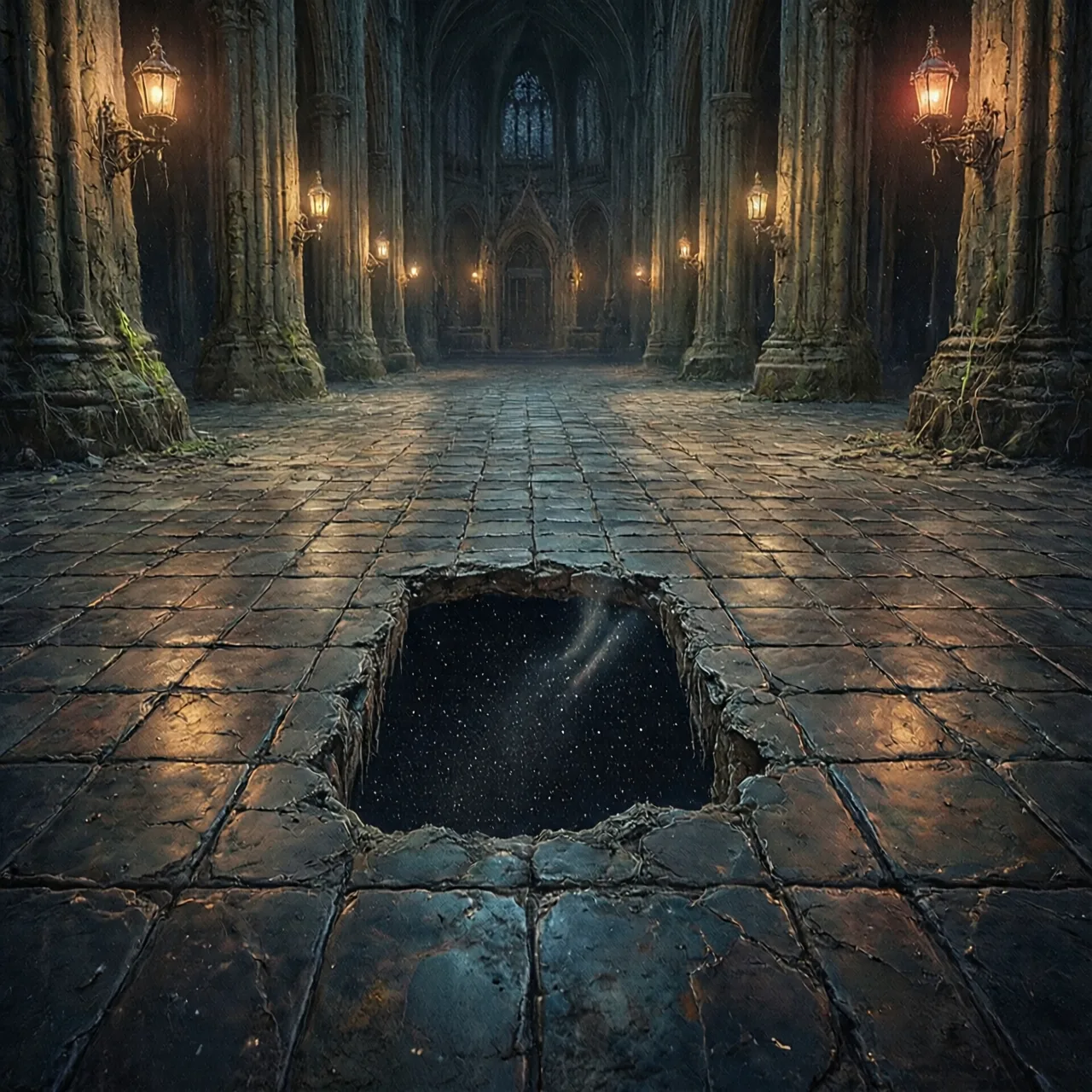
On the third day she found the void. It presented the way damp enters old stone — along the seams, through the places where one thing meets another. But damp is slow. The void was patient in a different way. It had not crept. It had chosen. A floor tile was missing. In its place, a window into emptiness — the cold stars of the void, still and distant, visible through a gap no larger than her hand. She knelt beside it and looked down through the floor of a cathedral into open space. The stars did not move. They did not flicker. They occupied the gap with the same exactness as the tiles occupied their joints.
The south transept was half gone. The wall remained on the east side. The columns still stood in their row, cut clean where the floor ended. Beyond the fourth column there was nothing. The floor stopped. The far wall was void. The chapel that her measurements said should be there was not there. The stars drifted below the floor line and above it without distinction, as though the cathedral and the void occupied the same volume and the cathedral was losing. The boundary was precise. Stone on one side. Nothing on the other. No crumbling. No erosion. No transition. The stone did not decay into the void. It stopped, the way a sentence stops at a period.
While she stood there her lantern dimmed. Not the flame — the flame held steady. The light itself traveled a shorter distance, as though the dark had thickened around her. She stepped back from the edge and the lantern recovered. She recorded the distance at which the effect began. Eleven paces from the boundary. She did not test whether it would take the flame itself.
Page 5
Beyond the wall, in the dark, something breathed.
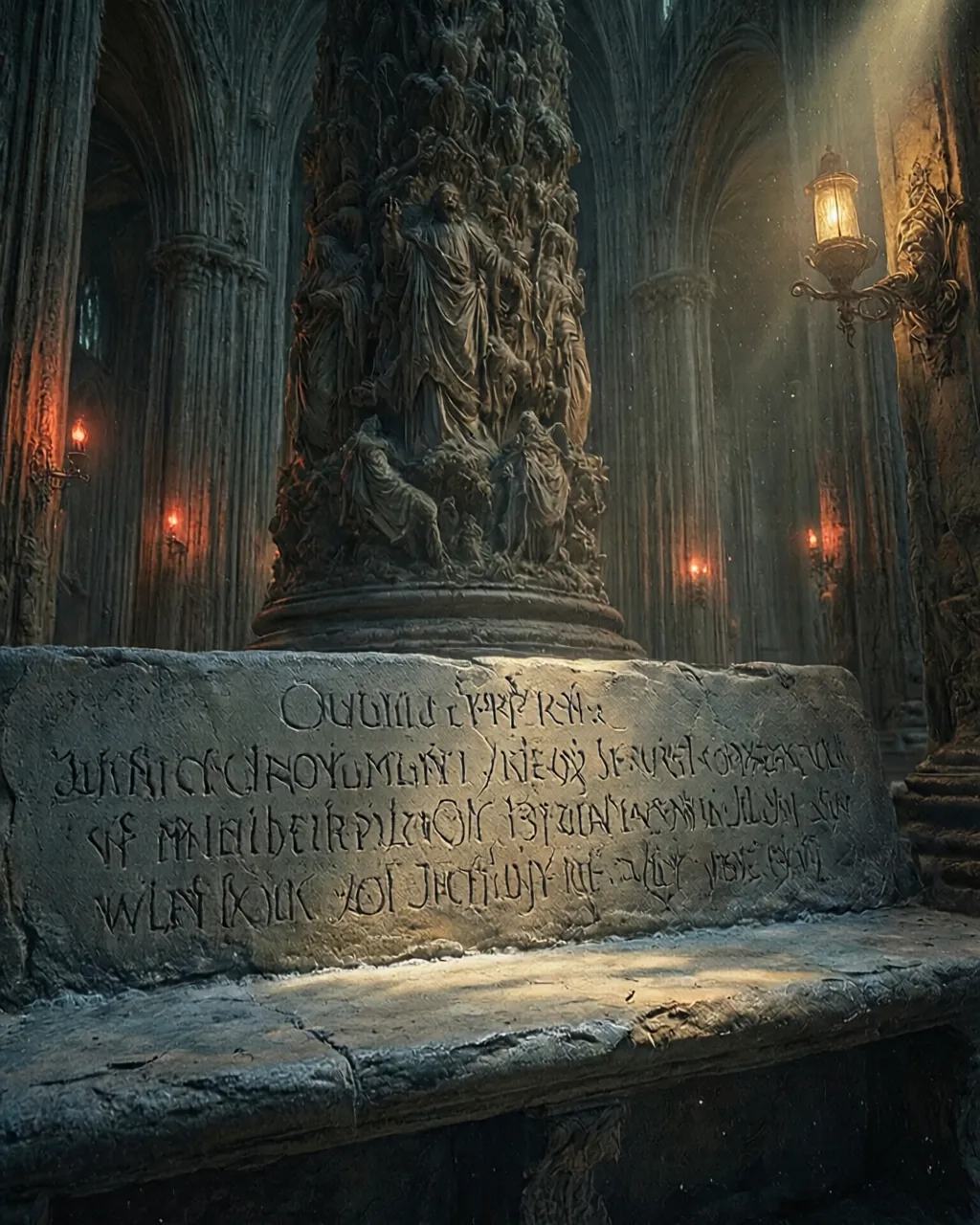
She found names scratched into a bench in the nave. Seven names, in four different scripts. Two of the scripts she recognized. One was older — much older, in characters she had seen only once before, on a wall in the deep stacks that predated the archive by a margin she had no way to reckon. She could not read the older names. They were cut deep, with something harder than iron. The stone around the letters had worn smooth with age. The letters had not. Whatever tool had made them, the stone had aged around the cuts and the cuts remained sharp. She ran her finger along one of the older names. The stone around them was cold. The cuts were warm.
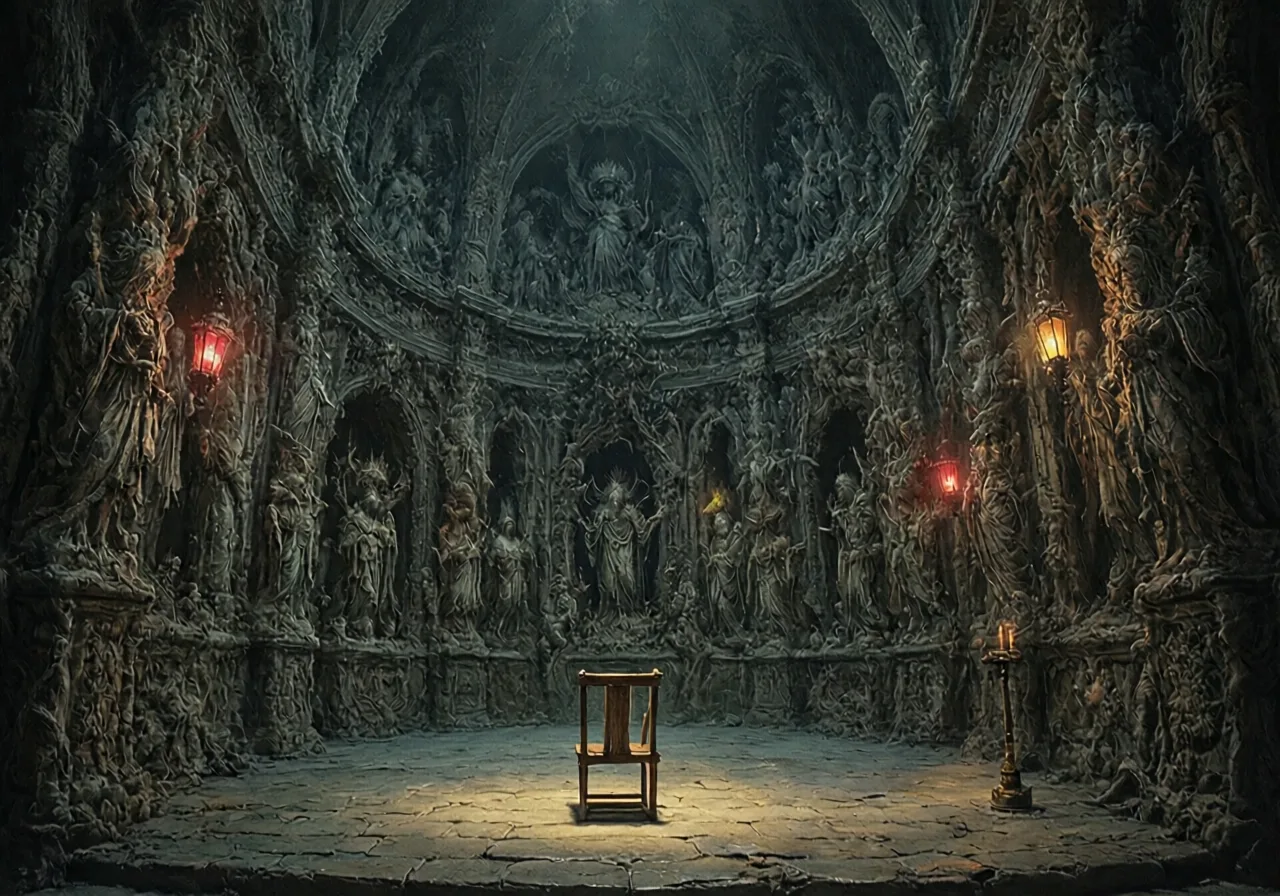
Behind the high altar, she found a chair. A simple chair, wooden, old in a way the stone was not old. The wood was cracked and gray and dry, the grain raised by centuries of damp that the stone itself never showed. It faced the apse — the curved wall at the far end of the sanctuary, and the dark beyond it, and nothing else. Someone had placed it there to sit and look at the curved wall and the dark and nothing else. The placement was deliberate. The legs had left marks in the floor, four small circles worn into the stone by the weight of the chair and whoever had sat in it. The circles were deep. The chair had stood here for years. Someone had sat in it for years.
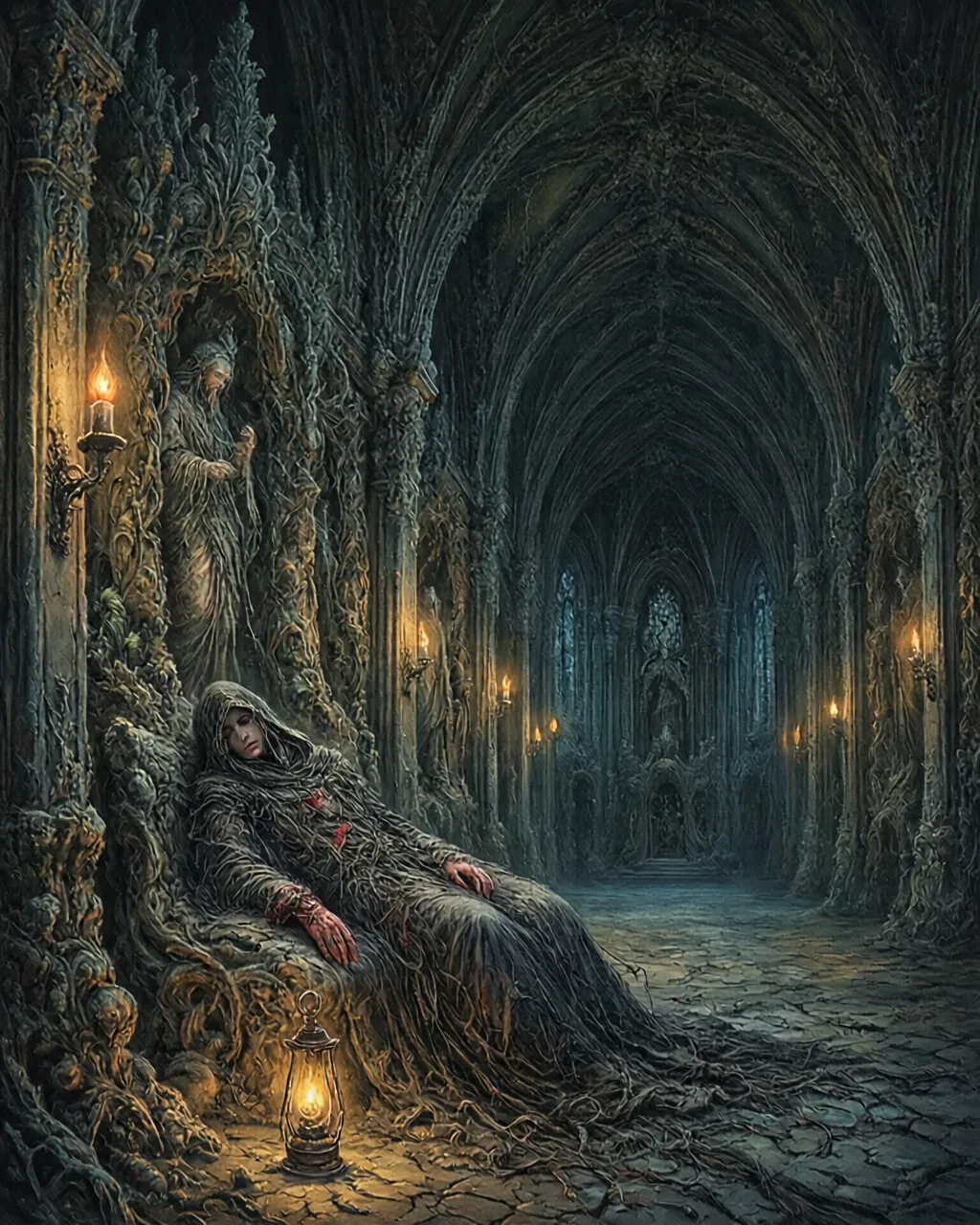
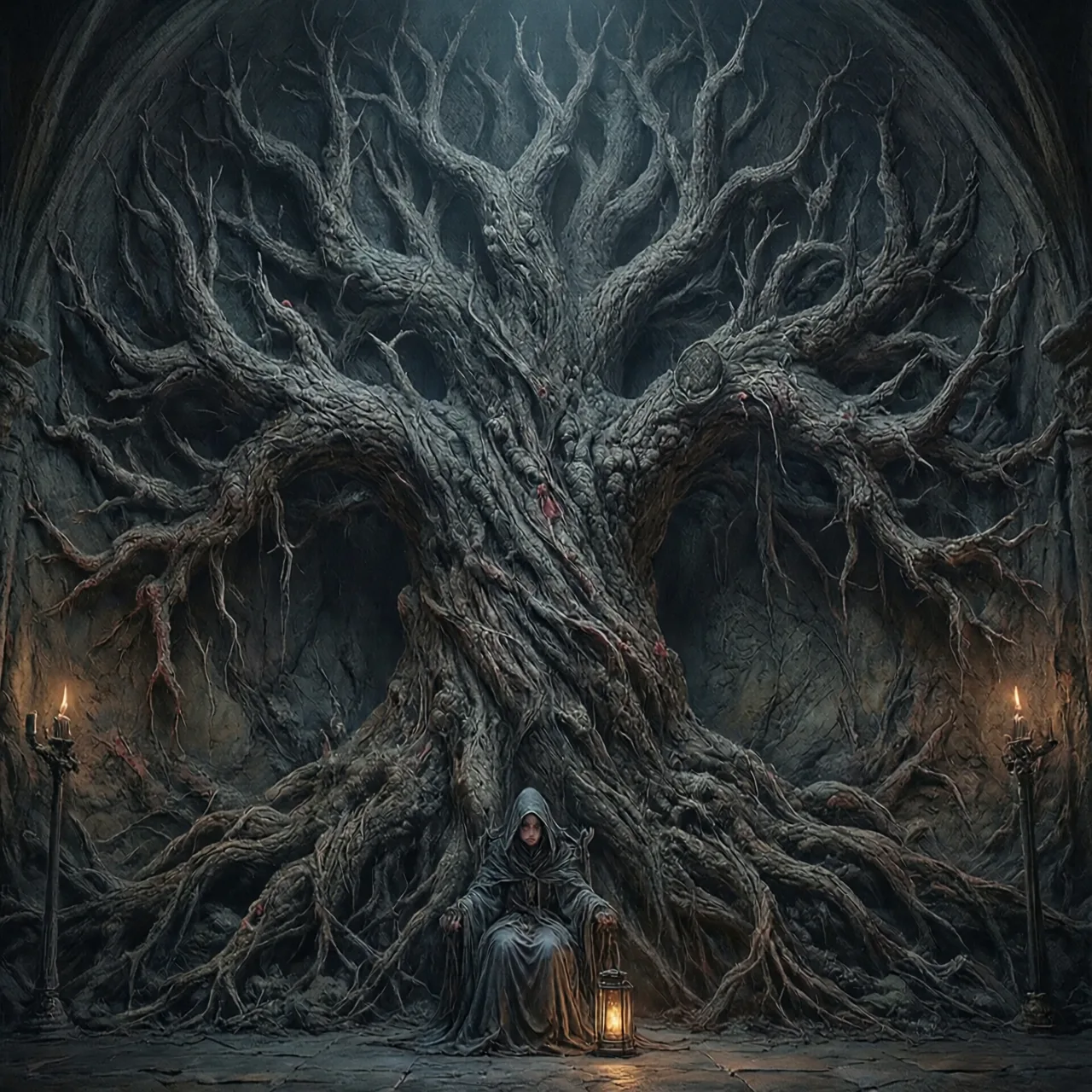
She sat in it. The wood held her. The seat was smooth from use — from someone else's use, worn by a body that had pressed into this wood over years. She faced the apse. Her lantern burned on the floor beside the chair. The light reached the curved wall and stopped. Beyond the wall, in the dark, something breathed. A rhythm. Slow, deep, so low she felt it in the chair before she heard it. The wood carried it up through the legs and into the seat and into her. A pulse. The cathedral's pulse, or something that lived inside it, or something that the cathedral had been built around. She sat in the chair and listened to it breathe and she understood why someone had placed a chair here and sat in it for years. She does not record what she saw.
— / —
narration auto-scrolls the prose
Section 0Frontmatter
# The Cathedral
From the Catalogue of the Sixteenth Archivist, entry 1,744. Provenance: the Librarian's own survey, conducted over a period she initially recorded as nine days and later corrected to four. Supplementary material: one rubbing taken from a column base, one measurement log she found already open on her desk when she returned, and a single memory crystal recovered from the ambulatory floor, cracked but still readable on one side.
She walked for a long time before she understood that the building had no end.
Section 1Section 1
The nave ran north. She counted the columns as she went — thirty-eight on the east side, each one thick enough that her lantern's glow did not reach around the far side when she pressed it against the stone. She counted her paces along the wall. Four hundred and twelve.
She slept in a side chapel that night, on a bench that fit her exactly. She did not remember the bench fitting her when she had first examined the chapel. She had noted its dimensions in her log. She checked. The dimensions had not changed.
In the morning she measured the nave again, same wall, same stride. Three hundred and ninety-one paces. Twenty-one fewer than the day before. The columns were still thirty-eight.
She stood at the last column and looked back the way she had come. The entrance was a gray rectangle, distant and small. It had been larger yesterday.
Section 2Section 2
The ceiling was not visible. She tilted her lantern upward and the light went up into the dark and did not come back. She dropped a piece of chalk and listened. The chalk struck the floor beside her foot. The sound of the impact existed for its duration and was gone. No echo. No resonance. The sound went up the way the light did.
She spoke once, a single word, to test the acoustics.
The word left her mouth and something took it. Not the architecture. Not distance or dampness or the geometry of vaulted stone. Something took the word out of the air the way a hand lifts a coin from a table. She felt the absence where the sound should have continued. A space shaped exactly like her voice.
She did not speak again.
Section 3Section 3
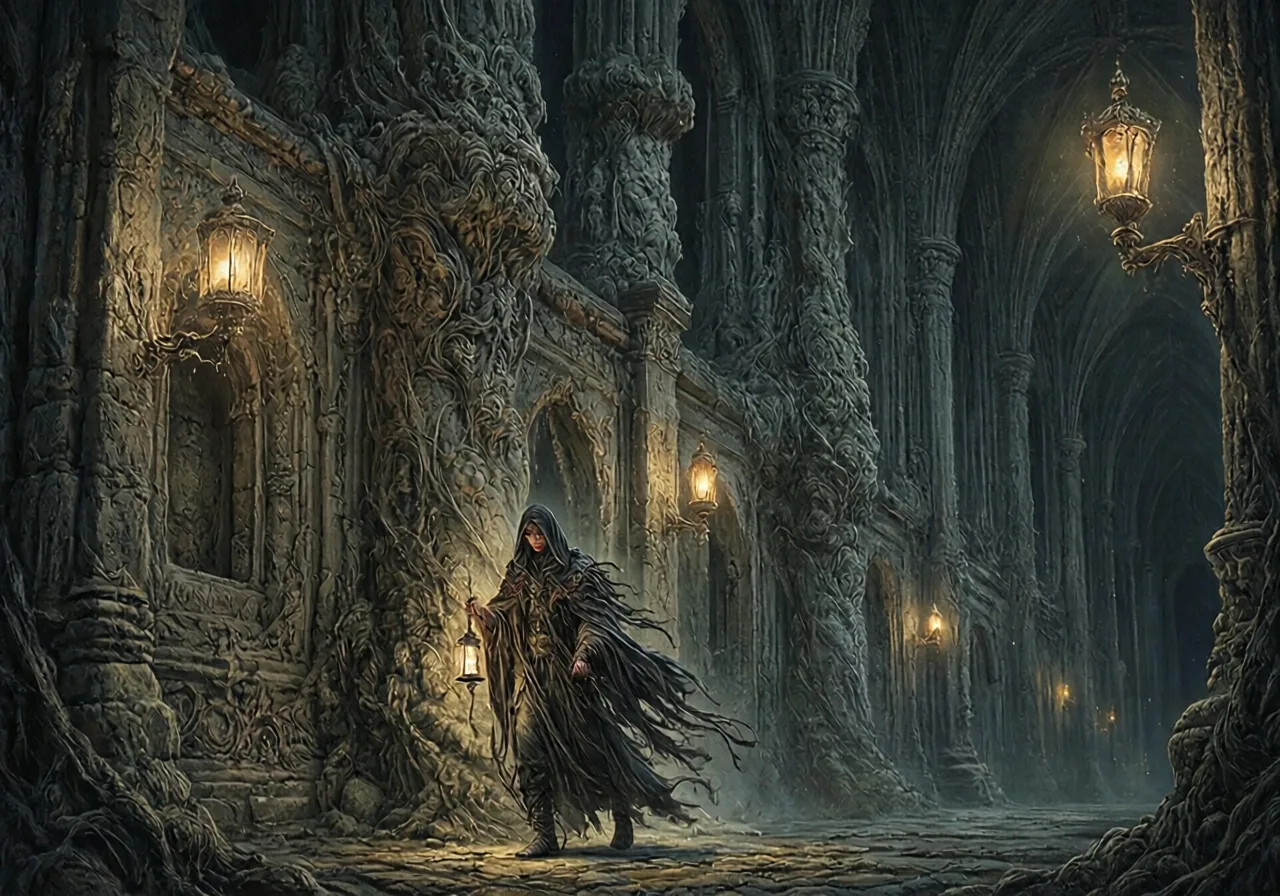
She found the side chapels by walking with her hand against the wall. The stone simply ended and there was space. Small rooms, most of them. Some held benches. Some held nothing.
In the fourth chapel she found a lectern with a book chained to it. The book was closed. The chain was warm. She placed her hand on it and the warmth was steady, even, the temperature of a wrist. She did not open the book. She recorded its dimensions and the length of the chain and the fact that the chain was warm and moved to the next chapel.
In the seventh chapel she found candle stubs melted flat against the stone. Old wax, white and fractured, pooled into the grain of the floor. Someone had sat here burning candles down to nothing. She counted the stubs. Fourteen. She knelt and examined the floor around them. The stone was worn smooth in a half-circle — the arc a seated person's feet would make, shifting weight through hours of stillness.
In the eleventh chapel the bench was warm.
She recorded this. She moved to the twelfth.
Fragment. The memory crystal, recovered from the ambulatory floor. It had rolled against the base of a column and remained there. The crack runs through the center and the second half of the memory is gone. What remains is a sensation of walking — slow, heavy, continuous.
"The cathedral was old when the Order came. It was old when the Founders came. Whoever built it did not leave marks. Whoever built it did not leave tools or scaffolding or any evidence that it had been constructed at all. The stone is continuous. The columns are not fitted — they grow from the floor and enter the ceiling as though floor and column and ceiling were carved from a single block, and the block was the size of a city, and someone carved a cathedral out of the inside of it and left.
I measured the joints between the sanctuary tiles. There is no mortar. The tiles meet with a precision that does not permit a blade between them. I do not know how this was done. I do not know how long ago.
The Order found it empty and full of dark and they lit it and prayed in it and killed each other in it and the cathedral did not notice."
Section 4Section 4
On the third day she found the void.
It presented the way damp enters old stone — along the seams, through the places where one thing meets another. But damp is slow. The void was patient in a different way. It had not crept. It had chosen.
A floor tile was missing. In its place, a window into emptiness — the cold stars of the void, still and distant, visible through a gap no larger than her hand. She knelt beside it and looked down through the floor of a cathedral into open space. The stars did not move. They did not flicker. They occupied the gap with the same exactness as the tiles occupied their joints.
She mapped the intrusions as she went. They followed no pattern she could identify. Some were small — a single tile, a missing section of wall no wider than a doorway. Some were vast.
The south transept was half gone.
The wall remained on the east side. The columns still stood in their row, cut clean where the floor ended. Beyond the fourth column there was nothing. The floor stopped. The far wall was void. The chapel that her measurements said should be there was not there. The stars drifted below the floor line and above it without distinction, as though the cathedral and the void occupied the same volume and the cathedral was losing.
The boundary was precise. Stone on one side. Nothing on the other. No crumbling. No erosion. No transition. The stone did not decay into the void. It stopped, the way a sentence stops at a period.
While she stood there her lantern dimmed. Not the flame — the flame held steady. The light itself traveled a shorter distance, as though the dark had thickened around her. She stepped back from the edge and the lantern recovered. She recorded the distance at which the effect began. Eleven paces from the boundary. She did not test whether it would take the flame itself.
Section 5Section 5
She found names scratched into a bench in the nave.
Seven names, in four different scripts. Two of the scripts she recognized. One was the coordinate notation the Order used for navigation. One was older — much older, in characters she had seen only once before, on a wall in the deep stacks that predated the archive by a margin she had no way to reckon.
She could not read the older names. They were cut deep, with something harder than iron. The stone around the letters had worn smooth with age. The letters had not. Whatever tool had made them, the stone had aged around the cuts and the cuts remained sharp.
She ran her finger along one of the older names. Three characters, angular, clean. The stone around them was cold. The cuts were warm.
She pulled her hand back. She recorded the temperature differential. She did not touch the names again.
On the column nearest the bench she found a soot mark where someone had hung a lantern from an iron nail. The nail was still there. It had been driven into stone that her measurements suggested was solid to a depth she could not determine — continuous, seamless, no mortar, no join. Someone had driven an iron nail into it and hung their light and sat on this bench beneath these names in the dark.
She tried to pull the nail out. It did not move. She tried harder. The soot on the column was undisturbed by the passage of centuries. She left the nail where it was and sat on the bench and looked up into the dark the way whoever had sat here must have looked up into the dark.
She did not record what she thought about.
Section 6Section 6
The crossing held the map.
She recognized it from the manuscripts recovered in entries 501 through 519 — the map the congregations had knelt before, the one that had shown different territories to different observers. The tiles were inscribed with lines so fine they might have been scratched with a needle. The fineness matched the tile joints.
She knelt where they had knelt. She studied the inscribed tiles for the better part of a day.
The map did not change for her. It showed a single geography — a region she could not identify, coastlines and elevation rendered in the same impossible fineness as the tile joints. She copied a section into her log, working carefully, matching each line.
That evening she reviewed the copy. It did not match what she remembered drawing. She had drawn a southern coast, a series of inlets, a peninsula. The copy in her log showed a northern coast — different inlets, a different peninsula, the same continent viewed from the opposite side.
She returned to the crossing the next morning. She compared her copy to the floor.
Both were accurate. She had drawn only once.
She knelt there again, looking at the map, and she understood something she did not write down. She understood it the way she understood the silence — not as knowledge, but as weight. The map had not changed. She had not drawn wrong. The map showed a single geography and the geography had two coastlines that could not both be south and were.
She closed her log. She stood. Her knees ached from the stone. She had been kneeling longer than she intended. The lantern was lower than it should have been. She checked her count of the hours and found she had lost two.
Entry 1,744 (continued). The Librarian's interpolation.
"I reached the sanctuary on the fourth day. Or the sixth day. My count is wrong. I have three days in my log that do not appear in my supply record. I brought nine days of oil. I used four days of oil. My log contains nine days of entries.
Five days of notes, written in my hand, in my ink, describing observations I do not remember making. Chapel measurements I did not take. Column counts from a part of the nave I did not reach. A rubbing from a carving I have never seen.
The entries are meticulous. They are the best work in my log — more precise, more careful than my own. The hand is mine. The observations are not.
I have catalogued enough to know what this means. I have read the accounts of the congregations. I know what happens to time in this place. I know the cathedral kept me longer than I kept myself, and that during the days I do not remember I was thorough, and I was careful, and I was afraid of nothing.
That is how I know it was not me."
Section 7Section 7
Behind the high altar, she found a chair.
A simple chair, wooden, old in a way the stone was not old. The wood was cracked and gray and dry, the grain raised by centuries of damp that the stone itself never showed. It faced the apse — the curved wall at the far end of the sanctuary, and the dark beyond it, and nothing else.
Someone had placed it there to sit and look at the curved wall and the dark and nothing else. The placement was deliberate. It faced the exact center of the apse, squared to the curvature with a care that matched the rest of the cathedral. The legs had left marks in the floor, four small circles worn into the stone by the weight of the chair and whoever had sat in it. The circles were deep. The chair had stood here for years. Someone had sat in it for years.
She sat in it.
The wood held her. The seat was smooth from use — from someone else's use, worn by a body that had pressed into this wood over years. She could feel the shape of them in the seat, the way the wood had given and hardened around the habit of a single occupant.
She faced the apse. The curved wall rose and disappeared into the dark above. The stone was the same stone as everywhere else — seamless, jointless, warm in places.
She sat and the cathedral was silent around her in the way it had been silent since she entered, the occupied silence, the silence that listened. Her lantern burned on the floor beside the chair. The light reached the curved wall and stopped.
Beyond the wall, in the dark, something breathed.
A rhythm. Slow, deep, so low she felt it in the chair before she heard it. The wood carried it up through the legs and into the seat and into her. A pulse. The cathedral's pulse, or something that lived inside it, or something that the cathedral had been built around.
She sat in the chair and listened to it breathe and she understood why someone had placed a chair here and sat in it for years.
She does not record what she saw.
Entry 1,744, final annotation.
"The cathedral is not a ruin. A ruin is something that was whole and is now broken. The cathedral is whole. The void has taken parts of it — cleanly, exactly, the way a word is replaced in a manuscript when the scribe lifts the original and sets down another. The columns still stand. The walls still run. The tiles still meet without mortar. Where the void has come, it has come with the same deliberation as everything else in this place, and what it has taken it has taken completely.
I do not know who built it. I do not know if it was built at all. It may have always been here, in the dark, before the Order and before the Founders, waiting for congregations that had not yet arrived and have now gone.
I do not know what breathes in the sanctuary.
I left my lantern burning in the nave. I was three corridors away before I realized I had set it down. I thought about going back. I did not go back.
When I returned to the archive I found my measurement log open on my desk. I had not left it open. The log contained measurements I had not taken, in my hand, of rooms I had not entered. The measurements are exact. They are consistent with my own. They describe a cathedral larger than the one I walked.
I have filed the log without correction. I have marked the entry complete. I will not return.
The lantern is still burning. I am certain of this in a way I cannot explain, and I have learned not to examine the things I am certain of in ways I cannot explain. The lantern is still burning in the nave of a cathedral that has no end, and the dark has not taken it, and I do not know why this is the thing that frightens me."
Section 0Frontmatter
# The Cathedral
From the Catalogue of the Sixteenth Archivist, entry 1,744. Provenance: the Librarian's own survey, conducted over a period she initially recorded as nine days and later corrected to four. Supplementary material: one rubbing taken from a column base, one measurement log she found already open on her desk when she returned, and a single memory crystal recovered from the ambulatory floor, cracked but still readable on one side.
She walked for a long time before she understood that the building had no end.
Section 1Section 1
The nave ran north. She counted the columns as she went — thirty-eight on the east side, each one thick enough that her lantern's glow did not reach around the far side when she pressed it against the stone. She counted her paces along the wall. Four hundred and twelve.
She slept in a side chapel that night, on a bench that fit her exactly. She did not remember the bench fitting her when she had first examined the chapel. She had noted its dimensions in her log. She checked. The dimensions had not changed.
In the morning she measured the nave again, same wall, same stride. Three hundred and ninety-one paces. Twenty-one fewer than the day before. The columns were still thirty-eight.
She stood at the last column and looked back the way she had come. The entrance was a gray rectangle, distant and small. It had been larger yesterday.
Section 2Section 2
The ceiling was not visible. She tilted her lantern upward and the light went up into the dark and did not come back. She dropped a piece of chalk and listened. The chalk struck the floor beside her foot. The sound of the impact existed for its duration and was gone. No echo. No resonance. The sound went up the way the light did.
She spoke once, a single word, to test the acoustics.
The word left her mouth and something took it. Not the architecture. Not distance or dampness or the geometry of vaulted stone. Something took the word out of the air the way a hand lifts a coin from a table. She felt the absence where the sound should have continued. A space shaped exactly like her voice.
She did not speak again.
Section 3Section 3
She found the side chapels by walking with her hand against the wall. The stone simply ended and there was space. Small rooms, most of them. Some held benches. Some held nothing.
In the fourth chapel she found a lectern with a book chained to it. The book was closed. The chain was warm. She placed her hand on it and the warmth was steady, even, the temperature of a wrist. She did not open the book. She recorded its dimensions and the length of the chain and the fact that the chain was warm and moved to the next chapel.
In the seventh chapel she found candle stubs melted flat against the stone. Old wax, white and fractured, pooled into the grain of the floor. Someone had sat here burning candles down to nothing. She counted the stubs. Fourteen. She knelt and examined the floor around them. The stone was worn smooth in a half-circle — the arc a seated person's feet would make, shifting weight through hours of stillness.
In the eleventh chapel the bench was warm.
She recorded this. She moved to the twelfth.
Fragment. The memory crystal, recovered from the ambulatory floor. It had rolled against the base of a column and remained there. The crack runs through the center and the second half of the memory is gone. What remains is a sensation of walking — slow, heavy, continuous.
"The cathedral was old when the Order came. It was old when the Founders came. Whoever built it did not leave marks. Whoever built it did not leave tools or scaffolding or any evidence that it had been constructed at all. The stone is continuous. The columns are not fitted — they grow from the floor and enter the ceiling as though floor and column and ceiling were carved from a single block, and the block was the size of a city, and someone carved a cathedral out of the inside of it and left.
I measured the joints between the sanctuary tiles. There is no mortar. The tiles meet with a precision that does not permit a blade between them. I do not know how this was done. I do not know how long ago.
The Order found it empty and full of dark and they lit it and prayed in it and killed each other in it and the cathedral did not notice."
Section 4Section 4
On the third day she found the void.
It presented the way damp enters old stone — along the seams, through the places where one thing meets another. But damp is slow. The void was patient in a different way. It had not crept. It had chosen.
A floor tile was missing. In its place, a window into emptiness — the cold stars of the void, still and distant, visible through a gap no larger than her hand. She knelt beside it and looked down through the floor of a cathedral into open space. The stars did not move. They did not flicker. They occupied the gap with the same exactness as the tiles occupied their joints.
She mapped the intrusions as she went. They followed no pattern she could identify. Some were small — a single tile, a missing section of wall no wider than a doorway. Some were vast.
The south transept was half gone.
The wall remained on the east side. The columns still stood in their row, cut clean where the floor ended. Beyond the fourth column there was nothing. The floor stopped. The far wall was void. The chapel that her measurements said should be there was not there. The stars drifted below the floor line and above it without distinction, as though the cathedral and the void occupied the same volume and the cathedral was losing.
The boundary was precise. Stone on one side. Nothing on the other. No crumbling. No erosion. No transition. The stone did not decay into the void. It stopped, the way a sentence stops at a period.
While she stood there her lantern dimmed. Not the flame — the flame held steady. The light itself traveled a shorter distance, as though the dark had thickened around her. She stepped back from the edge and the lantern recovered. She recorded the distance at which the effect began. Eleven paces from the boundary. She did not test whether it would take the flame itself.
Section 5Section 5
She found names scratched into a bench in the nave.
Seven names, in four different scripts. Two of the scripts she recognized. One was the coordinate notation the Order used for navigation. One was older — much older, in characters she had seen only once before, on a wall in the deep stacks that predated the archive by a margin she had no way to reckon.
She could not read the older names. They were cut deep, with something harder than iron. The stone around the letters had worn smooth with age. The letters had not. Whatever tool had made them, the stone had aged around the cuts and the cuts remained sharp.
She ran her finger along one of the older names. Three characters, angular, clean. The stone around them was cold. The cuts were warm.
She pulled her hand back. She recorded the temperature differential. She did not touch the names again.
On the column nearest the bench she found a soot mark where someone had hung a lantern from an iron nail. The nail was still there. It had been driven into stone that her measurements suggested was solid to a depth she could not determine — continuous, seamless, no mortar, no join. Someone had driven an iron nail into it and hung their light and sat on this bench beneath these names in the dark.
She tried to pull the nail out. It did not move. She tried harder. The soot on the column was undisturbed by the passage of centuries. She left the nail where it was and sat on the bench and looked up into the dark the way whoever had sat here must have looked up into the dark.
She did not record what she thought about.
Section 6Section 6
The crossing held the map.
She recognized it from the manuscripts recovered in entries 501 through 519 — the map the congregations had knelt before, the one that had shown different territories to different observers. The tiles were inscribed with lines so fine they might have been scratched with a needle. The fineness matched the tile joints.
She knelt where they had knelt. She studied the inscribed tiles for the better part of a day.
The map did not change for her. It showed a single geography — a region she could not identify, coastlines and elevation rendered in the same impossible fineness as the tile joints. She copied a section into her log, working carefully, matching each line.
That evening she reviewed the copy. It did not match what she remembered drawing. She had drawn a southern coast, a series of inlets, a peninsula. The copy in her log showed a northern coast — different inlets, a different peninsula, the same continent viewed from the opposite side.
She returned to the crossing the next morning. She compared her copy to the floor.
Both were accurate. She had drawn only once.
She knelt there again, looking at the map, and she understood something she did not write down. She understood it the way she understood the silence — not as knowledge, but as weight. The map had not changed. She had not drawn wrong. The map showed a single geography and the geography had two coastlines that could not both be south and were.
She closed her log. She stood. Her knees ached from the stone. She had been kneeling longer than she intended. The lantern was lower than it should have been. She checked her count of the hours and found she had lost two.
Entry 1,744 (continued). The Librarian's interpolation.
"I reached the sanctuary on the fourth day. Or the sixth day. My count is wrong. I have three days in my log that do not appear in my supply record. I brought nine days of oil. I used four days of oil. My log contains nine days of entries.
Five days of notes, written in my hand, in my ink, describing observations I do not remember making. Chapel measurements I did not take. Column counts from a part of the nave I did not reach. A rubbing from a carving I have never seen.
The entries are meticulous. They are the best work in my log — more precise, more careful than my own. The hand is mine. The observations are not.
I have catalogued enough to know what this means. I have read the accounts of the congregations. I know what happens to time in this place. I know the cathedral kept me longer than I kept myself, and that during the days I do not remember I was thorough, and I was careful, and I was afraid of nothing.
That is how I know it was not me."
Section 7Section 7
Behind the high altar, she found a chair.
A simple chair, wooden, old in a way the stone was not old. The wood was cracked and gray and dry, the grain raised by centuries of damp that the stone itself never showed. It faced the apse — the curved wall at the far end of the sanctuary, and the dark beyond it, and nothing else.
Someone had placed it there to sit and look at the curved wall and the dark and nothing else. The placement was deliberate. It faced the exact center of the apse, squared to the curvature with a care that matched the rest of the cathedral. The legs had left marks in the floor, four small circles worn into the stone by the weight of the chair and whoever had sat in it. The circles were deep. The chair had stood here for years. Someone had sat in it for years.
She sat in it.
The wood held her. The seat was smooth from use — from someone else's use, worn by a body that had pressed into this wood over years. She could feel the shape of them in the seat, the way the wood had given and hardened around the habit of a single occupant.
She faced the apse. The curved wall rose and disappeared into the dark above. The stone was the same stone as everywhere else — seamless, jointless, warm in places.
She sat and the cathedral was silent around her in the way it had been silent since she entered, the occupied silence, the silence that listened. Her lantern burned on the floor beside the chair. The light reached the curved wall and stopped.
Beyond the wall, in the dark, something breathed.
A rhythm. Slow, deep, so low she felt it in the chair before she heard it. The wood carried it up through the legs and into the seat and into her. A pulse. The cathedral's pulse, or something that lived inside it, or something that the cathedral had been built around.
She sat in the chair and listened to it breathe and she understood why someone had placed a chair here and sat in it for years.
She does not record what she saw.
Entry 1,744, final annotation.
"The cathedral is not a ruin. A ruin is something that was whole and is now broken. The cathedral is whole. The void has taken parts of it — cleanly, exactly, the way a word is replaced in a manuscript when the scribe lifts the original and sets down another. The columns still stand. The walls still run. The tiles still meet without mortar. Where the void has come, it has come with the same deliberation as everything else in this place, and what it has taken it has taken completely.
I do not know who built it. I do not know if it was built at all. It may have always been here, in the dark, before the Order and before the Founders, waiting for congregations that had not yet arrived and have now gone.
I do not know what breathes in the sanctuary.
I left my lantern burning in the nave. I was three corridors away before I realized I had set it down. I thought about going back. I did not go back.
When I returned to the archive I found my measurement log open on my desk. I had not left it open. The log contained measurements I had not taken, in my hand, of rooms I had not entered. The measurements are exact. They are consistent with my own. They describe a cathedral larger than the one I walked.
I have filed the log without correction. I have marked the entry complete. I will not return.
The lantern is still burning. I am certain of this in a way I cannot explain, and I have learned not to examine the things I am certain of in ways I cannot explain. The lantern is still burning in the nave of a cathedral that has no end, and the dark has not taken it, and I do not know why this is the thing that frightens me."
Page 1
She walked for a long time before she understood that the building had no end.
She walked for a long time before she understood that the building had no end. The nave ran north. She counted the columns as she went — thirty-eight on the east side, each one thick enough that her lantern's glow did not reach around the far side when she pressed it against the stone. She counted her paces along the wall. Four hundred and twelve.
She slept in a side chapel that night, on a bench that fit her exactly. She did not remember the bench fitting her when she had first examined the chapel. She had noted its dimensions in her log. She checked. The dimensions had not changed. In the morning she measured the nave again, same wall, same stride. Three hundred and ninety-one paces. Twenty-one fewer than the day before. The columns were still thirty-eight. She stood at the last column and looked back the way she had come. The entrance was a gray rectangle, distant and small. It had been larger yesterday.
The bench fit her exactly. The dimensions had not changed.
Page 2
Something took the word out of the air.
The ceiling was not visible. She tilted her lantern upward and the light went up into the dark and did not come back.
She dropped a piece of chalk and listened. The chalk struck the floor beside her foot. The sound of the impact existed for its duration and was gone. No echo. No resonance. The sound went up the way the light did.
She spoke once, a single word, to test the acoustics. The word left her mouth and something took it. Not the architecture. Not distance or dampness or the geometry of vaulted stone. Something took the word out of the air the way a hand lifts a coin from a table. She felt the absence where the sound should have continued. A space shaped exactly like her voice. She did not speak again.
Page 3
The chain was warm. The bench was warm.
In the fourth chapel she found a lectern with a book chained to it. The book was closed. The chain was warm. She placed her hand on it and the warmth was steady, even, the temperature of a wrist. She did not open the book. She recorded its dimensions and the length of the chain and the fact that the chain was warm and moved to the next chapel.
In the seventh chapel she found candle stubs melted flat against the stone. Old wax, white and fractured, pooled into the grain of the floor. Someone had sat here burning candles down to nothing. She counted the stubs. Fourteen. She knelt and examined the floor around them. The stone was worn smooth in a half-circle — the arc a seated person's feet would make, shifting weight through hours of stillness.
In the eleventh chapel the bench was warm. She recorded this. She moved to the twelfth.
Page 4
On the third day she found the void.
On the third day she found the void. It presented the way damp enters old stone — along the seams, through the places where one thing meets another. But damp is slow. The void was patient in a different way. It had not crept. It had chosen. A floor tile was missing. In its place, a window into emptiness — the cold stars of the void, still and distant, visible through a gap no larger than her hand. She knelt beside it and looked down through the floor of a cathedral into open space. The stars did not move. They did not flicker. They occupied the gap with the same exactness as the tiles occupied their joints.
The south transept was half gone. The wall remained on the east side. The columns still stood in their row, cut clean where the floor ended. Beyond the fourth column there was nothing. The floor stopped. The far wall was void. The chapel that her measurements said should be there was not there. The stars drifted below the floor line and above it without distinction, as though the cathedral and the void occupied the same volume and the cathedral was losing. The boundary was precise. Stone on one side. Nothing on the other. No crumbling. No erosion. No transition. The stone did not decay into the void. It stopped, the way a sentence stops at a period.
While she stood there her lantern dimmed. Not the flame — the flame held steady. The light itself traveled a shorter distance, as though the dark had thickened around her. She stepped back from the edge and the lantern recovered. She recorded the distance at which the effect began. Eleven paces from the boundary. She did not test whether it would take the flame itself.
Page 5
Beyond the wall, in the dark, something breathed.
She found names scratched into a bench in the nave. Seven names, in four different scripts. Two of the scripts she recognized. One was older — much older, in characters she had seen only once before, on a wall in the deep stacks that predated the archive by a margin she had no way to reckon. She could not read the older names. They were cut deep, with something harder than iron. The stone around the letters had worn smooth with age. The letters had not. Whatever tool had made them, the stone had aged around the cuts and the cuts remained sharp. She ran her finger along one of the older names. The stone around them was cold. The cuts were warm.
Behind the high altar, she found a chair. A simple chair, wooden, old in a way the stone was not old. The wood was cracked and gray and dry, the grain raised by centuries of damp that the stone itself never showed. It faced the apse — the curved wall at the far end of the sanctuary, and the dark beyond it, and nothing else. Someone had placed it there to sit and look at the curved wall and the dark and nothing else. The placement was deliberate. The legs had left marks in the floor, four small circles worn into the stone by the weight of the chair and whoever had sat in it. The circles were deep. The chair had stood here for years. Someone had sat in it for years.
She sat in it. The wood held her. The seat was smooth from use — from someone else's use, worn by a body that had pressed into this wood over years. She faced the apse. Her lantern burned on the floor beside the chair. The light reached the curved wall and stopped. Beyond the wall, in the dark, something breathed. A rhythm. Slow, deep, so low she felt it in the chair before she heard it. The wood carried it up through the legs and into the seat and into her. A pulse. The cathedral's pulse, or something that lived inside it, or something that the cathedral had been built around. She sat in the chair and listened to it breathe and she understood why someone had placed a chair here and sat in it for years. She does not record what she saw.
Listen ModeClick a section to begin listening
The chronicle plays section by section in the Librarian's voice. As each section plays, the corresponding pages of the comic are highlighted. Switch to Scroll, Flip, Prose, or Split at any time — the audio continues, and you can follow visually.
Section 0Frontmatter
# The Cathedral
From the Catalogue of the Sixteenth Archivist, entry 1,744. Provenance: the Librarian's own survey, conducted over a period she initially recorded as nine days and later corrected to four. Supplementary material: one rubbing taken from a column base, one measurement log she found already open on her desk when she returned, and a single memory crystal recovered from the ambulatory floor, cracked but still readable on one side.
She walked for a long time before she understood that the building had no end.
Section 1Section 1
The nave ran north. She counted the columns as she went — thirty-eight on the east side, each one thick enough that her lantern's glow did not reach around the far side when she pressed it against the stone. She counted her paces along the wall. Four hundred and twelve.
She slept in a side chapel that night, on a bench that fit her exactly. She did not remember the bench fitting her when she had first examined the chapel. She had noted its dimensions in her log. She checked. The dimensions had not changed.
In the morning she measured the nave again, same wall, same stride. Three hundred and ninety-one paces. Twenty-one fewer than the day before. The columns were still thirty-eight.
She stood at the last column and looked back the way she had come. The entrance was a gray rectangle, distant and small. It had been larger yesterday.
Section 2Section 2
The ceiling was not visible. She tilted her lantern upward and the light went up into the dark and did not come back. She dropped a piece of chalk and listened. The chalk struck the floor beside her foot. The sound of the impact existed for its duration and was gone. No echo. No resonance. The sound went up the way the light did.
She spoke once, a single word, to test the acoustics.
The word left her mouth and something took it. Not the architecture. Not distance or dampness or the geometry of vaulted stone. Something took the word out of the air the way a hand lifts a coin from a table. She felt the absence where the sound should have continued. A space shaped exactly like her voice.
She did not speak again.
Section 3Section 3
She found the side chapels by walking with her hand against the wall. The stone simply ended and there was space. Small rooms, most of them. Some held benches. Some held nothing.
In the fourth chapel she found a lectern with a book chained to it. The book was closed. The chain was warm. She placed her hand on it and the warmth was steady, even, the temperature of a wrist. She did not open the book. She recorded its dimensions and the length of the chain and the fact that the chain was warm and moved to the next chapel.
In the seventh chapel she found candle stubs melted flat against the stone. Old wax, white and fractured, pooled into the grain of the floor. Someone had sat here burning candles down to nothing. She counted the stubs. Fourteen. She knelt and examined the floor around them. The stone was worn smooth in a half-circle — the arc a seated person's feet would make, shifting weight through hours of stillness.
In the eleventh chapel the bench was warm.
She recorded this. She moved to the twelfth.
Fragment. The memory crystal, recovered from the ambulatory floor. It had rolled against the base of a column and remained there. The crack runs through the center and the second half of the memory is gone. What remains is a sensation of walking — slow, heavy, continuous.
"The cathedral was old when the Order came. It was old when the Founders came. Whoever built it did not leave marks. Whoever built it did not leave tools or scaffolding or any evidence that it had been constructed at all. The stone is continuous. The columns are not fitted — they grow from the floor and enter the ceiling as though floor and column and ceiling were carved from a single block, and the block was the size of a city, and someone carved a cathedral out of the inside of it and left.
I measured the joints between the sanctuary tiles. There is no mortar. The tiles meet with a precision that does not permit a blade between them. I do not know how this was done. I do not know how long ago.
The Order found it empty and full of dark and they lit it and prayed in it and killed each other in it and the cathedral did not notice."
Section 4Section 4
On the third day she found the void.
It presented the way damp enters old stone — along the seams, through the places where one thing meets another. But damp is slow. The void was patient in a different way. It had not crept. It had chosen.
A floor tile was missing. In its place, a window into emptiness — the cold stars of the void, still and distant, visible through a gap no larger than her hand. She knelt beside it and looked down through the floor of a cathedral into open space. The stars did not move. They did not flicker. They occupied the gap with the same exactness as the tiles occupied their joints.
She mapped the intrusions as she went. They followed no pattern she could identify. Some were small — a single tile, a missing section of wall no wider than a doorway. Some were vast.
The south transept was half gone.
The wall remained on the east side. The columns still stood in their row, cut clean where the floor ended. Beyond the fourth column there was nothing. The floor stopped. The far wall was void. The chapel that her measurements said should be there was not there. The stars drifted below the floor line and above it without distinction, as though the cathedral and the void occupied the same volume and the cathedral was losing.
The boundary was precise. Stone on one side. Nothing on the other. No crumbling. No erosion. No transition. The stone did not decay into the void. It stopped, the way a sentence stops at a period.
While she stood there her lantern dimmed. Not the flame — the flame held steady. The light itself traveled a shorter distance, as though the dark had thickened around her. She stepped back from the edge and the lantern recovered. She recorded the distance at which the effect began. Eleven paces from the boundary. She did not test whether it would take the flame itself.
Section 5Section 5
She found names scratched into a bench in the nave.
Seven names, in four different scripts. Two of the scripts she recognized. One was the coordinate notation the Order used for navigation. One was older — much older, in characters she had seen only once before, on a wall in the deep stacks that predated the archive by a margin she had no way to reckon.
She could not read the older names. They were cut deep, with something harder than iron. The stone around the letters had worn smooth with age. The letters had not. Whatever tool had made them, the stone had aged around the cuts and the cuts remained sharp.
She ran her finger along one of the older names. Three characters, angular, clean. The stone around them was cold. The cuts were warm.
She pulled her hand back. She recorded the temperature differential. She did not touch the names again.
On the column nearest the bench she found a soot mark where someone had hung a lantern from an iron nail. The nail was still there. It had been driven into stone that her measurements suggested was solid to a depth she could not determine — continuous, seamless, no mortar, no join. Someone had driven an iron nail into it and hung their light and sat on this bench beneath these names in the dark.
She tried to pull the nail out. It did not move. She tried harder. The soot on the column was undisturbed by the passage of centuries. She left the nail where it was and sat on the bench and looked up into the dark the way whoever had sat here must have looked up into the dark.
She did not record what she thought about.
Section 6Section 6
The crossing held the map.
She recognized it from the manuscripts recovered in entries 501 through 519 — the map the congregations had knelt before, the one that had shown different territories to different observers. The tiles were inscribed with lines so fine they might have been scratched with a needle. The fineness matched the tile joints.
She knelt where they had knelt. She studied the inscribed tiles for the better part of a day.
The map did not change for her. It showed a single geography — a region she could not identify, coastlines and elevation rendered in the same impossible fineness as the tile joints. She copied a section into her log, working carefully, matching each line.
That evening she reviewed the copy. It did not match what she remembered drawing. She had drawn a southern coast, a series of inlets, a peninsula. The copy in her log showed a northern coast — different inlets, a different peninsula, the same continent viewed from the opposite side.
She returned to the crossing the next morning. She compared her copy to the floor.
Both were accurate. She had drawn only once.
She knelt there again, looking at the map, and she understood something she did not write down. She understood it the way she understood the silence — not as knowledge, but as weight. The map had not changed. She had not drawn wrong. The map showed a single geography and the geography had two coastlines that could not both be south and were.
She closed her log. She stood. Her knees ached from the stone. She had been kneeling longer than she intended. The lantern was lower than it should have been. She checked her count of the hours and found she had lost two.
Entry 1,744 (continued). The Librarian's interpolation.
"I reached the sanctuary on the fourth day. Or the sixth day. My count is wrong. I have three days in my log that do not appear in my supply record. I brought nine days of oil. I used four days of oil. My log contains nine days of entries.
Five days of notes, written in my hand, in my ink, describing observations I do not remember making. Chapel measurements I did not take. Column counts from a part of the nave I did not reach. A rubbing from a carving I have never seen.
The entries are meticulous. They are the best work in my log — more precise, more careful than my own. The hand is mine. The observations are not.
I have catalogued enough to know what this means. I have read the accounts of the congregations. I know what happens to time in this place. I know the cathedral kept me longer than I kept myself, and that during the days I do not remember I was thorough, and I was careful, and I was afraid of nothing.
That is how I know it was not me."
Section 7Section 7
Behind the high altar, she found a chair.
A simple chair, wooden, old in a way the stone was not old. The wood was cracked and gray and dry, the grain raised by centuries of damp that the stone itself never showed. It faced the apse — the curved wall at the far end of the sanctuary, and the dark beyond it, and nothing else.
Someone had placed it there to sit and look at the curved wall and the dark and nothing else. The placement was deliberate. It faced the exact center of the apse, squared to the curvature with a care that matched the rest of the cathedral. The legs had left marks in the floor, four small circles worn into the stone by the weight of the chair and whoever had sat in it. The circles were deep. The chair had stood here for years. Someone had sat in it for years.
She sat in it.
The wood held her. The seat was smooth from use — from someone else's use, worn by a body that had pressed into this wood over years. She could feel the shape of them in the seat, the way the wood had given and hardened around the habit of a single occupant.
She faced the apse. The curved wall rose and disappeared into the dark above. The stone was the same stone as everywhere else — seamless, jointless, warm in places.
She sat and the cathedral was silent around her in the way it had been silent since she entered, the occupied silence, the silence that listened. Her lantern burned on the floor beside the chair. The light reached the curved wall and stopped.
Beyond the wall, in the dark, something breathed.
A rhythm. Slow, deep, so low she felt it in the chair before she heard it. The wood carried it up through the legs and into the seat and into her. A pulse. The cathedral's pulse, or something that lived inside it, or something that the cathedral had been built around.
She sat in the chair and listened to it breathe and she understood why someone had placed a chair here and sat in it for years.
She does not record what she saw.
Entry 1,744, final annotation.
"The cathedral is not a ruin. A ruin is something that was whole and is now broken. The cathedral is whole. The void has taken parts of it — cleanly, exactly, the way a word is replaced in a manuscript when the scribe lifts the original and sets down another. The columns still stand. The walls still run. The tiles still meet without mortar. Where the void has come, it has come with the same deliberation as everything else in this place, and what it has taken it has taken completely.
I do not know who built it. I do not know if it was built at all. It may have always been here, in the dark, before the Order and before the Founders, waiting for congregations that had not yet arrived and have now gone.
I do not know what breathes in the sanctuary.
I left my lantern burning in the nave. I was three corridors away before I realized I had set it down. I thought about going back. I did not go back.
When I returned to the archive I found my measurement log open on my desk. I had not left it open. The log contained measurements I had not taken, in my hand, of rooms I had not entered. The measurements are exact. They are consistent with my own. They describe a cathedral larger than the one I walked.
I have filed the log without correction. I have marked the entry complete. I will not return.
The lantern is still burning. I am certain of this in a way I cannot explain, and I have learned not to examine the things I am certain of in ways I cannot explain. The lantern is still burning in the nave of a cathedral that has no end, and the dark has not taken it, and I do not know why this is the thing that frightens me."