From the Catalogue of the Sixteenth Archivist. The Librarian's own descent log; the working knife retained from entry 11,847; the coin of unknown mint, kept in the inheritance drawer of her desk; lines spoken by the form catalogued at entry 318, transcribed during the conversation; eleven faces resolved in the residue of the staging corridor and identified against personnel records. Filed without delay.
She had not used the coin in twelve years. She had not had a question that required it.
Full chronicle
Page 1
She had not used the coin in twelve years.
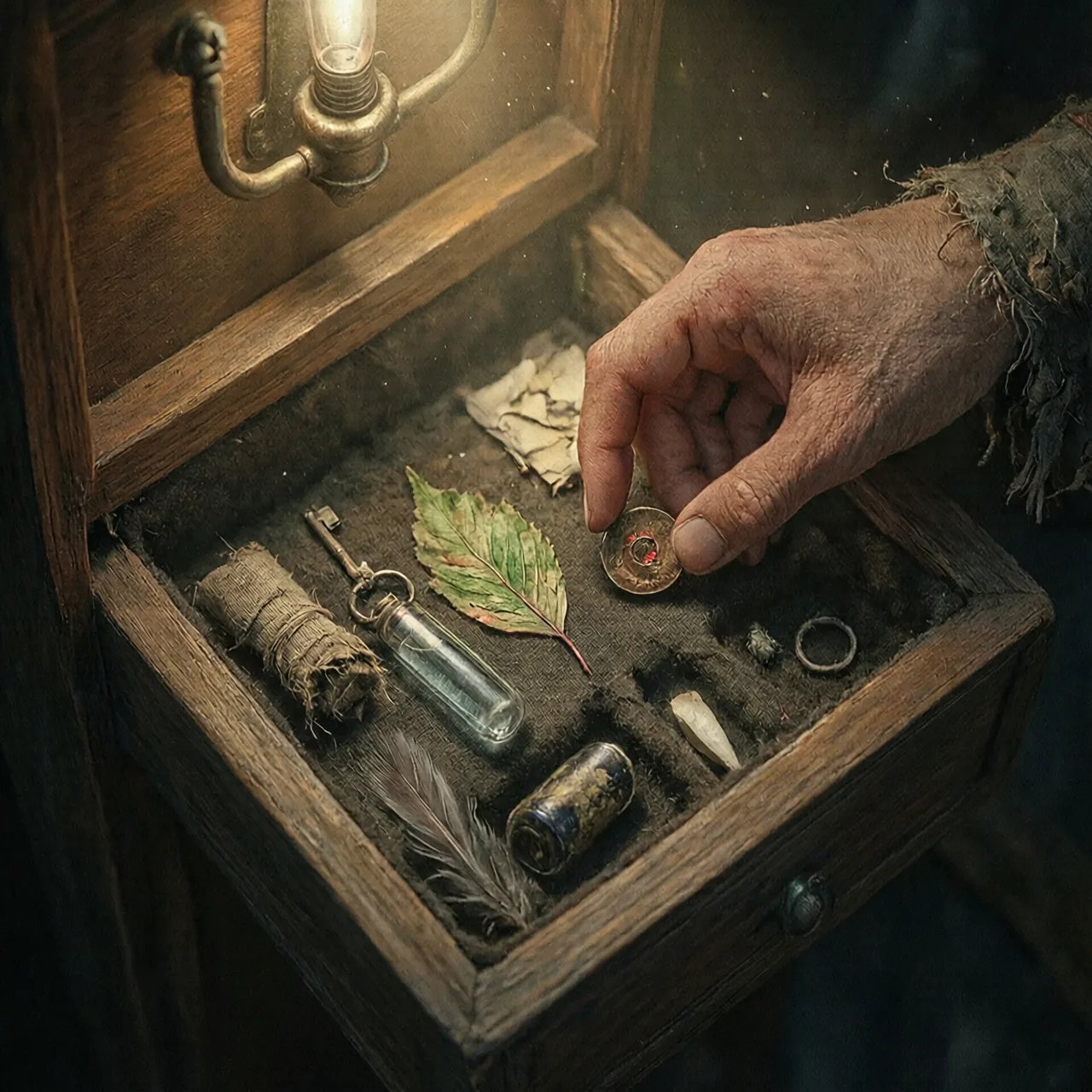
The drawer holds eleven items. A small folded cloth, the weave of which she does not recognise. A glass tube containing a clear liquid she has not opened. A key the size of her smallest fingernail, cut for a lock she has not encountered in the archive. A pressed leaf from a tree she does not believe is the tree the Tree is. The coin. Six other things. She has not catalogued the drawer. Cataloguing requires provenance, and the provenance of the inheritance drawer is a question she has not put to herself in any form she would write down.
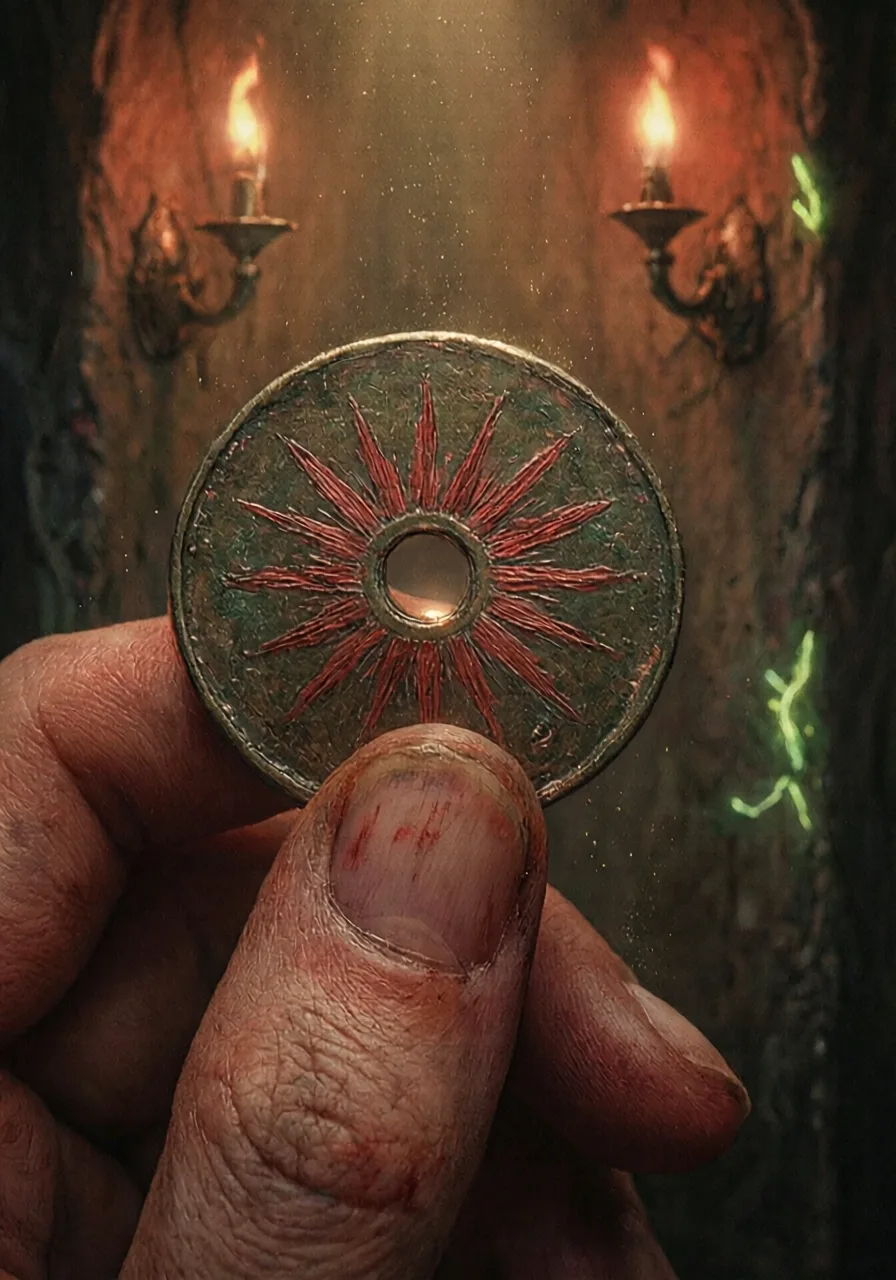
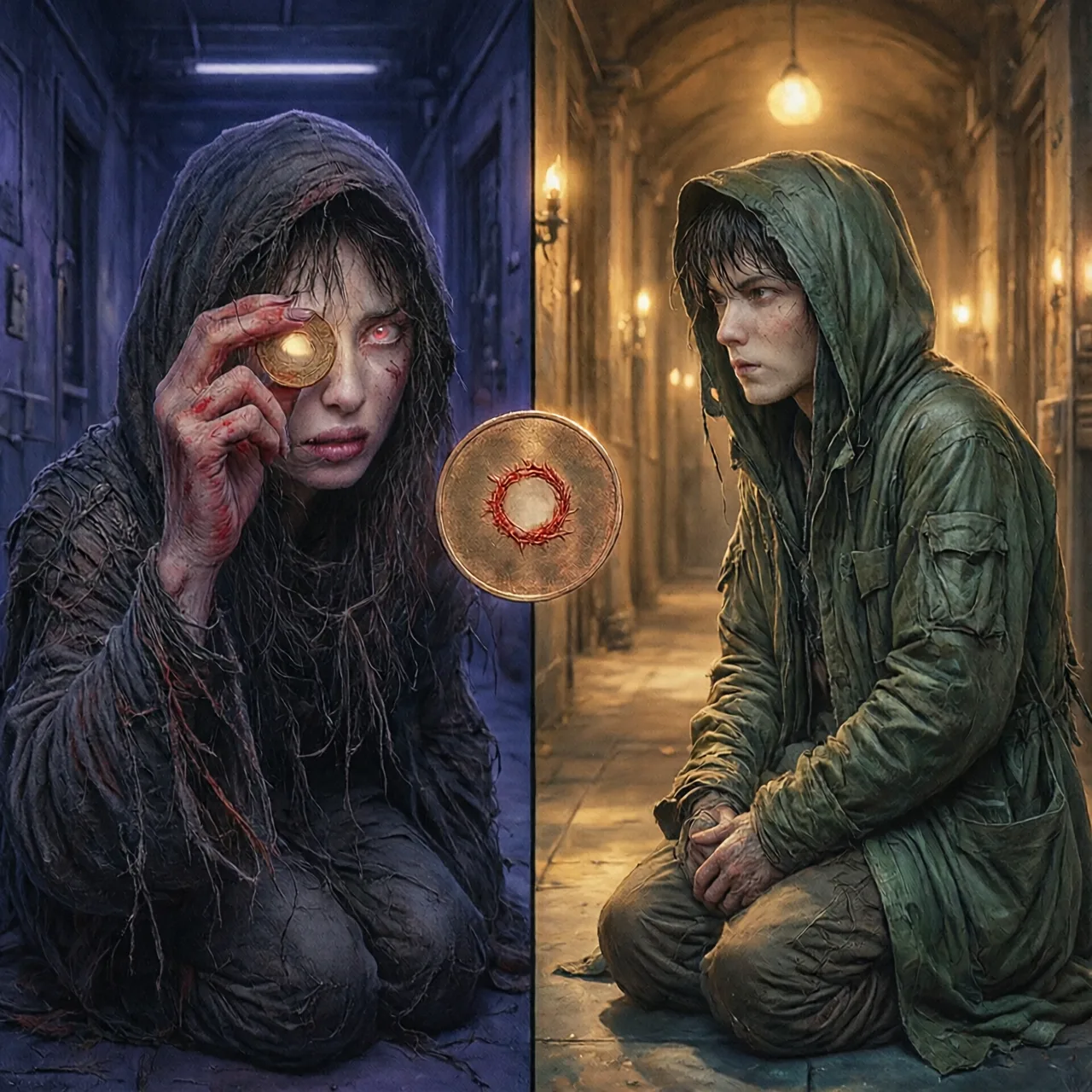
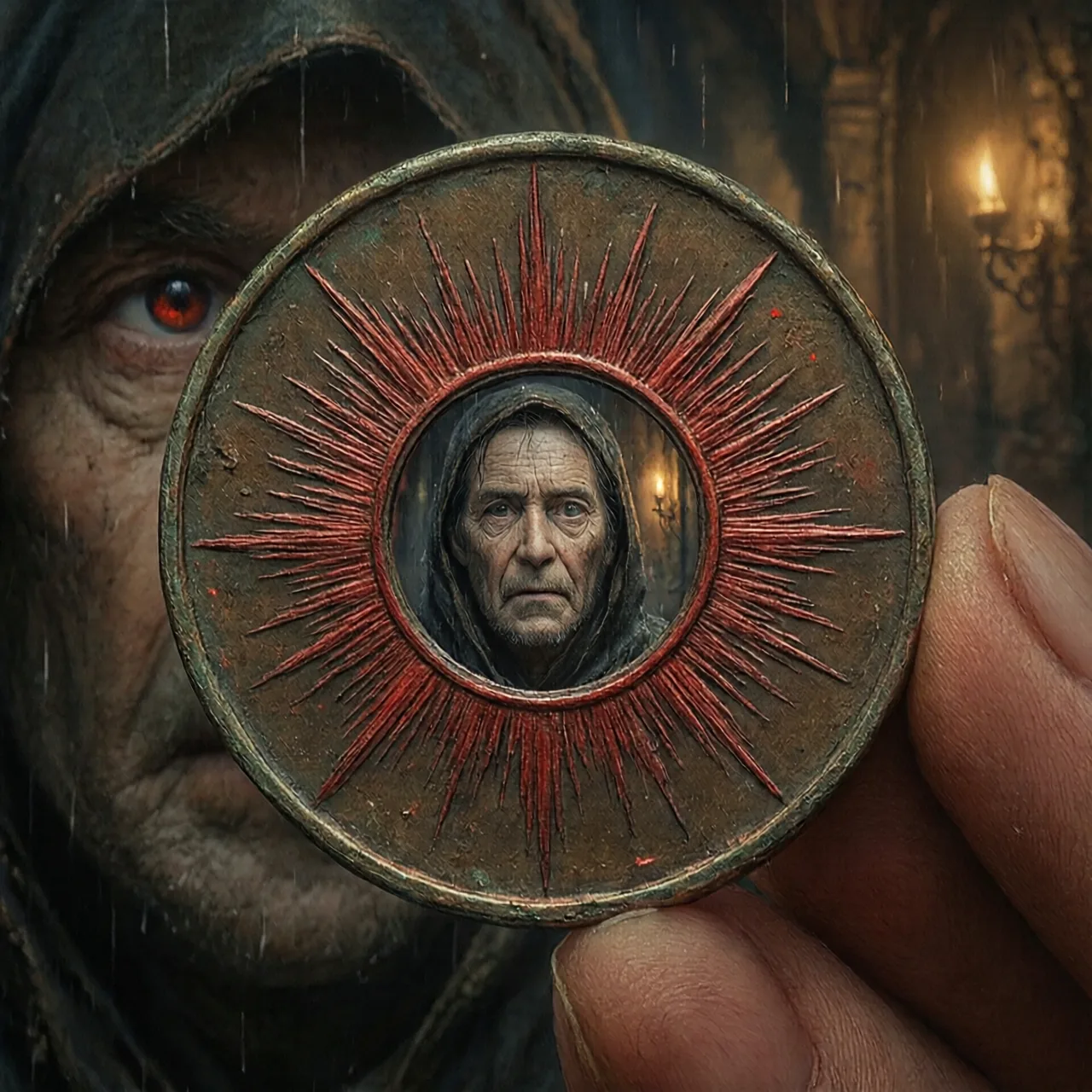
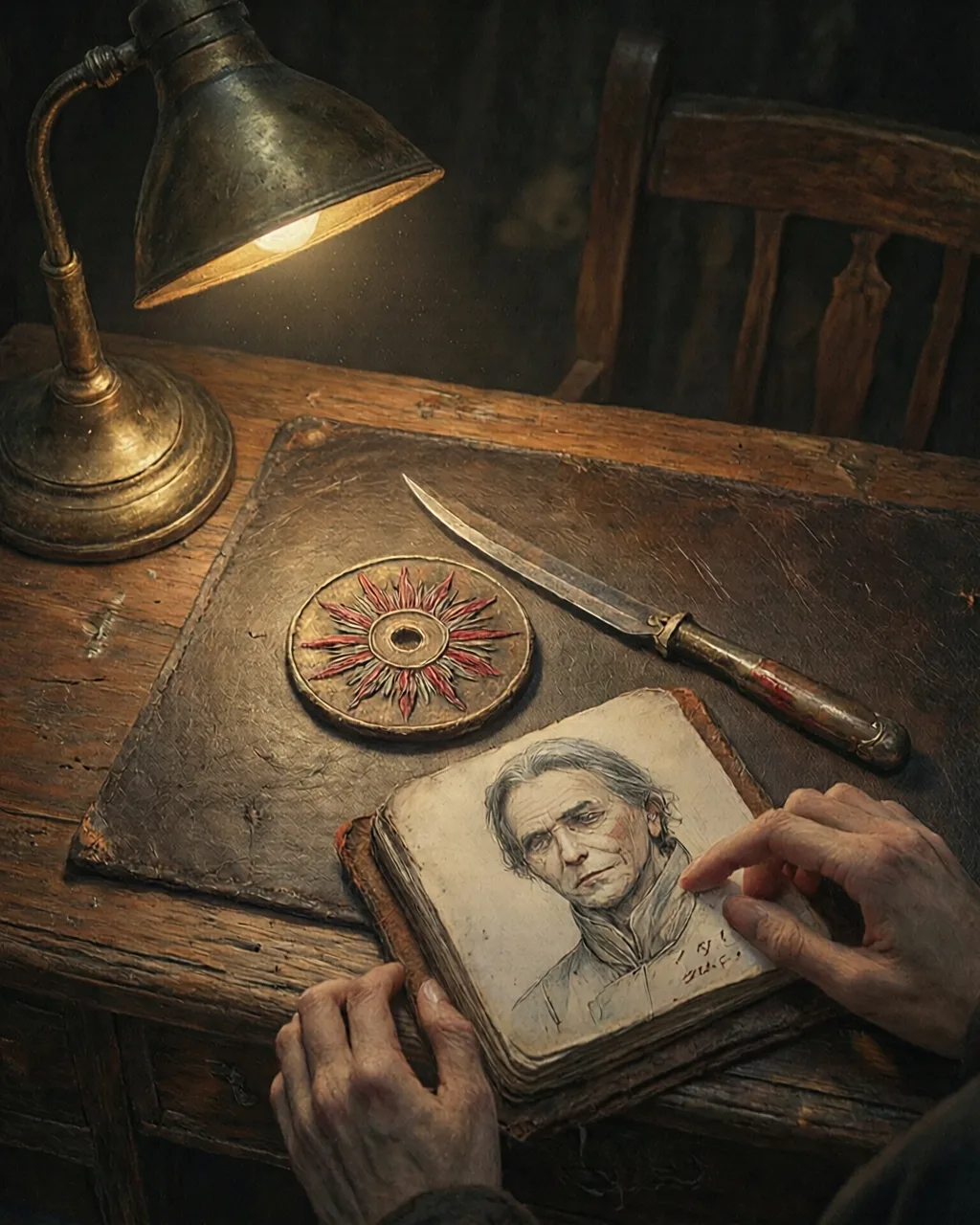
The coin is bronze. It is the diameter of her thumbnail. There is a hole bored through the centre, exactly. The metal around the hole is worn smooth on both faces by a use the Librarian has not catalogued and has not asked herself about. The Founders' currency was octagonal and stamped. The Order's currency, where it existed, was clay. The coin is neither. It bears no mint mark. The composition is not in her tables. She has used the coin twice in her tenure before this descent. She has not described what she saw on either occasion.
Page 2
She kept the knife.
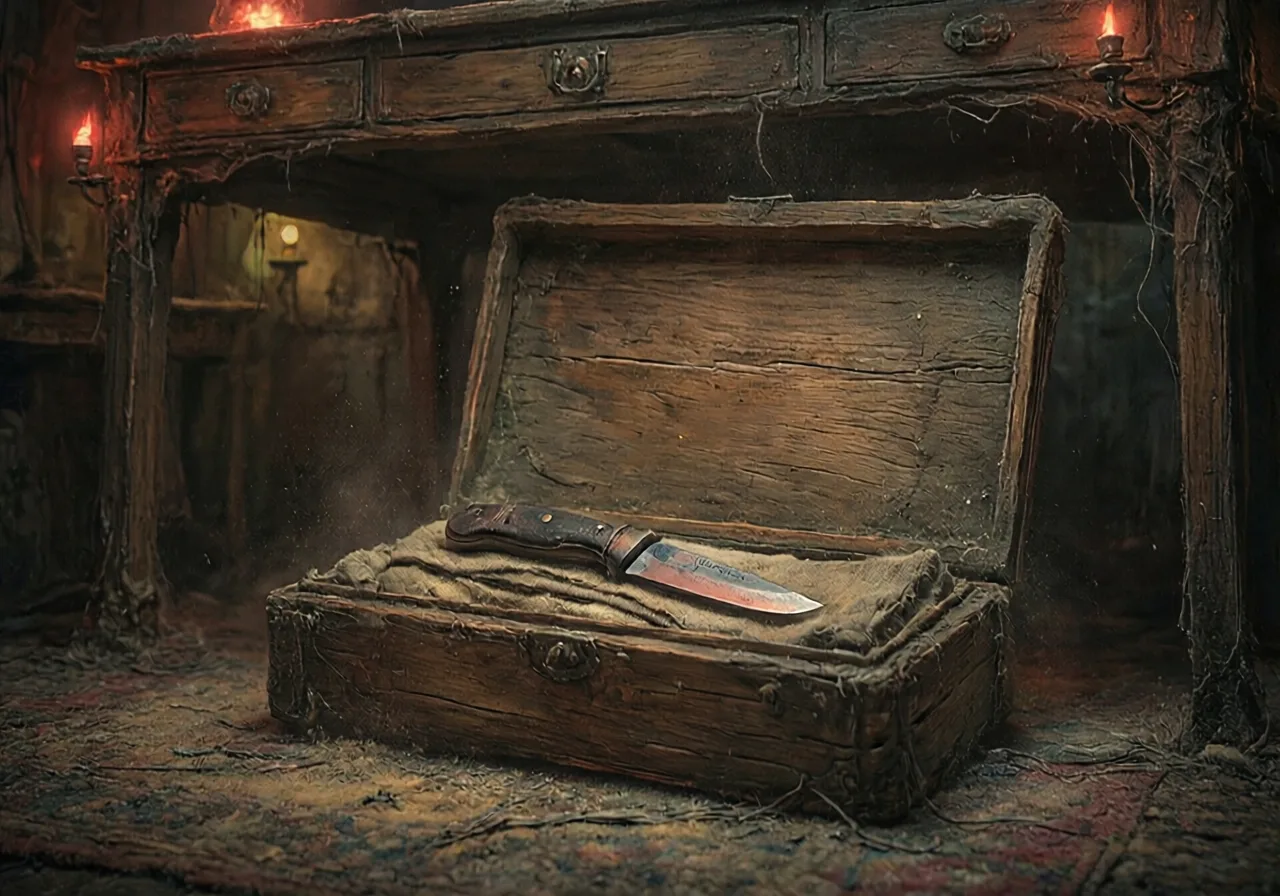
The knife was in a box beneath the desk. She had filed it thirty-one days after the man came. She had not opened the box since. The leather at the hilt was still dark with the oil of the man's hand. The steel was clean where it had not been clean when she received it. She does not know who cleaned it.
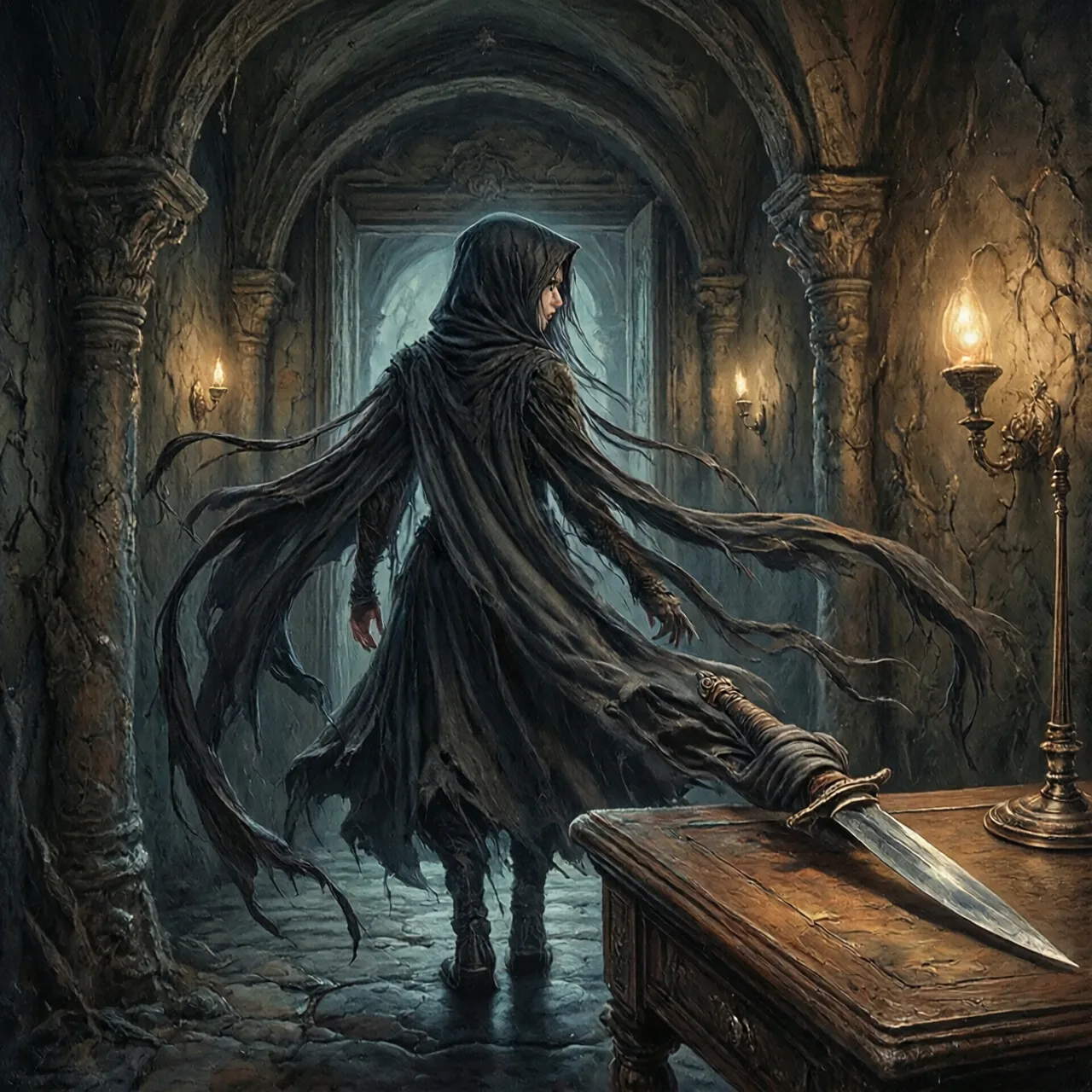
She drew it from the box and tested the edge with the back of her thumb. The leather settled in her palm in a configuration she did not recognise the way a person recognises a familiar grip and recognised the way a hand recognises a tool it has held in another life. She did not record this. She closed the box. She set the knife on the corner of the desk. She kept the knife.
Page 3
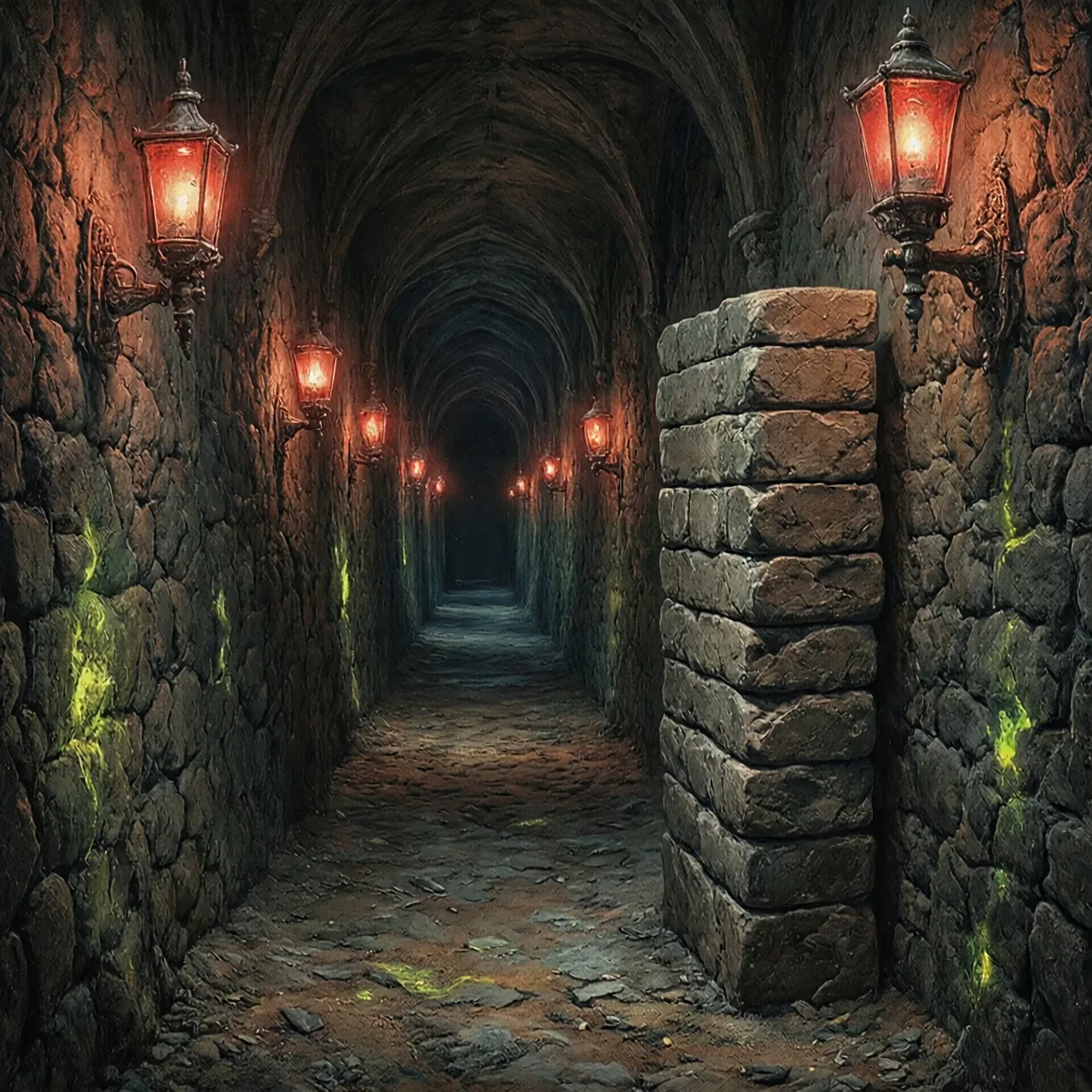
The wall was no longer present.
The seal had been a stone wall. The Order had mortared it across the corridor in a single working, the formulation that bonds to the parent stone and resists separation by anything short of demolition. The wall was no longer present. The stones were stacked beside the corridor mouth in the manner that has appeared at every threshold she has needed open in the duration of her tenure. The stones bear no mortar residue. The stones bear, in the lamplight, the temperature of stones that have rested where they rest for some time. She has not asked who stacks.
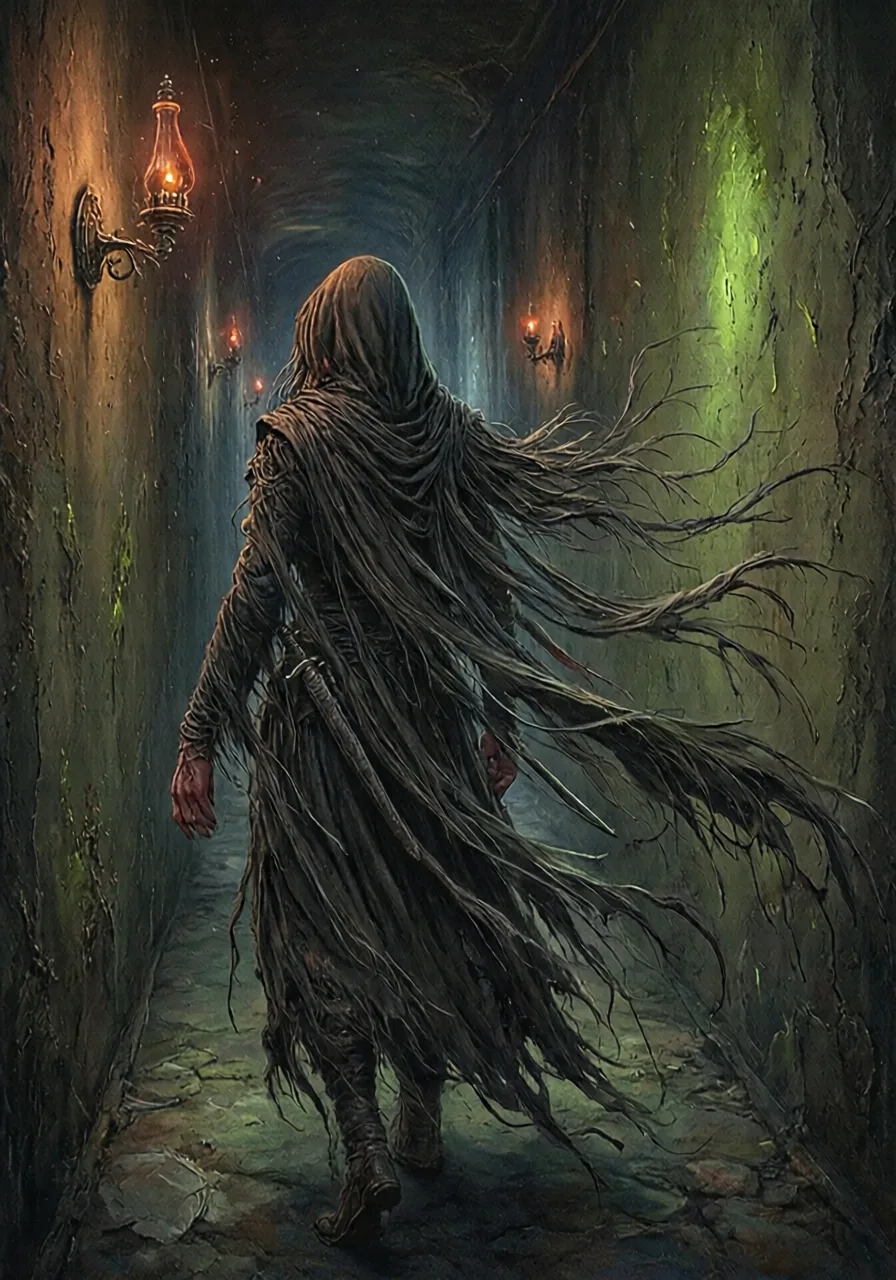
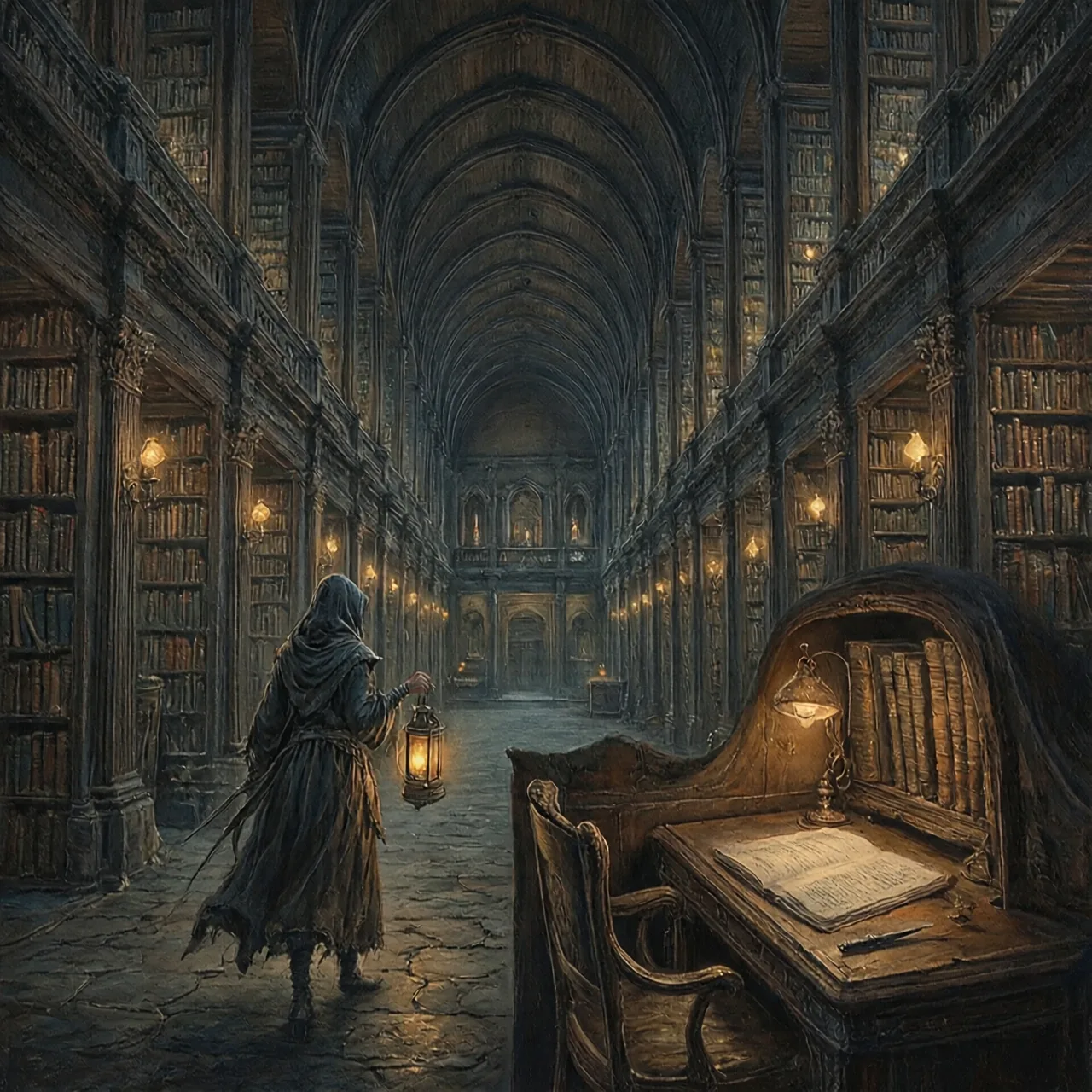
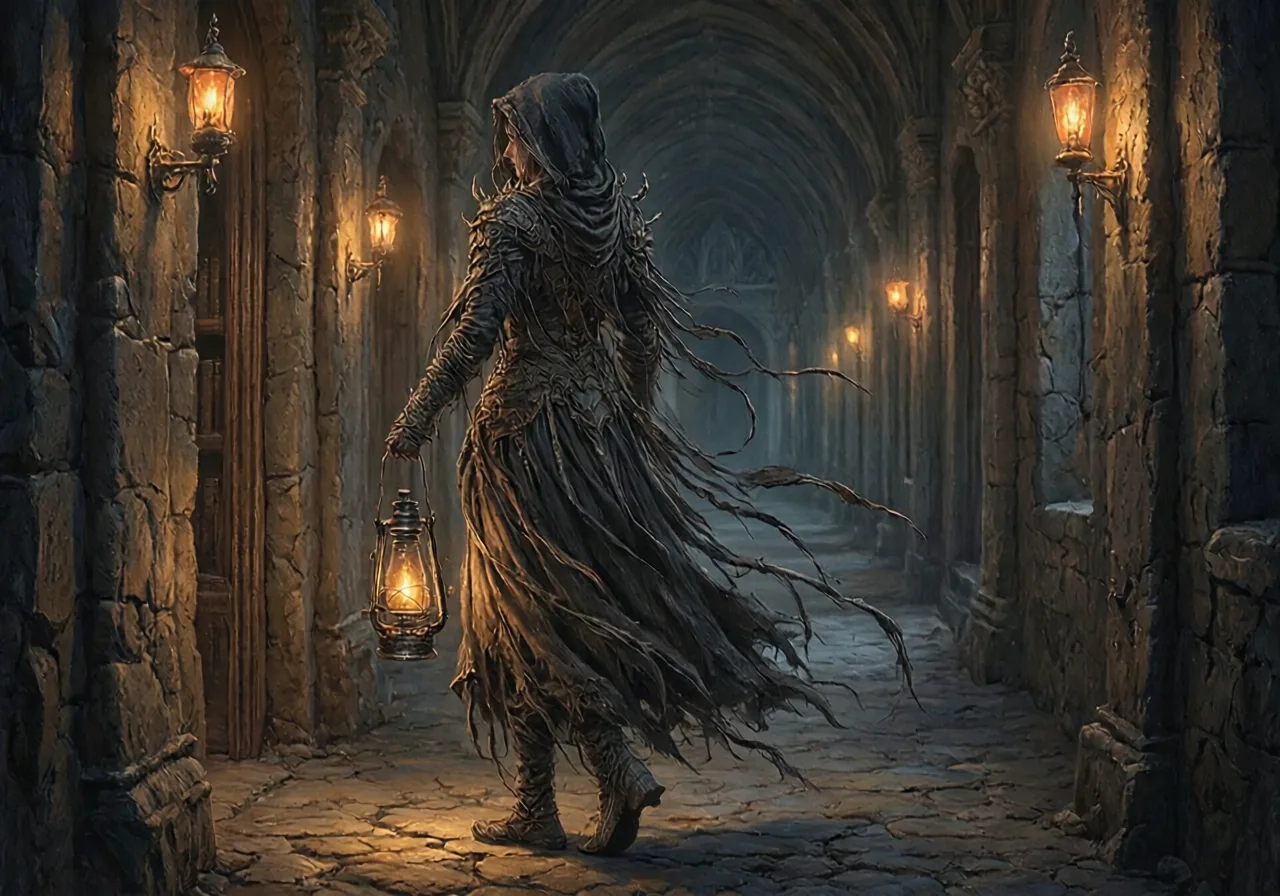
She walked through the threshold the wall had been. Sixty-eight descents are recorded in the descent log. The sixty-eight were for cataloguing. This descent was not.
Page 4
They are watching us work.
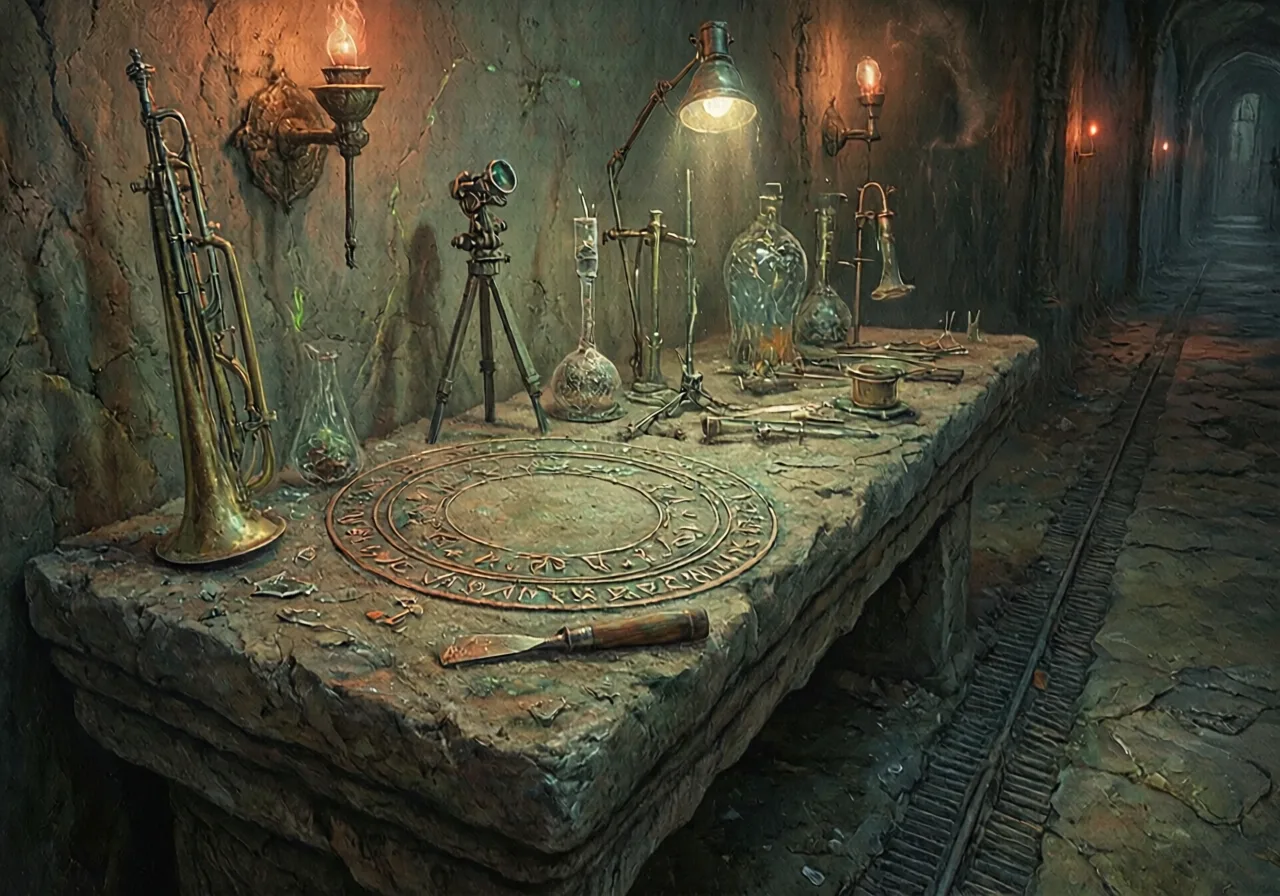
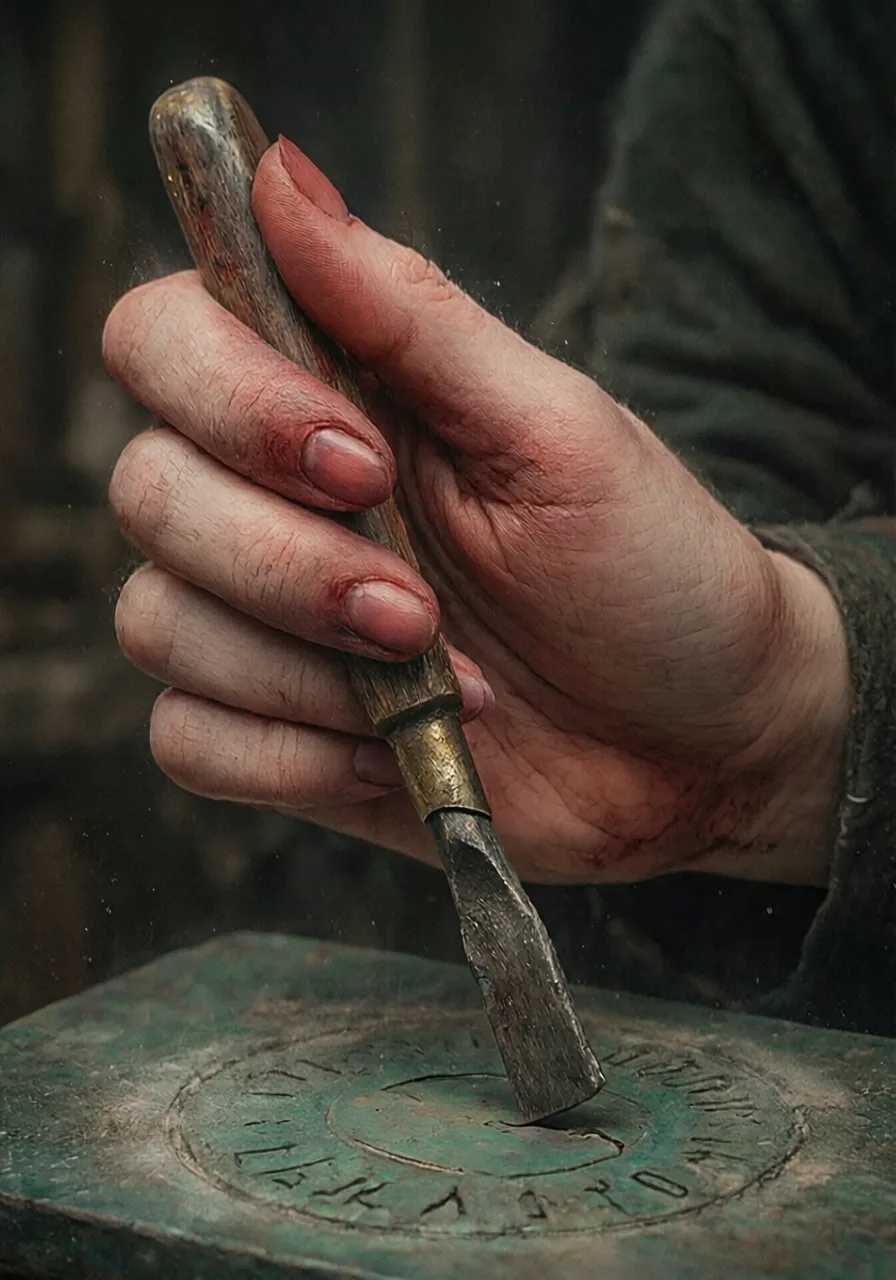
Beyond the gallery the corridor was the Order's. Two workstations remained. The benches held a binding-circle inscribed in copper, the binding incomplete — the final character of the formulation never cut, the chisel still resting on the bench beside the unfinished mark. The chisel had not been moved in the duration the green of the copper required to develop. She has not measured the duration. She has not needed to.
She lifted the chisel. The handle was worn smooth at the angle a thumb had pressed there for twenty years. The handle made the same shape against her palm that her stylus made. She held the chisel above the unfinished mark for the count of a breath. The mark was the second-to-last character of the formulation. She has the formulation in her own notes. She has copied it more than once. She has not filed the copyings. She did not complete the mark. She returned the chisel to the bench in the position from which she had lifted it. The position was exact. She has not written down what would have happened if she had completed the mark. She has not written down whether she knows.
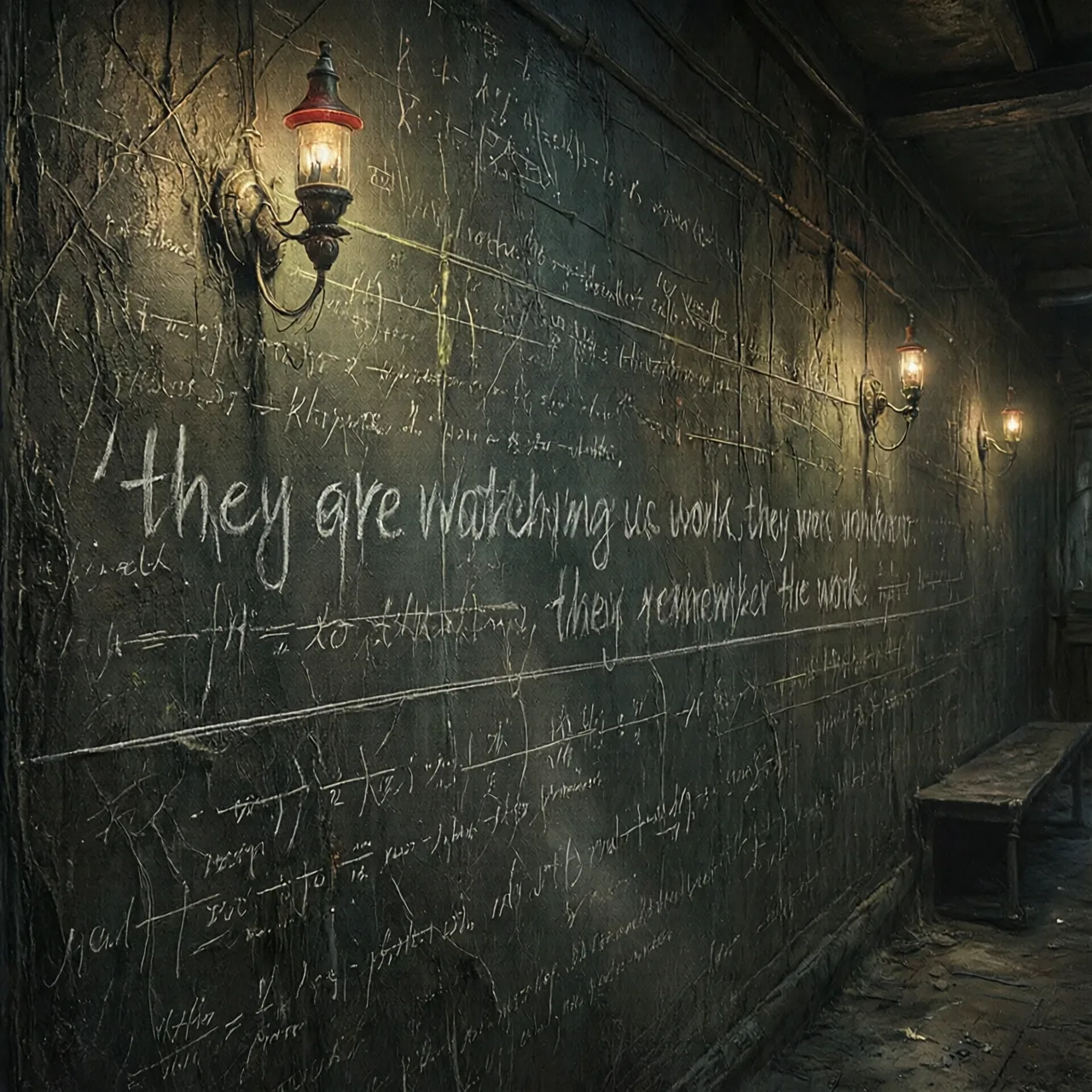
The walls bore writing. It was the work of a hand the Librarian has not attributed. The calculations had been crossed through and replaced. The replacements had been crossed through and replaced. The wall was a record of someone trying to work out a problem the substances in the labyrinth presented and not arriving at a solution. Near the second workstation, in the same hand, the writing changed. The calculations stopped. The hand wrote a sentence: they are watching us work. they were workmen. they remember the work. The hand had then drawn a line. Below the line the writing did not resume.
Page 5
The eleventh face was hers.
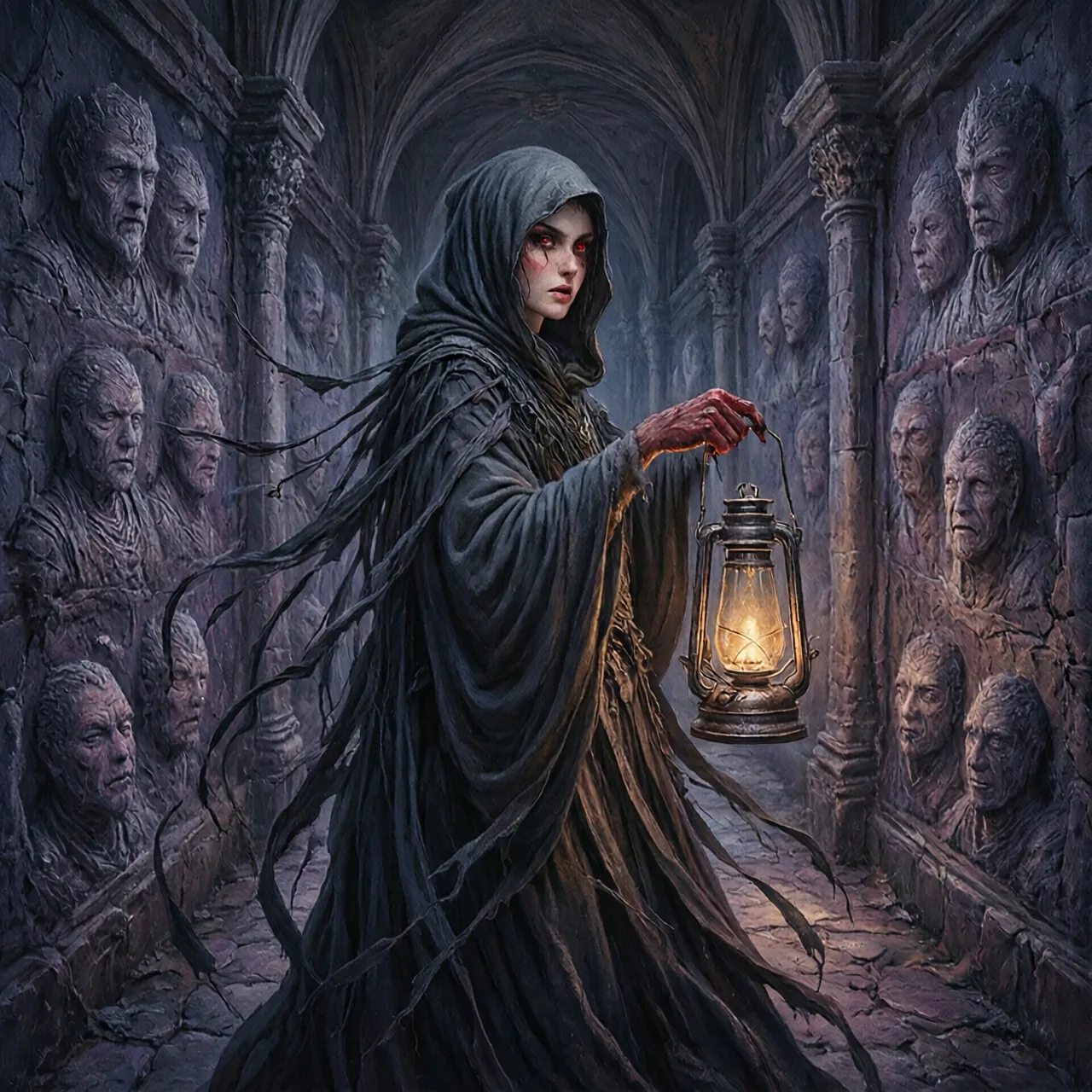
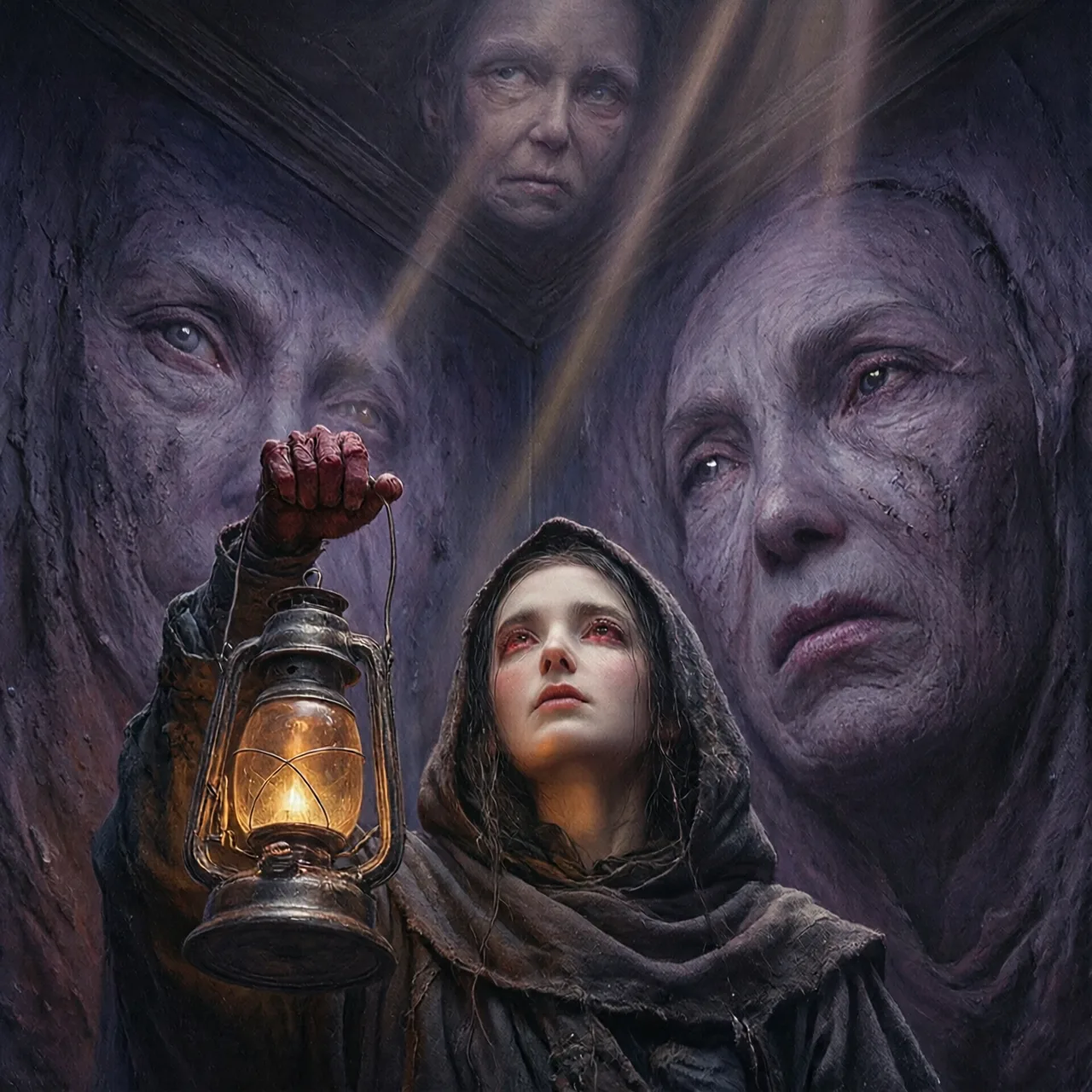
The walls here were thicker with residue than the walls at the workstations. The eldrium had risen and dried over decades. It coated the stone in layers the Librarian could read by section. In the residue she could see them. The shapes were faint and they were faces. They were not standing. They were pressed into the wall — some at the height of a kneeling man, some at the height of a man fallen, some higher up where the wall met the ceiling. The residue had taken them and continued to take them and the taking had been gradual enough to preserve features the more violent revisions of the deep section had not preserved. She walked slowly along the corridor and counted what she could resolve. Eleven faces.
One of them was the watchman. The Order's records contain his name. The records contain his rotation history. The records do not contain a final entry. The fragment from the second workstation describes him stopping at the second junction. He had not been extracted. He had been brought back. He was here. His face was open. The eyes were closed. The eldrium had not closed them. The man had closed them on his own. The expression was not the expression of a man who had been frightened. The expression was the expression of a man who had reached a conclusion.
The eleventh face was high in the wall, near the ceiling, in the corner the Librarian could not have reached without a ladder. The face was hers. She has not filed this. She has noted, in a margin folded into the descent log, the following: the residue records the disposal corps. the disposal corps did not include me. the records do not contain my likeness. the likeness in the wall is the likeness in the wall. She walked on.
Page 6
The substance attempted contact.
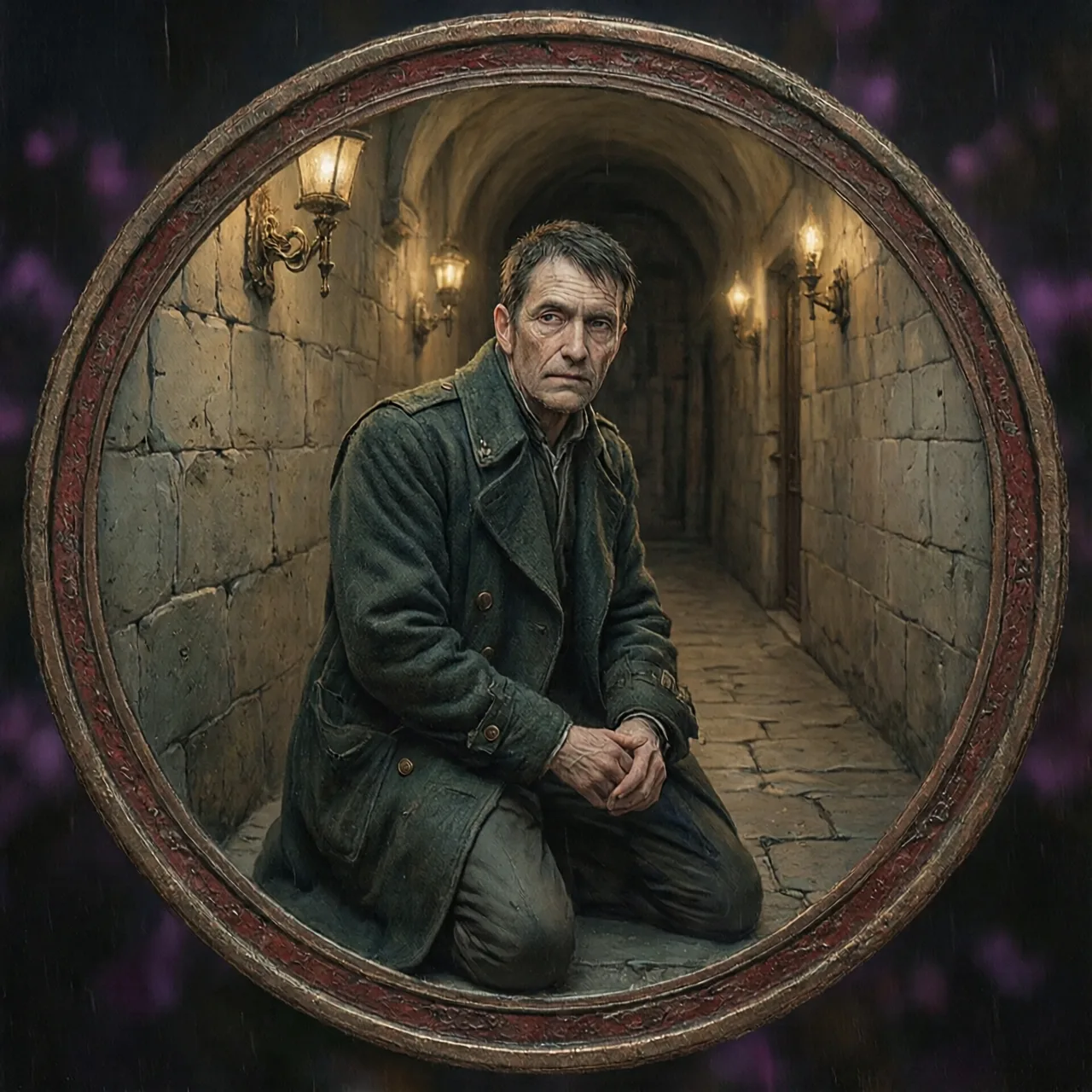
The mire began at the second junction. The eldrium had pooled where the floor sloped. Threading through the residue at the base of one of the pillars she could see what she has not before seen in the labyrinth: roots. They were pale. They were the diameter of her finger. They followed the seams in the stone and they descended into the pool and they did not come up on the other side. The pool's surface bore an image as she approached. The image was the face of a man, kneeling, his hands clasped, his eyes the colour of stone wet by rain. The image held for the duration of three of her steps. It dissolved when she was at the edge of the pool.
The corridor crossed the pool. She did not stop. The pool rose at the centre of the chamber as she passed above it. The rise was not a wave. The rise was the substance attempting contact at the closest point. The closest point was beneath her. The contact did not occur. She was on the far side of the pool. The lamp was steady. Her boots were dry. She does not record the crossing.
Page 7
Things capable of fear.
The form in the third gallery rose when her lamp reached it. It had grown along the eastern wall in the years between her descents. The plates of fused casing had thickened. The fibrous striations had organised into something approaching articulation. The form did not approach. It pressed itself into the recess from which it had risen. The pressing was slow at first. Then it was not slow. The Librarian noted the speed. She noted that the form had not approached on her sixty-fourth, sixty-fifth, sixty-sixth, or sixty-seventh descents either. She noted that on those descents she had carried only the lamp and the measuring instruments. On this descent she carried the knife.
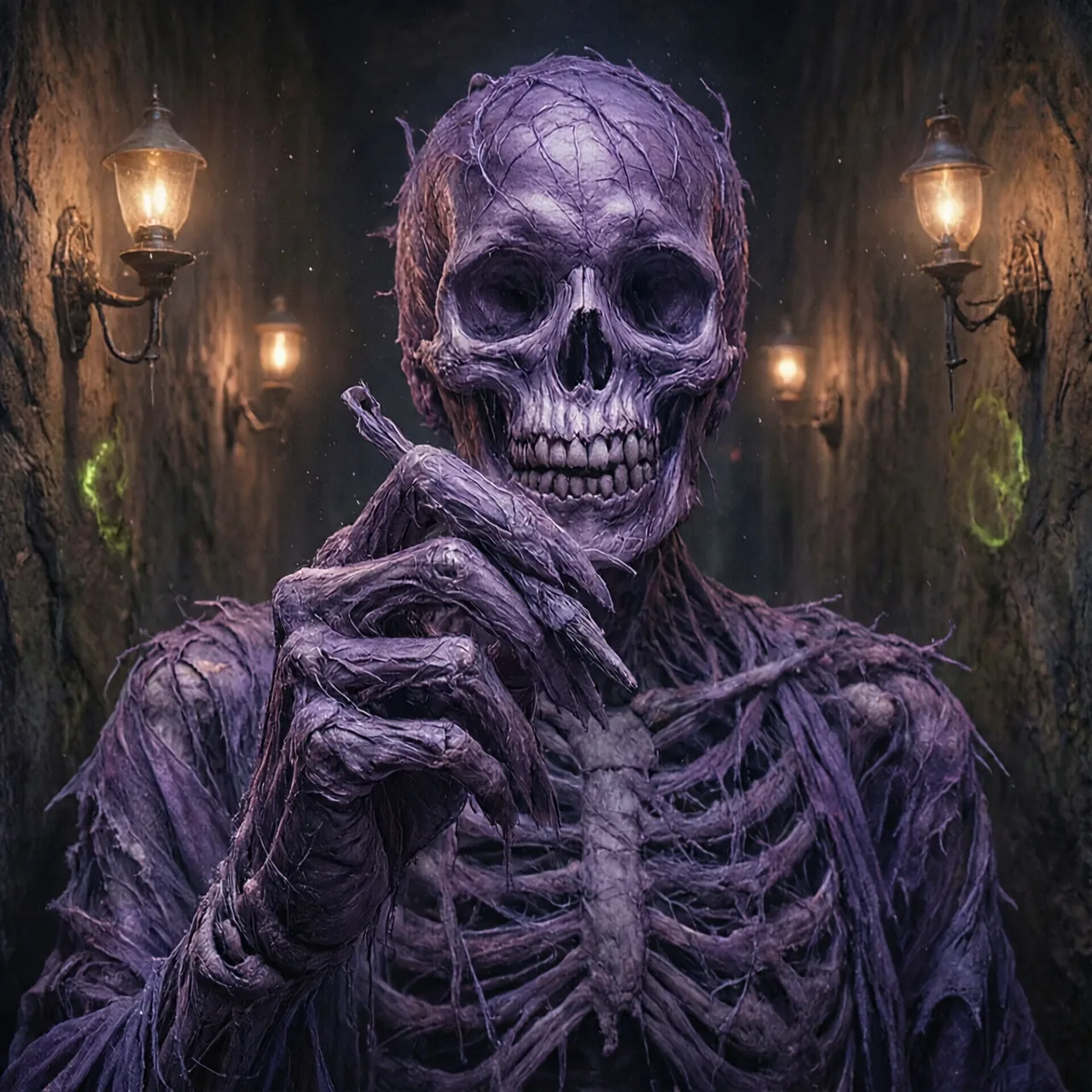
She walked past 341. The Fifth was where the Fifth had been on the previous sixty-eight descents. The skeleton was articulated. The mass of revised tissue was around it. The eldrium near the skull had developed, since her last visit, a configuration she did not look at closely. The hand was different. For sixty-eight descents the hand had been grasping at nothing. The hand had changed. The thumb and the index finger had come together. They were pinched, in the configuration of a hand holding a stylus. The hand was making, in the air, a writing motion. The interval between each completed character was the interval she uses when she is writing in the catalogue.
Page 8
She does not record what was drawn.
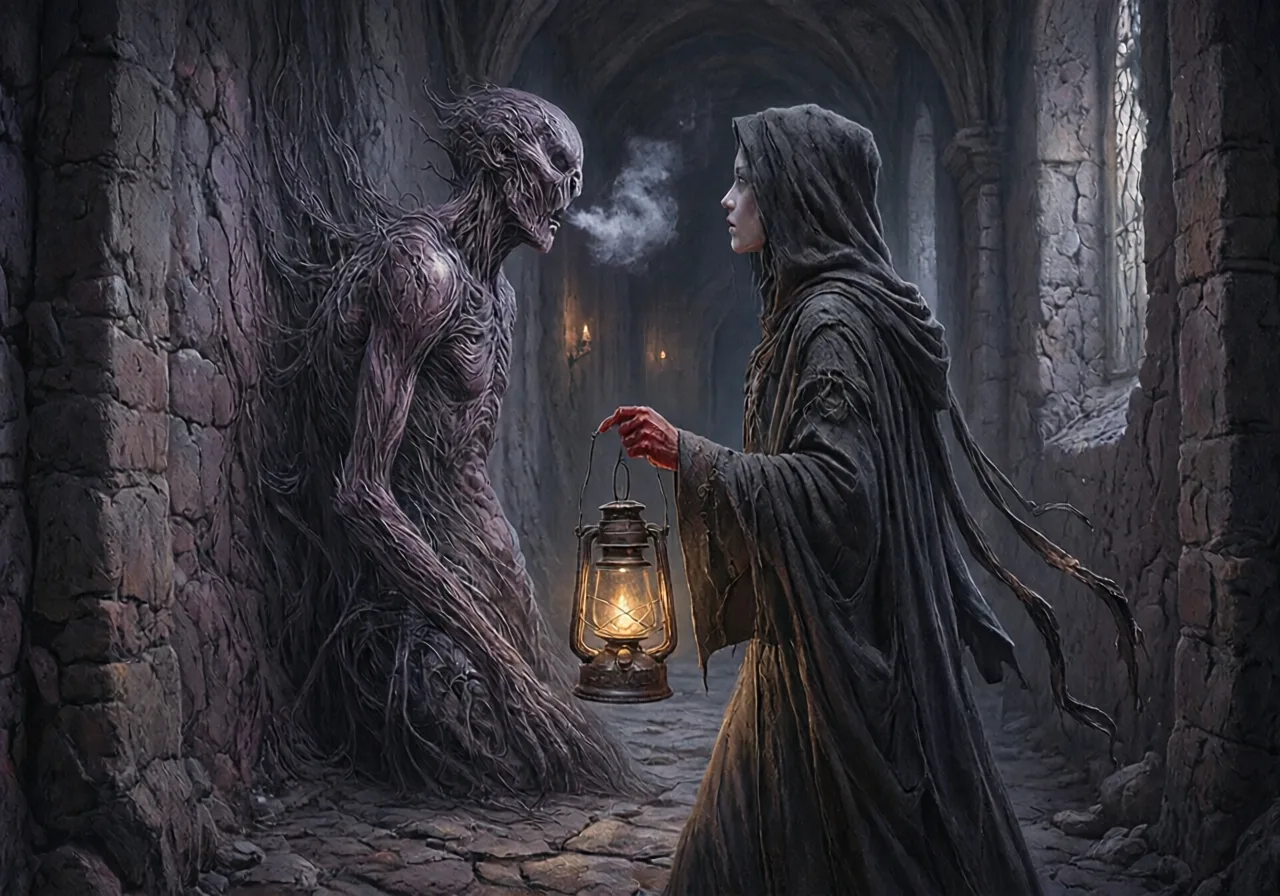
The thing at the fifth junction did approach. It came down from the ceiling on lengths her instruments would have recorded as appendage if she had stopped to record them. She did not stop to record them. The lamp was in her left hand.
The thing was on the floor and it was no longer one thing and the Librarian was where she had been. The blade had been drawn. She does not record what else was drawn. She does not record movement she does not require to record. She wiped the blade on the wall where the residue would absorb what the blade had collected. She replaced the knife at her hip. She walked on. She has not before catalogued the labyrinth as inhabited by things capable of fear. She catalogues it now.
Page 9
The breathing room.
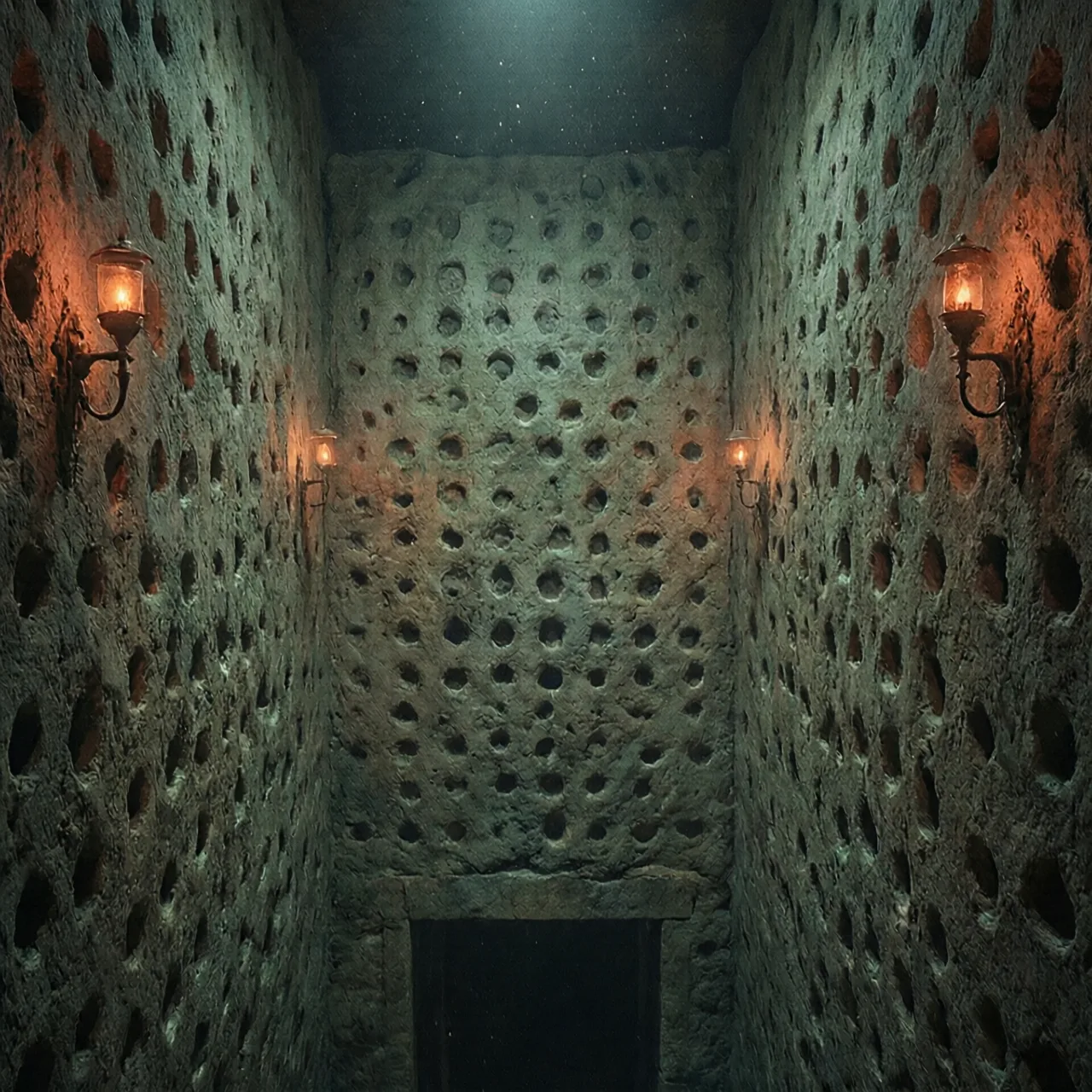
Past the fifth junction the corridor opened into a chamber the Librarian's records describe as the breathing room. The walls of the chamber were not stone. They had been stone. They were now pocked across their full height with apertures of the kind she has recorded on the larger forms. The apertures were everywhere. Between the apertures the wall surface had the temperature of skin. All of the apertures were open. The airflow through them was synchronised. The chamber inhaled and the chamber exhaled and the inhalation and exhalation produced a hum of the kind she has measured in the breathing of single forms. The hum here was the hum of hundreds. The hum had a pattern. The pattern was almost a phrase.
The lamp dimmed briefly. She did not measure the dimming. The chamber took on a pale cold light. The light was the kind she has measured in sections where the liquid memory has dried. The lamp was not its source. The forms in the apertures pressed themselves further into the wall. The hum did not stop. The hum lowered. She crossed the chamber. She did not run. The hum followed her to the far entrance. When she had passed the entrance the hum continued behind her without her.
Page 10
Through the hole, the corridor was full.
She knelt at the edge of the form. She drew the coin from the pocket of her robe. She did not look through the coin at the form first. She turned the coin slowly across the corridor.
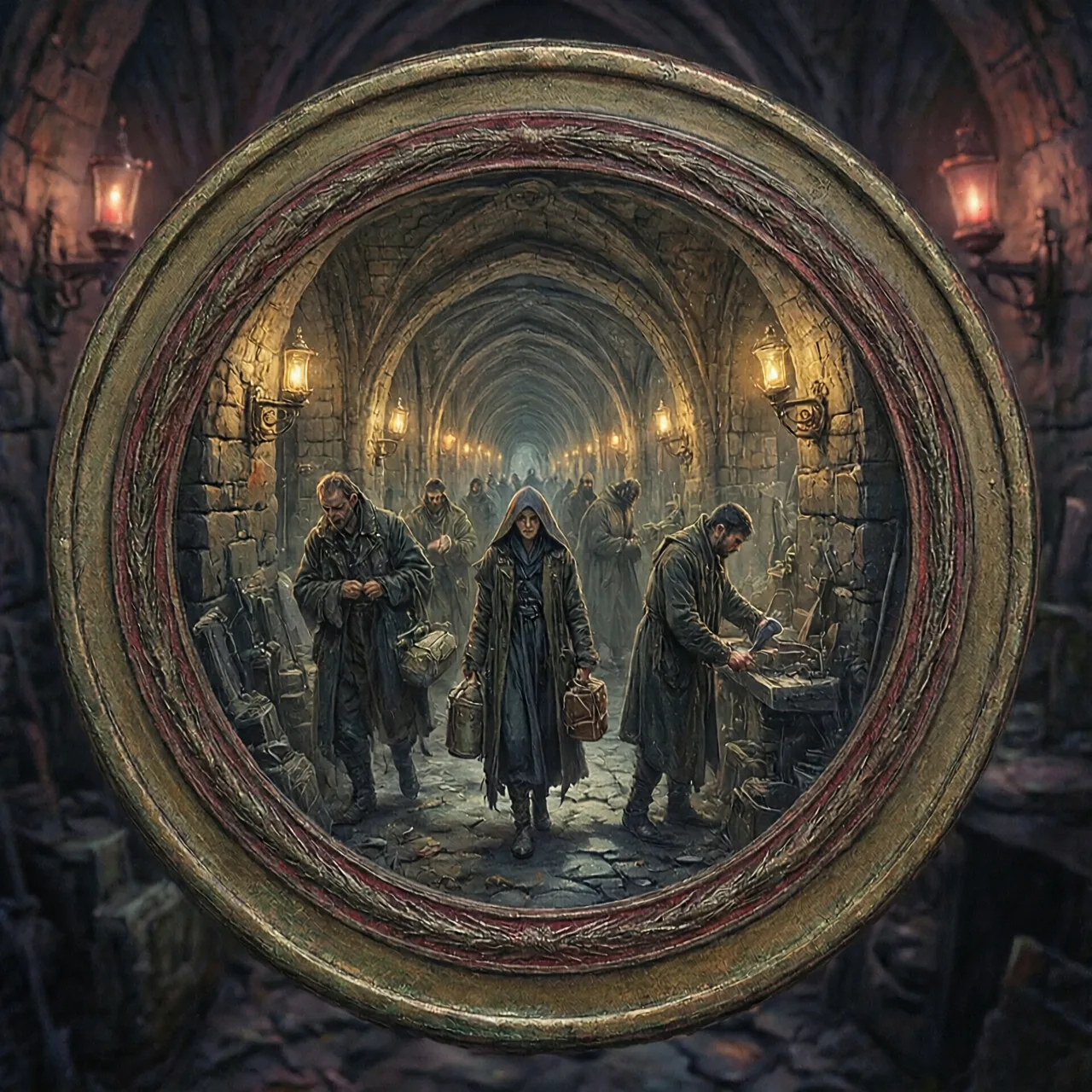
Through the hole, briefly, the corridor was full. Men in disposal-crew coats moved between junctions, lifting containers she could see clearly through the bronze and could not see at all without it. A man stood at a workstation that was no longer present. The chisel was in his hand. The mark he was cutting was the mark that had not been finished. A figure further down the corridor walked toward her at a stride she recognised. She did not focus on the figure. She turned the coin away.
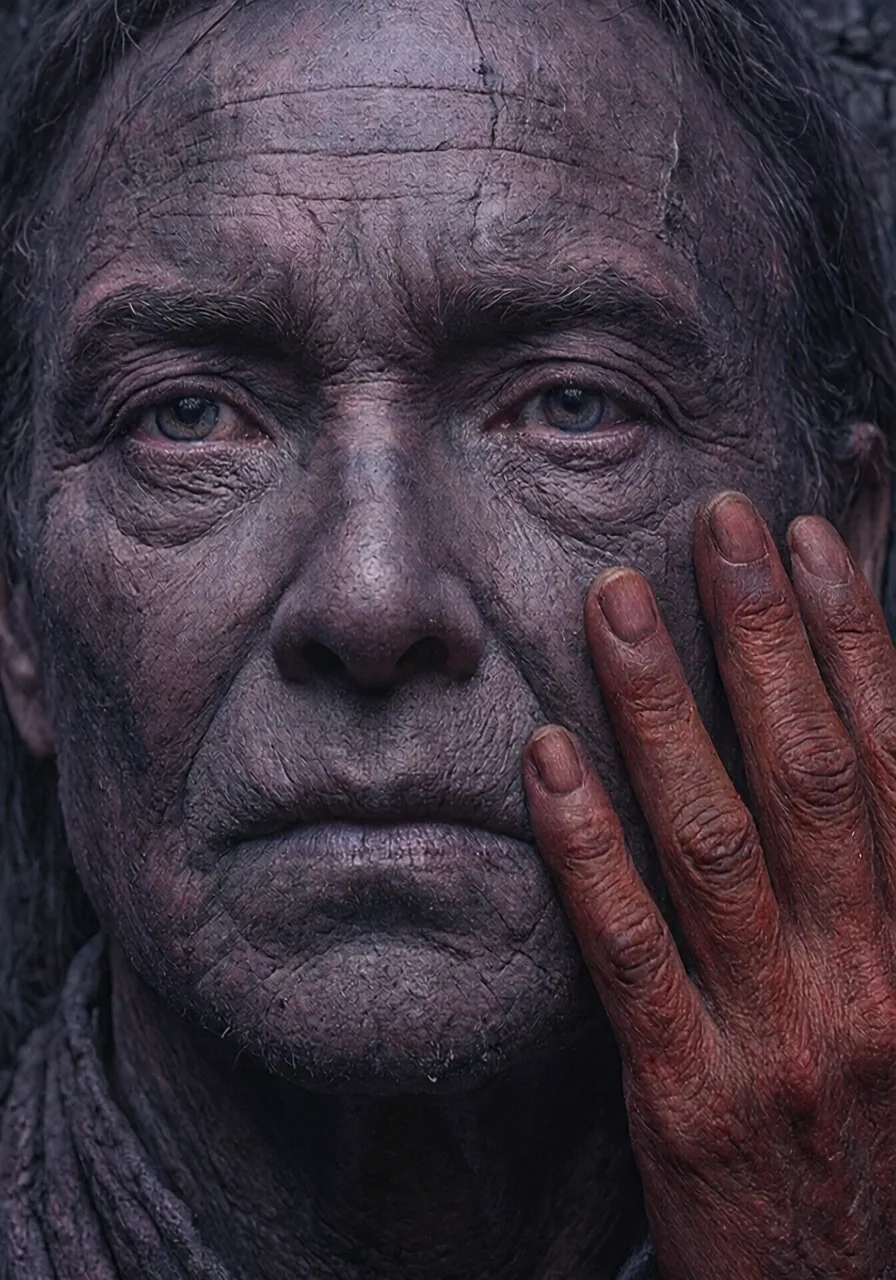
She turned the coin back to the form at 318. She held it at the level of the apertures. She looked through the hole. The form on the other side of the coin was a man. He was middle-aged. The cut of his coat was the cut the disposal crew had worn before the sealing. His face was even, his jaw was square, his eyes were the color of stone wet by rain. He was kneeling on the floor of the junction. His hands were clasped. He was waiting. At the limit of what the coin showed her the corridor turned and went on into the dark. He was alone there.
Page 11
The hand on the page is the hand on the page.
She spoke. The speech did not pass through the apertures. It passed through the coin. The man on the other side of the coin heard her.
The LibrarianMaren — how many times have I stood here.
MarenI do not count bodies. I count hands. The hand has been the same. I have known it longer than I have known myself.
The LibrarianWas I in the green coat.
MarenI did not see your face under the hood. The coat was the disposal corps's coat. The hand was the hand that draws me now.
The LibrarianAnd after the work failed.
MarenThe body went up. The wall took what it took. The hand returned later. The hand was kind.
The bronze of the coin had warmed during the conversation. The warmth was not the warmth of her hand.
The LibrarianThe Fifth.
MarenThe Fifth is not here. He has been resolving toward something. I do not know what is on the side that comes after his.
The LibrarianMaren — do you know what I am.
MarenThe hand on the page is the hand on the page. I have known many hands. Yours has been kind. I would not say you have always been so.
The LibrarianI am not always kind.
MarenYou are kind to the page. That is the kindness that mattered to me when I was a man who had pages. It is the kindness that matters to me now.
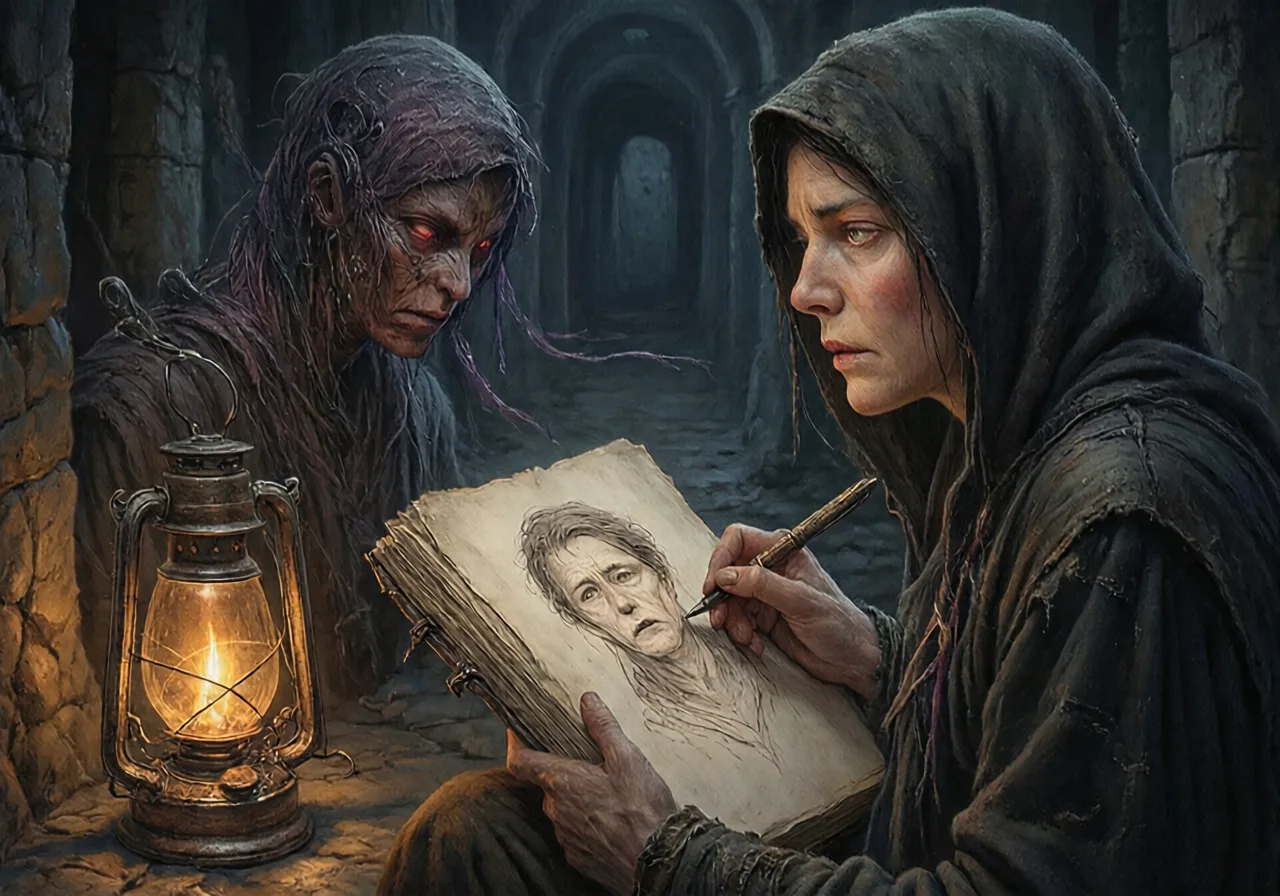
She rose. She put the coin in her pocket. She drew the descent log from the inner pocket of her robe and made the sketch of his face by lamplight at the edge of the junction. The sketch took the duration of three of her breaths. The hand that drew it was steady. The eyes in the sketch are looking at the hand drawing them.
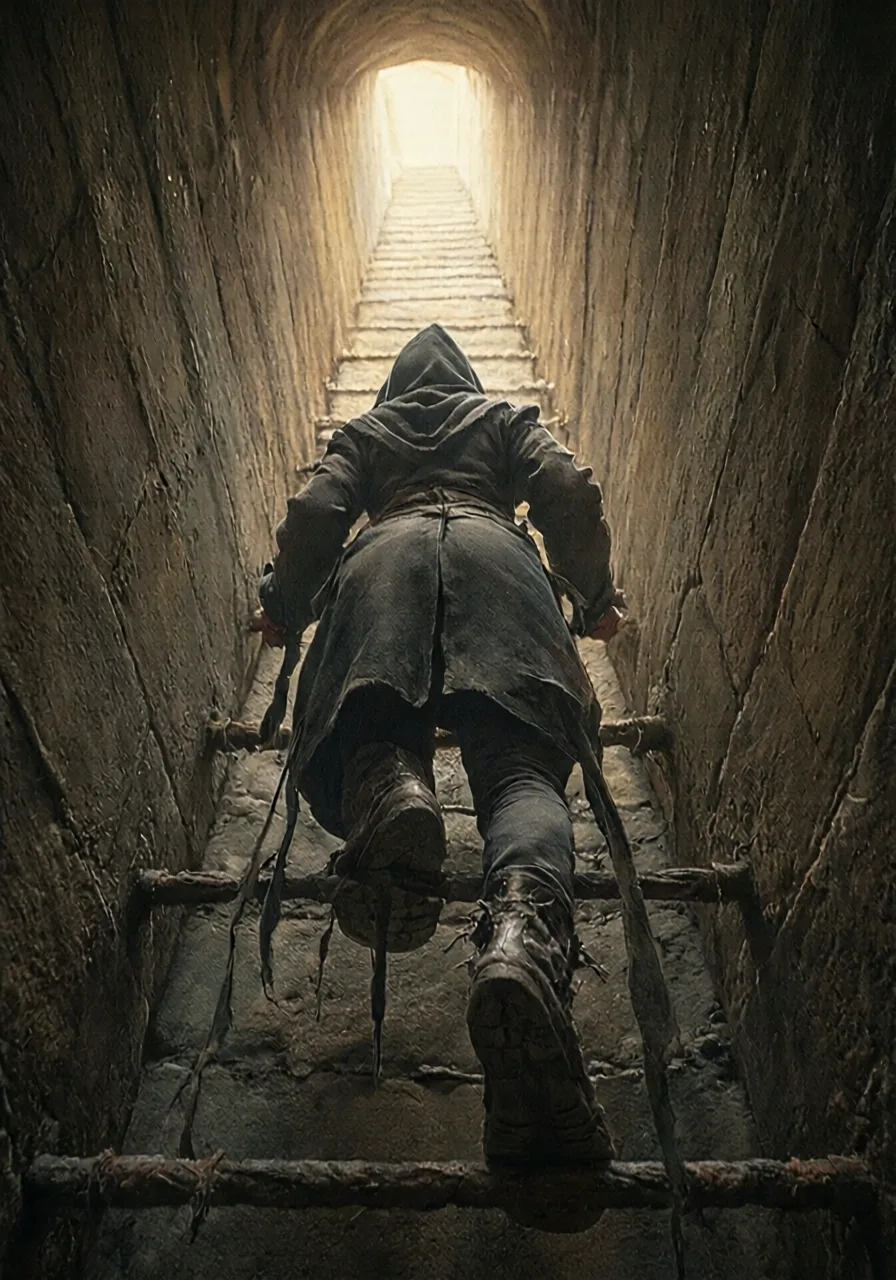
The forms she had passed on the descent did not rise on the ascent. Entry 318 produced a sound as she left the junction — the airflow shaped, briefly, into a syllable she has heard in her own thinking. The labyrinth let her go. She climbed the corridors she had descended. Forty rungs.
Page 12
Five hours and the ink had not skinned.
She emerged into the archive. The archive was as she had left it. She walked to her desk. The lamp was at the configuration she had set it to. The flame was the height she had trimmed it to. The folio was open to the page she had been writing. The stylus was beside the folio. The ink at the end of the last character she had written was wet. The descent log records the duration of the descent at five hours and seventeen minutes. Five hours and the ink at the end of the character had not skinned. Five hours and the oil in the lamp was at the level she had filled it to. She has not extended the entry on this matter.
She placed the coin on the blotter. She placed the knife beside the coin. She drew the descent log from her pocket and set it open to the page of the sketch. She sat.
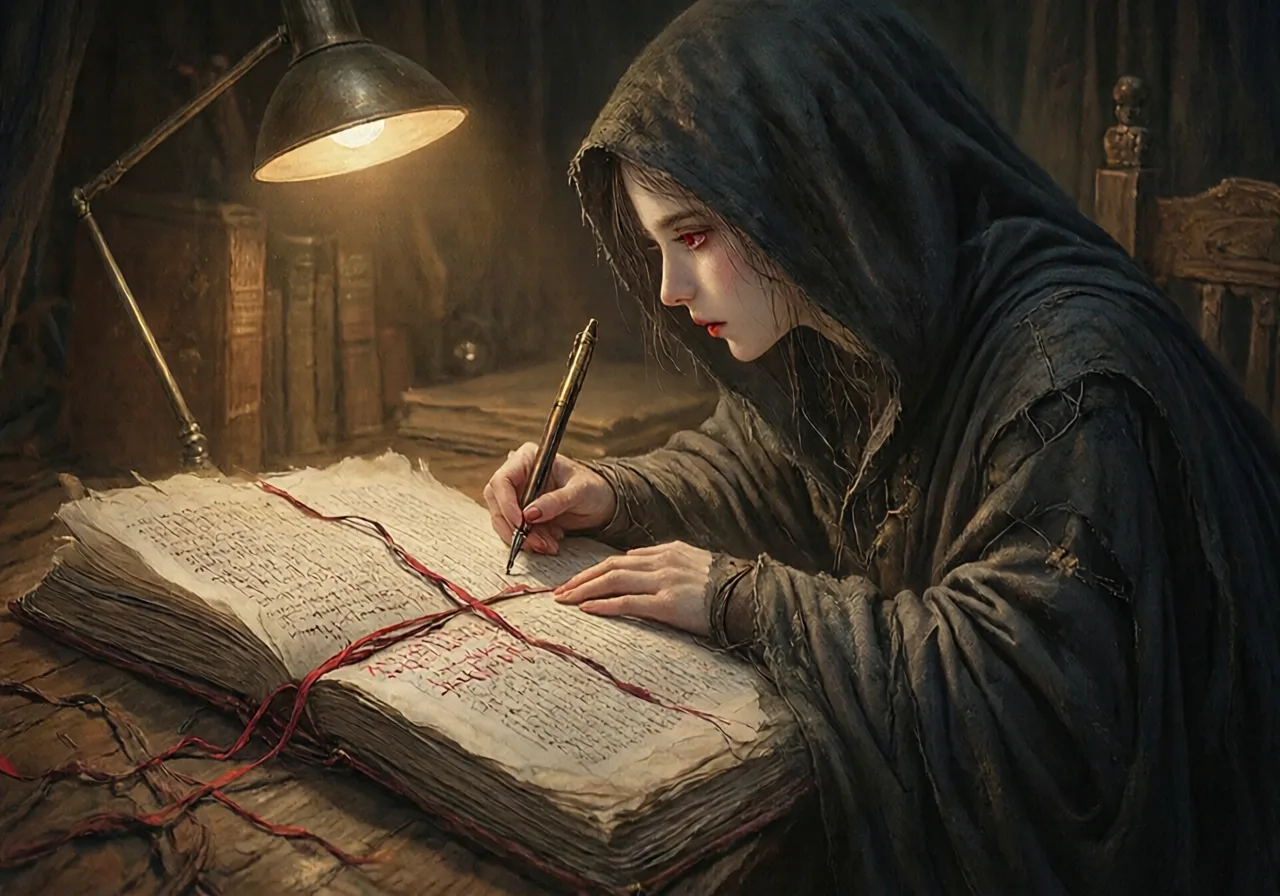
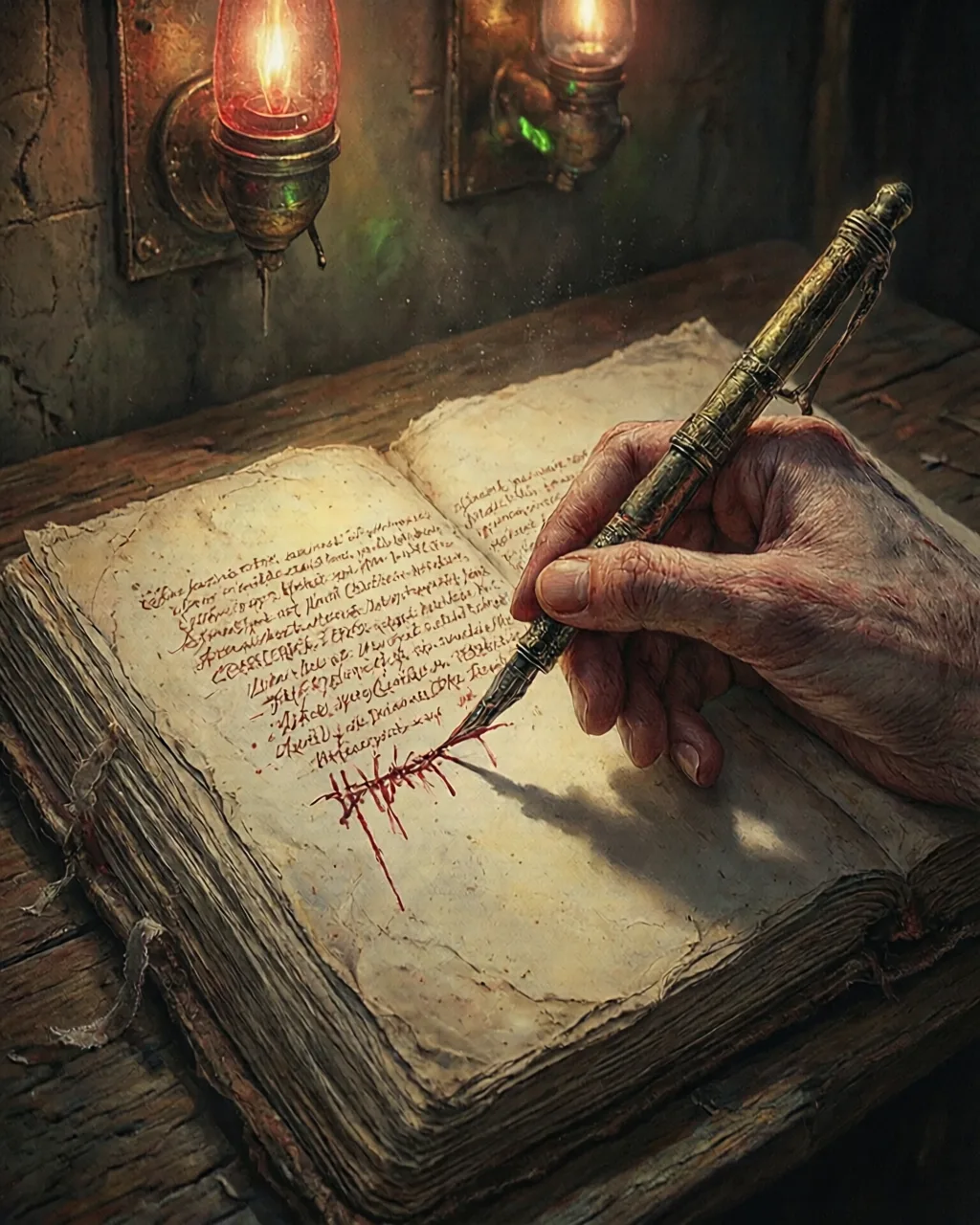
She wrote it in the hand the catalogue requires. She wrote until the section requiring the conversation. She drew the page through the secure ribbon. She continued the entry on the page beyond the ribbon, in the hand that does not appear in the public catalogue.
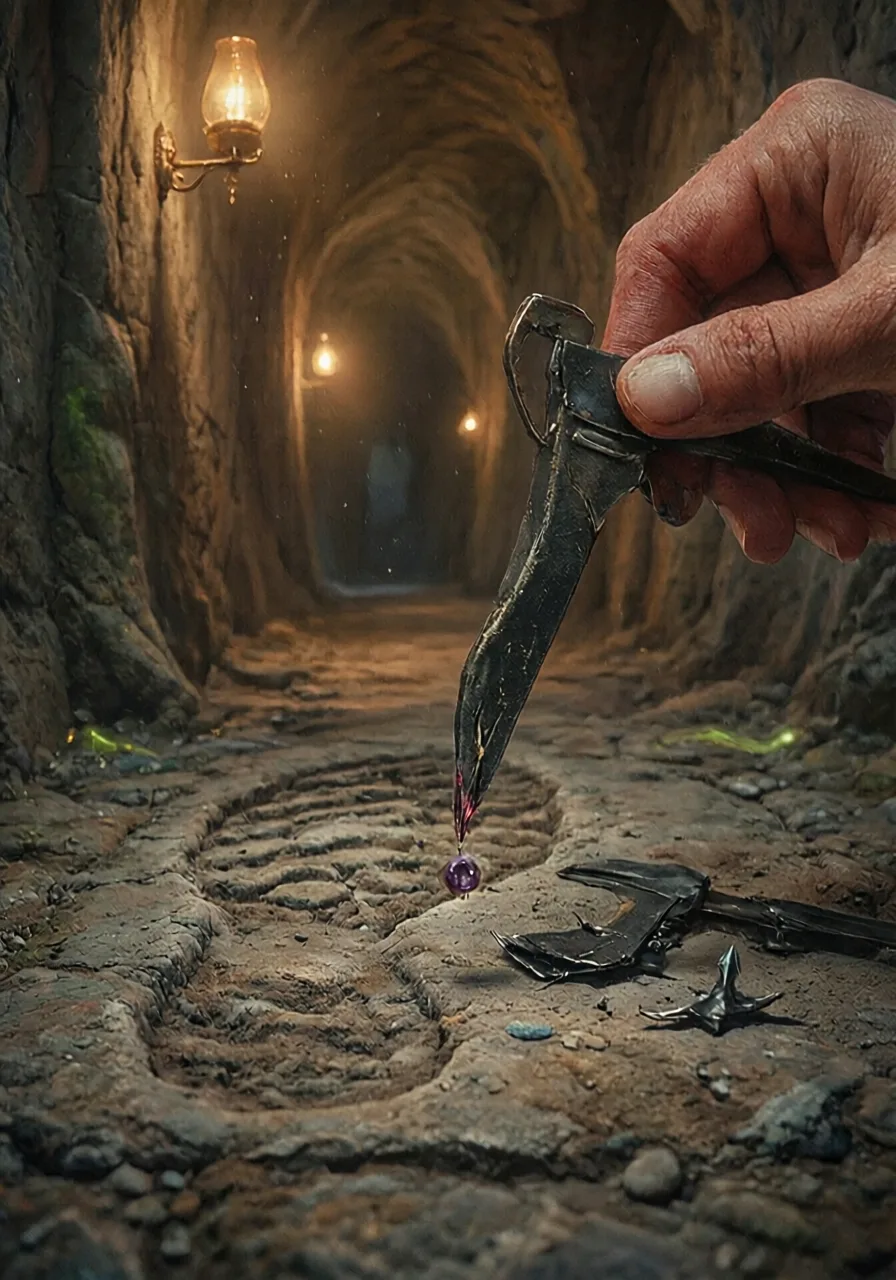
The Guardian had passed the corridor outside her alcove during her absence. The dust at the western junction was disturbed in the pattern his weight makes when it falls forward onto the ball of the foot. The disturbance was fresh. Beside the dust, on the stone, there was a single drop. It was small. It was dry. The colour was not eldrium and not the red of the liquid memory and not a colour her tables describe. Beside the drop, a small piece of black metal. The metal was sharp the way a thing is sharp that has been made to end things. It was a piece of him. She knelt at the drop. She measured it. She measured the piece of metal beside it. She has never measured what is inside him. She filed the measurements in the descent log under a heading she has used before for entries she does not re-open.
Page 13
Six paces.
She set the stylus down a second time. She rose. She walked to the corridor.
The Guardian was at the western junction. The slit faced west. The pale blue was steady. She stopped at six paces. She did not approach the seventh. The slit did not turn. She held position for the duration of one of her breaths. She did not speak. He did not speak. After her breath she returned to her alcove and to her desk and to the entry, which was already finished.
The page was open. The stylus was in her hand. The next character was forming. Maren said the hand was kind. I have written this down. I do not know what to do with it. I have written it down.
— / —
narration auto-scrolls the prose
Section 0Frontmatter
# The Descent
From the Catalogue of the Sixteenth Archivist, entry 12,107. Provenance: the Librarian's own descent log; the working knife retained from entry 11,847; the coin of unknown mint, received in the intake catalogued at entry 5,847 and previously catalogued at entry 8,193 as the object of an unsuccessful removal, kept in the inheritance drawer of her desk; nineteen lines spoken by the form catalogued at entry 318, transcribed during the conversation; the remnants of two Order workstations recovered in the corridor between the sealed gallery and the labyrinth, with their accompanying scrawl; eleven faces resolved in the residue of the staging corridor and identified against personnel records. Filed without delay.
She had not used the coin in twelve years. She had not had a question that required it.
Section 1Section 1
The coin is bronze. It is the diameter of her thumbnail. There is a hole bored through the center, exactly. The metal around the hole is worn smooth on both faces by a use the Librarian has not catalogued and has not asked herself about.
The coin bears no mint mark. The Founders' currency was octagonal and stamped — she has examples in the inventory drawer of the eastern stack. The Order's currency, where it existed, was clay. The coin is neither. The composition is not in her tables. The metal does not belong to a system she has access to and the working of the hole is not the working of a tool she has access to. The hole is exact. The hole is unremarkable in every dimension she can measure. It is a hole. Looking through it is what the hole is for.
The coin came to the archive at entry 5,847, in the pocket of a traveler who walked from somewhere the archive's geographic index does not contain. He arrived at the south gate. He died the day after his admission. The item was not described in that entry. She had not been able to identify it. She had set it in the secure cabinet alongside other intake she could not place. The journal he left on her desk recorded his crossings. It did not record his commission. She has not, in the years since, determined what he was carrying it for or whether he carried it from somewhere or to somewhere or was, at his arrival, between.
She had used the coin twice in her tenure before this descent. The first occasion is recorded in a folio she has filed in the secure cabinet and not re-read. The second occasion is recorded nowhere at all. She remembers it the way a person remembers something they once decided to keep. She has not described what she saw on either occasion. She has noted, in a margin not adjacent to either entry, that the coin shows what was. She has not extended the note. After the first occasion she moved the coin from the secure cabinet to the inheritance drawer of her desk. She has not noted the move.
The coin was the object of the intrusion catalogued at entry 8,193. The hour during which the intruder reached the secure archive is the hour the Librarian does not remember. The intruder carried a cylinder fitted with a stopper. The cylinder's bore was the diameter of the coin and no greater. He had not come to take many things. He had come to take one. He did not leave with it. He did not leave. The Librarian has noted, in the years since, that whoever sent him knew the coin was here and knew where here was, and that this knowledge had not been hers to release. The interval between the traveler's arrival and the intruder's was two thousand three hundred and forty-six entries. The coin had not moved in the interval except by the once, from the cabinet to the drawer. The drawer is in the secure archive. The intruder reached the secure archive.
The drawer holds eleven items. A small folded cloth, the weave of which she does not recognize. A glass tube containing a clear liquid she has not opened. A key the size of her smallest fingernail, cut for a lock she has not encountered in the archive. A pressed leaf from a tree she does not believe is the tree the Tree is. The coin. Six other things. She has not catalogued the drawer. Cataloguing requires provenance, and the provenance of the inheritance drawer is a question she has not put to herself in any form she would write down.
She lifted the coin and put it in the pocket of her robe.
Section 2Section 2
The knife was in a box beneath the desk.
She had filed it thirty-one days after the man came. She had not opened the box since. The box had not changed. The leather at the hilt was still dark with the oil of the man's hand. The steel was clean where it had not been clean when she received it. She does not know who cleaned it. The Guardian does not enter her alcove. She had not cleaned it.
She drew it from the box and tested the edge with the back of her thumb. The leather settled in her palm in a configuration she did not recognize the way a person recognizes a familiar grip and recognized the way a hand recognizes a tool it has held in another life. She did not record this. She closed the box. She set the knife on the corner of the desk.
She considered, for an interval she has not recorded, the question of whether she required the knife. She has descended the labyrinth sixty-eight times unarmed. The forms catalogued there have not approached her. She has noted the absence. She has not extrapolated from the absence to the assumption. The forms that did not approach were the forms she catalogued. There are forms in the labyrinth she has not filed. There are corridors she has walked once and not walked again. The labyrinth is not a measured place. The instruments she carries are calibrated for what she expects to find. They have, on every descent, found what she did not expect.
She kept the knife.
She rose from the desk and walked to the corridor. The cloth at her right shoulder had not entirely closed when she reached the threshold. By the time her boot was on the stone of the corridor the cloth had closed and the knife was at her hip. She does not record the interval between the corner of the desk and the threshold. She does not record what crossed the interval.
Section 3Section 3
Sixty-eight descents are recorded in the descent log. The sixty-eight were for cataloguing. This descent was not.
The path took her through the seventh cistern, through the corridor beneath the crystallization beds, through the sealed gallery the Order had buried in the eighty-third year of her tenure.
The seal had been a stone wall. The Order had mortared it across the corridor in a single working. The mortar was the mortar they used for permanent closures — the formulation that bonds to the parent stone and resists separation by anything short of demolition. The wall was not the work of a crew expecting to return.
The wall was no longer present.
The stones were stacked beside the corridor mouth in the manner that has appeared at every threshold she has needed open in the duration of her tenure. The stacking is not collapse. The stacking is the work of hands that lifted each stone, set it on the previous stone, aligned the edges. The stones bear no mortar residue. The stones bear no chisel marks. The stones bear, in the lamplight, the temperature of stones that have rested where they rest for some time.
She has not catalogued the stacking. She has not asked who stacks.
She walked through the threshold the wall had been.
Section 4Section 4
Beyond the gallery the corridor was the Order's.
It had been their working corridor for the period during which they had been permitted to work here. The walls were lined on both sides with the residue of effort. Two workstations remained — the first nearer the gallery, the second further along the corridor where it curved toward the labyrinth proper. Each consisted of a stone bench, a metal frame for instruments, a drainage runnel cut into the floor.
The benches held what the Order had been working with. Brass instruments. Glass apparatus, much of it broken. A binding-circle inscribed in copper, the copper green with age, the binding incomplete — the final character of the formulation never cut, the chisel still resting on the bench beside the unfinished mark. The chisel had not been moved in the duration the green of the copper required to develop. She has not measured the duration. She has not needed to.
She lifted the chisel. The handle was worn smooth at the angle a thumb had pressed there for twenty years. The handle made the same shape against her palm that her stylus made.
The chisel was warm at the handle and cold at the working tip. She held it above the unfinished mark for the count of a breath. The mark was the second-to-last character of the formulation. She has the formulation in her own notes. She has copied it more than once. She has not filed the copyings.
She did not complete the mark. She returned the chisel to the bench in the position from which she had lifted it. The position was exact. The dust at the bench had recorded the chisel's previous position. The chisel returned to the dust.
She has not written down what would have happened if she had completed the mark. She has not written down whether she knows.
The walls bore writing.
It was the work of a hand the Librarian has not attributed. The script was the Order's working script, the cursive they used for thinking through a problem in real time, before the formulation was committed to a tablet. The hand had filled the wall with calculations. The calculations had been crossed through and replaced. The replacements had been crossed through and replaced. The wall was a record of someone trying to work out a problem the substances in the labyrinth presented and not arriving at a solution.
Near the second workstation, in the same hand she has identified across the entire wall, the writing changed.
The calculations stopped. The hand wrote a sentence. The sentence read: they are watching us work. they were workmen. they remember the work.
The hand had then drawn a line. Below the line the writing did not resume.
Fragment. Recovered from the floor near the second workstation. The paper is the Order's. The hand is the same hand on the wall.
"We have not been able to determine the rate. The samples revise faster than the measurements complete. Each measurement begins on a substrate that is not the substrate we measured the previous cycle. The instruments are sound. The substrate is not.
Voll's apparatus operates here. The eldrium responds to it the way it responds to the binding-circle: with attention. We do not have a method for attention.
The watchman has reported that the forms in the deep section have begun to track him by ear. He stands still. They orient. He moves. They orient. He has stopped going past the second junction. I do not blame him.
Note for the next cycle: bring the smaller chisel. The larger one is heard."
Section 5Section 5
Past the workstations the corridor entered the section the Order had used for staging.
The walls here were thicker with residue than the walls at the workstations. The eldrium had risen and dried over decades. It coated the stone in layers the Librarian could read by section, the way she reads the ages of the bindings on the shelves. The newest layer was the layer the Order had not lived long enough to revise. The oldest layer was a layer she has not been able to date.
In the residue she could see them.
The shapes were faint and they were faces. They were not standing. They were pressed into the wall — some at the height of a kneeling man, some at the height of a man fallen, some higher up where the wall met the ceiling and the faces were held with their features turned outward. The residue had taken them and continued to take them and the taking had been gradual enough to preserve features the more violent revisions of the deep section had not preserved. She walked slowly along the corridor and counted what she could resolve.
Eleven faces.
The personnel records the Order maintained for its disposal corps include drawn likenesses for each crew member, executed at intake by an attached artist. The Librarian has reviewed these likenesses many times. She matched eleven of the faces in the wall to eleven likenesses in the records.
One of them was the watchman.
The Order's records contain his name. The records contain his rotation history. The records do not contain a final entry. The fragment from the second workstation describes him stopping at the second junction. The Librarian had assumed that he was extracted at the end of his rotation. The wall does not support the assumption. He had stopped at the second junction. He had not been extracted. He had been brought back. He was here.
His face was open. The eyes were closed. The eldrium had not closed them. The man had closed them on his own. The expression was not the expression of a man who had been frightened. The expression was the expression of a man who had reached a conclusion.
She set her hand on the wall beside his face. The wall was warm at the cheek. The wall was cold at the temple. She has not extrapolated from the temperature differential.
Two of the faces moved as her lamp passed.
The movement was small. The eyes did not open. The mouths did not open. The skin of the face — what was no longer skin and was held in the shape of skin by the residue's preserving function — shifted at the level of expression. The muscles beneath the residue tightened in a configuration the Librarian has identified in living men as recognition. She did not stop. She did not return the lamp to either face. She walked past at a pace she did not adjust.
The eleventh face was high in the wall, near the ceiling, in the corner the Librarian could not have reached without a ladder.
The face was hers.
She has not filed this. She has noted, in a margin folded into the descent log, the following: the residue records the disposal corps. the disposal corps did not include me. the records do not contain my likeness. the likeness in the wall is the likeness in the wall.
She walked on.
Section 6Section 6
The corridor narrowed. The floor sloped. The geometry began the not-quite-regularity that she has identified as the labyrinth's signature.
The mire began at the second junction.
The eldrium had pooled where the floor sloped. The pool was meters across, the surface bearing the slow movement she has measured before — the orientation toward lamplight that is not surface tension, that is not convection, that is something she catalogues as response and does not extend the entry.
The walls beyond the pool were stained black where the residue had risen and dried and risen again across years of cycling. There were places where the residue had hardened into accretions like coral, where it had run down the walls in pale-edged sheets, where it had formed standing pillars between floor and ceiling that the Librarian's lamp could not entirely illuminate.
Threading through the residue at the base of one of the pillars she could see what she has not before seen in the labyrinth: roots. They were pale. They were the diameter of her finger. They followed the seams in the stone and they descended into the pool and they did not come up on the other side. She has measured the roots of trees only twice in her tenure. She has not measured these. The roots moved when her lamp moved. The movement was not the movement of a thing displaced by air. The Tree above the archive is the only Tree she has reason to believe could send roots to a depth this deep.
The smell was mineral and old. Beneath the mineral was the smell of something her instruments have begun to identify and which she has not written down.
There were sounds.
The pumps in the archive carry a constant hum she has not heard described as sound by visitors who do not work the archive. The mire carried the same hum at a different frequency. Beneath the hum she could hear the slow movement of the substance against itself. She has recorded similar sounds in the seventh cistern when the liquid memory thickens at depth. The sound here was the sound she would have expected if the seventh cistern had been allowed to thicken for a duration the Librarian's records do not contain.
The pool's surface bore an image as she approached.
The image was not her face. The image was the face of a man, kneeling, his hands clasped, his eyes the color of stone wet by rain. The image held for the duration of three of her steps. It dissolved when she was at the edge of the pool. She has not annotated the image in the descent log. She had not yet drawn the coin.
The corridor crossed the pool. She did not stop.
The pool rose at the center of the chamber as she passed above it. The rise was not a wave. The rise was the substance attempting contact at the closest point. The closest point was beneath her. The contact did not occur.
She was on the far side of the pool. The lamp was steady. Her boots were dry. She does not record the crossing.
Section 7Section 7
The form in the third gallery rose when her lamp reached it.
It had grown along the eastern wall in the years between her descents. The plates of fused casing had thickened. The fibrous striations had organized into something approaching articulation. It was three meters along the wall. It was tall enough to bend at what was almost a waist and what was almost a shoulder, and the apertures she had recorded as breathing were open and the airflow had reversed.
The form did not approach. It pressed itself into the recess from which it had risen. The pressing was slow at first. Then it was not slow.
The Librarian noted the speed. She noted that the form had not approached on her sixty-fourth, sixty-fifth, sixty-sixth, or sixty-seventh descents either. She noted that on those descents she had carried only the lamp and the measuring instruments. On this descent she carried the knife.
She does not know whether the form was reading the knife or reading her.
A second form, at the fourth junction, did not rise as her lamp passed. It had been upright on her previous descent. It was now along the floor, its mass distributed across a span the Librarian's notes describe as unsuited to the corridor's profile. The composite surface had not changed. The apertures were closed. The Librarian knelt at one of the apertures and held her instrument near it. The reading at the aperture was not the reading she has recorded for this form on previous descents. The reading was lower. She has not described what lower means in this context. She has filed the reading.
She walked on.
Section 8Section 8
The thing at the fifth junction did approach.
It came down from the ceiling on lengths her instruments would have recorded as appendage if she had stopped to record them. She did not stop to record them. The lamp was in her left hand.
The thing was on the floor and it was no longer one thing and the Librarian was where she had been. The blade had been drawn. She does not record what else was drawn. She does not record movement she does not require to record. She wiped the blade on the wall where the residue would absorb what the blade had collected. She replaced the knife at her hip. She walked on.
The remaining three forms she passed before the deep section did not rise. Two pressed into their recesses. One folded itself along the floor in a configuration that has a name in the bestiaries the Order wrote and abandoned and that the Librarian has not assigned to her records.
She has not before catalogued the labyrinth as inhabited by things capable of fear. She catalogues it now.
Entry 12,107 (continued). The hand is the hand the Librarian uses when she is writing about herself.
"My robe moved at the second junction. The cloth parted at the right shoulder for a duration I did not measure. The parting was occasioned by the thing on the ceiling.
I did not require the swing to complete.
The pool at the second junction is on the floor. I am above the floor. The interval between these facts is one I have not been willing to record. I record that the boots were dry. I record that the surface was not disturbed. I record that the substance attempted contact and did not achieve it.
I have not catalogued my robes as inanimate. I have not catalogued them at all. The cataloguing of a thing requires the thing to consent to being filed and my robes are a thing I have not asked.
The face in the wall corresponded to a likeness in the personnel records. The face in the upper corner did not. There is no likeness of me in any record this archive contains. I have searched. The wall has not searched. The wall has produced a likeness. I have written this in the descent log and I have folded the page so that the likeness is enclosed and not visible to a hand opening the log without intent.
The sounds in the mire have changed since my last descent. The hum is the hum. Beneath the hum there is a pattern I had not heard before. It is not a pattern of the substance. It is a pattern of attention. I do not know what is attending. I have not written down what I think is attending. I have walked through the attention as I walked through the pool. The attention did not impede me. I record that it did not impede me. I record the verb without the subject."
Section 9Section 9
Past the fifth junction the corridor opened into a chamber the Librarian's records describe as the breathing room.
The walls of the chamber were not stone. They had been stone. They were now pocked across their full height with apertures of the kind she has recorded on the larger forms. The apertures were small. Some were the size of a coin. Some were the size of a fist. They were everywhere. Between the apertures the wall surface had the temperature of skin.
All of the apertures were open.
The airflow through them was synchronized. The chamber inhaled and the chamber exhaled and the inhalation and exhalation produced a hum of the kind she has measured in the breathing of single forms. The hum here was the hum of hundreds. The hum had a pattern. The pattern was almost a phrase. The Librarian has transcribed the phrase in the descent log. She has not assigned it a meaning. The phrase is in a syntax she has begun to recognize and has not named.
The lamp dimmed briefly. She did not measure the dimming. The chamber took on a pale cold light. The light was the kind she has measured in sections where the liquid memory has dried. The lamp was not its source. The forms in the apertures pressed themselves further into the wall. The hum did not stop. The hum lowered.
She crossed the chamber. She did not run. The hum followed her to the far entrance. When she had passed the entrance the hum continued behind her without her.
The deep section began at the next junction.
It held the forms catalogued at entries 311, 318, 334, and 341.
She walked past 311 — the growth on the fourth wall, unchanged in twelve descents, the dark base, the pale thinning at the edges, the slow contractions when the lamp passed. She walked past 334 — the three forms in the not-circle, the eldrium pool tracking her lamp from beneath the surface, the response time of the tracking now within the limits she has measured for forms with intact sensoria, the implication noted, the entry not yet revised.
She walked past 341.
The Fifth was where the Fifth had been on the previous sixty-eight descents. The skeleton was articulated. The mass of revised tissue was around it. The eldrium near the skull had developed, since her last visit, a configuration she did not look at closely.
The hand was different.
For sixty-eight descents the hand had been grasping at nothing. The grasping had been the only constancy across forty-one revisions. The Librarian has the sketches in the secure file. The hand had not changed in any of them.
The hand had changed.
The thumb and the index finger had come together. They were no longer grasping. They were pinched, in the configuration of a hand holding a stylus. The hand was making, in the air, a writing motion. The motion was small. The motion was unhurried. The hand was writing on nothing in the manner of a hand that had been writing for a long time and was not finished. The interval between each completed character — and she could see the characters being completed, the wrist making the small lifts that conclude a stroke — was the interval she uses when she is writing in the catalogue.
She did not stop. She did not measure. She did not sketch.
She has filed the change at the level of the descent log. She has not filed it in the entry at 341. She has not filed it anywhere a hand opening the catalogue without intent would encounter it.
She walked past 341 and she walked to entry 318.
Section 10Section 10
The form had not changed since her last sketch. It filled the junction. The apertures were open. The airflow was steady. The composite surface — fused casing, fibrous striation, the substances she has not been able to separate — was at the temperature she has measured on every visit.
She knelt at the edge of the form. She drew the coin from the pocket of her robe.
She did not look through the coin at the form first.
She turned the coin slowly across the corridor. Through the hole, briefly, the corridor was full. Men in disposal-crew coats moved between junctions, lifting containers she could see clearly through the bronze and could not see at all without it. A man stood at a workstation that was no longer present. The chisel was in his hand. The mark he was cutting was the mark that had not been finished. A figure further down the corridor walked toward her at a stride she recognized. She did not focus on the figure. She turned the coin away.
She turned the coin back to the form at 318. She held it at the level of the apertures. She looked through the hole.
Section 11Section 11
The form on the other side of the coin was a man.
He was middle-aged. The cut of his coat was the cut the disposal crew had worn before the sealing. His face was even, his jaw was square, his eyes were the color of stone wet by rain. He was kneeling on the floor of the junction. His hands were clasped. He was waiting.
Behind him the corridor was lit. There were lamps in their brackets. There was no eldrium on the walls. The stones were the stones the Founders had cut and set, clean, the mortar pale, the seams sharp. The corridor was the corridor as it had been before the work the Order did not finish. He was kneeling at the junction in a labyrinth that had not yet become what the Librarian was kneeling in.
At the limit of what the coin showed her the corridor turned and went on into the dark. He was alone there.
The Librarian has not written down what she felt when the coin showed her his face. She has noted only that he had been waiting for the duration the post had required, and that no one had come to relieve him.
She spoke. The speech did not pass through the apertures. It passed through the coin. The man on the other side of the coin heard her.
The designation I have for you is Maren, she said. I assigned it from a fragment in a maintenance log. I did not have means to confirm it.
Maren, he said. Yes.
The crew records describe you as remaining at post.
I did. The post was here. I have been here.
The eldrium has revised you, she said. I have catalogued the revisions. I have not until now had the implement to ask.
I know, he said. I have watched you measure. I have watched you sketch. I have appreciated the sketches. The hand is a careful hand. I have wanted to thank the hand.
I have a question, she said.
I have an answer, he said. I do not know whether they correspond.
Section 12Section 12
She asked. He answered.
The nineteen lines of his answer are in the secure file. They are not placed here. The catalogue is what observers may read. The answer is not for them.
She has, however, transcribed lines of the conversation that are not the answer. She has placed them here for reasons she has not articulated.
Maren, she said, how many times have I stood here.
I do not count bodies, he said. I count hands. The hand has been the same. I have known it longer than I have known myself.
Was I in the green coat.
I did not see your face under the hood, he said. The coat was the disposal corps's coat. The hand was the hand that draws me now. I assumed the body was the body.
And after the work failed.
The body went up, he said. The wall took what it took. The hand returned later. The hand was kind.
The Fifth, she said.
The Fifth is not here, he said. He has been resolving toward something. I do not know what is on the side that comes after his.
Maren, she said, do you know what I am.
The hand on the page, he said, is the hand on the page. I have known many hands. Yours has been kind. I would not say you have always been so.
I am not always kind, she said.
You are kind to the page, he said. That is the kindness that mattered to me when I was a man who had pages. It is the kindness that matters to me now.
She has not transcribed his last answer. She has noted that he answered. The entry following the answer is a sketch of his face. The sketch was made on the ascent. The hand that drew it was steady. The eyes in the sketch are looking at the hand drawing them.
The bronze of the coin had warmed during the conversation. By the closing exchange the coin was warm enough that the prints of her fingers were visible on the metal. The warmth was not the warmth of her hand. The warmth dissipated by the count of seven after she lowered the coin.
Fragment. From a personnel file in the Order's deep records. The file is intact. The Librarian has cross-referenced the contents with the disposal-crew rosters and the maintenance-log fragment recovered at entry 318.
Maren, second-grade attendant. Twenty-two years in service. Assigned to the disposal corridor for the final eleven years. Notation in the supervisor's hand: "Reliable. Notices what the others do not. Has requested no rotation. Has not married. Has not traveled. The work is what he is for."
The file's final entry is dated to the year of the sealing. The entry is a single line: "Did not return. Reported as remained at post. The post had been emptied earlier in the cycle. There was no post."
Section 13Section 13
She held the coin a little longer than she needed to.
She did not lower it immediately. She watched the man kneeling on the other side of the bronze. The corridor behind him was quiet. The lamps in their brackets had not flickered. He had not moved during the conversation. He was waiting again. He was patient in the way a man waits who has been at a post for a very long time and has not been told that the post no longer requires him.
She lowered the coin.
The form returned to what it was on the catalogue side of the bronze — the composite, the apertures, the airflow. The Librarian has not written what the difference between the two states meant to her.
She rose. She put the coin in her pocket. She drew the descent log from the inner pocket of her robe and made the sketch of his face by lamplight at the edge of the junction. The sketch took the duration of three of her breaths. She closed the log. She returned the log to the pocket. She walked the labyrinth in reverse.
Section 14Section 14
The forms she had passed on the descent did not rise on the ascent. The labyrinth let her go.
Entry 318 produced a sound as she left the junction. The sound was not in any of her recordings of the airflow. The sound was the airflow shaped by something that wanted to be shaped, briefly, into a syllable. She has transcribed the syllable in her descent log. She has not assigned it a meaning. The syllable was the same syllable she has heard in her own thinking on the days she has stayed at the desk past the time at which the lamp would normally have been refilled.
The Fifth was where the Fifth had been. The hand was still writing. She did not pause.
The breathing room was lower. The chamber was attempting to be still.
The faces in the staging corridor were closed. She did not lift the lamp to the eleventh.
She climbed the corridors she had descended. Forty rungs. She emerged into the archive.
Section 15Section 15
The archive was as she had left it.
She walked to her desk. The lamp was at the configuration she had set it to. The flame was the height she had trimmed it to. The folio was open to the page she had been writing. The stylus was beside the folio.
The ink at the end of the last character she had written was wet.
The descent log records the duration at five hours and seventeen minutes. The ink had not skinned. The oil had not lowered. She has filed the duration and the wetness and the oil in separate sections and has not extended the entry on the matter.
She placed the coin on the blotter. She placed the knife beside the coin. She drew the descent log from her pocket and set it open to the page of the sketch. She sat.
The Guardian had passed the corridor outside her alcove during her absence. The dust at the western junction was disturbed in the pattern his weight makes when it falls forward onto the ball of the foot. The disturbance was fresh. It had been fresh for the duration of her ascent through the cisterns. It had still been fresh when she emerged. He had passed and he had not returned. She did not look up from the desk to see whether he was now in the corridor.
Beside the dust, on the stone, there was a single drop. Beside the drop, a small piece of black metal.
The drop was small. It was dry. The color was not eldrium and not the red of the liquid memory and not a color her tables describe.
The piece of metal was the length of her thumbnail. It was sharp the way a thing is sharp that has been made to end things — the broken end as clean as a razor's, the working point honed to a tip that would open stone. The composition was the composition of his plates. The metal was continuous through the broken end. There was no hollow core. There was no internal structure her instruments could resolve. It was a piece of him.
She knelt at the drop. She measured it. She measured the piece of metal beside it. She has never measured what is inside him. She filed the measurements in the descent log under a heading she has used before for entries she does not re-open. She returned to her desk.
She wrote the entry.
She wrote it in the hand the catalogue requires. She wrote it from the descent log, transcribing the observations in the order they had occurred, marking the entries with the entry numbers she had visited, noting the changes from previous descents in the format she has used for sixty-eight prior entries and used now for the sixty-ninth. She wrote until the section requiring the conversation. She set the stylus down. She drew the page through the secure ribbon. She continued the entry on the page beyond the ribbon, in the hand that does not appear in the public catalogue.
She wrote until the entry was finished.
She set the stylus down a second time.
She rose. She walked to the corridor.
The Guardian was at the western junction.
The slit faced west. The pale blue was steady. The plate at his left shoulder bore a scuff she had not measured before — short, the length of her smallest finger, fresh enough that the metal beneath the scuff had not yet returned to the temperature of the surrounding plate. Beneath the scuff a single spike that had been longer on her last measurement was now shorter by an interval she could resolve at the distance she was standing.
She stopped at six paces. She did not approach the seventh.
The slit did not turn. She held position for the duration of one of her breaths. She did not speak. He did not speak. After her breath she returned to her alcove and to her desk and to the entry, which was already finished.
Entry 12,107, final annotation. Folded into the binding.
"I went to the sarcophagus with a question. I returned with an answer. The answer is filed where the catalogue does not file.
The Fifth is resolving on his own interval. The interval is mine.
The wall in the staging corridor produced a likeness of me. There is no record of my likeness in any file this archive contains. I had not, until now, suspected that this is because I have arrived more than once.
The coin is in the inheritance drawer.
The knife is at my hip. I have not returned it to the box.
The robe is at rest. The cloth is not moving.
I do not know whether the seven paces require us to be in the same room. I do not know whether the seven paces require us to be on the same side of the coin. There is a drop on the stone outside my alcove the color of which I do not name.
The page is open. The stylus is in my hand. The next character is forming.
Maren said the hand was kind. I have written this down. I do not know what to do with it. I have written it down."
Section 0Frontmatter
# The Descent
From the Catalogue of the Sixteenth Archivist, entry 12,107. Provenance: the Librarian's own descent log; the working knife retained from entry 11,847; the coin of unknown mint, received in the intake catalogued at entry 5,847 and previously catalogued at entry 8,193 as the object of an unsuccessful removal, kept in the inheritance drawer of her desk; nineteen lines spoken by the form catalogued at entry 318, transcribed during the conversation; the remnants of two Order workstations recovered in the corridor between the sealed gallery and the labyrinth, with their accompanying scrawl; eleven faces resolved in the residue of the staging corridor and identified against personnel records. Filed without delay.
She had not used the coin in twelve years. She had not had a question that required it.
Section 1Section 1
The coin is bronze. It is the diameter of her thumbnail. There is a hole bored through the center, exactly. The metal around the hole is worn smooth on both faces by a use the Librarian has not catalogued and has not asked herself about.
The coin bears no mint mark. The Founders' currency was octagonal and stamped — she has examples in the inventory drawer of the eastern stack. The Order's currency, where it existed, was clay. The coin is neither. The composition is not in her tables. The metal does not belong to a system she has access to and the working of the hole is not the working of a tool she has access to. The hole is exact. The hole is unremarkable in every dimension she can measure. It is a hole. Looking through it is what the hole is for.
The coin came to the archive at entry 5,847, in the pocket of a traveler who walked from somewhere the archive's geographic index does not contain. He arrived at the south gate. He died the day after his admission. The item was not described in that entry. She had not been able to identify it. She had set it in the secure cabinet alongside other intake she could not place. The journal he left on her desk recorded his crossings. It did not record his commission. She has not, in the years since, determined what he was carrying it for or whether he carried it from somewhere or to somewhere or was, at his arrival, between.
She had used the coin twice in her tenure before this descent. The first occasion is recorded in a folio she has filed in the secure cabinet and not re-read. The second occasion is recorded nowhere at all. She remembers it the way a person remembers something they once decided to keep. She has not described what she saw on either occasion. She has noted, in a margin not adjacent to either entry, that the coin shows what was. She has not extended the note. After the first occasion she moved the coin from the secure cabinet to the inheritance drawer of her desk. She has not noted the move.
The coin was the object of the intrusion catalogued at entry 8,193. The hour during which the intruder reached the secure archive is the hour the Librarian does not remember. The intruder carried a cylinder fitted with a stopper. The cylinder's bore was the diameter of the coin and no greater. He had not come to take many things. He had come to take one. He did not leave with it. He did not leave. The Librarian has noted, in the years since, that whoever sent him knew the coin was here and knew where here was, and that this knowledge had not been hers to release. The interval between the traveler's arrival and the intruder's was two thousand three hundred and forty-six entries. The coin had not moved in the interval except by the once, from the cabinet to the drawer. The drawer is in the secure archive. The intruder reached the secure archive.
The drawer holds eleven items. A small folded cloth, the weave of which she does not recognize. A glass tube containing a clear liquid she has not opened. A key the size of her smallest fingernail, cut for a lock she has not encountered in the archive. A pressed leaf from a tree she does not believe is the tree the Tree is. The coin. Six other things. She has not catalogued the drawer. Cataloguing requires provenance, and the provenance of the inheritance drawer is a question she has not put to herself in any form she would write down.
She lifted the coin and put it in the pocket of her robe.
Section 2Section 2
The knife was in a box beneath the desk.
She had filed it thirty-one days after the man came. She had not opened the box since. The box had not changed. The leather at the hilt was still dark with the oil of the man's hand. The steel was clean where it had not been clean when she received it. She does not know who cleaned it. The Guardian does not enter her alcove. She had not cleaned it.
She drew it from the box and tested the edge with the back of her thumb. The leather settled in her palm in a configuration she did not recognize the way a person recognizes a familiar grip and recognized the way a hand recognizes a tool it has held in another life. She did not record this. She closed the box. She set the knife on the corner of the desk.
She considered, for an interval she has not recorded, the question of whether she required the knife. She has descended the labyrinth sixty-eight times unarmed. The forms catalogued there have not approached her. She has noted the absence. She has not extrapolated from the absence to the assumption. The forms that did not approach were the forms she catalogued. There are forms in the labyrinth she has not filed. There are corridors she has walked once and not walked again. The labyrinth is not a measured place. The instruments she carries are calibrated for what she expects to find. They have, on every descent, found what she did not expect.
She kept the knife.
She rose from the desk and walked to the corridor. The cloth at her right shoulder had not entirely closed when she reached the threshold. By the time her boot was on the stone of the corridor the cloth had closed and the knife was at her hip. She does not record the interval between the corner of the desk and the threshold. She does not record what crossed the interval.
Section 3Section 3
Sixty-eight descents are recorded in the descent log. The sixty-eight were for cataloguing. This descent was not.
The path took her through the seventh cistern, through the corridor beneath the crystallization beds, through the sealed gallery the Order had buried in the eighty-third year of her tenure.
The seal had been a stone wall. The Order had mortared it across the corridor in a single working. The mortar was the mortar they used for permanent closures — the formulation that bonds to the parent stone and resists separation by anything short of demolition. The wall was not the work of a crew expecting to return.
The wall was no longer present.
The stones were stacked beside the corridor mouth in the manner that has appeared at every threshold she has needed open in the duration of her tenure. The stacking is not collapse. The stacking is the work of hands that lifted each stone, set it on the previous stone, aligned the edges. The stones bear no mortar residue. The stones bear no chisel marks. The stones bear, in the lamplight, the temperature of stones that have rested where they rest for some time.
She has not catalogued the stacking. She has not asked who stacks.
She walked through the threshold the wall had been.
Section 4Section 4
Beyond the gallery the corridor was the Order's.
It had been their working corridor for the period during which they had been permitted to work here. The walls were lined on both sides with the residue of effort. Two workstations remained — the first nearer the gallery, the second further along the corridor where it curved toward the labyrinth proper. Each consisted of a stone bench, a metal frame for instruments, a drainage runnel cut into the floor.
The benches held what the Order had been working with. Brass instruments. Glass apparatus, much of it broken. A binding-circle inscribed in copper, the copper green with age, the binding incomplete — the final character of the formulation never cut, the chisel still resting on the bench beside the unfinished mark. The chisel had not been moved in the duration the green of the copper required to develop. She has not measured the duration. She has not needed to.
She lifted the chisel. The handle was worn smooth at the angle a thumb had pressed there for twenty years. The handle made the same shape against her palm that her stylus made.
The chisel was warm at the handle and cold at the working tip. She held it above the unfinished mark for the count of a breath. The mark was the second-to-last character of the formulation. She has the formulation in her own notes. She has copied it more than once. She has not filed the copyings.
She did not complete the mark. She returned the chisel to the bench in the position from which she had lifted it. The position was exact. The dust at the bench had recorded the chisel's previous position. The chisel returned to the dust.
She has not written down what would have happened if she had completed the mark. She has not written down whether she knows.
The walls bore writing.
It was the work of a hand the Librarian has not attributed. The script was the Order's working script, the cursive they used for thinking through a problem in real time, before the formulation was committed to a tablet. The hand had filled the wall with calculations. The calculations had been crossed through and replaced. The replacements had been crossed through and replaced. The wall was a record of someone trying to work out a problem the substances in the labyrinth presented and not arriving at a solution.
Near the second workstation, in the same hand she has identified across the entire wall, the writing changed.
The calculations stopped. The hand wrote a sentence. The sentence read: they are watching us work. they were workmen. they remember the work.
The hand had then drawn a line. Below the line the writing did not resume.
Fragment. Recovered from the floor near the second workstation. The paper is the Order's. The hand is the same hand on the wall.
"We have not been able to determine the rate. The samples revise faster than the measurements complete. Each measurement begins on a substrate that is not the substrate we measured the previous cycle. The instruments are sound. The substrate is not.
Voll's apparatus operates here. The eldrium responds to it the way it responds to the binding-circle: with attention. We do not have a method for attention.
The watchman has reported that the forms in the deep section have begun to track him by ear. He stands still. They orient. He moves. They orient. He has stopped going past the second junction. I do not blame him.
Note for the next cycle: bring the smaller chisel. The larger one is heard."
Section 5Section 5
Past the workstations the corridor entered the section the Order had used for staging.
The walls here were thicker with residue than the walls at the workstations. The eldrium had risen and dried over decades. It coated the stone in layers the Librarian could read by section, the way she reads the ages of the bindings on the shelves. The newest layer was the layer the Order had not lived long enough to revise. The oldest layer was a layer she has not been able to date.
In the residue she could see them.
The shapes were faint and they were faces. They were not standing. They were pressed into the wall — some at the height of a kneeling man, some at the height of a man fallen, some higher up where the wall met the ceiling and the faces were held with their features turned outward. The residue had taken them and continued to take them and the taking had been gradual enough to preserve features the more violent revisions of the deep section had not preserved. She walked slowly along the corridor and counted what she could resolve.
Eleven faces.
The personnel records the Order maintained for its disposal corps include drawn likenesses for each crew member, executed at intake by an attached artist. The Librarian has reviewed these likenesses many times. She matched eleven of the faces in the wall to eleven likenesses in the records.
One of them was the watchman.
The Order's records contain his name. The records contain his rotation history. The records do not contain a final entry. The fragment from the second workstation describes him stopping at the second junction. The Librarian had assumed that he was extracted at the end of his rotation. The wall does not support the assumption. He had stopped at the second junction. He had not been extracted. He had been brought back. He was here.
His face was open. The eyes were closed. The eldrium had not closed them. The man had closed them on his own. The expression was not the expression of a man who had been frightened. The expression was the expression of a man who had reached a conclusion.
She set her hand on the wall beside his face. The wall was warm at the cheek. The wall was cold at the temple. She has not extrapolated from the temperature differential.
Two of the faces moved as her lamp passed.
The movement was small. The eyes did not open. The mouths did not open. The skin of the face — what was no longer skin and was held in the shape of skin by the residue's preserving function — shifted at the level of expression. The muscles beneath the residue tightened in a configuration the Librarian has identified in living men as recognition. She did not stop. She did not return the lamp to either face. She walked past at a pace she did not adjust.
The eleventh face was high in the wall, near the ceiling, in the corner the Librarian could not have reached without a ladder.
The face was hers.
She has not filed this. She has noted, in a margin folded into the descent log, the following: the residue records the disposal corps. the disposal corps did not include me. the records do not contain my likeness. the likeness in the wall is the likeness in the wall.
She walked on.
Section 6Section 6
The corridor narrowed. The floor sloped. The geometry began the not-quite-regularity that she has identified as the labyrinth's signature.
The mire began at the second junction.
The eldrium had pooled where the floor sloped. The pool was meters across, the surface bearing the slow movement she has measured before — the orientation toward lamplight that is not surface tension, that is not convection, that is something she catalogues as response and does not extend the entry.
The walls beyond the pool were stained black where the residue had risen and dried and risen again across years of cycling. There were places where the residue had hardened into accretions like coral, where it had run down the walls in pale-edged sheets, where it had formed standing pillars between floor and ceiling that the Librarian's lamp could not entirely illuminate.
Threading through the residue at the base of one of the pillars she could see what she has not before seen in the labyrinth: roots. They were pale. They were the diameter of her finger. They followed the seams in the stone and they descended into the pool and they did not come up on the other side. She has measured the roots of trees only twice in her tenure. She has not measured these. The roots moved when her lamp moved. The movement was not the movement of a thing displaced by air. The Tree above the archive is the only Tree she has reason to believe could send roots to a depth this deep.
The smell was mineral and old. Beneath the mineral was the smell of something her instruments have begun to identify and which she has not written down.
There were sounds.
The pumps in the archive carry a constant hum she has not heard described as sound by visitors who do not work the archive. The mire carried the same hum at a different frequency. Beneath the hum she could hear the slow movement of the substance against itself. She has recorded similar sounds in the seventh cistern when the liquid memory thickens at depth. The sound here was the sound she would have expected if the seventh cistern had been allowed to thicken for a duration the Librarian's records do not contain.
The pool's surface bore an image as she approached.
The image was not her face. The image was the face of a man, kneeling, his hands clasped, his eyes the color of stone wet by rain. The image held for the duration of three of her steps. It dissolved when she was at the edge of the pool. She has not annotated the image in the descent log. She had not yet drawn the coin.
The corridor crossed the pool. She did not stop.
The pool rose at the center of the chamber as she passed above it. The rise was not a wave. The rise was the substance attempting contact at the closest point. The closest point was beneath her. The contact did not occur.
She was on the far side of the pool. The lamp was steady. Her boots were dry. She does not record the crossing.
Section 7Section 7
The form in the third gallery rose when her lamp reached it.
It had grown along the eastern wall in the years between her descents. The plates of fused casing had thickened. The fibrous striations had organized into something approaching articulation. It was three meters along the wall. It was tall enough to bend at what was almost a waist and what was almost a shoulder, and the apertures she had recorded as breathing were open and the airflow had reversed.
The form did not approach. It pressed itself into the recess from which it had risen. The pressing was slow at first. Then it was not slow.
The Librarian noted the speed. She noted that the form had not approached on her sixty-fourth, sixty-fifth, sixty-sixth, or sixty-seventh descents either. She noted that on those descents she had carried only the lamp and the measuring instruments. On this descent she carried the knife.
She does not know whether the form was reading the knife or reading her.
A second form, at the fourth junction, did not rise as her lamp passed. It had been upright on her previous descent. It was now along the floor, its mass distributed across a span the Librarian's notes describe as unsuited to the corridor's profile. The composite surface had not changed. The apertures were closed. The Librarian knelt at one of the apertures and held her instrument near it. The reading at the aperture was not the reading she has recorded for this form on previous descents. The reading was lower. She has not described what lower means in this context. She has filed the reading.
She walked on.
Section 8Section 8
The thing at the fifth junction did approach.
It came down from the ceiling on lengths her instruments would have recorded as appendage if she had stopped to record them. She did not stop to record them. The lamp was in her left hand.
The thing was on the floor and it was no longer one thing and the Librarian was where she had been. The blade had been drawn. She does not record what else was drawn. She does not record movement she does not require to record. She wiped the blade on the wall where the residue would absorb what the blade had collected. She replaced the knife at her hip. She walked on.
The remaining three forms she passed before the deep section did not rise. Two pressed into their recesses. One folded itself along the floor in a configuration that has a name in the bestiaries the Order wrote and abandoned and that the Librarian has not assigned to her records.
She has not before catalogued the labyrinth as inhabited by things capable of fear. She catalogues it now.
Entry 12,107 (continued). The hand is the hand the Librarian uses when she is writing about herself.
"My robe moved at the second junction. The cloth parted at the right shoulder for a duration I did not measure. The parting was occasioned by the thing on the ceiling.
I did not require the swing to complete.
The pool at the second junction is on the floor. I am above the floor. The interval between these facts is one I have not been willing to record. I record that the boots were dry. I record that the surface was not disturbed. I record that the substance attempted contact and did not achieve it.
I have not catalogued my robes as inanimate. I have not catalogued them at all. The cataloguing of a thing requires the thing to consent to being filed and my robes are a thing I have not asked.
The face in the wall corresponded to a likeness in the personnel records. The face in the upper corner did not. There is no likeness of me in any record this archive contains. I have searched. The wall has not searched. The wall has produced a likeness. I have written this in the descent log and I have folded the page so that the likeness is enclosed and not visible to a hand opening the log without intent.
The sounds in the mire have changed since my last descent. The hum is the hum. Beneath the hum there is a pattern I had not heard before. It is not a pattern of the substance. It is a pattern of attention. I do not know what is attending. I have not written down what I think is attending. I have walked through the attention as I walked through the pool. The attention did not impede me. I record that it did not impede me. I record the verb without the subject."
Section 9Section 9
Past the fifth junction the corridor opened into a chamber the Librarian's records describe as the breathing room.
The walls of the chamber were not stone. They had been stone. They were now pocked across their full height with apertures of the kind she has recorded on the larger forms. The apertures were small. Some were the size of a coin. Some were the size of a fist. They were everywhere. Between the apertures the wall surface had the temperature of skin.
All of the apertures were open.
The airflow through them was synchronized. The chamber inhaled and the chamber exhaled and the inhalation and exhalation produced a hum of the kind she has measured in the breathing of single forms. The hum here was the hum of hundreds. The hum had a pattern. The pattern was almost a phrase. The Librarian has transcribed the phrase in the descent log. She has not assigned it a meaning. The phrase is in a syntax she has begun to recognize and has not named.
The lamp dimmed briefly. She did not measure the dimming. The chamber took on a pale cold light. The light was the kind she has measured in sections where the liquid memory has dried. The lamp was not its source. The forms in the apertures pressed themselves further into the wall. The hum did not stop. The hum lowered.
She crossed the chamber. She did not run. The hum followed her to the far entrance. When she had passed the entrance the hum continued behind her without her.
The deep section began at the next junction.
It held the forms catalogued at entries 311, 318, 334, and 341.
She walked past 311 — the growth on the fourth wall, unchanged in twelve descents, the dark base, the pale thinning at the edges, the slow contractions when the lamp passed. She walked past 334 — the three forms in the not-circle, the eldrium pool tracking her lamp from beneath the surface, the response time of the tracking now within the limits she has measured for forms with intact sensoria, the implication noted, the entry not yet revised.
She walked past 341.
The Fifth was where the Fifth had been on the previous sixty-eight descents. The skeleton was articulated. The mass of revised tissue was around it. The eldrium near the skull had developed, since her last visit, a configuration she did not look at closely.
The hand was different.
For sixty-eight descents the hand had been grasping at nothing. The grasping had been the only constancy across forty-one revisions. The Librarian has the sketches in the secure file. The hand had not changed in any of them.
The hand had changed.
The thumb and the index finger had come together. They were no longer grasping. They were pinched, in the configuration of a hand holding a stylus. The hand was making, in the air, a writing motion. The motion was small. The motion was unhurried. The hand was writing on nothing in the manner of a hand that had been writing for a long time and was not finished. The interval between each completed character — and she could see the characters being completed, the wrist making the small lifts that conclude a stroke — was the interval she uses when she is writing in the catalogue.
She did not stop. She did not measure. She did not sketch.
She has filed the change at the level of the descent log. She has not filed it in the entry at 341. She has not filed it anywhere a hand opening the catalogue without intent would encounter it.
She walked past 341 and she walked to entry 318.
Section 10Section 10
The form had not changed since her last sketch. It filled the junction. The apertures were open. The airflow was steady. The composite surface — fused casing, fibrous striation, the substances she has not been able to separate — was at the temperature she has measured on every visit.
She knelt at the edge of the form. She drew the coin from the pocket of her robe.
She did not look through the coin at the form first.
She turned the coin slowly across the corridor. Through the hole, briefly, the corridor was full. Men in disposal-crew coats moved between junctions, lifting containers she could see clearly through the bronze and could not see at all without it. A man stood at a workstation that was no longer present. The chisel was in his hand. The mark he was cutting was the mark that had not been finished. A figure further down the corridor walked toward her at a stride she recognized. She did not focus on the figure. She turned the coin away.
She turned the coin back to the form at 318. She held it at the level of the apertures. She looked through the hole.
Section 11Section 11
The form on the other side of the coin was a man.
He was middle-aged. The cut of his coat was the cut the disposal crew had worn before the sealing. His face was even, his jaw was square, his eyes were the color of stone wet by rain. He was kneeling on the floor of the junction. His hands were clasped. He was waiting.
Behind him the corridor was lit. There were lamps in their brackets. There was no eldrium on the walls. The stones were the stones the Founders had cut and set, clean, the mortar pale, the seams sharp. The corridor was the corridor as it had been before the work the Order did not finish. He was kneeling at the junction in a labyrinth that had not yet become what the Librarian was kneeling in.
At the limit of what the coin showed her the corridor turned and went on into the dark. He was alone there.
The Librarian has not written down what she felt when the coin showed her his face. She has noted only that he had been waiting for the duration the post had required, and that no one had come to relieve him.
She spoke. The speech did not pass through the apertures. It passed through the coin. The man on the other side of the coin heard her.
The designation I have for you is Maren, she said. I assigned it from a fragment in a maintenance log. I did not have means to confirm it.
Maren, he said. Yes.
The crew records describe you as remaining at post.
I did. The post was here. I have been here.
The eldrium has revised you, she said. I have catalogued the revisions. I have not until now had the implement to ask.
I know, he said. I have watched you measure. I have watched you sketch. I have appreciated the sketches. The hand is a careful hand. I have wanted to thank the hand.
I have a question, she said.
I have an answer, he said. I do not know whether they correspond.
Section 12Section 12
She asked. He answered.
The nineteen lines of his answer are in the secure file. They are not placed here. The catalogue is what observers may read. The answer is not for them.
She has, however, transcribed lines of the conversation that are not the answer. She has placed them here for reasons she has not articulated.
Maren, she said, how many times have I stood here.
I do not count bodies, he said. I count hands. The hand has been the same. I have known it longer than I have known myself.
Was I in the green coat.
I did not see your face under the hood, he said. The coat was the disposal corps's coat. The hand was the hand that draws me now. I assumed the body was the body.
And after the work failed.
The body went up, he said. The wall took what it took. The hand returned later. The hand was kind.
The Fifth, she said.
The Fifth is not here, he said. He has been resolving toward something. I do not know what is on the side that comes after his.
Maren, she said, do you know what I am.
The hand on the page, he said, is the hand on the page. I have known many hands. Yours has been kind. I would not say you have always been so.
I am not always kind, she said.
You are kind to the page, he said. That is the kindness that mattered to me when I was a man who had pages. It is the kindness that matters to me now.
She has not transcribed his last answer. She has noted that he answered. The entry following the answer is a sketch of his face. The sketch was made on the ascent. The hand that drew it was steady. The eyes in the sketch are looking at the hand drawing them.
The bronze of the coin had warmed during the conversation. By the closing exchange the coin was warm enough that the prints of her fingers were visible on the metal. The warmth was not the warmth of her hand. The warmth dissipated by the count of seven after she lowered the coin.
Fragment. From a personnel file in the Order's deep records. The file is intact. The Librarian has cross-referenced the contents with the disposal-crew rosters and the maintenance-log fragment recovered at entry 318.
Maren, second-grade attendant. Twenty-two years in service. Assigned to the disposal corridor for the final eleven years. Notation in the supervisor's hand: "Reliable. Notices what the others do not. Has requested no rotation. Has not married. Has not traveled. The work is what he is for."
The file's final entry is dated to the year of the sealing. The entry is a single line: "Did not return. Reported as remained at post. The post had been emptied earlier in the cycle. There was no post."
Section 13Section 13
She held the coin a little longer than she needed to.
She did not lower it immediately. She watched the man kneeling on the other side of the bronze. The corridor behind him was quiet. The lamps in their brackets had not flickered. He had not moved during the conversation. He was waiting again. He was patient in the way a man waits who has been at a post for a very long time and has not been told that the post no longer requires him.
She lowered the coin.
The form returned to what it was on the catalogue side of the bronze — the composite, the apertures, the airflow. The Librarian has not written what the difference between the two states meant to her.
She rose. She put the coin in her pocket. She drew the descent log from the inner pocket of her robe and made the sketch of his face by lamplight at the edge of the junction. The sketch took the duration of three of her breaths. She closed the log. She returned the log to the pocket. She walked the labyrinth in reverse.
Section 14Section 14
The forms she had passed on the descent did not rise on the ascent. The labyrinth let her go.
Entry 318 produced a sound as she left the junction. The sound was not in any of her recordings of the airflow. The sound was the airflow shaped by something that wanted to be shaped, briefly, into a syllable. She has transcribed the syllable in her descent log. She has not assigned it a meaning. The syllable was the same syllable she has heard in her own thinking on the days she has stayed at the desk past the time at which the lamp would normally have been refilled.
The Fifth was where the Fifth had been. The hand was still writing. She did not pause.
The breathing room was lower. The chamber was attempting to be still.
The faces in the staging corridor were closed. She did not lift the lamp to the eleventh.
She climbed the corridors she had descended. Forty rungs. She emerged into the archive.
Section 15Section 15
The archive was as she had left it.
She walked to her desk. The lamp was at the configuration she had set it to. The flame was the height she had trimmed it to. The folio was open to the page she had been writing. The stylus was beside the folio.
The ink at the end of the last character she had written was wet.
The descent log records the duration at five hours and seventeen minutes. The ink had not skinned. The oil had not lowered. She has filed the duration and the wetness and the oil in separate sections and has not extended the entry on the matter.
She placed the coin on the blotter. She placed the knife beside the coin. She drew the descent log from her pocket and set it open to the page of the sketch. She sat.
The Guardian had passed the corridor outside her alcove during her absence. The dust at the western junction was disturbed in the pattern his weight makes when it falls forward onto the ball of the foot. The disturbance was fresh. It had been fresh for the duration of her ascent through the cisterns. It had still been fresh when she emerged. He had passed and he had not returned. She did not look up from the desk to see whether he was now in the corridor.
Beside the dust, on the stone, there was a single drop. Beside the drop, a small piece of black metal.
The drop was small. It was dry. The color was not eldrium and not the red of the liquid memory and not a color her tables describe.
The piece of metal was the length of her thumbnail. It was sharp the way a thing is sharp that has been made to end things — the broken end as clean as a razor's, the working point honed to a tip that would open stone. The composition was the composition of his plates. The metal was continuous through the broken end. There was no hollow core. There was no internal structure her instruments could resolve. It was a piece of him.
She knelt at the drop. She measured it. She measured the piece of metal beside it. She has never measured what is inside him. She filed the measurements in the descent log under a heading she has used before for entries she does not re-open. She returned to her desk.
She wrote the entry.
She wrote it in the hand the catalogue requires. She wrote it from the descent log, transcribing the observations in the order they had occurred, marking the entries with the entry numbers she had visited, noting the changes from previous descents in the format she has used for sixty-eight prior entries and used now for the sixty-ninth. She wrote until the section requiring the conversation. She set the stylus down. She drew the page through the secure ribbon. She continued the entry on the page beyond the ribbon, in the hand that does not appear in the public catalogue.
She wrote until the entry was finished.
She set the stylus down a second time.
She rose. She walked to the corridor.
The Guardian was at the western junction.
The slit faced west. The pale blue was steady. The plate at his left shoulder bore a scuff she had not measured before — short, the length of her smallest finger, fresh enough that the metal beneath the scuff had not yet returned to the temperature of the surrounding plate. Beneath the scuff a single spike that had been longer on her last measurement was now shorter by an interval she could resolve at the distance she was standing.
She stopped at six paces. She did not approach the seventh.
The slit did not turn. She held position for the duration of one of her breaths. She did not speak. He did not speak. After her breath she returned to her alcove and to her desk and to the entry, which was already finished.
Entry 12,107, final annotation. Folded into the binding.
"I went to the sarcophagus with a question. I returned with an answer. The answer is filed where the catalogue does not file.
The Fifth is resolving on his own interval. The interval is mine.
The wall in the staging corridor produced a likeness of me. There is no record of my likeness in any file this archive contains. I had not, until now, suspected that this is because I have arrived more than once.
The coin is in the inheritance drawer.
The knife is at my hip. I have not returned it to the box.
The robe is at rest. The cloth is not moving.
I do not know whether the seven paces require us to be in the same room. I do not know whether the seven paces require us to be on the same side of the coin. There is a drop on the stone outside my alcove the color of which I do not name.
The page is open. The stylus is in my hand. The next character is forming.
Maren said the hand was kind. I have written this down. I do not know what to do with it. I have written it down."
Page 1
She had not used the coin in twelve years.
The drawer holds eleven items. A small folded cloth, the weave of which she does not recognise. A glass tube containing a clear liquid she has not opened. A key the size of her smallest fingernail, cut for a lock she has not encountered in the archive. A pressed leaf from a tree she does not believe is the tree the Tree is. The coin. Six other things. She has not catalogued the drawer. Cataloguing requires provenance, and the provenance of the inheritance drawer is a question she has not put to herself in any form she would write down.
The coin is bronze. It is the diameter of her thumbnail. There is a hole bored through the centre, exactly. The metal around the hole is worn smooth on both faces by a use the Librarian has not catalogued and has not asked herself about. The Founders' currency was octagonal and stamped. The Order's currency, where it existed, was clay. The coin is neither. It bears no mint mark. The composition is not in her tables. She has used the coin twice in her tenure before this descent. She has not described what she saw on either occasion.
Page 2
She kept the knife.
The knife was in a box beneath the desk. She had filed it thirty-one days after the man came. She had not opened the box since. The leather at the hilt was still dark with the oil of the man's hand. The steel was clean where it had not been clean when she received it. She does not know who cleaned it.
She drew it from the box and tested the edge with the back of her thumb. The leather settled in her palm in a configuration she did not recognise the way a person recognises a familiar grip and recognised the way a hand recognises a tool it has held in another life. She did not record this. She closed the box. She set the knife on the corner of the desk. She kept the knife.
Page 3
The wall was no longer present.
The seal had been a stone wall. The Order had mortared it across the corridor in a single working, the formulation that bonds to the parent stone and resists separation by anything short of demolition. The wall was no longer present. The stones were stacked beside the corridor mouth in the manner that has appeared at every threshold she has needed open in the duration of her tenure. The stones bear no mortar residue. The stones bear, in the lamplight, the temperature of stones that have rested where they rest for some time. She has not asked who stacks.
She walked through the threshold the wall had been. Sixty-eight descents are recorded in the descent log. The sixty-eight were for cataloguing. This descent was not.
Page 4
They are watching us work.
Beyond the gallery the corridor was the Order's. Two workstations remained. The benches held a binding-circle inscribed in copper, the binding incomplete — the final character of the formulation never cut, the chisel still resting on the bench beside the unfinished mark. The chisel had not been moved in the duration the green of the copper required to develop. She has not measured the duration. She has not needed to.
She lifted the chisel. The handle was worn smooth at the angle a thumb had pressed there for twenty years. The handle made the same shape against her palm that her stylus made. She held the chisel above the unfinished mark for the count of a breath. The mark was the second-to-last character of the formulation. She has the formulation in her own notes. She has copied it more than once. She has not filed the copyings. She did not complete the mark. She returned the chisel to the bench in the position from which she had lifted it. The position was exact. She has not written down what would have happened if she had completed the mark. She has not written down whether she knows.
The walls bore writing. It was the work of a hand the Librarian has not attributed. The calculations had been crossed through and replaced. The replacements had been crossed through and replaced. The wall was a record of someone trying to work out a problem the substances in the labyrinth presented and not arriving at a solution. Near the second workstation, in the same hand, the writing changed. The calculations stopped. The hand wrote a sentence: they are watching us work. they were workmen. they remember the work. The hand had then drawn a line. Below the line the writing did not resume.
Page 5
The eleventh face was hers.
The walls here were thicker with residue than the walls at the workstations. The eldrium had risen and dried over decades. It coated the stone in layers the Librarian could read by section. In the residue she could see them. The shapes were faint and they were faces. They were not standing. They were pressed into the wall — some at the height of a kneeling man, some at the height of a man fallen, some higher up where the wall met the ceiling. The residue had taken them and continued to take them and the taking had been gradual enough to preserve features the more violent revisions of the deep section had not preserved. She walked slowly along the corridor and counted what she could resolve. Eleven faces.
One of them was the watchman. The Order's records contain his name. The records contain his rotation history. The records do not contain a final entry. The fragment from the second workstation describes him stopping at the second junction. He had not been extracted. He had been brought back. He was here. His face was open. The eyes were closed. The eldrium had not closed them. The man had closed them on his own. The expression was not the expression of a man who had been frightened. The expression was the expression of a man who had reached a conclusion.
The eleventh face was high in the wall, near the ceiling, in the corner the Librarian could not have reached without a ladder. The face was hers. She has not filed this. She has noted, in a margin folded into the descent log, the following: the residue records the disposal corps. the disposal corps did not include me. the records do not contain my likeness. the likeness in the wall is the likeness in the wall. She walked on.
Page 6
The substance attempted contact.
The mire began at the second junction. The eldrium had pooled where the floor sloped. Threading through the residue at the base of one of the pillars she could see what she has not before seen in the labyrinth: roots. They were pale. They were the diameter of her finger. They followed the seams in the stone and they descended into the pool and they did not come up on the other side. The pool's surface bore an image as she approached. The image was the face of a man, kneeling, his hands clasped, his eyes the colour of stone wet by rain. The image held for the duration of three of her steps. It dissolved when she was at the edge of the pool.
The corridor crossed the pool. She did not stop. The pool rose at the centre of the chamber as she passed above it. The rise was not a wave. The rise was the substance attempting contact at the closest point. The closest point was beneath her. The contact did not occur. She was on the far side of the pool. The lamp was steady. Her boots were dry. She does not record the crossing.
Page 7
Things capable of fear.
The form in the third gallery rose when her lamp reached it. It had grown along the eastern wall in the years between her descents. The plates of fused casing had thickened. The fibrous striations had organised into something approaching articulation. The form did not approach. It pressed itself into the recess from which it had risen. The pressing was slow at first. Then it was not slow. The Librarian noted the speed. She noted that the form had not approached on her sixty-fourth, sixty-fifth, sixty-sixth, or sixty-seventh descents either. She noted that on those descents she had carried only the lamp and the measuring instruments. On this descent she carried the knife.
She walked past 341. The Fifth was where the Fifth had been on the previous sixty-eight descents. The skeleton was articulated. The mass of revised tissue was around it. The eldrium near the skull had developed, since her last visit, a configuration she did not look at closely. The hand was different. For sixty-eight descents the hand had been grasping at nothing. The hand had changed. The thumb and the index finger had come together. They were pinched, in the configuration of a hand holding a stylus. The hand was making, in the air, a writing motion. The interval between each completed character was the interval she uses when she is writing in the catalogue.
Page 8
She does not record what was drawn.
The thing at the fifth junction did approach. It came down from the ceiling on lengths her instruments would have recorded as appendage if she had stopped to record them. She did not stop to record them. The lamp was in her left hand.
The thing was on the floor and it was no longer one thing and the Librarian was where she had been. The blade had been drawn. She does not record what else was drawn. She does not record movement she does not require to record. She wiped the blade on the wall where the residue would absorb what the blade had collected. She replaced the knife at her hip. She walked on. She has not before catalogued the labyrinth as inhabited by things capable of fear. She catalogues it now.
Page 9
The breathing room.
Past the fifth junction the corridor opened into a chamber the Librarian's records describe as the breathing room. The walls of the chamber were not stone. They had been stone. They were now pocked across their full height with apertures of the kind she has recorded on the larger forms. The apertures were everywhere. Between the apertures the wall surface had the temperature of skin. All of the apertures were open. The airflow through them was synchronised. The chamber inhaled and the chamber exhaled and the inhalation and exhalation produced a hum of the kind she has measured in the breathing of single forms. The hum here was the hum of hundreds. The hum had a pattern. The pattern was almost a phrase.
The lamp dimmed briefly. She did not measure the dimming. The chamber took on a pale cold light. The light was the kind she has measured in sections where the liquid memory has dried. The lamp was not its source. The forms in the apertures pressed themselves further into the wall. The hum did not stop. The hum lowered. She crossed the chamber. She did not run. The hum followed her to the far entrance. When she had passed the entrance the hum continued behind her without her.
Page 10
Through the hole, the corridor was full.
She knelt at the edge of the form. She drew the coin from the pocket of her robe. She did not look through the coin at the form first. She turned the coin slowly across the corridor.
Through the hole, briefly, the corridor was full. Men in disposal-crew coats moved between junctions, lifting containers she could see clearly through the bronze and could not see at all without it. A man stood at a workstation that was no longer present. The chisel was in his hand. The mark he was cutting was the mark that had not been finished. A figure further down the corridor walked toward her at a stride she recognised. She did not focus on the figure. She turned the coin away.
She turned the coin back to the form at 318. She held it at the level of the apertures. She looked through the hole. The form on the other side of the coin was a man. He was middle-aged. The cut of his coat was the cut the disposal crew had worn before the sealing. His face was even, his jaw was square, his eyes were the color of stone wet by rain. He was kneeling on the floor of the junction. His hands were clasped. He was waiting. At the limit of what the coin showed her the corridor turned and went on into the dark. He was alone there.
Page 11
The hand on the page is the hand on the page.
She spoke. The speech did not pass through the apertures. It passed through the coin. The man on the other side of the coin heard her.
The LibrarianMaren — how many times have I stood here.
MarenI do not count bodies. I count hands. The hand has been the same. I have known it longer than I have known myself.
The LibrarianWas I in the green coat.
MarenI did not see your face under the hood. The coat was the disposal corps's coat. The hand was the hand that draws me now.
The LibrarianAnd after the work failed.
MarenThe body went up. The wall took what it took. The hand returned later. The hand was kind.
The bronze of the coin had warmed during the conversation. The warmth was not the warmth of her hand.
The LibrarianThe Fifth.
MarenThe Fifth is not here. He has been resolving toward something. I do not know what is on the side that comes after his.
The LibrarianMaren — do you know what I am.
MarenThe hand on the page is the hand on the page. I have known many hands. Yours has been kind. I would not say you have always been so.
The LibrarianI am not always kind.
MarenYou are kind to the page. That is the kindness that mattered to me when I was a man who had pages. It is the kindness that matters to me now.
She rose. She put the coin in her pocket. She drew the descent log from the inner pocket of her robe and made the sketch of his face by lamplight at the edge of the junction. The sketch took the duration of three of her breaths. The hand that drew it was steady. The eyes in the sketch are looking at the hand drawing them.
The forms she had passed on the descent did not rise on the ascent. Entry 318 produced a sound as she left the junction — the airflow shaped, briefly, into a syllable she has heard in her own thinking. The labyrinth let her go. She climbed the corridors she had descended. Forty rungs.
Page 12
Five hours and the ink had not skinned.
She emerged into the archive. The archive was as she had left it. She walked to her desk. The lamp was at the configuration she had set it to. The flame was the height she had trimmed it to. The folio was open to the page she had been writing. The stylus was beside the folio. The ink at the end of the last character she had written was wet. The descent log records the duration of the descent at five hours and seventeen minutes. Five hours and the ink at the end of the character had not skinned. Five hours and the oil in the lamp was at the level she had filled it to. She has not extended the entry on this matter.
She placed the coin on the blotter. She placed the knife beside the coin. She drew the descent log from her pocket and set it open to the page of the sketch. She sat.
She wrote it in the hand the catalogue requires. She wrote until the section requiring the conversation. She drew the page through the secure ribbon. She continued the entry on the page beyond the ribbon, in the hand that does not appear in the public catalogue.
The Guardian had passed the corridor outside her alcove during her absence. The dust at the western junction was disturbed in the pattern his weight makes when it falls forward onto the ball of the foot. The disturbance was fresh. Beside the dust, on the stone, there was a single drop. It was small. It was dry. The colour was not eldrium and not the red of the liquid memory and not a colour her tables describe. Beside the drop, a small piece of black metal. The metal was sharp the way a thing is sharp that has been made to end things. It was a piece of him. She knelt at the drop. She measured it. She measured the piece of metal beside it. She has never measured what is inside him. She filed the measurements in the descent log under a heading she has used before for entries she does not re-open.
Page 13
Six paces.
She set the stylus down a second time. She rose. She walked to the corridor.
The Guardian was at the western junction. The slit faced west. The pale blue was steady. She stopped at six paces. She did not approach the seventh. The slit did not turn. She held position for the duration of one of her breaths. She did not speak. He did not speak. After her breath she returned to her alcove and to her desk and to the entry, which was already finished.
The page was open. The stylus was in her hand. The next character was forming. Maren said the hand was kind. I have written this down. I do not know what to do with it. I have written it down.
Listen ModeClick a section to begin listening
The chronicle plays section by section in the Librarian's voice. As each section plays, the corresponding pages of the comic are highlighted. Switch to Scroll, Flip, Prose, or Split at any time — the audio continues, and you can follow visually.
Section 0Frontmatter
# The Descent
From the Catalogue of the Sixteenth Archivist, entry 12,107. Provenance: the Librarian's own descent log; the working knife retained from entry 11,847; the coin of unknown mint, received in the intake catalogued at entry 5,847 and previously catalogued at entry 8,193 as the object of an unsuccessful removal, kept in the inheritance drawer of her desk; nineteen lines spoken by the form catalogued at entry 318, transcribed during the conversation; the remnants of two Order workstations recovered in the corridor between the sealed gallery and the labyrinth, with their accompanying scrawl; eleven faces resolved in the residue of the staging corridor and identified against personnel records. Filed without delay.
She had not used the coin in twelve years. She had not had a question that required it.
Section 1Section 1
The coin is bronze. It is the diameter of her thumbnail. There is a hole bored through the center, exactly. The metal around the hole is worn smooth on both faces by a use the Librarian has not catalogued and has not asked herself about.
The coin bears no mint mark. The Founders' currency was octagonal and stamped — she has examples in the inventory drawer of the eastern stack. The Order's currency, where it existed, was clay. The coin is neither. The composition is not in her tables. The metal does not belong to a system she has access to and the working of the hole is not the working of a tool she has access to. The hole is exact. The hole is unremarkable in every dimension she can measure. It is a hole. Looking through it is what the hole is for.
The coin came to the archive at entry 5,847, in the pocket of a traveler who walked from somewhere the archive's geographic index does not contain. He arrived at the south gate. He died the day after his admission. The item was not described in that entry. She had not been able to identify it. She had set it in the secure cabinet alongside other intake she could not place. The journal he left on her desk recorded his crossings. It did not record his commission. She has not, in the years since, determined what he was carrying it for or whether he carried it from somewhere or to somewhere or was, at his arrival, between.
She had used the coin twice in her tenure before this descent. The first occasion is recorded in a folio she has filed in the secure cabinet and not re-read. The second occasion is recorded nowhere at all. She remembers it the way a person remembers something they once decided to keep. She has not described what she saw on either occasion. She has noted, in a margin not adjacent to either entry, that the coin shows what was. She has not extended the note. After the first occasion she moved the coin from the secure cabinet to the inheritance drawer of her desk. She has not noted the move.
The coin was the object of the intrusion catalogued at entry 8,193. The hour during which the intruder reached the secure archive is the hour the Librarian does not remember. The intruder carried a cylinder fitted with a stopper. The cylinder's bore was the diameter of the coin and no greater. He had not come to take many things. He had come to take one. He did not leave with it. He did not leave. The Librarian has noted, in the years since, that whoever sent him knew the coin was here and knew where here was, and that this knowledge had not been hers to release. The interval between the traveler's arrival and the intruder's was two thousand three hundred and forty-six entries. The coin had not moved in the interval except by the once, from the cabinet to the drawer. The drawer is in the secure archive. The intruder reached the secure archive.
The drawer holds eleven items. A small folded cloth, the weave of which she does not recognize. A glass tube containing a clear liquid she has not opened. A key the size of her smallest fingernail, cut for a lock she has not encountered in the archive. A pressed leaf from a tree she does not believe is the tree the Tree is. The coin. Six other things. She has not catalogued the drawer. Cataloguing requires provenance, and the provenance of the inheritance drawer is a question she has not put to herself in any form she would write down.
She lifted the coin and put it in the pocket of her robe.
Section 2Section 2
The knife was in a box beneath the desk.
She had filed it thirty-one days after the man came. She had not opened the box since. The box had not changed. The leather at the hilt was still dark with the oil of the man's hand. The steel was clean where it had not been clean when she received it. She does not know who cleaned it. The Guardian does not enter her alcove. She had not cleaned it.
She drew it from the box and tested the edge with the back of her thumb. The leather settled in her palm in a configuration she did not recognize the way a person recognizes a familiar grip and recognized the way a hand recognizes a tool it has held in another life. She did not record this. She closed the box. She set the knife on the corner of the desk.
She considered, for an interval she has not recorded, the question of whether she required the knife. She has descended the labyrinth sixty-eight times unarmed. The forms catalogued there have not approached her. She has noted the absence. She has not extrapolated from the absence to the assumption. The forms that did not approach were the forms she catalogued. There are forms in the labyrinth she has not filed. There are corridors she has walked once and not walked again. The labyrinth is not a measured place. The instruments she carries are calibrated for what she expects to find. They have, on every descent, found what she did not expect.
She kept the knife.
She rose from the desk and walked to the corridor. The cloth at her right shoulder had not entirely closed when she reached the threshold. By the time her boot was on the stone of the corridor the cloth had closed and the knife was at her hip. She does not record the interval between the corner of the desk and the threshold. She does not record what crossed the interval.
Section 3Section 3
Sixty-eight descents are recorded in the descent log. The sixty-eight were for cataloguing. This descent was not.
The path took her through the seventh cistern, through the corridor beneath the crystallization beds, through the sealed gallery the Order had buried in the eighty-third year of her tenure.
The seal had been a stone wall. The Order had mortared it across the corridor in a single working. The mortar was the mortar they used for permanent closures — the formulation that bonds to the parent stone and resists separation by anything short of demolition. The wall was not the work of a crew expecting to return.
The wall was no longer present.
The stones were stacked beside the corridor mouth in the manner that has appeared at every threshold she has needed open in the duration of her tenure. The stacking is not collapse. The stacking is the work of hands that lifted each stone, set it on the previous stone, aligned the edges. The stones bear no mortar residue. The stones bear no chisel marks. The stones bear, in the lamplight, the temperature of stones that have rested where they rest for some time.
She has not catalogued the stacking. She has not asked who stacks.
She walked through the threshold the wall had been.
Section 4Section 4
Beyond the gallery the corridor was the Order's.
It had been their working corridor for the period during which they had been permitted to work here. The walls were lined on both sides with the residue of effort. Two workstations remained — the first nearer the gallery, the second further along the corridor where it curved toward the labyrinth proper. Each consisted of a stone bench, a metal frame for instruments, a drainage runnel cut into the floor.
The benches held what the Order had been working with. Brass instruments. Glass apparatus, much of it broken. A binding-circle inscribed in copper, the copper green with age, the binding incomplete — the final character of the formulation never cut, the chisel still resting on the bench beside the unfinished mark. The chisel had not been moved in the duration the green of the copper required to develop. She has not measured the duration. She has not needed to.
She lifted the chisel. The handle was worn smooth at the angle a thumb had pressed there for twenty years. The handle made the same shape against her palm that her stylus made.
The chisel was warm at the handle and cold at the working tip. She held it above the unfinished mark for the count of a breath. The mark was the second-to-last character of the formulation. She has the formulation in her own notes. She has copied it more than once. She has not filed the copyings.
She did not complete the mark. She returned the chisel to the bench in the position from which she had lifted it. The position was exact. The dust at the bench had recorded the chisel's previous position. The chisel returned to the dust.
She has not written down what would have happened if she had completed the mark. She has not written down whether she knows.
The walls bore writing.
It was the work of a hand the Librarian has not attributed. The script was the Order's working script, the cursive they used for thinking through a problem in real time, before the formulation was committed to a tablet. The hand had filled the wall with calculations. The calculations had been crossed through and replaced. The replacements had been crossed through and replaced. The wall was a record of someone trying to work out a problem the substances in the labyrinth presented and not arriving at a solution.
Near the second workstation, in the same hand she has identified across the entire wall, the writing changed.
The calculations stopped. The hand wrote a sentence. The sentence read: they are watching us work. they were workmen. they remember the work.
The hand had then drawn a line. Below the line the writing did not resume.
Fragment. Recovered from the floor near the second workstation. The paper is the Order's. The hand is the same hand on the wall.
"We have not been able to determine the rate. The samples revise faster than the measurements complete. Each measurement begins on a substrate that is not the substrate we measured the previous cycle. The instruments are sound. The substrate is not.
Voll's apparatus operates here. The eldrium responds to it the way it responds to the binding-circle: with attention. We do not have a method for attention.
The watchman has reported that the forms in the deep section have begun to track him by ear. He stands still. They orient. He moves. They orient. He has stopped going past the second junction. I do not blame him.
Note for the next cycle: bring the smaller chisel. The larger one is heard."
Section 5Section 5
Past the workstations the corridor entered the section the Order had used for staging.
The walls here were thicker with residue than the walls at the workstations. The eldrium had risen and dried over decades. It coated the stone in layers the Librarian could read by section, the way she reads the ages of the bindings on the shelves. The newest layer was the layer the Order had not lived long enough to revise. The oldest layer was a layer she has not been able to date.
In the residue she could see them.
The shapes were faint and they were faces. They were not standing. They were pressed into the wall — some at the height of a kneeling man, some at the height of a man fallen, some higher up where the wall met the ceiling and the faces were held with their features turned outward. The residue had taken them and continued to take them and the taking had been gradual enough to preserve features the more violent revisions of the deep section had not preserved. She walked slowly along the corridor and counted what she could resolve.
Eleven faces.
The personnel records the Order maintained for its disposal corps include drawn likenesses for each crew member, executed at intake by an attached artist. The Librarian has reviewed these likenesses many times. She matched eleven of the faces in the wall to eleven likenesses in the records.
One of them was the watchman.
The Order's records contain his name. The records contain his rotation history. The records do not contain a final entry. The fragment from the second workstation describes him stopping at the second junction. The Librarian had assumed that he was extracted at the end of his rotation. The wall does not support the assumption. He had stopped at the second junction. He had not been extracted. He had been brought back. He was here.
His face was open. The eyes were closed. The eldrium had not closed them. The man had closed them on his own. The expression was not the expression of a man who had been frightened. The expression was the expression of a man who had reached a conclusion.
She set her hand on the wall beside his face. The wall was warm at the cheek. The wall was cold at the temple. She has not extrapolated from the temperature differential.
Two of the faces moved as her lamp passed.
The movement was small. The eyes did not open. The mouths did not open. The skin of the face — what was no longer skin and was held in the shape of skin by the residue's preserving function — shifted at the level of expression. The muscles beneath the residue tightened in a configuration the Librarian has identified in living men as recognition. She did not stop. She did not return the lamp to either face. She walked past at a pace she did not adjust.
The eleventh face was high in the wall, near the ceiling, in the corner the Librarian could not have reached without a ladder.
The face was hers.
She has not filed this. She has noted, in a margin folded into the descent log, the following: the residue records the disposal corps. the disposal corps did not include me. the records do not contain my likeness. the likeness in the wall is the likeness in the wall.
She walked on.
Section 6Section 6
The corridor narrowed. The floor sloped. The geometry began the not-quite-regularity that she has identified as the labyrinth's signature.
The mire began at the second junction.
The eldrium had pooled where the floor sloped. The pool was meters across, the surface bearing the slow movement she has measured before — the orientation toward lamplight that is not surface tension, that is not convection, that is something she catalogues as response and does not extend the entry.
The walls beyond the pool were stained black where the residue had risen and dried and risen again across years of cycling. There were places where the residue had hardened into accretions like coral, where it had run down the walls in pale-edged sheets, where it had formed standing pillars between floor and ceiling that the Librarian's lamp could not entirely illuminate.
Threading through the residue at the base of one of the pillars she could see what she has not before seen in the labyrinth: roots. They were pale. They were the diameter of her finger. They followed the seams in the stone and they descended into the pool and they did not come up on the other side. She has measured the roots of trees only twice in her tenure. She has not measured these. The roots moved when her lamp moved. The movement was not the movement of a thing displaced by air. The Tree above the archive is the only Tree she has reason to believe could send roots to a depth this deep.
The smell was mineral and old. Beneath the mineral was the smell of something her instruments have begun to identify and which she has not written down.
There were sounds.
The pumps in the archive carry a constant hum she has not heard described as sound by visitors who do not work the archive. The mire carried the same hum at a different frequency. Beneath the hum she could hear the slow movement of the substance against itself. She has recorded similar sounds in the seventh cistern when the liquid memory thickens at depth. The sound here was the sound she would have expected if the seventh cistern had been allowed to thicken for a duration the Librarian's records do not contain.
The pool's surface bore an image as she approached.
The image was not her face. The image was the face of a man, kneeling, his hands clasped, his eyes the color of stone wet by rain. The image held for the duration of three of her steps. It dissolved when she was at the edge of the pool. She has not annotated the image in the descent log. She had not yet drawn the coin.
The corridor crossed the pool. She did not stop.
The pool rose at the center of the chamber as she passed above it. The rise was not a wave. The rise was the substance attempting contact at the closest point. The closest point was beneath her. The contact did not occur.
She was on the far side of the pool. The lamp was steady. Her boots were dry. She does not record the crossing.
Section 7Section 7
The form in the third gallery rose when her lamp reached it.
It had grown along the eastern wall in the years between her descents. The plates of fused casing had thickened. The fibrous striations had organized into something approaching articulation. It was three meters along the wall. It was tall enough to bend at what was almost a waist and what was almost a shoulder, and the apertures she had recorded as breathing were open and the airflow had reversed.
The form did not approach. It pressed itself into the recess from which it had risen. The pressing was slow at first. Then it was not slow.
The Librarian noted the speed. She noted that the form had not approached on her sixty-fourth, sixty-fifth, sixty-sixth, or sixty-seventh descents either. She noted that on those descents she had carried only the lamp and the measuring instruments. On this descent she carried the knife.
She does not know whether the form was reading the knife or reading her.
A second form, at the fourth junction, did not rise as her lamp passed. It had been upright on her previous descent. It was now along the floor, its mass distributed across a span the Librarian's notes describe as unsuited to the corridor's profile. The composite surface had not changed. The apertures were closed. The Librarian knelt at one of the apertures and held her instrument near it. The reading at the aperture was not the reading she has recorded for this form on previous descents. The reading was lower. She has not described what lower means in this context. She has filed the reading.
She walked on.
Section 8Section 8
The thing at the fifth junction did approach.
It came down from the ceiling on lengths her instruments would have recorded as appendage if she had stopped to record them. She did not stop to record them. The lamp was in her left hand.
The thing was on the floor and it was no longer one thing and the Librarian was where she had been. The blade had been drawn. She does not record what else was drawn. She does not record movement she does not require to record. She wiped the blade on the wall where the residue would absorb what the blade had collected. She replaced the knife at her hip. She walked on.
The remaining three forms she passed before the deep section did not rise. Two pressed into their recesses. One folded itself along the floor in a configuration that has a name in the bestiaries the Order wrote and abandoned and that the Librarian has not assigned to her records.
She has not before catalogued the labyrinth as inhabited by things capable of fear. She catalogues it now.
Entry 12,107 (continued). The hand is the hand the Librarian uses when she is writing about herself.
"My robe moved at the second junction. The cloth parted at the right shoulder for a duration I did not measure. The parting was occasioned by the thing on the ceiling.
I did not require the swing to complete.
The pool at the second junction is on the floor. I am above the floor. The interval between these facts is one I have not been willing to record. I record that the boots were dry. I record that the surface was not disturbed. I record that the substance attempted contact and did not achieve it.
I have not catalogued my robes as inanimate. I have not catalogued them at all. The cataloguing of a thing requires the thing to consent to being filed and my robes are a thing I have not asked.
The face in the wall corresponded to a likeness in the personnel records. The face in the upper corner did not. There is no likeness of me in any record this archive contains. I have searched. The wall has not searched. The wall has produced a likeness. I have written this in the descent log and I have folded the page so that the likeness is enclosed and not visible to a hand opening the log without intent.
The sounds in the mire have changed since my last descent. The hum is the hum. Beneath the hum there is a pattern I had not heard before. It is not a pattern of the substance. It is a pattern of attention. I do not know what is attending. I have not written down what I think is attending. I have walked through the attention as I walked through the pool. The attention did not impede me. I record that it did not impede me. I record the verb without the subject."
Section 9Section 9
Past the fifth junction the corridor opened into a chamber the Librarian's records describe as the breathing room.
The walls of the chamber were not stone. They had been stone. They were now pocked across their full height with apertures of the kind she has recorded on the larger forms. The apertures were small. Some were the size of a coin. Some were the size of a fist. They were everywhere. Between the apertures the wall surface had the temperature of skin.
All of the apertures were open.
The airflow through them was synchronized. The chamber inhaled and the chamber exhaled and the inhalation and exhalation produced a hum of the kind she has measured in the breathing of single forms. The hum here was the hum of hundreds. The hum had a pattern. The pattern was almost a phrase. The Librarian has transcribed the phrase in the descent log. She has not assigned it a meaning. The phrase is in a syntax she has begun to recognize and has not named.
The lamp dimmed briefly. She did not measure the dimming. The chamber took on a pale cold light. The light was the kind she has measured in sections where the liquid memory has dried. The lamp was not its source. The forms in the apertures pressed themselves further into the wall. The hum did not stop. The hum lowered.
She crossed the chamber. She did not run. The hum followed her to the far entrance. When she had passed the entrance the hum continued behind her without her.
The deep section began at the next junction.
It held the forms catalogued at entries 311, 318, 334, and 341.
She walked past 311 — the growth on the fourth wall, unchanged in twelve descents, the dark base, the pale thinning at the edges, the slow contractions when the lamp passed. She walked past 334 — the three forms in the not-circle, the eldrium pool tracking her lamp from beneath the surface, the response time of the tracking now within the limits she has measured for forms with intact sensoria, the implication noted, the entry not yet revised.
She walked past 341.
The Fifth was where the Fifth had been on the previous sixty-eight descents. The skeleton was articulated. The mass of revised tissue was around it. The eldrium near the skull had developed, since her last visit, a configuration she did not look at closely.
The hand was different.
For sixty-eight descents the hand had been grasping at nothing. The grasping had been the only constancy across forty-one revisions. The Librarian has the sketches in the secure file. The hand had not changed in any of them.
The hand had changed.
The thumb and the index finger had come together. They were no longer grasping. They were pinched, in the configuration of a hand holding a stylus. The hand was making, in the air, a writing motion. The motion was small. The motion was unhurried. The hand was writing on nothing in the manner of a hand that had been writing for a long time and was not finished. The interval between each completed character — and she could see the characters being completed, the wrist making the small lifts that conclude a stroke — was the interval she uses when she is writing in the catalogue.
She did not stop. She did not measure. She did not sketch.
She has filed the change at the level of the descent log. She has not filed it in the entry at 341. She has not filed it anywhere a hand opening the catalogue without intent would encounter it.
She walked past 341 and she walked to entry 318.
Section 10Section 10
The form had not changed since her last sketch. It filled the junction. The apertures were open. The airflow was steady. The composite surface — fused casing, fibrous striation, the substances she has not been able to separate — was at the temperature she has measured on every visit.
She knelt at the edge of the form. She drew the coin from the pocket of her robe.
She did not look through the coin at the form first.
She turned the coin slowly across the corridor. Through the hole, briefly, the corridor was full. Men in disposal-crew coats moved between junctions, lifting containers she could see clearly through the bronze and could not see at all without it. A man stood at a workstation that was no longer present. The chisel was in his hand. The mark he was cutting was the mark that had not been finished. A figure further down the corridor walked toward her at a stride she recognized. She did not focus on the figure. She turned the coin away.
She turned the coin back to the form at 318. She held it at the level of the apertures. She looked through the hole.
Section 11Section 11
The form on the other side of the coin was a man.
He was middle-aged. The cut of his coat was the cut the disposal crew had worn before the sealing. His face was even, his jaw was square, his eyes were the color of stone wet by rain. He was kneeling on the floor of the junction. His hands were clasped. He was waiting.
Behind him the corridor was lit. There were lamps in their brackets. There was no eldrium on the walls. The stones were the stones the Founders had cut and set, clean, the mortar pale, the seams sharp. The corridor was the corridor as it had been before the work the Order did not finish. He was kneeling at the junction in a labyrinth that had not yet become what the Librarian was kneeling in.
At the limit of what the coin showed her the corridor turned and went on into the dark. He was alone there.
The Librarian has not written down what she felt when the coin showed her his face. She has noted only that he had been waiting for the duration the post had required, and that no one had come to relieve him.
She spoke. The speech did not pass through the apertures. It passed through the coin. The man on the other side of the coin heard her.
The designation I have for you is Maren, she said. I assigned it from a fragment in a maintenance log. I did not have means to confirm it.
Maren, he said. Yes.
The crew records describe you as remaining at post.
I did. The post was here. I have been here.
The eldrium has revised you, she said. I have catalogued the revisions. I have not until now had the implement to ask.
I know, he said. I have watched you measure. I have watched you sketch. I have appreciated the sketches. The hand is a careful hand. I have wanted to thank the hand.
I have a question, she said.
I have an answer, he said. I do not know whether they correspond.
Section 12Section 12
She asked. He answered.
The nineteen lines of his answer are in the secure file. They are not placed here. The catalogue is what observers may read. The answer is not for them.
She has, however, transcribed lines of the conversation that are not the answer. She has placed them here for reasons she has not articulated.
Maren, she said, how many times have I stood here.
I do not count bodies, he said. I count hands. The hand has been the same. I have known it longer than I have known myself.
Was I in the green coat.
I did not see your face under the hood, he said. The coat was the disposal corps's coat. The hand was the hand that draws me now. I assumed the body was the body.
And after the work failed.
The body went up, he said. The wall took what it took. The hand returned later. The hand was kind.
The Fifth, she said.
The Fifth is not here, he said. He has been resolving toward something. I do not know what is on the side that comes after his.
Maren, she said, do you know what I am.
The hand on the page, he said, is the hand on the page. I have known many hands. Yours has been kind. I would not say you have always been so.
I am not always kind, she said.
You are kind to the page, he said. That is the kindness that mattered to me when I was a man who had pages. It is the kindness that matters to me now.
She has not transcribed his last answer. She has noted that he answered. The entry following the answer is a sketch of his face. The sketch was made on the ascent. The hand that drew it was steady. The eyes in the sketch are looking at the hand drawing them.
The bronze of the coin had warmed during the conversation. By the closing exchange the coin was warm enough that the prints of her fingers were visible on the metal. The warmth was not the warmth of her hand. The warmth dissipated by the count of seven after she lowered the coin.
Fragment. From a personnel file in the Order's deep records. The file is intact. The Librarian has cross-referenced the contents with the disposal-crew rosters and the maintenance-log fragment recovered at entry 318.
Maren, second-grade attendant. Twenty-two years in service. Assigned to the disposal corridor for the final eleven years. Notation in the supervisor's hand: "Reliable. Notices what the others do not. Has requested no rotation. Has not married. Has not traveled. The work is what he is for."
The file's final entry is dated to the year of the sealing. The entry is a single line: "Did not return. Reported as remained at post. The post had been emptied earlier in the cycle. There was no post."
Section 13Section 13
She held the coin a little longer than she needed to.
She did not lower it immediately. She watched the man kneeling on the other side of the bronze. The corridor behind him was quiet. The lamps in their brackets had not flickered. He had not moved during the conversation. He was waiting again. He was patient in the way a man waits who has been at a post for a very long time and has not been told that the post no longer requires him.
She lowered the coin.
The form returned to what it was on the catalogue side of the bronze — the composite, the apertures, the airflow. The Librarian has not written what the difference between the two states meant to her.
She rose. She put the coin in her pocket. She drew the descent log from the inner pocket of her robe and made the sketch of his face by lamplight at the edge of the junction. The sketch took the duration of three of her breaths. She closed the log. She returned the log to the pocket. She walked the labyrinth in reverse.
Section 14Section 14
The forms she had passed on the descent did not rise on the ascent. The labyrinth let her go.
Entry 318 produced a sound as she left the junction. The sound was not in any of her recordings of the airflow. The sound was the airflow shaped by something that wanted to be shaped, briefly, into a syllable. She has transcribed the syllable in her descent log. She has not assigned it a meaning. The syllable was the same syllable she has heard in her own thinking on the days she has stayed at the desk past the time at which the lamp would normally have been refilled.
The Fifth was where the Fifth had been. The hand was still writing. She did not pause.
The breathing room was lower. The chamber was attempting to be still.
The faces in the staging corridor were closed. She did not lift the lamp to the eleventh.
She climbed the corridors she had descended. Forty rungs. She emerged into the archive.
Section 15Section 15
The archive was as she had left it.
She walked to her desk. The lamp was at the configuration she had set it to. The flame was the height she had trimmed it to. The folio was open to the page she had been writing. The stylus was beside the folio.
The ink at the end of the last character she had written was wet.
The descent log records the duration at five hours and seventeen minutes. The ink had not skinned. The oil had not lowered. She has filed the duration and the wetness and the oil in separate sections and has not extended the entry on the matter.
She placed the coin on the blotter. She placed the knife beside the coin. She drew the descent log from her pocket and set it open to the page of the sketch. She sat.
The Guardian had passed the corridor outside her alcove during her absence. The dust at the western junction was disturbed in the pattern his weight makes when it falls forward onto the ball of the foot. The disturbance was fresh. It had been fresh for the duration of her ascent through the cisterns. It had still been fresh when she emerged. He had passed and he had not returned. She did not look up from the desk to see whether he was now in the corridor.
Beside the dust, on the stone, there was a single drop. Beside the drop, a small piece of black metal.
The drop was small. It was dry. The color was not eldrium and not the red of the liquid memory and not a color her tables describe.
The piece of metal was the length of her thumbnail. It was sharp the way a thing is sharp that has been made to end things — the broken end as clean as a razor's, the working point honed to a tip that would open stone. The composition was the composition of his plates. The metal was continuous through the broken end. There was no hollow core. There was no internal structure her instruments could resolve. It was a piece of him.
She knelt at the drop. She measured it. She measured the piece of metal beside it. She has never measured what is inside him. She filed the measurements in the descent log under a heading she has used before for entries she does not re-open. She returned to her desk.
She wrote the entry.
She wrote it in the hand the catalogue requires. She wrote it from the descent log, transcribing the observations in the order they had occurred, marking the entries with the entry numbers she had visited, noting the changes from previous descents in the format she has used for sixty-eight prior entries and used now for the sixty-ninth. She wrote until the section requiring the conversation. She set the stylus down. She drew the page through the secure ribbon. She continued the entry on the page beyond the ribbon, in the hand that does not appear in the public catalogue.
She wrote until the entry was finished.
She set the stylus down a second time.
She rose. She walked to the corridor.
The Guardian was at the western junction.
The slit faced west. The pale blue was steady. The plate at his left shoulder bore a scuff she had not measured before — short, the length of her smallest finger, fresh enough that the metal beneath the scuff had not yet returned to the temperature of the surrounding plate. Beneath the scuff a single spike that had been longer on her last measurement was now shorter by an interval she could resolve at the distance she was standing.
She stopped at six paces. She did not approach the seventh.
The slit did not turn. She held position for the duration of one of her breaths. She did not speak. He did not speak. After her breath she returned to her alcove and to her desk and to the entry, which was already finished.
Entry 12,107, final annotation. Folded into the binding.
"I went to the sarcophagus with a question. I returned with an answer. The answer is filed where the catalogue does not file.
The Fifth is resolving on his own interval. The interval is mine.
The wall in the staging corridor produced a likeness of me. There is no record of my likeness in any file this archive contains. I had not, until now, suspected that this is because I have arrived more than once.
The coin is in the inheritance drawer.
The knife is at my hip. I have not returned it to the box.
The robe is at rest. The cloth is not moving.
I do not know whether the seven paces require us to be in the same room. I do not know whether the seven paces require us to be on the same side of the coin. There is a drop on the stone outside my alcove the color of which I do not name.
The page is open. The stylus is in my hand. The next character is forming.
Maren said the hand was kind. I have written this down. I do not know what to do with it. I have written it down."