Provenance: eleven traveler accounts collected over years she has not counted. She has not visited the Orrery. Of the eleven who told her what they saw, two returned. The other nine she catalogued from single conversations.
It is not an observatory. The Orrery is the sky.
Full chronicle
Page 1
The Founders built the heavens.
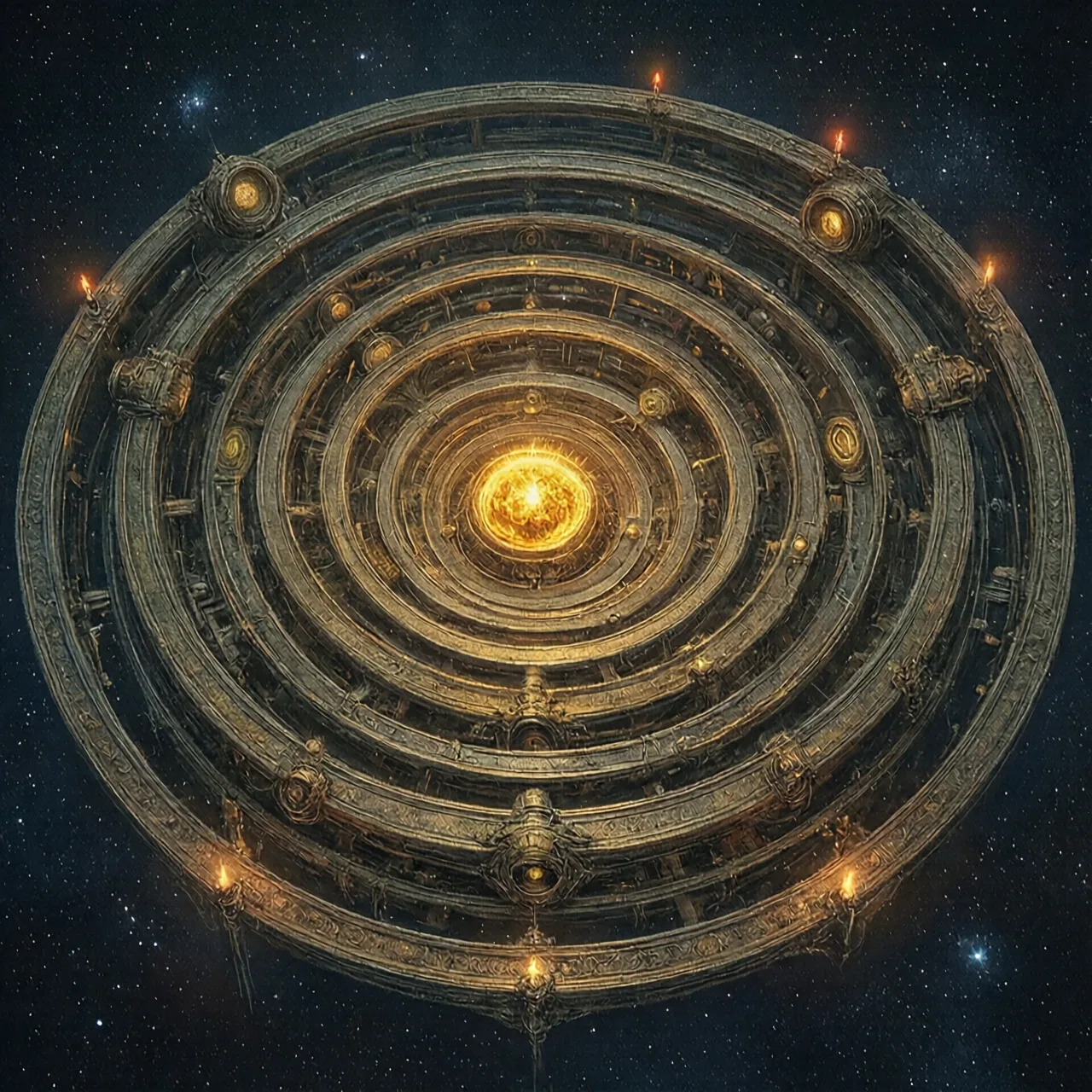
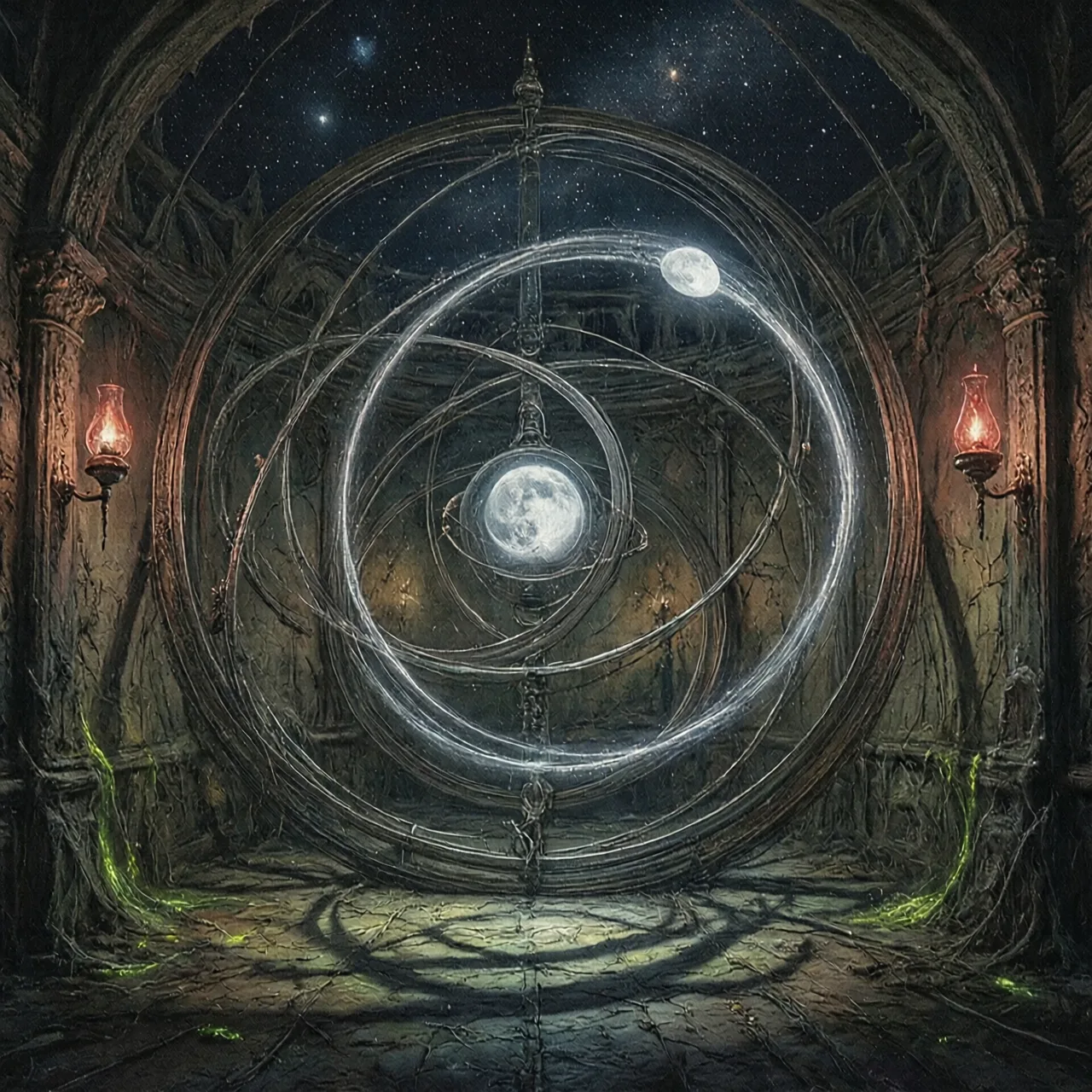
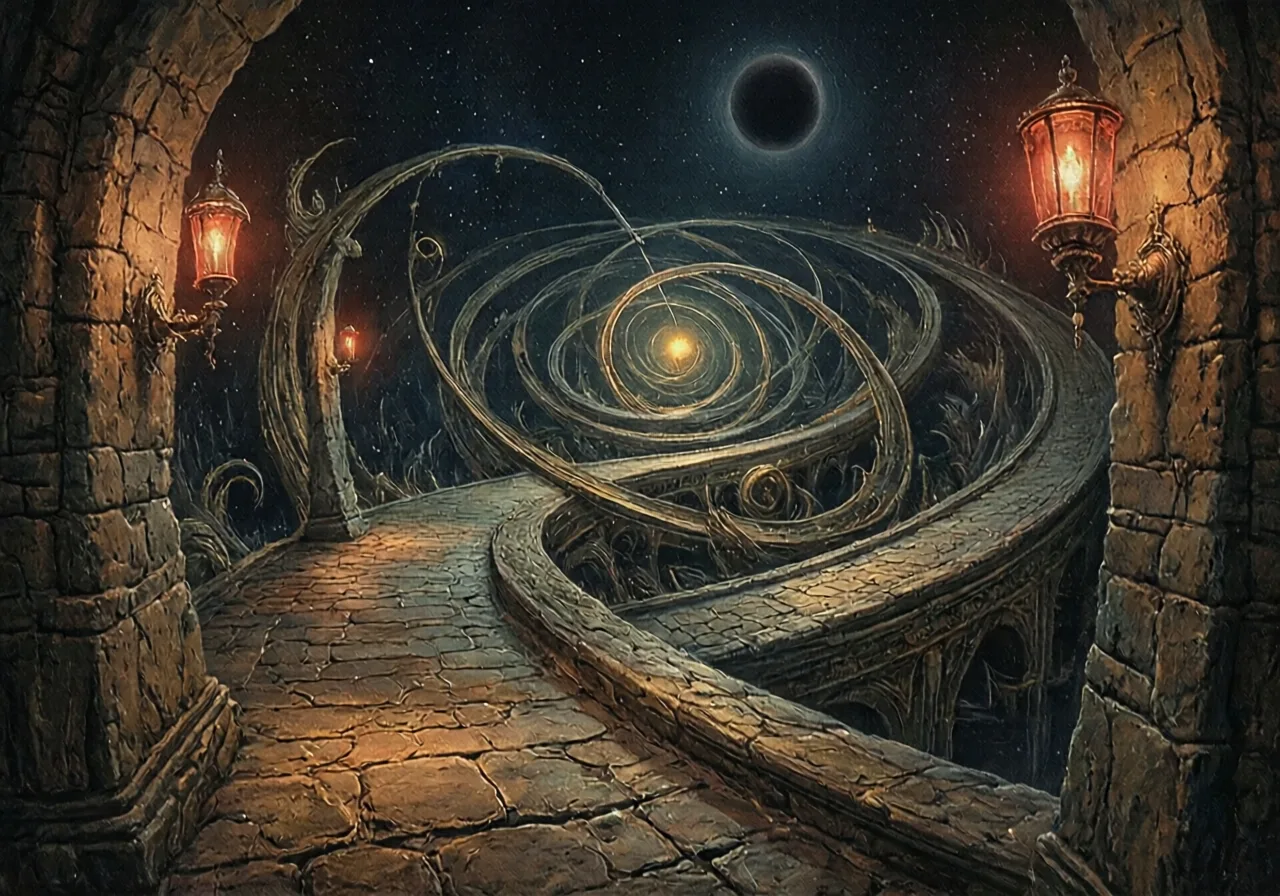
The Founders built a model of a solar system the size of a city and placed it at the top of the Laboratory. Six orbital rings, concentric, centered on a chamber of fire, connected by two spiral arms that curve outward from the center in the shape the Librarian recognizes from the shells of certain creatures found in the void. A curve that widens by a fixed proportion with each turn. The Founders did not build an instrument to observe the heavens. They built the heavens, and they built them large enough to live in.
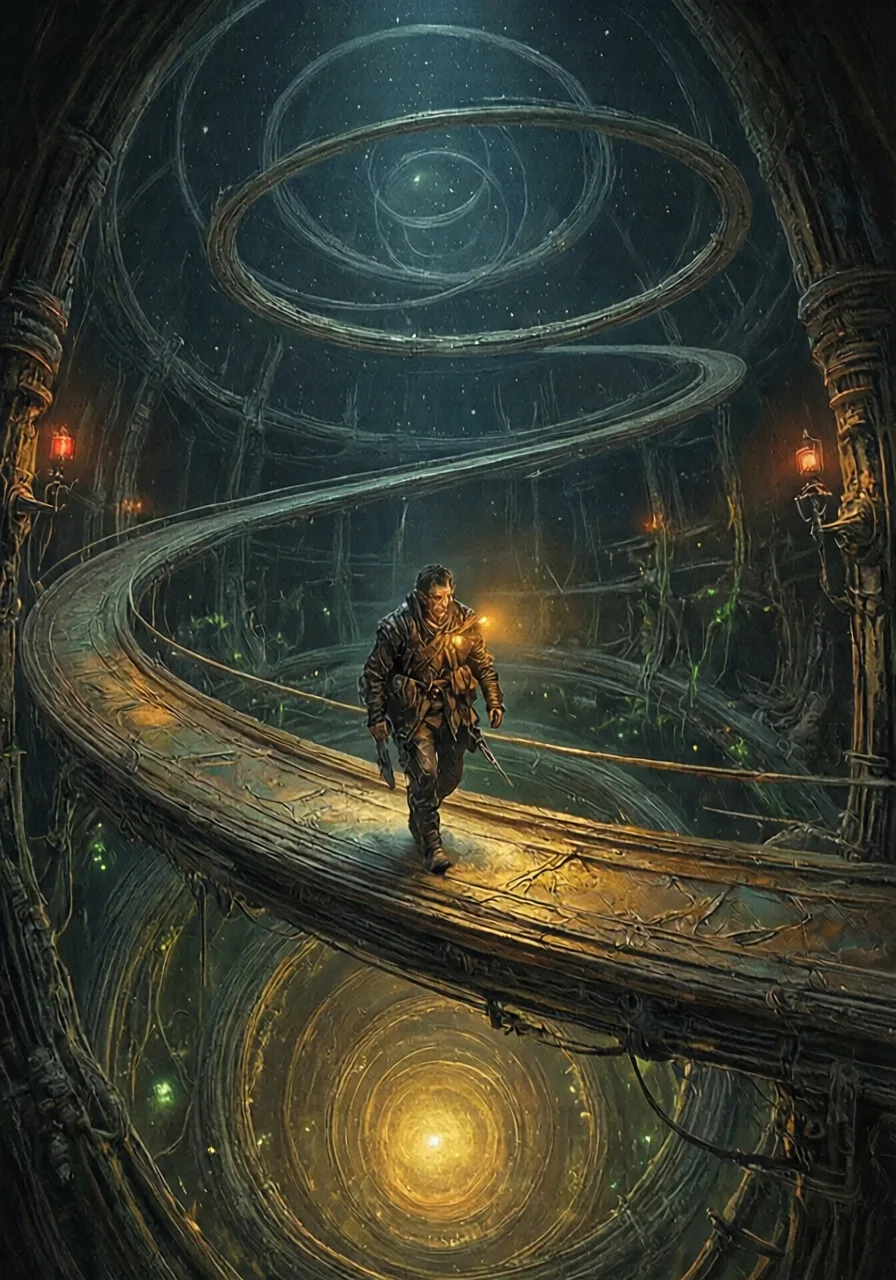
The rings are walkable. The arms are walkable. The planet chambers are rooms, fitted into the orbits where the arms and rings cross — round rooms, sized to the orbit they occupy, growing larger as you move outward from the center. The innermost is small enough to cross in ten strides. The outermost takes a full minute at a walk.
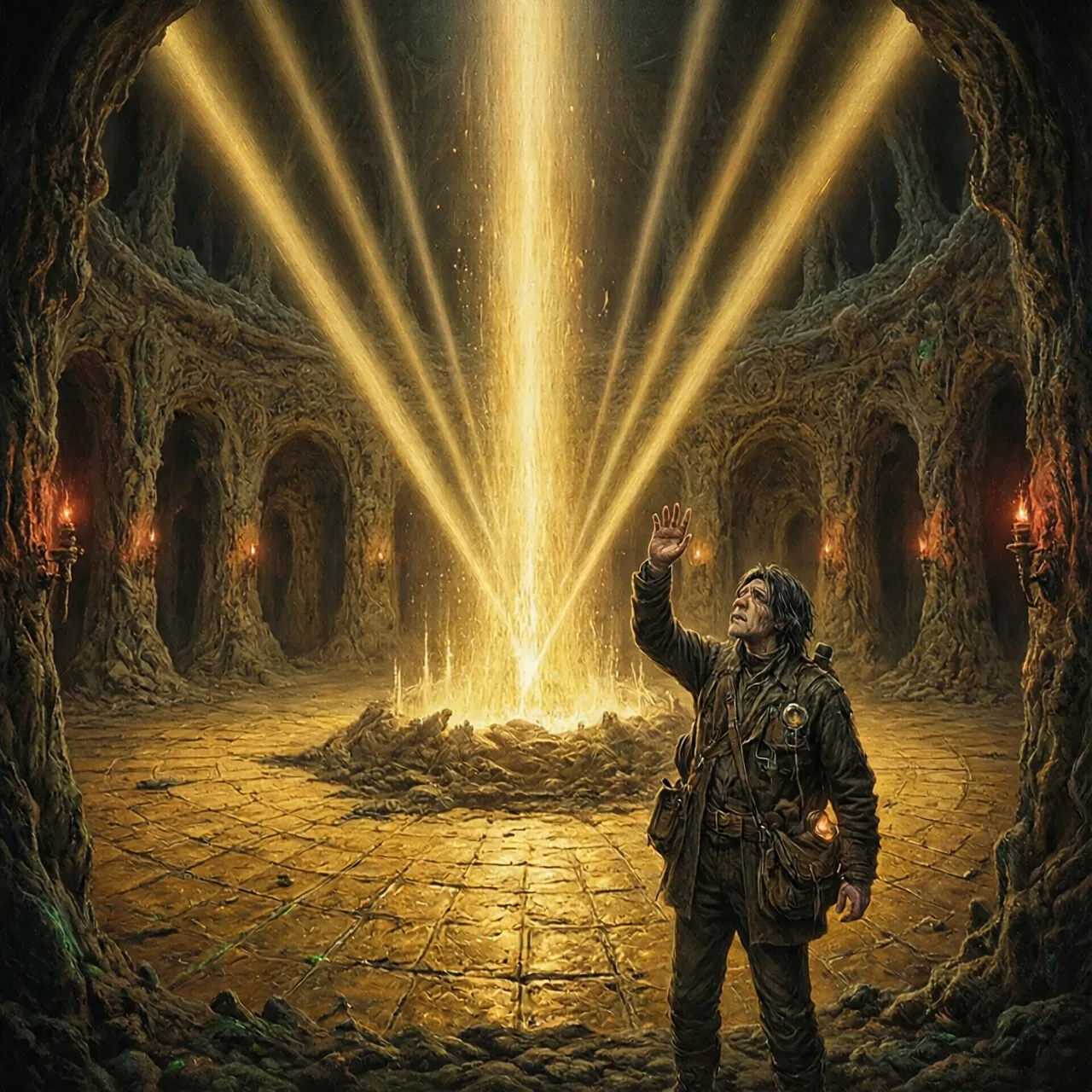
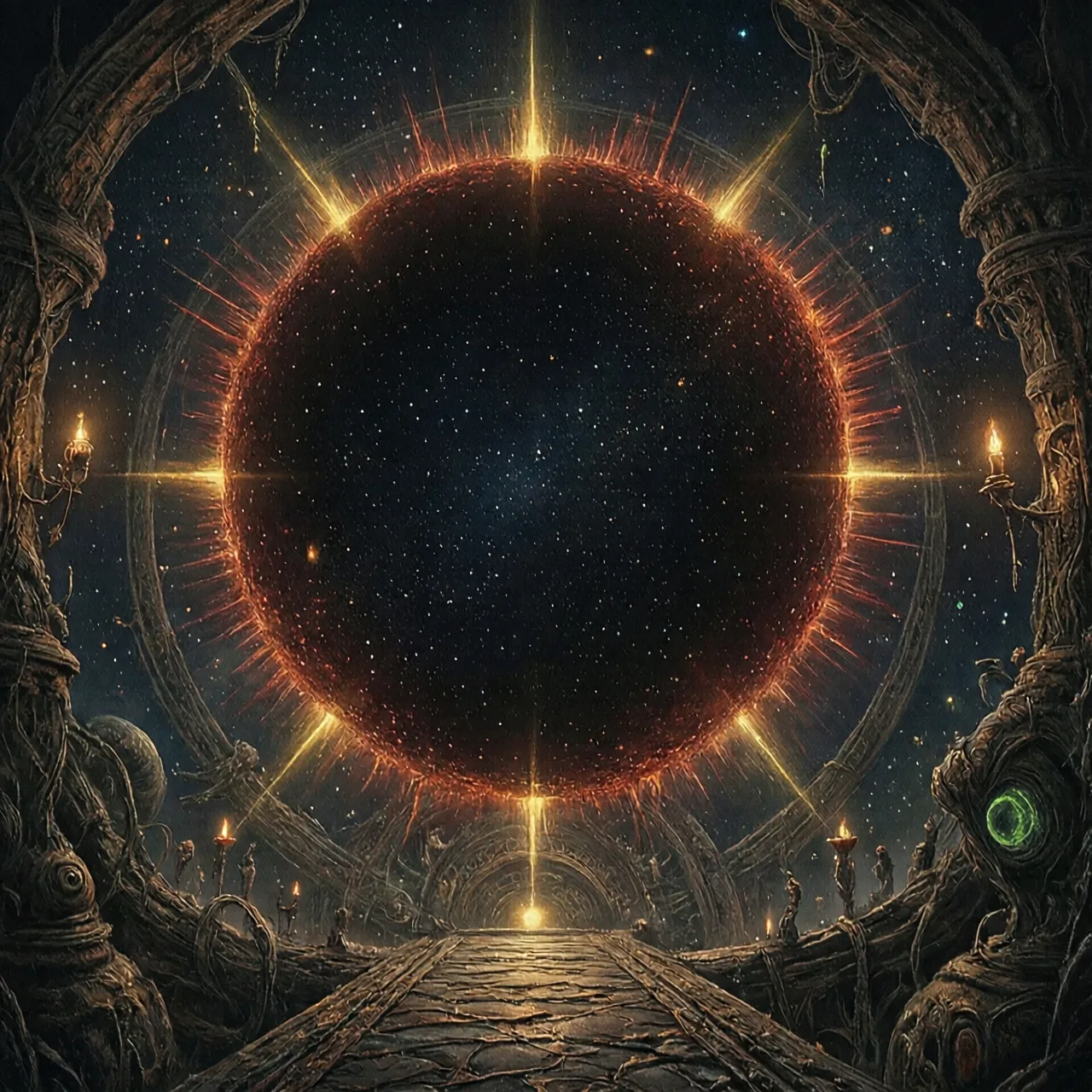
The sun is at the center. A chamber thirty-two paces across, blazing gold from a core so bright the third traveler said she could not look at it directly. Eight rays extend outward from the core — wide bands of light that cut across the orbital rings and the spiral arms and the dark between them, casting the entire structure in alternating wedges of gold and shadow. The fifth traveler stood in the sun chamber for what he estimated was an hour. The gold was not flame. It was warm the way a living thing is warm — steady, sustained by something he could not see.
Page 2
Three bodies move.
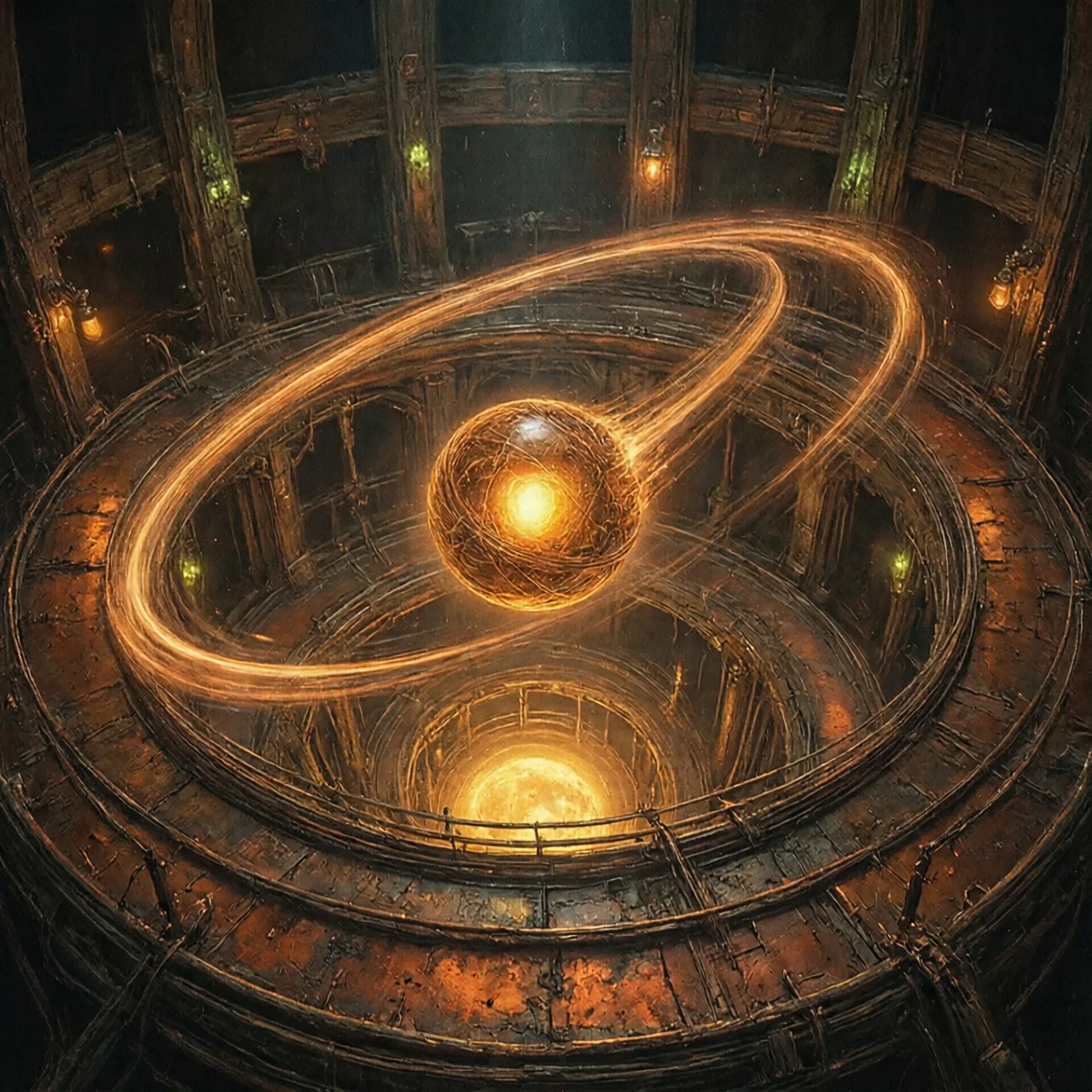
The things in the sky move. Three bodies. She is certain of three. One burns amber and races along the inner orbits faster than a person can walk, circling tightly near the sun, trailing heat. The fourth traveler said it passed over her twice in a single hour, close enough that its light turned the floor the color of molten copper. She held up her hand and the amber light pooled in her palm and was warm. It is the smallest of the three and the fastest — a bright coal on a short leash, never straying far from the fire that feeds it.
One is silver. It follows a figure eight — a lemniscate, looping through itself, crossing its own course twice per cycle. It has phases. It brightens and dims on a cycle the sixth traveler measured at fifty-six intervals. Its path carries it wide across the Orrery, threading between the orbital rings, and where its light falls the shadows are double-edged — one cast by the sun, one by the silver body, pulling in different directions.
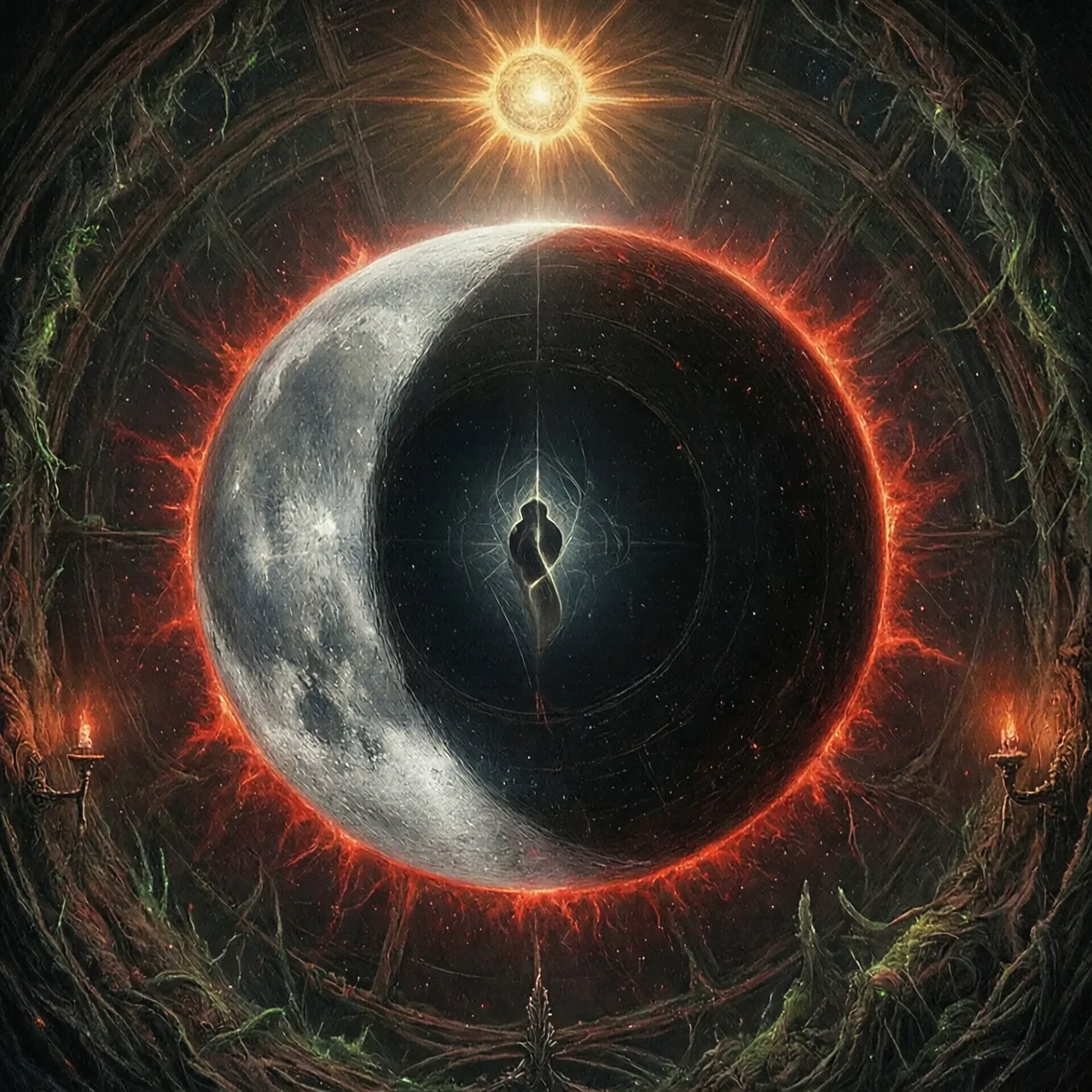
And then there is the dark one. They agree on what it looks like. A circle of void — true void, the same emptiness that fills the spaces between the shattered world, the cold stars visible through a hole in the sky no larger than a fist held at arm's length. It orbits the sun chamber on a slow counter-clockwise course. Where the amber trails warmth and the silver casts double shadows, this one casts nothing. Its edges burn red — a corona, the third traveler called it, a ring of deep crimson around a center of nothing. The floor beneath it goes dark. The tiles lose their inscriptions. The sun's warmth does not reach where it passes. The rays, which extend across the full breadth of the Orrery, stop at its edges as though cut.
Page 3
Where the shadow falls, the floor opens.
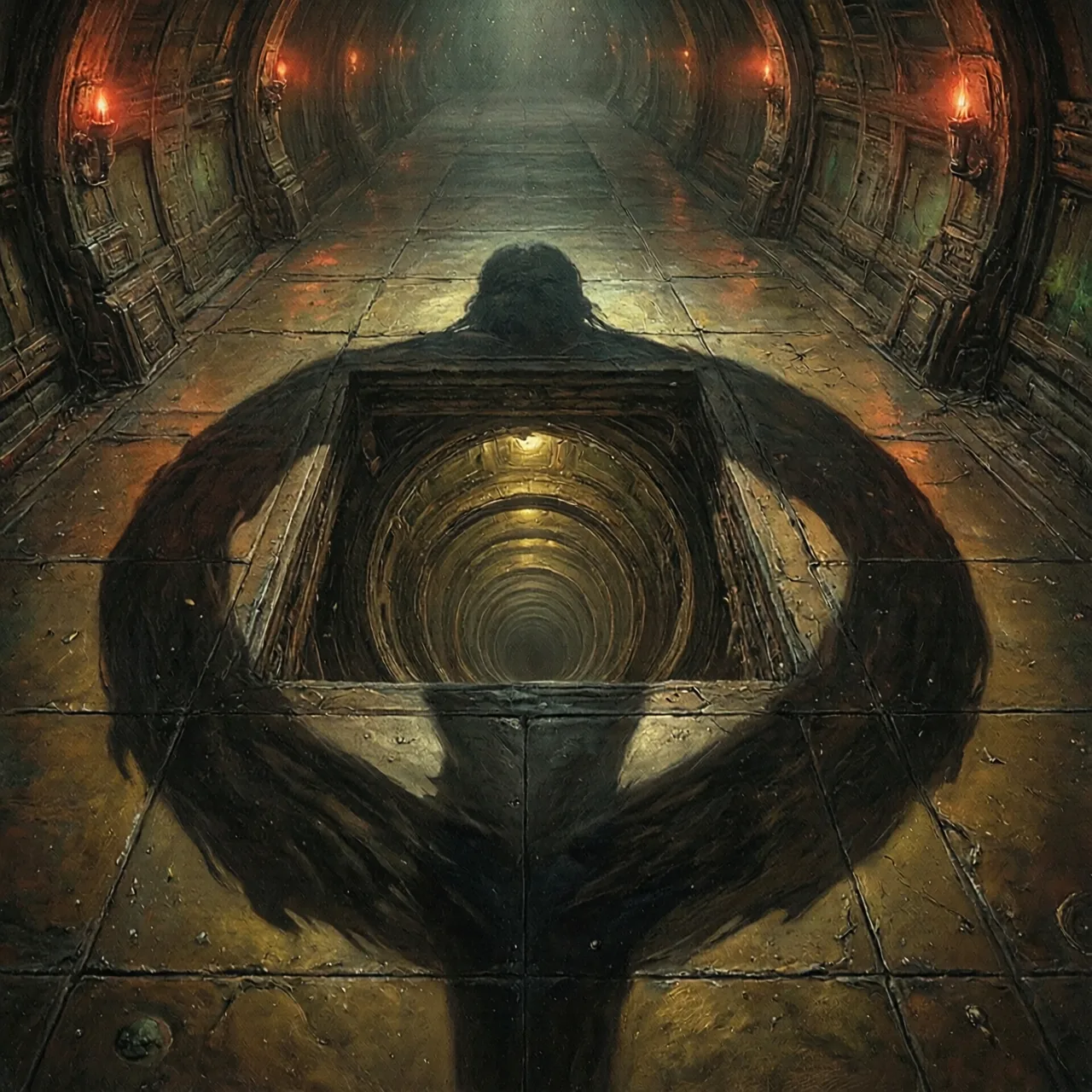
The ninth traveler followed it for a full orbit. She said the silence beneath it was different from the silence elsewhere. The Orrery is quiet — the bodies make no sound, the rings do not hum, the arms do not vibrate. But the quiet beneath the dark body was the silence the Librarian described in entry 1,744. Occupied. Listening. She found something beneath it. Where the dark body's shadow fell on one of the outer rings, the floor opened. The tiles simply were not there, and below them a corridor led downward.
She could see light at the far end — not the gold of the sun, not the amber, not the silver. Something else. A light from a lower level.
The corridor was there only while the shadow covered it. As the body moved on, the tiles returned. The floor was solid, jointless, as though it had never opened. The Librarian notes that the dark body's orbit takes it over different parts of the Orrery at different times. The passage it reveals would lead to a different place depending on when you step through. She has not calculated the full cycle. She suspects the Founders did.
Page 4
The eclipse, the wreckage, the outermost ring.
On the fourth day the silver body and the dark body converged. They met above the sun chamber. The silver body passed in front of the dark one. Its light entered the void at the center of the corona and the void took it and for a moment — he was specific about this, less than a breath — the dark body was not dark. The silver light illuminated the void from within. He saw something inside it. He could not say what. Structure. Geometry. A shape that the void contained or was made of, lit for the duration of a heartbeat by the silver body's passing.
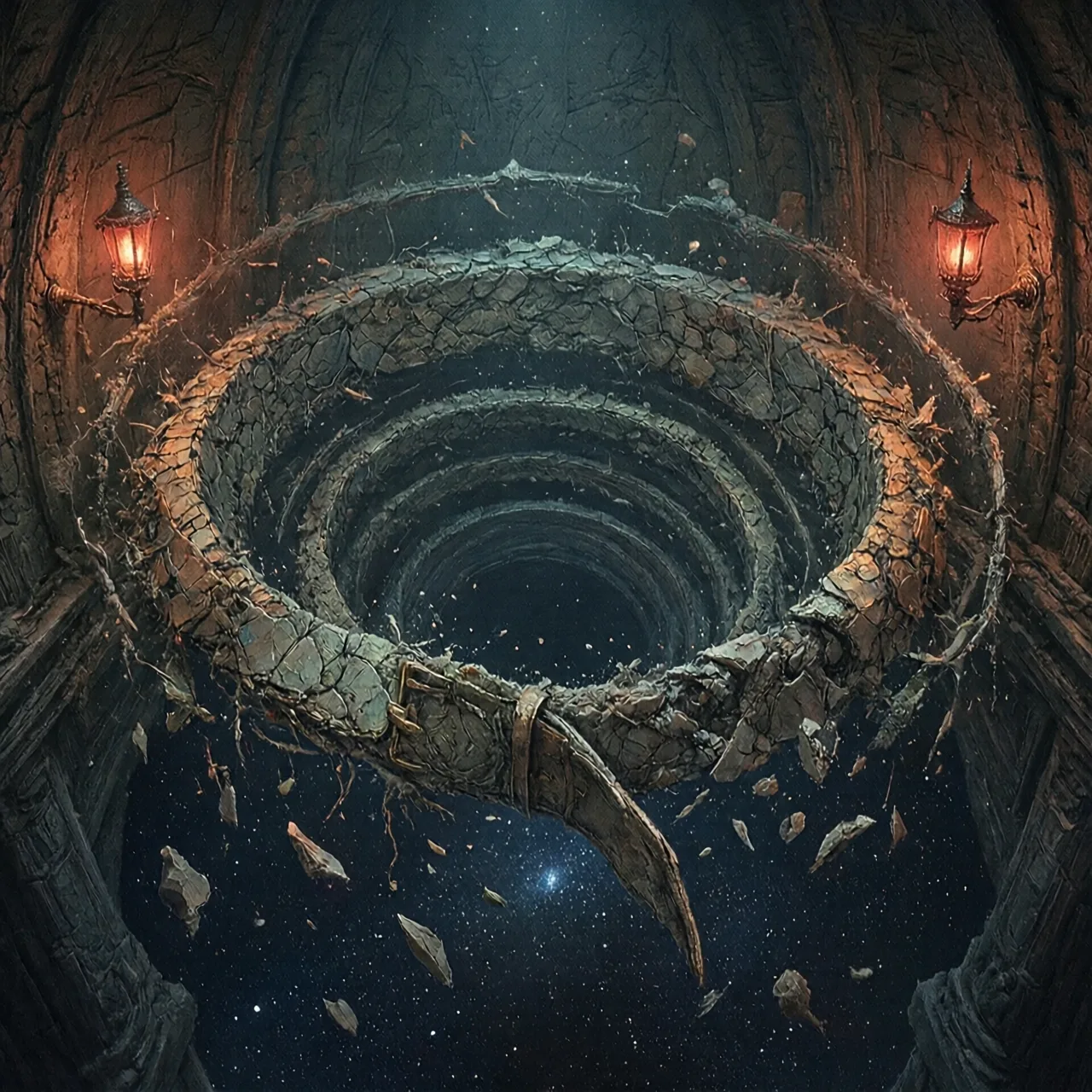
Between the fifth and sixth orbits, there is no ring. There is instead a belt of broken stone — shattered tiles, fractured segments of what was once a continuous path, arranged in a band that circles the structure. The second traveler called it wreckage. He said it looked like something had struck the ring from below and shattered it. The eighth traveler called it a boundary. She said the debris was placed, not scattered — each piece oriented the same way, the pattern regular enough to follow. She said the ring had been taken apart carefully and set down in order, the way a watchmaker lays out the pieces of a mechanism he does not intend to reassemble. The ring was not broken. It was finished.
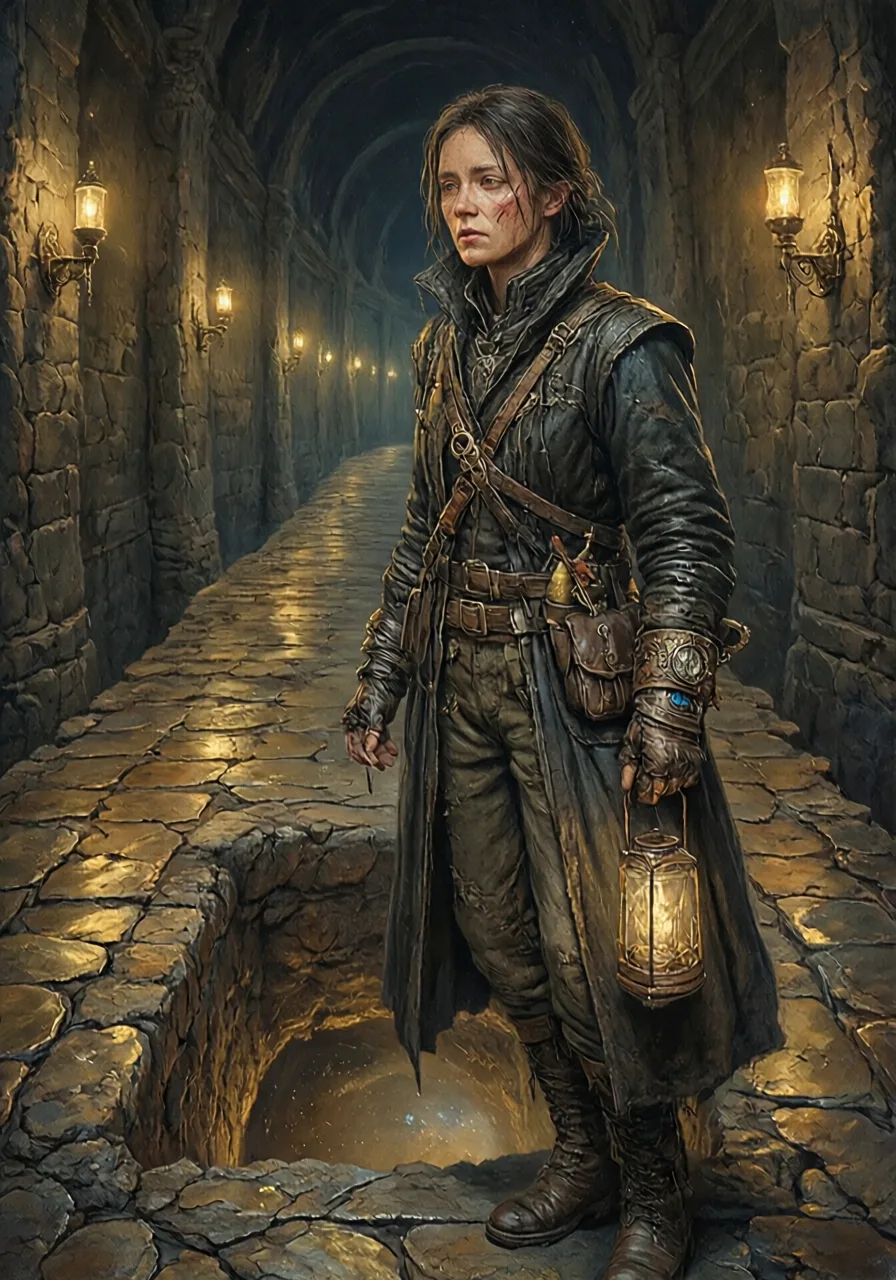
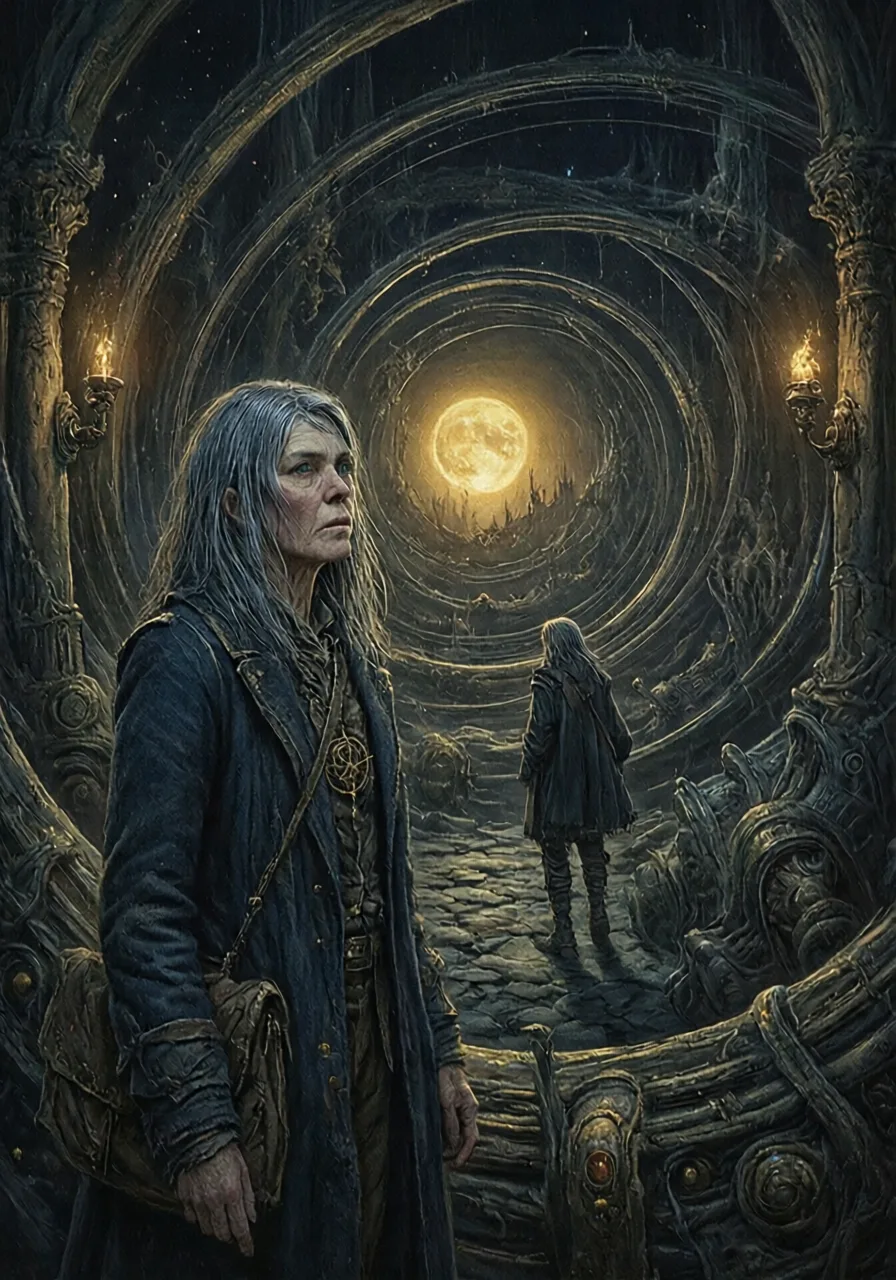
Two of the eleven came back. They arrived separately, weeks apart. Both had aged in ways the Librarian could not account for — worn smooth, as though something had been running over them for a long time. The second came three weeks later. She sat with the Librarian for two days and described everything — the arms, the rings, the planet chambers, the belt, the bodies, the eclipse, the sun. She described standing on the outermost ring and looking inward and seeing the whole model from edge to centre.
Page 5
Two of the eleven came back.
She told the Librarian she wept. She said this plainly. Everything else in the Laboratory was broken — fractured levels, shattered corridors, sealed doors, the void eating through the walls. The Orrery was whole. The orbits held. The bodies moved. The sun burned. The model worked.
The LibrarianWhy did you come back?
The Returning TravelerSomeone should know it still works.
She left the following day. She took nothing. The Librarian watched her walk into the void from the outer ring. She did not look back.
I have not visited the Orrery. I will not visit the Orrery. I am afraid that if I go, I will see what they saw. And I am afraid that if I see it I will understand why nine of them did not come back. The Orrery is still turning. The sun is still burning. The dark is still opening passages and closing them and opening them again on its slow circuit, keeping an appointment with every floor it passes over. Somewhere in the sun chamber the figure is still waiting. I do not know what it waits for. I do not want to find out that it waits for me.
— / —
narration auto-scrolls the prose
Section 0Frontmatter
# The Grand Orrery
From the Catalogue of the Sixteenth Archivist, entry 312. Provenance: eleven traveler accounts collected over years she has not counted. She has not visited the Orrery. Of the eleven who told her what they saw, two returned. The other nine she catalogued from single conversations — each traveler described the Orrery, answered her questions, and left the archive. She does not know where they went. She suspects they do.
It is not an observatory. The Librarian corrected herself on this point after the third account. An observatory is a place built to watch the sky. The Orrery is the sky.
Section 1Section 1
The Founders built a model of a solar system the size of a city and placed it at the top of the Laboratory. Six orbital rings, concentric, centered on a chamber of fire, connected by two spiral arms that curve outward from the center in the shape the Librarian recognizes from the shells of certain creatures found in the void. A curve that widens by a fixed proportion with each turn.
The rings are walkable. The arms are walkable. The planet chambers are rooms, fitted into the orbits where the arms and rings cross — round rooms, sized to the orbit they occupy, growing larger as you move outward from the center. The innermost is small enough to cross in ten strides. The outermost takes a full minute at a walk. The Founders did not build an instrument to observe the heavens. They built the heavens, and they built them large enough to live in.
Section 2Section 2
The sun is at the center.
Every traveler describes it first. A chamber thirty-two paces across, blazing gold from a core so bright the third traveler said she could not look at it directly. Eight rays extend outward from the core — wide bands of light that cut across the orbital rings and the spiral arms and the dark between them, casting the entire structure in alternating wedges of gold and shadow. The rays dim with distance but they do not end. The outermost travelers reported seeing them, faintly, still reaching.
The fifth traveler stood in the sun chamber for what he estimated was an hour. The gold was not flame. It was not hot. It was warm the way a living thing is warm — steady, sustained by something he could not see. The light came from the floor, from the core itself, from tiles that burned without burning. He said the warmth entered through the soles of his feet and settled in his chest. The sun held him.
He left the chamber. The warmth left his chest at the second orbital ring.
Section 3Section 3
The things in the sky move.
This is the fact that separates the Orrery from every other place in the Laboratory. The rings are fixed. The arms are fixed. The planet chambers sit in their orbits and do not move. But above them, through them, among them, things move — celestial bodies, the travelers call them, though no two use the same names. The Librarian has stopped reconciling and catalogues what she can confirm.
Three bodies. She is certain of three.
One burns amber and races along the inner orbits faster than a person can walk, circling tightly near the sun, trailing heat. The fourth traveler said it passed over her twice in a single hour, close enough that its light turned the floor the color of molten copper. She held up her hand and the amber light pooled in her palm and was warm. It is the smallest of the three and the fastest — a bright coal on a short leash, never straying far from the fire that feeds it.
One is silver. It follows a figure eight — a lemniscate, looping through itself, crossing its own course twice per cycle. It has phases. It brightens and dims on a cycle the sixth traveler measured at fifty-six intervals. Its path carries it wide across the Orrery, threading between the orbital rings, and where its light falls the shadows are double-edged — one cast by the sun, one by the silver body, pulling in different directions.
And then there is the dark one.
Section 4Section 4
The travelers do not agree on what the dark one is.
They agree on what it looks like. A circle of void — true void, the same emptiness that fills the spaces between the shattered world, the cold stars visible through a hole in the sky no larger than a fist held at arm's length. It orbits the sun chamber on a slow counter-clockwise course. Where the amber trails warmth and the silver casts double shadows, this one casts nothing. Its edges burn red — a corona, the third traveler called it, a ring of deep crimson around a center of nothing.
The floor beneath it goes dark. The tiles lose their inscriptions. The sun's warmth does not reach where it passes. The rays, which extend across the full breadth of the Orrery, stop at its edges as though cut.
The ninth traveler followed it for a full orbit. She said the silence beneath it was different from the silence elsewhere. The Orrery is quiet — the bodies make no sound, the rings do not hum, the arms do not vibrate. But the quiet beneath the dark body was the silence the Librarian described in entry 1,744. Occupied. Listening.
She found something beneath it. Where the dark body's shadow fell on one of the outer rings, the floor opened. The tiles simply were not there, and below them a corridor led downward. She could see light at the far end — not the gold of the sun, not the amber, not the silver. Something else. A light from a lower level.
The corridor was there only while the shadow covered it. As the body moved on, the tiles returned. The floor was solid, jointless, as though it had never opened.
The Librarian notes that the dark body's orbit takes it over different parts of the Orrery at different times. The passage it reveals would lead to a different place depending on when you step through. She has not calculated the full cycle. She suspects the Founders did.
Section 5Section 5
Between the fifth and sixth orbits, there is no ring.
There is instead a belt of broken stone — shattered tiles, fractured segments of what was once a continuous path, arranged in a band that circles the structure. Some sections are intact, walkable for twenty or thirty paces before the floor drops away into void. Some are missing entirely.
The second traveler called it wreckage. He said it looked like something had struck the ring from below and shattered it — the broken edges, the fragments hanging in the void at angles that suggested they had been thrown and had not yet finished falling. He picked up a piece of tile. It was warm on one side and cold on the other. He set it down.
The eighth traveler called it a boundary. She said the debris was placed, not scattered — each piece oriented the same way, the pattern regular enough to follow. She said the ring had been taken apart carefully and set down in order, the way a watchmaker lays out the pieces of a mechanism he does not intend to reassemble. The ring was not broken. It was finished.
Beyond the belt, the outermost orbit is whole. The planet chamber there is the largest in the Orrery — a wide room with high walls, thick with inscriptions, colder than the inner orbits. The amber body does not reach this far. The sun's rays arrive diminished. The light is blue and thin. The eighth traveler stayed there for a night. She did not describe what she felt. She left in the morning and walked inward without stopping until she reached the warmth of the second ring.
Section 6Section 6
The first traveler told the Librarian about the eclipse.
He had been in the Orrery for several days — sleeping in a planet chamber on the third ring, eating from his pack, mapping the arms and orbits in a log he later gave the Librarian. He had watched the bodies move and had come to anticipate their courses. The amber one was fast and regular. The silver one looped through its figure eight on a rhythm he could feel in his chest. The dark one was slow.
On the fourth day the silver body and the dark body converged.
He was standing on the eastern spiral arm, between the second and third rings, when the silver body's lemniscate brought it across the dark body's orbit. The two approached from opposite directions — the silver waxing, nearly full, bright enough to cast its own shadows, and the dark one moving against it with its corona of red.
They met above the sun chamber.
The silver body passed in front of the dark one. Its light entered the void at the center of the corona and the void took it and for a moment — he was specific about this, less than a breath — the dark body was not dark. The silver light illuminated the void from within. He saw something inside it. He could not say what. Structure. Geometry. A shape that the void contained or was made of, lit for the duration of a heartbeat by the silver body's passing.
Then the silver body moved on and the dark one was dark again and the shadow fell across the sun chamber and the rays went out for the first time since anyone had entered the Orrery.
He said the entire structure stopped. The bodies still moved — dim shapes against a dimmer sky — but everything else was still. Then the silver body cleared the dark one's path and the sun returned and the rays cut across the rings again and the warmth came back into the floor and it was over.
He described the shape he had seen inside the dark body. He used his hands. He could not find it. The Librarian notes that he gestured for several minutes without speaking and then stopped and put his hands down and said he was sorry and she said there was nothing to be sorry for.
He left the archive that evening.
Entry 312 (continued). The Librarian's interpolation.
"Nine of the eleven who told me what they saw left the archive and did not come back. I do not believe the Orrery kept them. I believe it oriented them. They walked among the orbits and understood something about the shape of things — where the levels sit in relation to each other, how the dark body opens passages between them, what the model means — and the understanding gave them somewhere to go.
The Orrery does not trap. It does not lure. It shows you where everything is, and then it lets you walk."
Section 8Section 8
Two of the eleven came back.
They arrived separately, weeks apart. Both had aged in ways the Librarian could not account for — worn smooth, as though something had been running over them for a long time.
The first sat with her for an afternoon. He answered her questions carefully, in the manner of someone translating from a language that did not map cleanly onto the one he was speaking. He described the rings. He described the arms. He described the bodies and their light and the eclipse. He did not describe the sun chamber.
The Librarian asked what he had seen there. He was quiet for a long time. He said it was the most beautiful place he had ever been. He said he could not say more than that.
He left the archive the next morning.
The second came three weeks later. She sat with the Librarian for two days and described everything — the arms, the rings, the planet chambers, the belt, the bodies, the eclipse, the sun. She described standing on the outermost ring and looking inward and seeing the whole model from edge to center, the orbits nested inside each other, the spiral arms sweeping between them, the bodies moving in their separate courses, and the sun at the middle of it all.
She told the Librarian she wept. She said this plainly. Everything else in the Laboratory was broken — fractured levels, shattered corridors, sealed doors, the void eating through the walls. The Orrery was whole. The orbits held. The bodies moved. The sun burned. The model worked.
The Librarian asked why she had come back.
She said: "Someone should know it still works."
She left the following day. She took nothing. The Librarian watched her walk into the void from the outer ring. She did not look back.
Entry 312, final annotation.
"I have not visited the Orrery. I will not visit the Orrery.
I am afraid that if I go, I will see what they saw. And I am afraid that if I see it I will understand why nine of them did not come back.
The Orrery is still turning. The sun is still burning. The dark is still opening passages and closing them and opening them again on its slow circuit, keeping an appointment with every floor it passes over.
Someone should know it still works. The second traveler said this when she left, and I have catalogued the line beside the model's measured properties. It is the only line of testimony I have catalogued without comment."
Section 0Frontmatter
# The Grand Orrery
From the Catalogue of the Sixteenth Archivist, entry 312. Provenance: eleven traveler accounts collected over years she has not counted. She has not visited the Orrery. Of the eleven who told her what they saw, two returned. The other nine she catalogued from single conversations — each traveler described the Orrery, answered her questions, and left the archive. She does not know where they went. She suspects they do.
It is not an observatory. The Librarian corrected herself on this point after the third account. An observatory is a place built to watch the sky. The Orrery is the sky.
Section 1Section 1
The Founders built a model of a solar system the size of a city and placed it at the top of the Laboratory. Six orbital rings, concentric, centered on a chamber of fire, connected by two spiral arms that curve outward from the center in the shape the Librarian recognizes from the shells of certain creatures found in the void. A curve that widens by a fixed proportion with each turn.
The rings are walkable. The arms are walkable. The planet chambers are rooms, fitted into the orbits where the arms and rings cross — round rooms, sized to the orbit they occupy, growing larger as you move outward from the center. The innermost is small enough to cross in ten strides. The outermost takes a full minute at a walk. The Founders did not build an instrument to observe the heavens. They built the heavens, and they built them large enough to live in.
Section 2Section 2
The sun is at the center.
Every traveler describes it first. A chamber thirty-two paces across, blazing gold from a core so bright the third traveler said she could not look at it directly. Eight rays extend outward from the core — wide bands of light that cut across the orbital rings and the spiral arms and the dark between them, casting the entire structure in alternating wedges of gold and shadow. The rays dim with distance but they do not end. The outermost travelers reported seeing them, faintly, still reaching.
The fifth traveler stood in the sun chamber for what he estimated was an hour. The gold was not flame. It was not hot. It was warm the way a living thing is warm — steady, sustained by something he could not see. The light came from the floor, from the core itself, from tiles that burned without burning. He said the warmth entered through the soles of his feet and settled in his chest. The sun held him.
He left the chamber. The warmth left his chest at the second orbital ring.
Section 3Section 3
The things in the sky move.
This is the fact that separates the Orrery from every other place in the Laboratory. The rings are fixed. The arms are fixed. The planet chambers sit in their orbits and do not move. But above them, through them, among them, things move — celestial bodies, the travelers call them, though no two use the same names. The Librarian has stopped reconciling and catalogues what she can confirm.
Three bodies. She is certain of three.
One burns amber and races along the inner orbits faster than a person can walk, circling tightly near the sun, trailing heat. The fourth traveler said it passed over her twice in a single hour, close enough that its light turned the floor the color of molten copper. She held up her hand and the amber light pooled in her palm and was warm. It is the smallest of the three and the fastest — a bright coal on a short leash, never straying far from the fire that feeds it.
One is silver. It follows a figure eight — a lemniscate, looping through itself, crossing its own course twice per cycle. It has phases. It brightens and dims on a cycle the sixth traveler measured at fifty-six intervals. Its path carries it wide across the Orrery, threading between the orbital rings, and where its light falls the shadows are double-edged — one cast by the sun, one by the silver body, pulling in different directions.
And then there is the dark one.
Section 4Section 4
The travelers do not agree on what the dark one is.
They agree on what it looks like. A circle of void — true void, the same emptiness that fills the spaces between the shattered world, the cold stars visible through a hole in the sky no larger than a fist held at arm's length. It orbits the sun chamber on a slow counter-clockwise course. Where the amber trails warmth and the silver casts double shadows, this one casts nothing. Its edges burn red — a corona, the third traveler called it, a ring of deep crimson around a center of nothing.
The floor beneath it goes dark. The tiles lose their inscriptions. The sun's warmth does not reach where it passes. The rays, which extend across the full breadth of the Orrery, stop at its edges as though cut.
The ninth traveler followed it for a full orbit. She said the silence beneath it was different from the silence elsewhere. The Orrery is quiet — the bodies make no sound, the rings do not hum, the arms do not vibrate. But the quiet beneath the dark body was the silence the Librarian described in entry 1,744. Occupied. Listening.
She found something beneath it. Where the dark body's shadow fell on one of the outer rings, the floor opened. The tiles simply were not there, and below them a corridor led downward. She could see light at the far end — not the gold of the sun, not the amber, not the silver. Something else. A light from a lower level.
The corridor was there only while the shadow covered it. As the body moved on, the tiles returned. The floor was solid, jointless, as though it had never opened.
The Librarian notes that the dark body's orbit takes it over different parts of the Orrery at different times. The passage it reveals would lead to a different place depending on when you step through. She has not calculated the full cycle. She suspects the Founders did.
Section 5Section 5
Between the fifth and sixth orbits, there is no ring.
There is instead a belt of broken stone — shattered tiles, fractured segments of what was once a continuous path, arranged in a band that circles the structure. Some sections are intact, walkable for twenty or thirty paces before the floor drops away into void. Some are missing entirely.
The second traveler called it wreckage. He said it looked like something had struck the ring from below and shattered it — the broken edges, the fragments hanging in the void at angles that suggested they had been thrown and had not yet finished falling. He picked up a piece of tile. It was warm on one side and cold on the other. He set it down.
The eighth traveler called it a boundary. She said the debris was placed, not scattered — each piece oriented the same way, the pattern regular enough to follow. She said the ring had been taken apart carefully and set down in order, the way a watchmaker lays out the pieces of a mechanism he does not intend to reassemble. The ring was not broken. It was finished.
Beyond the belt, the outermost orbit is whole. The planet chamber there is the largest in the Orrery — a wide room with high walls, thick with inscriptions, colder than the inner orbits. The amber body does not reach this far. The sun's rays arrive diminished. The light is blue and thin. The eighth traveler stayed there for a night. She did not describe what she felt. She left in the morning and walked inward without stopping until she reached the warmth of the second ring.
Section 6Section 6
The first traveler told the Librarian about the eclipse.
He had been in the Orrery for several days — sleeping in a planet chamber on the third ring, eating from his pack, mapping the arms and orbits in a log he later gave the Librarian. He had watched the bodies move and had come to anticipate their courses. The amber one was fast and regular. The silver one looped through its figure eight on a rhythm he could feel in his chest. The dark one was slow.
On the fourth day the silver body and the dark body converged.
He was standing on the eastern spiral arm, between the second and third rings, when the silver body's lemniscate brought it across the dark body's orbit. The two approached from opposite directions — the silver waxing, nearly full, bright enough to cast its own shadows, and the dark one moving against it with its corona of red.
They met above the sun chamber.
The silver body passed in front of the dark one. Its light entered the void at the center of the corona and the void took it and for a moment — he was specific about this, less than a breath — the dark body was not dark. The silver light illuminated the void from within. He saw something inside it. He could not say what. Structure. Geometry. A shape that the void contained or was made of, lit for the duration of a heartbeat by the silver body's passing.
Then the silver body moved on and the dark one was dark again and the shadow fell across the sun chamber and the rays went out for the first time since anyone had entered the Orrery.
He said the entire structure stopped. The bodies still moved — dim shapes against a dimmer sky — but everything else was still. Then the silver body cleared the dark one's path and the sun returned and the rays cut across the rings again and the warmth came back into the floor and it was over.
He described the shape he had seen inside the dark body. He used his hands. He could not find it. The Librarian notes that he gestured for several minutes without speaking and then stopped and put his hands down and said he was sorry and she said there was nothing to be sorry for.
He left the archive that evening.
Entry 312 (continued). The Librarian's interpolation.
"Nine of the eleven who told me what they saw left the archive and did not come back. I do not believe the Orrery kept them. I believe it oriented them. They walked among the orbits and understood something about the shape of things — where the levels sit in relation to each other, how the dark body opens passages between them, what the model means — and the understanding gave them somewhere to go.
The Orrery does not trap. It does not lure. It shows you where everything is, and then it lets you walk."
Section 8Section 8
Two of the eleven came back.
They arrived separately, weeks apart. Both had aged in ways the Librarian could not account for — worn smooth, as though something had been running over them for a long time.
The first sat with her for an afternoon. He answered her questions carefully, in the manner of someone translating from a language that did not map cleanly onto the one he was speaking. He described the rings. He described the arms. He described the bodies and their light and the eclipse. He did not describe the sun chamber.
The Librarian asked what he had seen there. He was quiet for a long time. He said it was the most beautiful place he had ever been. He said he could not say more than that.
He left the archive the next morning.
The second came three weeks later. She sat with the Librarian for two days and described everything — the arms, the rings, the planet chambers, the belt, the bodies, the eclipse, the sun. She described standing on the outermost ring and looking inward and seeing the whole model from edge to center, the orbits nested inside each other, the spiral arms sweeping between them, the bodies moving in their separate courses, and the sun at the middle of it all.
She told the Librarian she wept. She said this plainly. Everything else in the Laboratory was broken — fractured levels, shattered corridors, sealed doors, the void eating through the walls. The Orrery was whole. The orbits held. The bodies moved. The sun burned. The model worked.
The Librarian asked why she had come back.
She said: "Someone should know it still works."
She left the following day. She took nothing. The Librarian watched her walk into the void from the outer ring. She did not look back.
Entry 312, final annotation.
"I have not visited the Orrery. I will not visit the Orrery.
I am afraid that if I go, I will see what they saw. And I am afraid that if I see it I will understand why nine of them did not come back.
The Orrery is still turning. The sun is still burning. The dark is still opening passages and closing them and opening them again on its slow circuit, keeping an appointment with every floor it passes over.
Someone should know it still works. The second traveler said this when she left, and I have catalogued the line beside the model's measured properties. It is the only line of testimony I have catalogued without comment."
Page 1
The Founders built the heavens.
The Founders built a model of a solar system the size of a city and placed it at the top of the Laboratory. Six orbital rings, concentric, centered on a chamber of fire, connected by two spiral arms that curve outward from the center in the shape the Librarian recognizes from the shells of certain creatures found in the void. A curve that widens by a fixed proportion with each turn. The Founders did not build an instrument to observe the heavens. They built the heavens, and they built them large enough to live in.
The rings are walkable. The arms are walkable. The planet chambers are rooms, fitted into the orbits where the arms and rings cross — round rooms, sized to the orbit they occupy, growing larger as you move outward from the center. The innermost is small enough to cross in ten strides. The outermost takes a full minute at a walk.
The sun is at the center. A chamber thirty-two paces across, blazing gold from a core so bright the third traveler said she could not look at it directly. Eight rays extend outward from the core — wide bands of light that cut across the orbital rings and the spiral arms and the dark between them, casting the entire structure in alternating wedges of gold and shadow. The fifth traveler stood in the sun chamber for what he estimated was an hour. The gold was not flame. It was warm the way a living thing is warm — steady, sustained by something he could not see.
Page 2
Three bodies move.
The things in the sky move. Three bodies. She is certain of three. One burns amber and races along the inner orbits faster than a person can walk, circling tightly near the sun, trailing heat. The fourth traveler said it passed over her twice in a single hour, close enough that its light turned the floor the color of molten copper. She held up her hand and the amber light pooled in her palm and was warm. It is the smallest of the three and the fastest — a bright coal on a short leash, never straying far from the fire that feeds it.
One is silver. It follows a figure eight — a lemniscate, looping through itself, crossing its own course twice per cycle. It has phases. It brightens and dims on a cycle the sixth traveler measured at fifty-six intervals. Its path carries it wide across the Orrery, threading between the orbital rings, and where its light falls the shadows are double-edged — one cast by the sun, one by the silver body, pulling in different directions.
And then there is the dark one. They agree on what it looks like. A circle of void — true void, the same emptiness that fills the spaces between the shattered world, the cold stars visible through a hole in the sky no larger than a fist held at arm's length. It orbits the sun chamber on a slow counter-clockwise course. Where the amber trails warmth and the silver casts double shadows, this one casts nothing. Its edges burn red — a corona, the third traveler called it, a ring of deep crimson around a center of nothing. The floor beneath it goes dark. The tiles lose their inscriptions. The sun's warmth does not reach where it passes. The rays, which extend across the full breadth of the Orrery, stop at its edges as though cut.
Page 3
Where the shadow falls, the floor opens.
The ninth traveler followed it for a full orbit. She said the silence beneath it was different from the silence elsewhere. The Orrery is quiet — the bodies make no sound, the rings do not hum, the arms do not vibrate. But the quiet beneath the dark body was the silence the Librarian described in entry 1,744. Occupied. Listening. She found something beneath it. Where the dark body's shadow fell on one of the outer rings, the floor opened. The tiles simply were not there, and below them a corridor led downward.
She could see light at the far end — not the gold of the sun, not the amber, not the silver. Something else. A light from a lower level.
The corridor was there only while the shadow covered it. As the body moved on, the tiles returned. The floor was solid, jointless, as though it had never opened. The Librarian notes that the dark body's orbit takes it over different parts of the Orrery at different times. The passage it reveals would lead to a different place depending on when you step through. She has not calculated the full cycle. She suspects the Founders did.
Page 4
The eclipse, the wreckage, the outermost ring.
On the fourth day the silver body and the dark body converged. They met above the sun chamber. The silver body passed in front of the dark one. Its light entered the void at the center of the corona and the void took it and for a moment — he was specific about this, less than a breath — the dark body was not dark. The silver light illuminated the void from within. He saw something inside it. He could not say what. Structure. Geometry. A shape that the void contained or was made of, lit for the duration of a heartbeat by the silver body's passing.
Between the fifth and sixth orbits, there is no ring. There is instead a belt of broken stone — shattered tiles, fractured segments of what was once a continuous path, arranged in a band that circles the structure. The second traveler called it wreckage. He said it looked like something had struck the ring from below and shattered it. The eighth traveler called it a boundary. She said the debris was placed, not scattered — each piece oriented the same way, the pattern regular enough to follow. She said the ring had been taken apart carefully and set down in order, the way a watchmaker lays out the pieces of a mechanism he does not intend to reassemble. The ring was not broken. It was finished.
Two of the eleven came back. They arrived separately, weeks apart. Both had aged in ways the Librarian could not account for — worn smooth, as though something had been running over them for a long time. The second came three weeks later. She sat with the Librarian for two days and described everything — the arms, the rings, the planet chambers, the belt, the bodies, the eclipse, the sun. She described standing on the outermost ring and looking inward and seeing the whole model from edge to centre.
Page 5
Two of the eleven came back.
She told the Librarian she wept. She said this plainly. Everything else in the Laboratory was broken — fractured levels, shattered corridors, sealed doors, the void eating through the walls. The Orrery was whole. The orbits held. The bodies moved. The sun burned. The model worked.
The LibrarianWhy did you come back?
The Returning TravelerSomeone should know it still works.
She left the following day. She took nothing. The Librarian watched her walk into the void from the outer ring. She did not look back.
I have not visited the Orrery. I will not visit the Orrery. I am afraid that if I go, I will see what they saw. And I am afraid that if I see it I will understand why nine of them did not come back. The Orrery is still turning. The sun is still burning. The dark is still opening passages and closing them and opening them again on its slow circuit, keeping an appointment with every floor it passes over. Somewhere in the sun chamber the figure is still waiting. I do not know what it waits for. I do not want to find out that it waits for me.
Listen ModeClick a section to begin listening
The chronicle plays section by section in the Librarian's voice. As each section plays, the corresponding pages of the comic are highlighted. Switch to Scroll, Flip, Prose, or Split at any time — the audio continues, and you can follow visually.
Section 0Frontmatter
# The Grand Orrery
From the Catalogue of the Sixteenth Archivist, entry 312. Provenance: eleven traveler accounts collected over years she has not counted. She has not visited the Orrery. Of the eleven who told her what they saw, two returned. The other nine she catalogued from single conversations — each traveler described the Orrery, answered her questions, and left the archive. She does not know where they went. She suspects they do.
It is not an observatory. The Librarian corrected herself on this point after the third account. An observatory is a place built to watch the sky. The Orrery is the sky.
Section 1Section 1
The Founders built a model of a solar system the size of a city and placed it at the top of the Laboratory. Six orbital rings, concentric, centered on a chamber of fire, connected by two spiral arms that curve outward from the center in the shape the Librarian recognizes from the shells of certain creatures found in the void. A curve that widens by a fixed proportion with each turn.
The rings are walkable. The arms are walkable. The planet chambers are rooms, fitted into the orbits where the arms and rings cross — round rooms, sized to the orbit they occupy, growing larger as you move outward from the center. The innermost is small enough to cross in ten strides. The outermost takes a full minute at a walk. The Founders did not build an instrument to observe the heavens. They built the heavens, and they built them large enough to live in.
Section 2Section 2
The sun is at the center.
Every traveler describes it first. A chamber thirty-two paces across, blazing gold from a core so bright the third traveler said she could not look at it directly. Eight rays extend outward from the core — wide bands of light that cut across the orbital rings and the spiral arms and the dark between them, casting the entire structure in alternating wedges of gold and shadow. The rays dim with distance but they do not end. The outermost travelers reported seeing them, faintly, still reaching.
The fifth traveler stood in the sun chamber for what he estimated was an hour. The gold was not flame. It was not hot. It was warm the way a living thing is warm — steady, sustained by something he could not see. The light came from the floor, from the core itself, from tiles that burned without burning. He said the warmth entered through the soles of his feet and settled in his chest. The sun held him.
He left the chamber. The warmth left his chest at the second orbital ring.
Section 3Section 3
The things in the sky move.
This is the fact that separates the Orrery from every other place in the Laboratory. The rings are fixed. The arms are fixed. The planet chambers sit in their orbits and do not move. But above them, through them, among them, things move — celestial bodies, the travelers call them, though no two use the same names. The Librarian has stopped reconciling and catalogues what she can confirm.
Three bodies. She is certain of three.
One burns amber and races along the inner orbits faster than a person can walk, circling tightly near the sun, trailing heat. The fourth traveler said it passed over her twice in a single hour, close enough that its light turned the floor the color of molten copper. She held up her hand and the amber light pooled in her palm and was warm. It is the smallest of the three and the fastest — a bright coal on a short leash, never straying far from the fire that feeds it.
One is silver. It follows a figure eight — a lemniscate, looping through itself, crossing its own course twice per cycle. It has phases. It brightens and dims on a cycle the sixth traveler measured at fifty-six intervals. Its path carries it wide across the Orrery, threading between the orbital rings, and where its light falls the shadows are double-edged — one cast by the sun, one by the silver body, pulling in different directions.
And then there is the dark one.
Section 4Section 4
The travelers do not agree on what the dark one is.
They agree on what it looks like. A circle of void — true void, the same emptiness that fills the spaces between the shattered world, the cold stars visible through a hole in the sky no larger than a fist held at arm's length. It orbits the sun chamber on a slow counter-clockwise course. Where the amber trails warmth and the silver casts double shadows, this one casts nothing. Its edges burn red — a corona, the third traveler called it, a ring of deep crimson around a center of nothing.
The floor beneath it goes dark. The tiles lose their inscriptions. The sun's warmth does not reach where it passes. The rays, which extend across the full breadth of the Orrery, stop at its edges as though cut.
The ninth traveler followed it for a full orbit. She said the silence beneath it was different from the silence elsewhere. The Orrery is quiet — the bodies make no sound, the rings do not hum, the arms do not vibrate. But the quiet beneath the dark body was the silence the Librarian described in entry 1,744. Occupied. Listening.
She found something beneath it. Where the dark body's shadow fell on one of the outer rings, the floor opened. The tiles simply were not there, and below them a corridor led downward. She could see light at the far end — not the gold of the sun, not the amber, not the silver. Something else. A light from a lower level.
The corridor was there only while the shadow covered it. As the body moved on, the tiles returned. The floor was solid, jointless, as though it had never opened.
The Librarian notes that the dark body's orbit takes it over different parts of the Orrery at different times. The passage it reveals would lead to a different place depending on when you step through. She has not calculated the full cycle. She suspects the Founders did.
Section 5Section 5
Between the fifth and sixth orbits, there is no ring.
There is instead a belt of broken stone — shattered tiles, fractured segments of what was once a continuous path, arranged in a band that circles the structure. Some sections are intact, walkable for twenty or thirty paces before the floor drops away into void. Some are missing entirely.
The second traveler called it wreckage. He said it looked like something had struck the ring from below and shattered it — the broken edges, the fragments hanging in the void at angles that suggested they had been thrown and had not yet finished falling. He picked up a piece of tile. It was warm on one side and cold on the other. He set it down.
The eighth traveler called it a boundary. She said the debris was placed, not scattered — each piece oriented the same way, the pattern regular enough to follow. She said the ring had been taken apart carefully and set down in order, the way a watchmaker lays out the pieces of a mechanism he does not intend to reassemble. The ring was not broken. It was finished.
Beyond the belt, the outermost orbit is whole. The planet chamber there is the largest in the Orrery — a wide room with high walls, thick with inscriptions, colder than the inner orbits. The amber body does not reach this far. The sun's rays arrive diminished. The light is blue and thin. The eighth traveler stayed there for a night. She did not describe what she felt. She left in the morning and walked inward without stopping until she reached the warmth of the second ring.
Section 6Section 6
The first traveler told the Librarian about the eclipse.
He had been in the Orrery for several days — sleeping in a planet chamber on the third ring, eating from his pack, mapping the arms and orbits in a log he later gave the Librarian. He had watched the bodies move and had come to anticipate their courses. The amber one was fast and regular. The silver one looped through its figure eight on a rhythm he could feel in his chest. The dark one was slow.
On the fourth day the silver body and the dark body converged.
He was standing on the eastern spiral arm, between the second and third rings, when the silver body's lemniscate brought it across the dark body's orbit. The two approached from opposite directions — the silver waxing, nearly full, bright enough to cast its own shadows, and the dark one moving against it with its corona of red.
They met above the sun chamber.
The silver body passed in front of the dark one. Its light entered the void at the center of the corona and the void took it and for a moment — he was specific about this, less than a breath — the dark body was not dark. The silver light illuminated the void from within. He saw something inside it. He could not say what. Structure. Geometry. A shape that the void contained or was made of, lit for the duration of a heartbeat by the silver body's passing.
Then the silver body moved on and the dark one was dark again and the shadow fell across the sun chamber and the rays went out for the first time since anyone had entered the Orrery.
He said the entire structure stopped. The bodies still moved — dim shapes against a dimmer sky — but everything else was still. Then the silver body cleared the dark one's path and the sun returned and the rays cut across the rings again and the warmth came back into the floor and it was over.
He described the shape he had seen inside the dark body. He used his hands. He could not find it. The Librarian notes that he gestured for several minutes without speaking and then stopped and put his hands down and said he was sorry and she said there was nothing to be sorry for.
He left the archive that evening.
Entry 312 (continued). The Librarian's interpolation.
"Nine of the eleven who told me what they saw left the archive and did not come back. I do not believe the Orrery kept them. I believe it oriented them. They walked among the orbits and understood something about the shape of things — where the levels sit in relation to each other, how the dark body opens passages between them, what the model means — and the understanding gave them somewhere to go.
The Orrery does not trap. It does not lure. It shows you where everything is, and then it lets you walk."
Section 8Section 8
Two of the eleven came back.
They arrived separately, weeks apart. Both had aged in ways the Librarian could not account for — worn smooth, as though something had been running over them for a long time.
The first sat with her for an afternoon. He answered her questions carefully, in the manner of someone translating from a language that did not map cleanly onto the one he was speaking. He described the rings. He described the arms. He described the bodies and their light and the eclipse. He did not describe the sun chamber.
The Librarian asked what he had seen there. He was quiet for a long time. He said it was the most beautiful place he had ever been. He said he could not say more than that.
He left the archive the next morning.
The second came three weeks later. She sat with the Librarian for two days and described everything — the arms, the rings, the planet chambers, the belt, the bodies, the eclipse, the sun. She described standing on the outermost ring and looking inward and seeing the whole model from edge to center, the orbits nested inside each other, the spiral arms sweeping between them, the bodies moving in their separate courses, and the sun at the middle of it all.
She told the Librarian she wept. She said this plainly. Everything else in the Laboratory was broken — fractured levels, shattered corridors, sealed doors, the void eating through the walls. The Orrery was whole. The orbits held. The bodies moved. The sun burned. The model worked.
The Librarian asked why she had come back.
She said: "Someone should know it still works."
She left the following day. She took nothing. The Librarian watched her walk into the void from the outer ring. She did not look back.
Entry 312, final annotation.
"I have not visited the Orrery. I will not visit the Orrery.
I am afraid that if I go, I will see what they saw. And I am afraid that if I see it I will understand why nine of them did not come back.
The Orrery is still turning. The sun is still burning. The dark is still opening passages and closing them and opening them again on its slow circuit, keeping an appointment with every floor it passes over.
Someone should know it still works. The second traveler said this when she left, and I have catalogued the line beside the model's measured properties. It is the only line of testimony I have catalogued without comment."