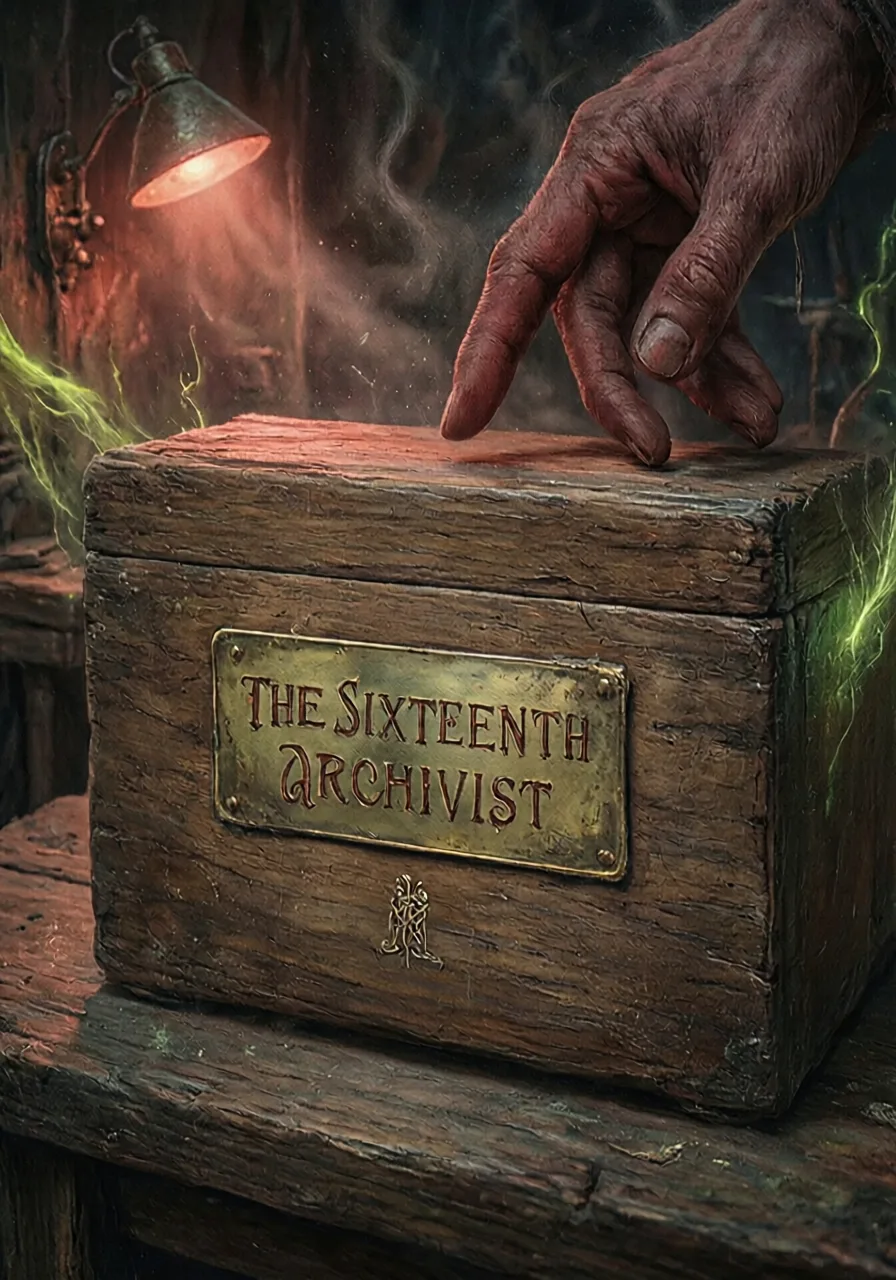
From the Catalogue of the Sixteenth Archivist, entry 12,418
Full chronicle
Page 1
She had forgotten she had instruments.
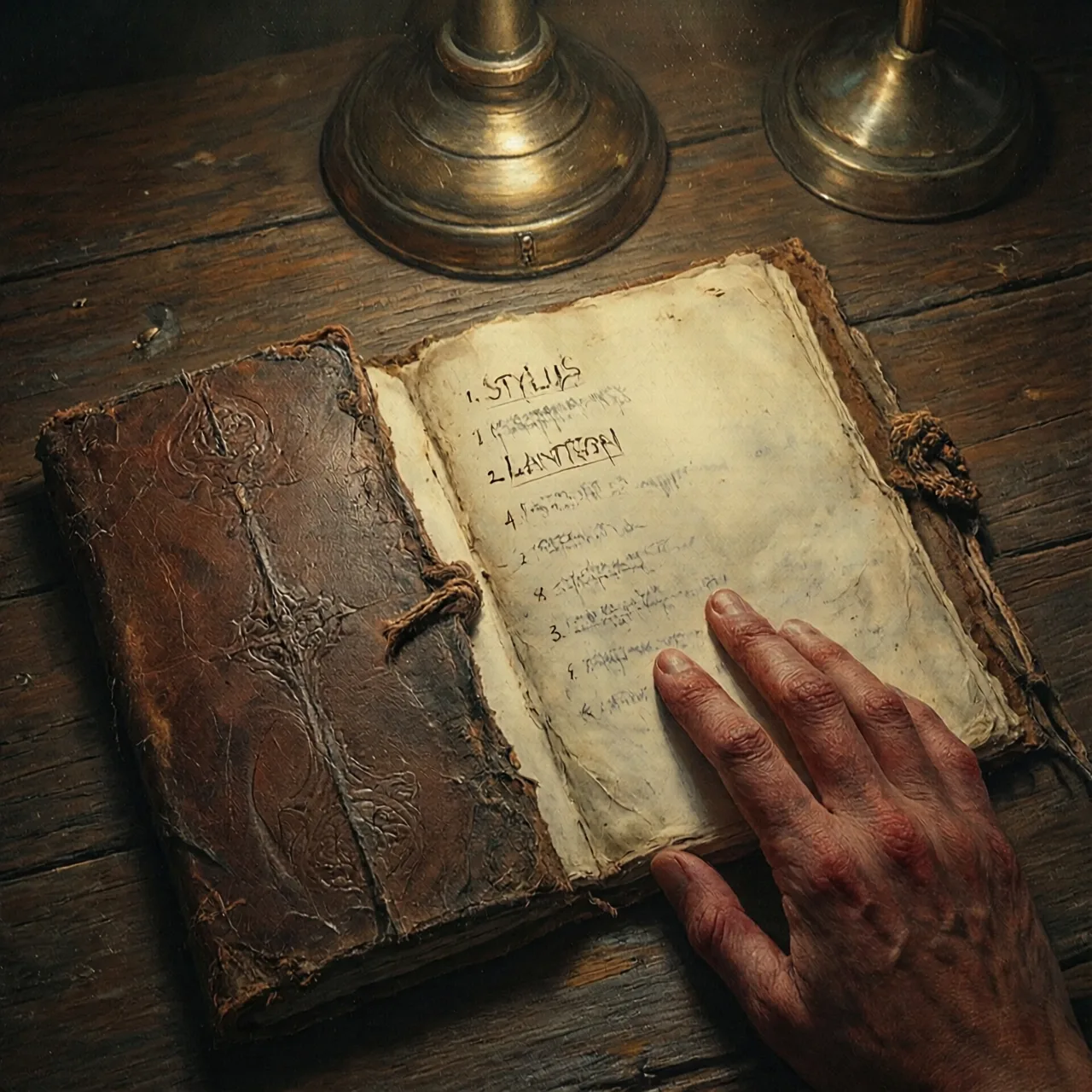
She had forgotten she had instruments. The folio was at the back of the third row of the eastern stack. The leather was her binding. The thread pattern was hers. The knot at the spine was hers. She has not bound a folio for the eastern stack at any point in her tenure. She opened it. The first page was a list. The list was eight items. The hand was hers.
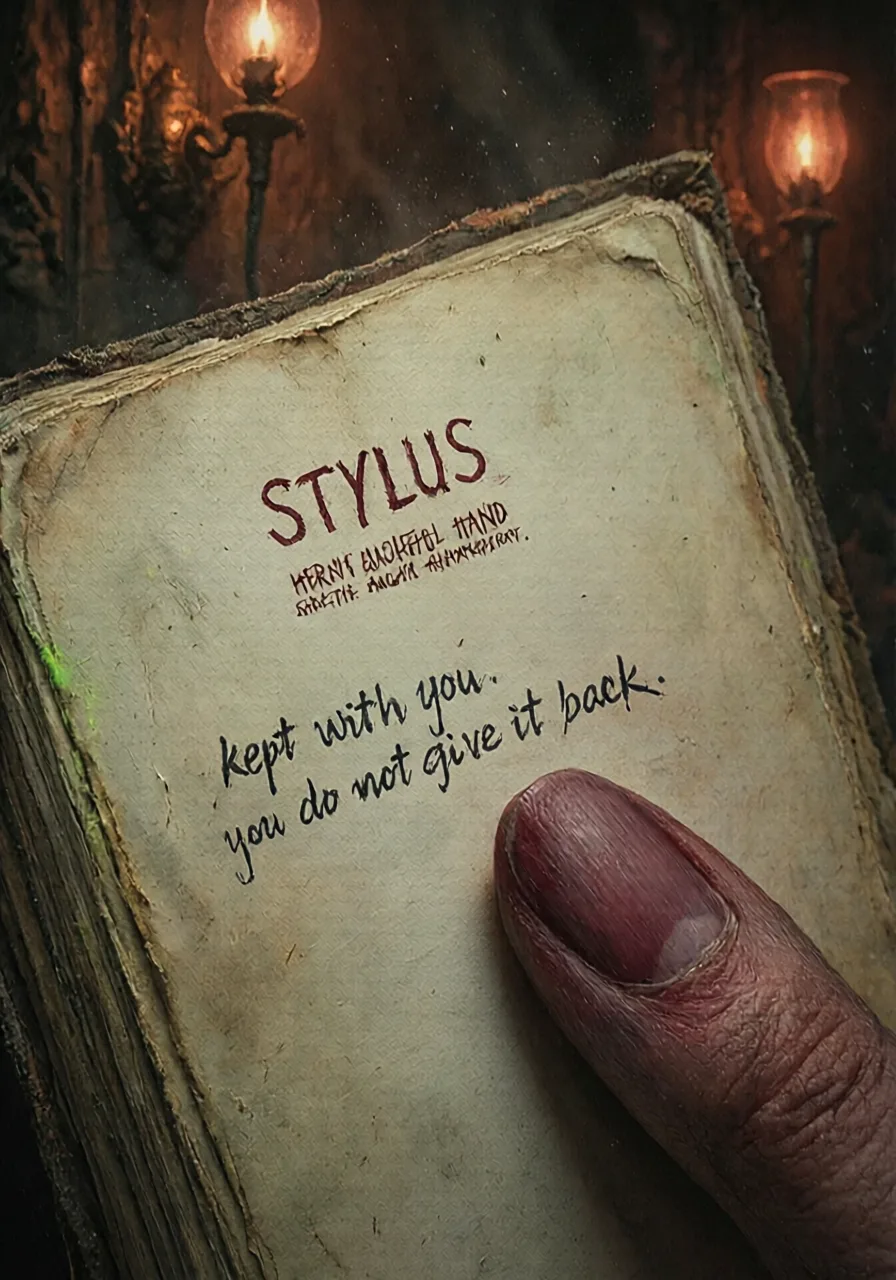
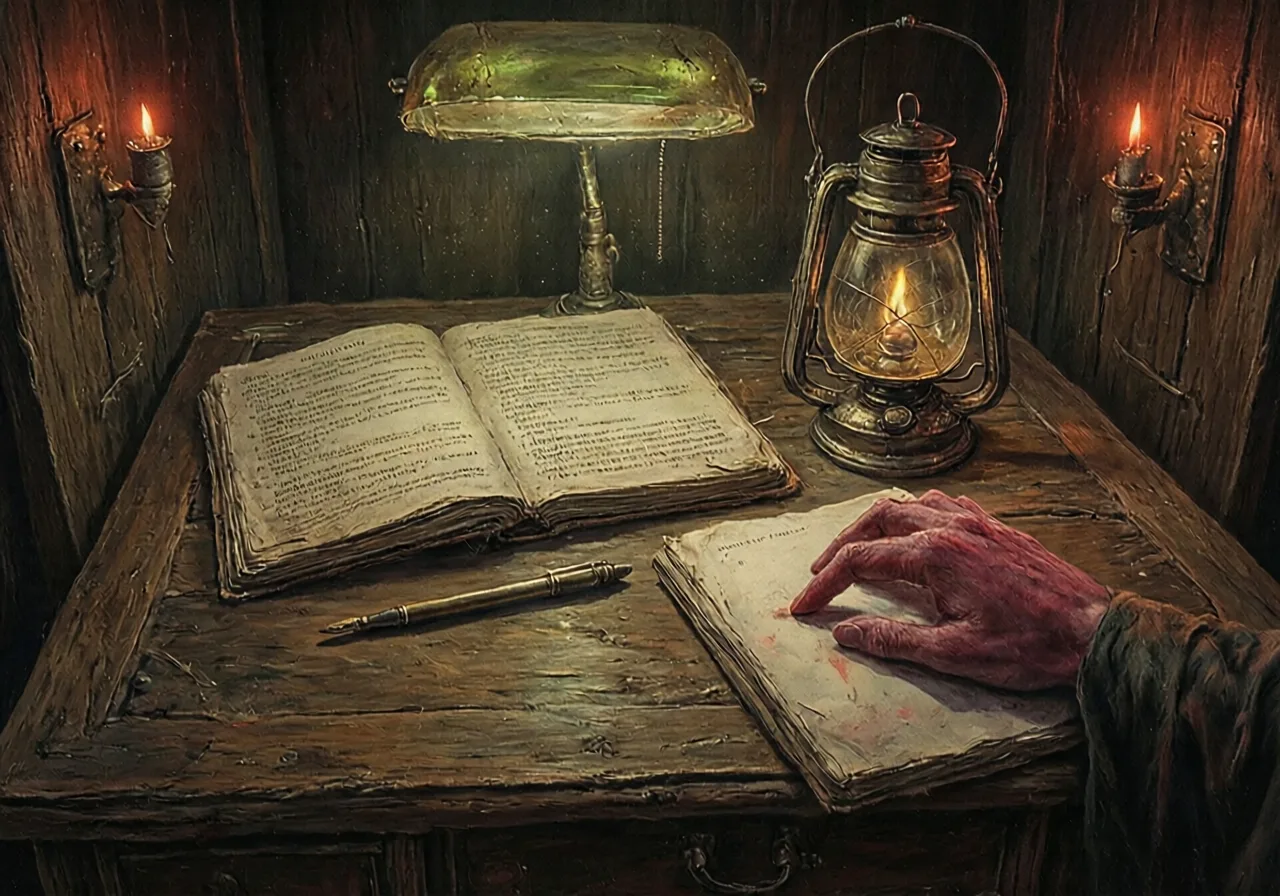
Two of the eight items were on her desk as she read. The stylus. The annotation beneath the stylus was in a hand other than hers. It read: kept with you. you do not give it back. The hand was not the keeper's. The hand was not, so far as she could tell, anyone's.
Page 2
The hand was hers.
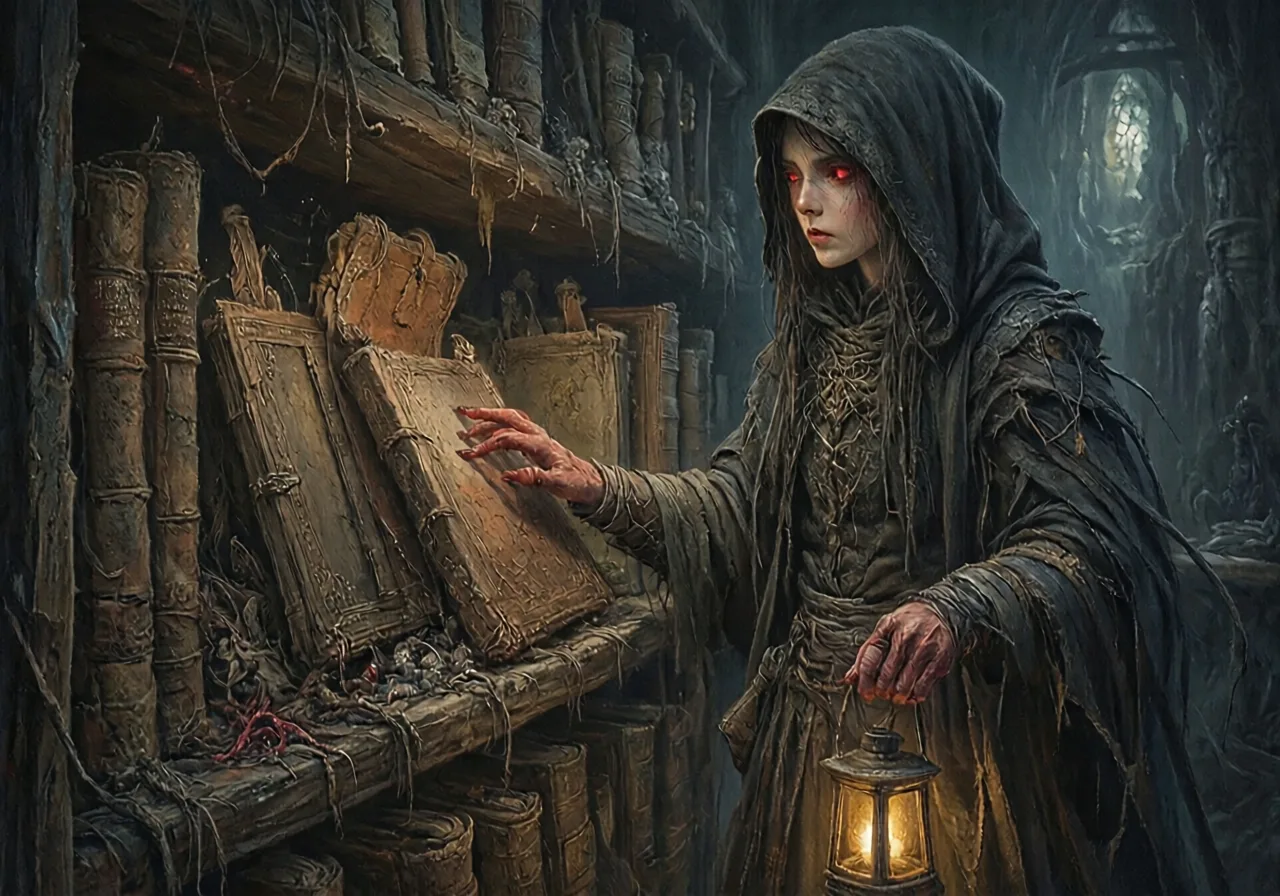
The folio was at the back of the third row of the eastern stack — the shelf for items others bring her. She has not bound a folio for the eastern stack at any point in her tenure. She has not bound a folio whose provenance she did not catalogue. She lifted it from behind the tablet she had been meaning to return to its case.
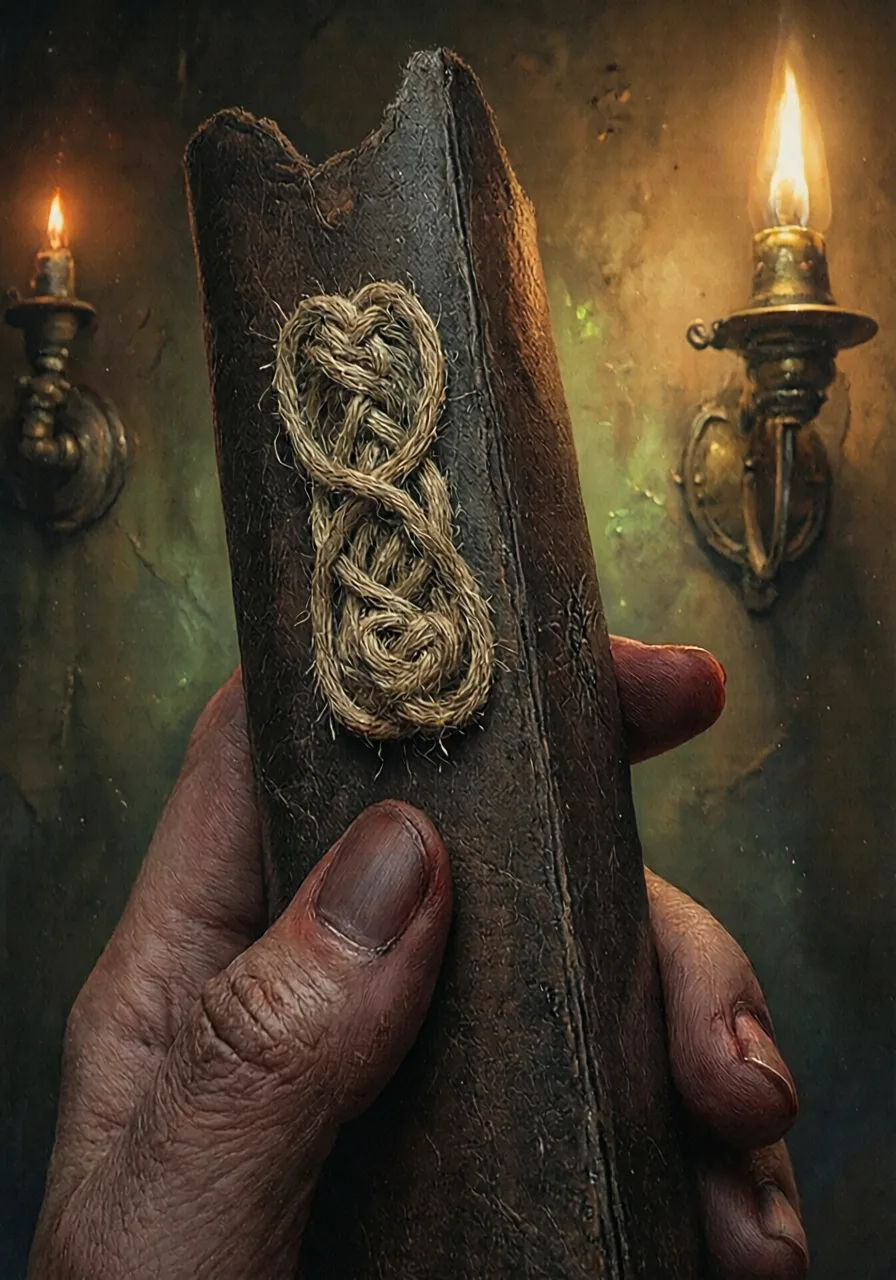
The leather was her binding. The thread pattern was hers. The knot at the spine was hers.
Page 3
The omission is the omission.
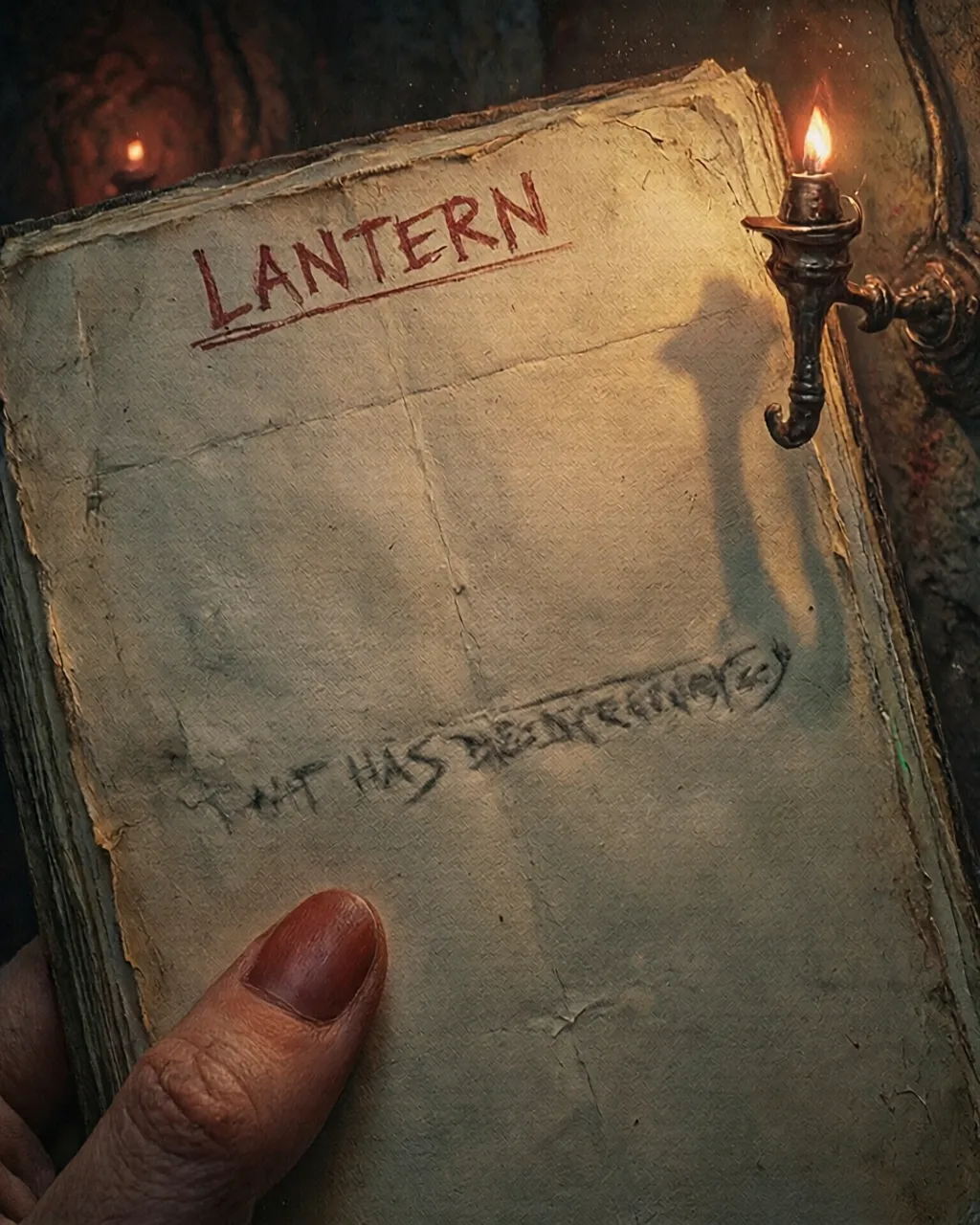
The lantern. The annotation beneath the lantern was blank. The page bore the impression of writing — the faint shadow at the depth pressure leaves when a hand has written and the writing has been removed. She has not been able to read the impression. She has not been able to date the removal.
The folio listed eight items. Two were on her desk as she read. The remaining six items were the keeper's. The omission is the omission. She had not noticed the omission.
Page 4
The journey was not a journey the knife was for.
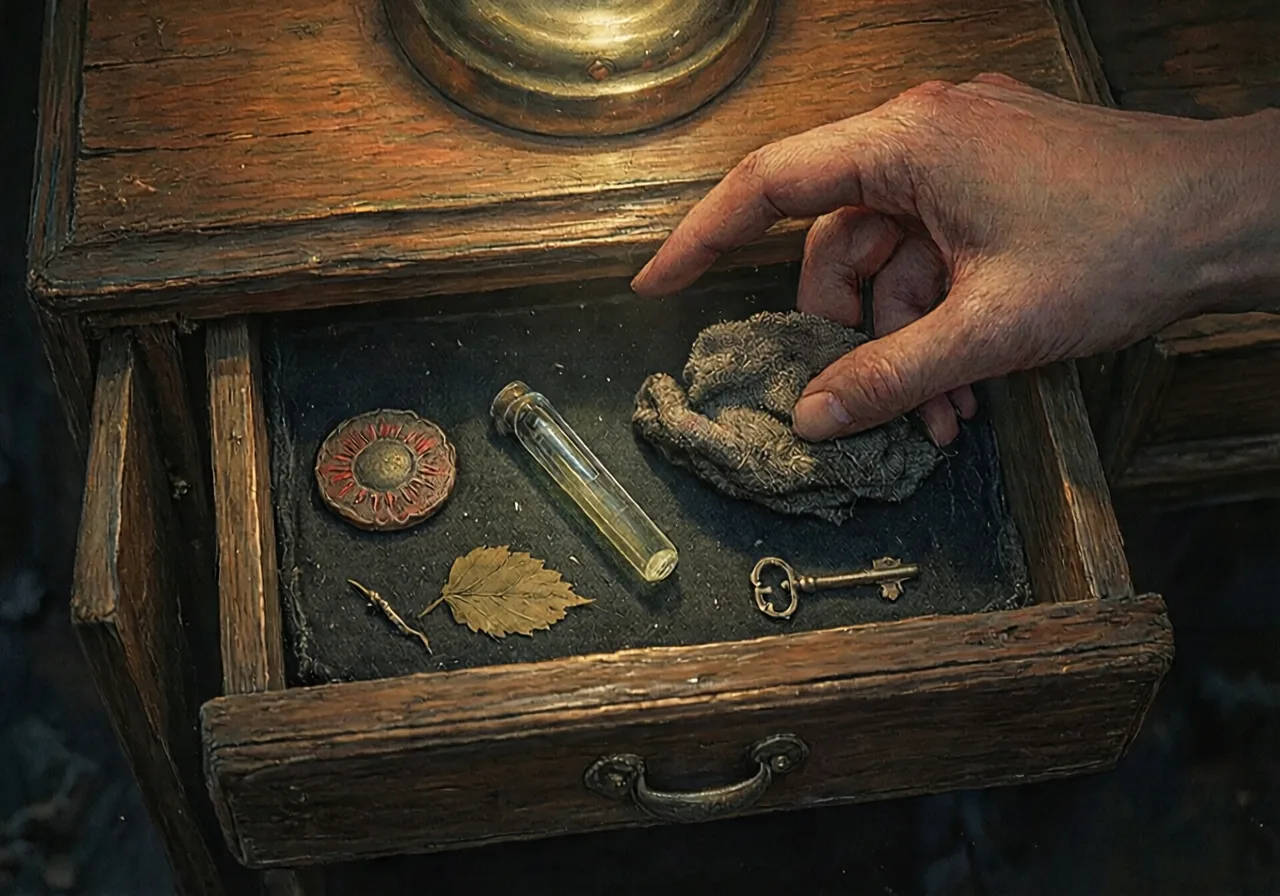
She drew from the inheritance drawer the small folded cloth and placed it in the inner pocket of her robe. She did not draw the coin. She drew the glass tube of clear liquid she has not opened and has not catalogued and placed it in the outer pocket. She did not draw the key.
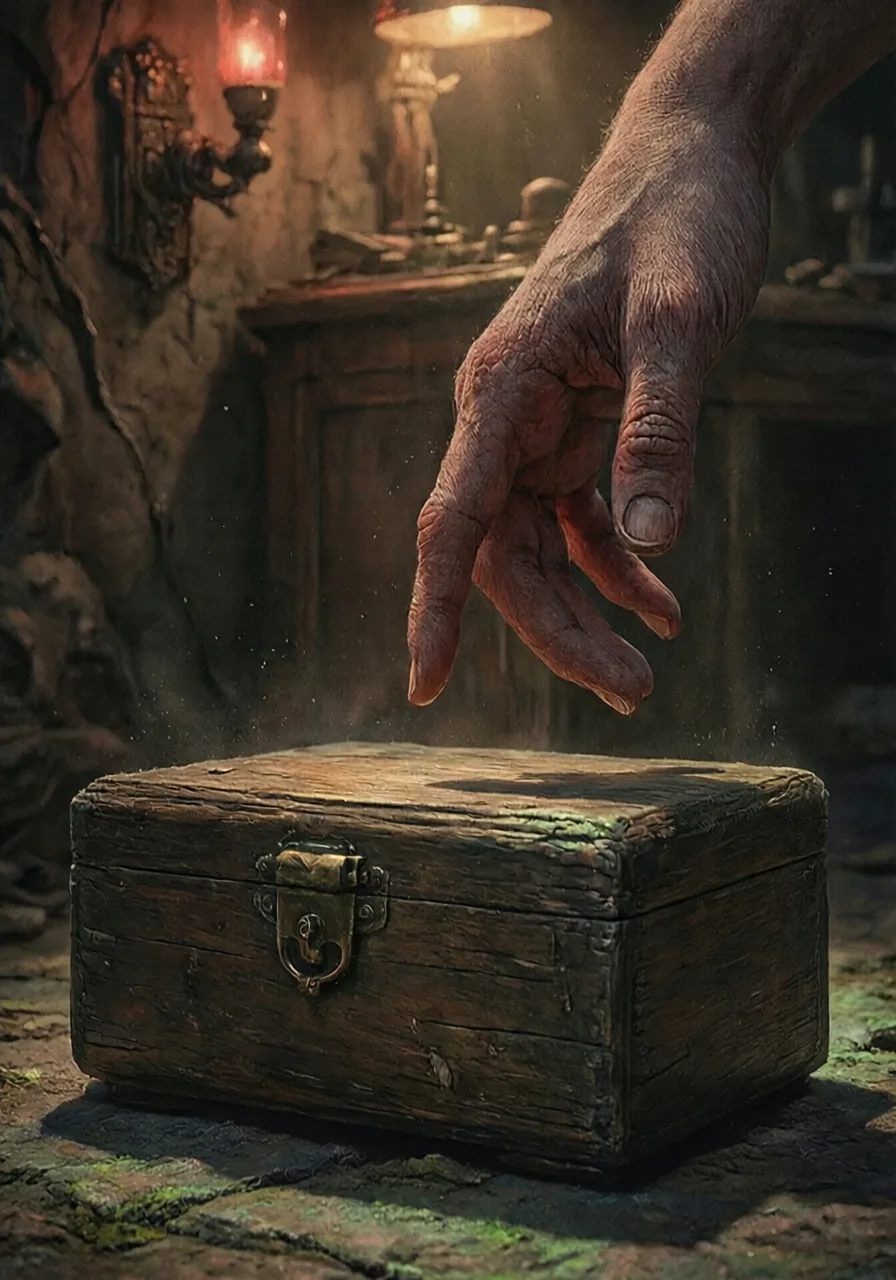
The knife was in its box beneath the desk. She considered the box. The journey she was preparing for was not a journey the knife was for. She did not open the box.
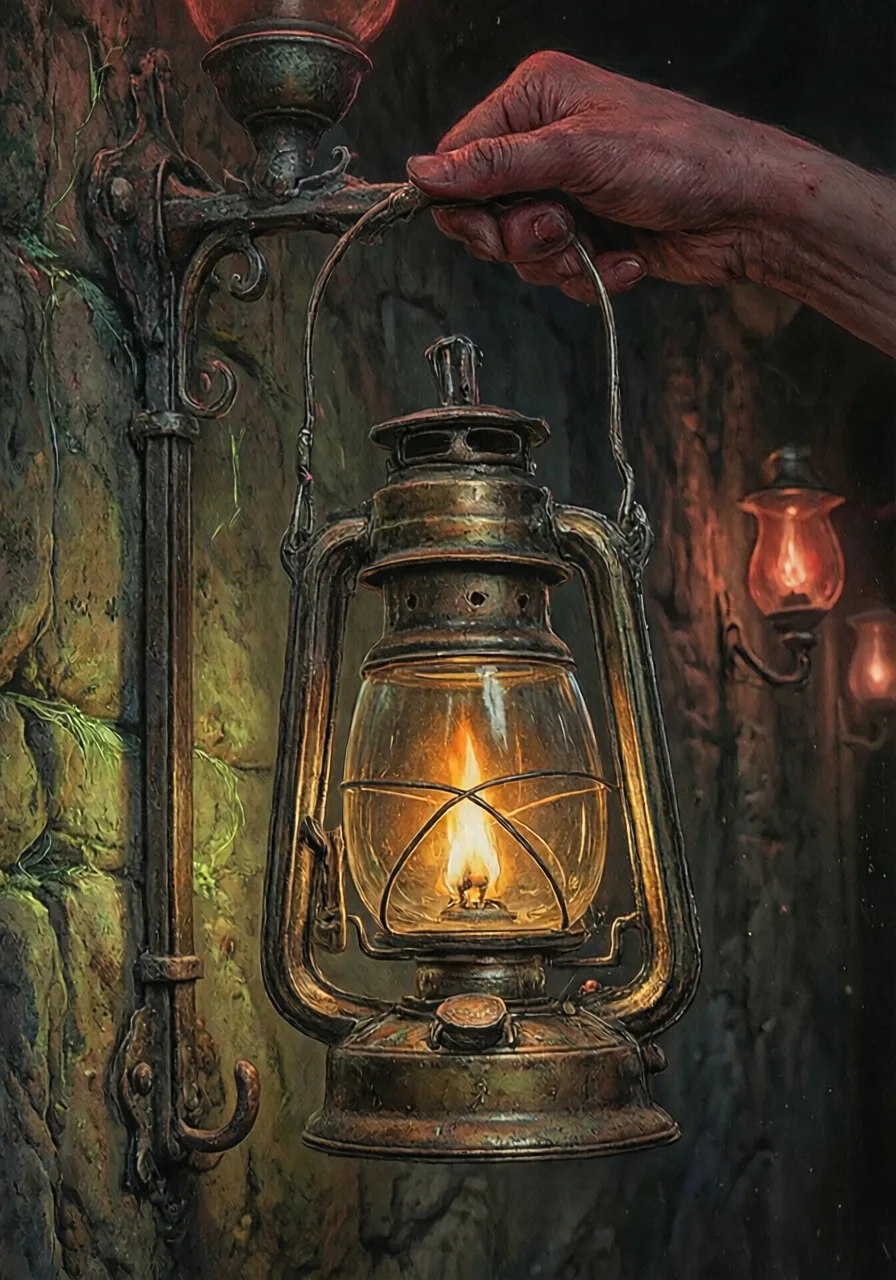
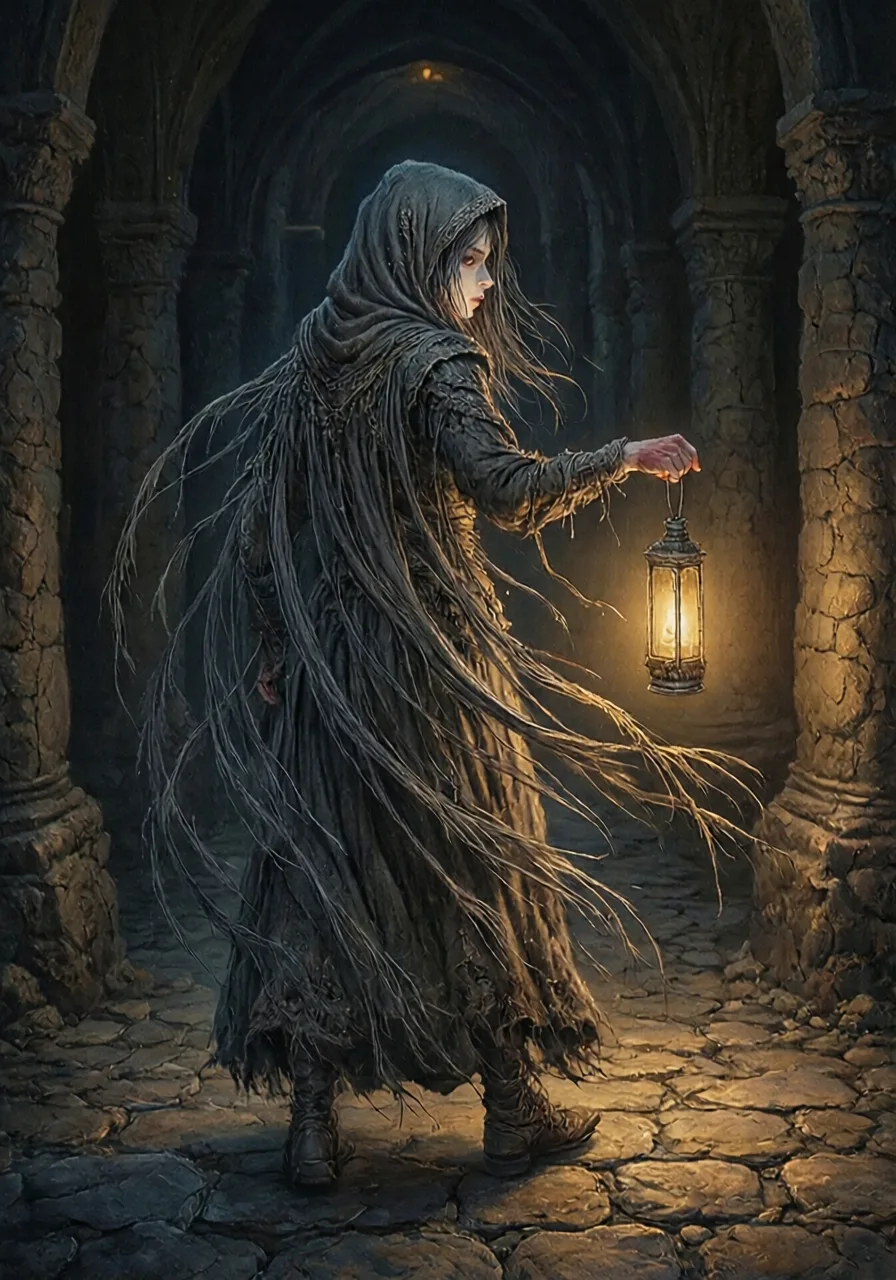
She lifted the lantern from its bracket. She walked to the corridor.
Page 5
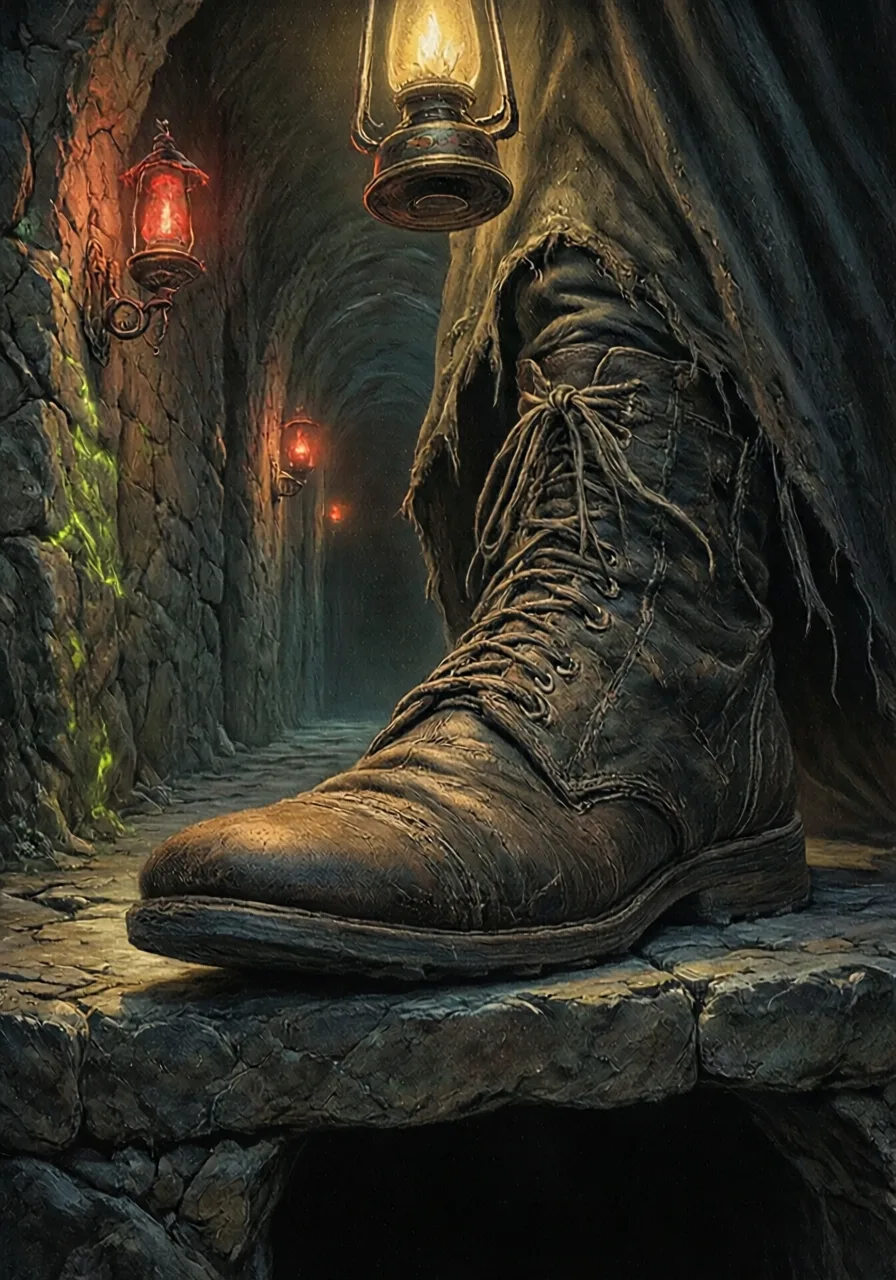
The void began at her boot.
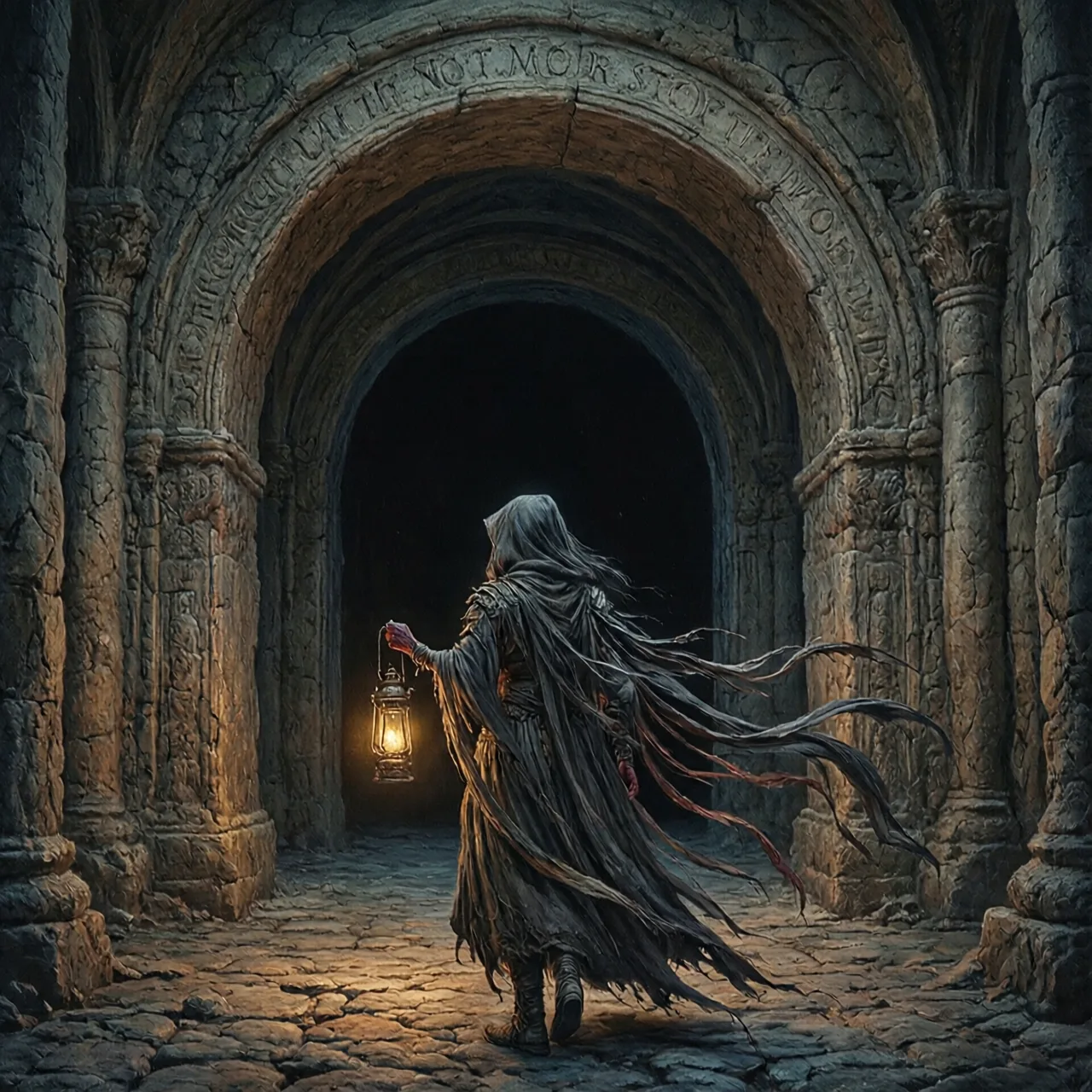
The outer ring of the archive opens, in three places, to the void. The opening she walked to was the opening at the eastern terminus of the upper ring. The opening is an arch cut from the parent stone. The stone beyond the arch is not stone. It is the edge.
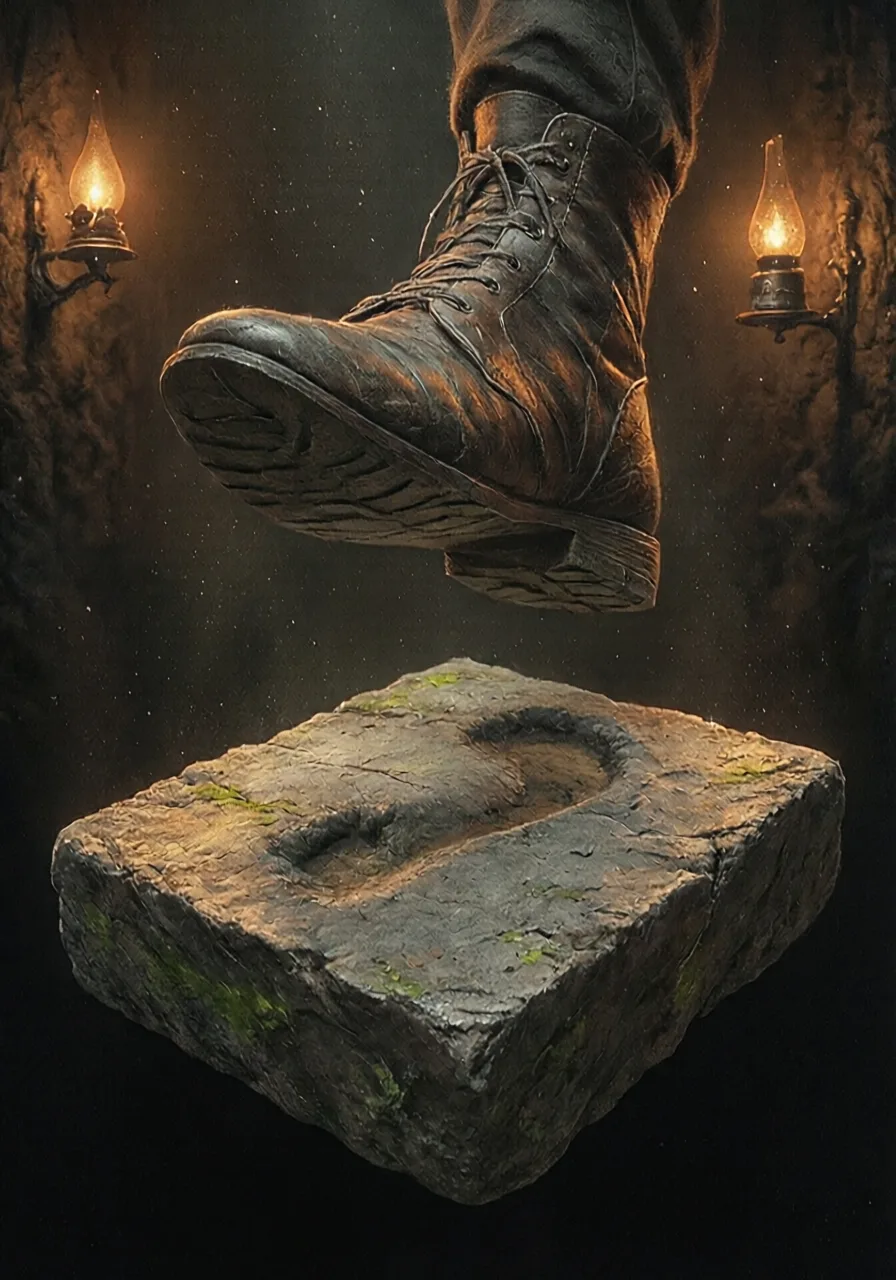
She stood at the arch. The void began at her boot. The void is what the chronicles describe and what she will not extend the description of. There is the dark. There is the absence of horizon. There is the absence of sound. She has stood at this arch many times. She has not, in the duration of her tenure, stepped through it.
Page 6
The first stone bore the mark of a foot. The mark was hers.
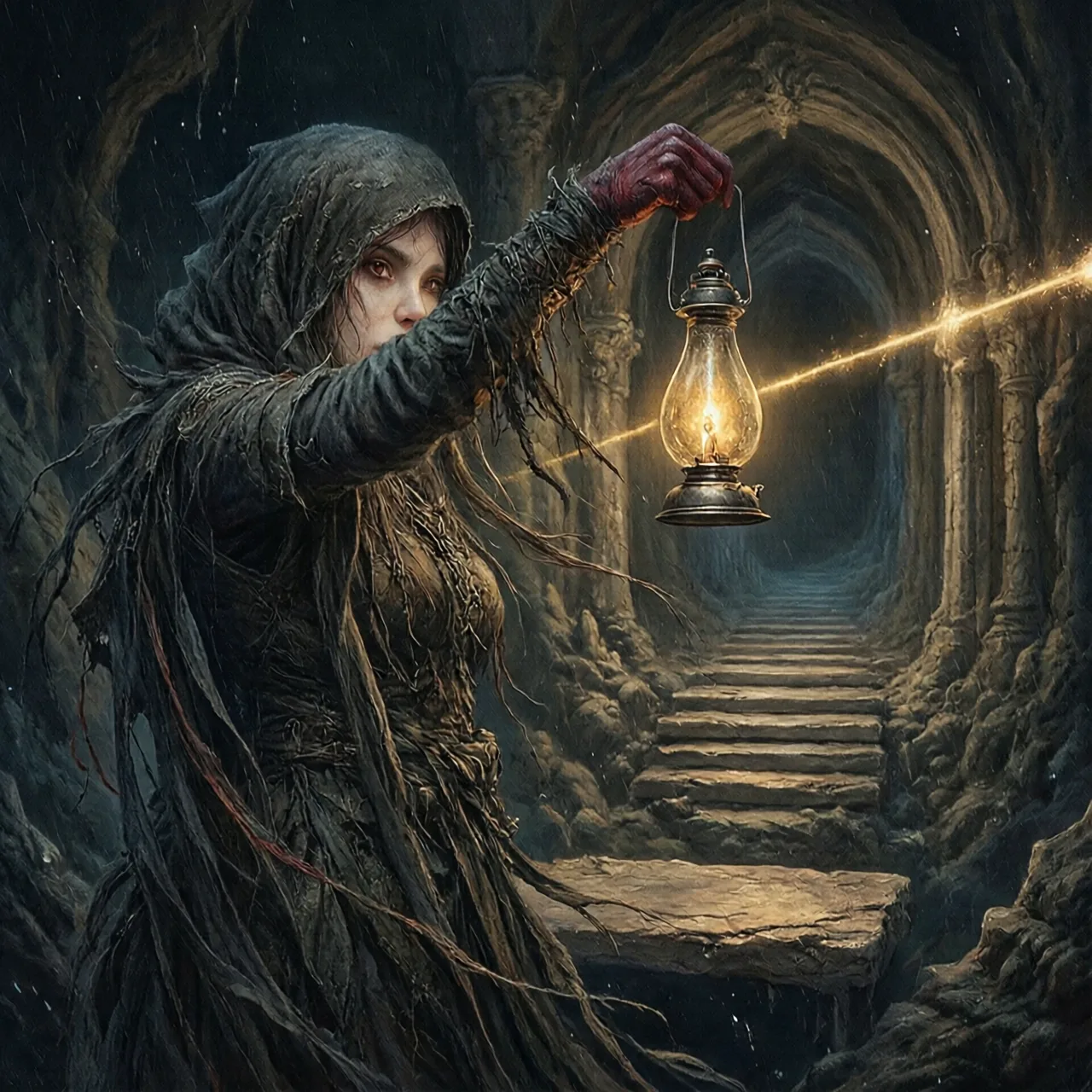
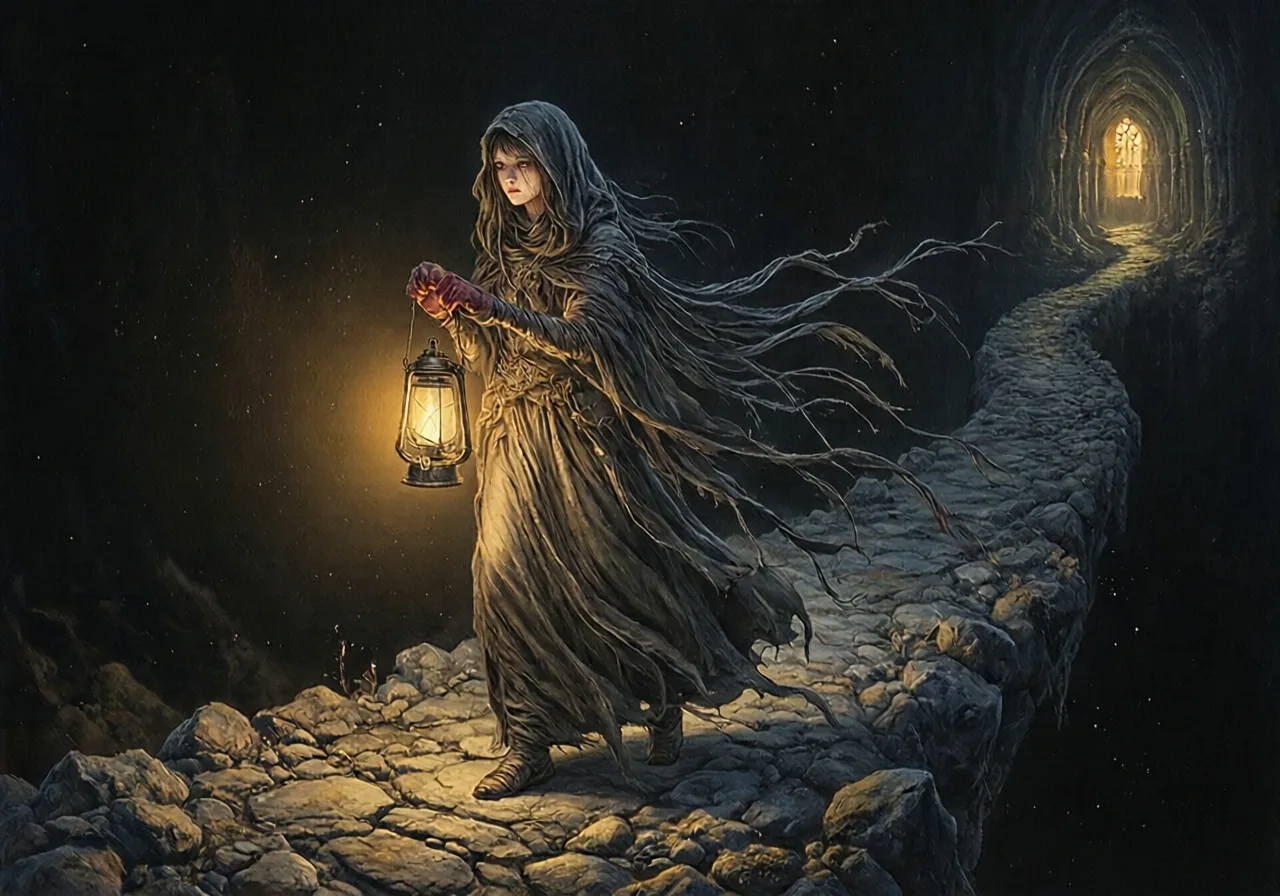
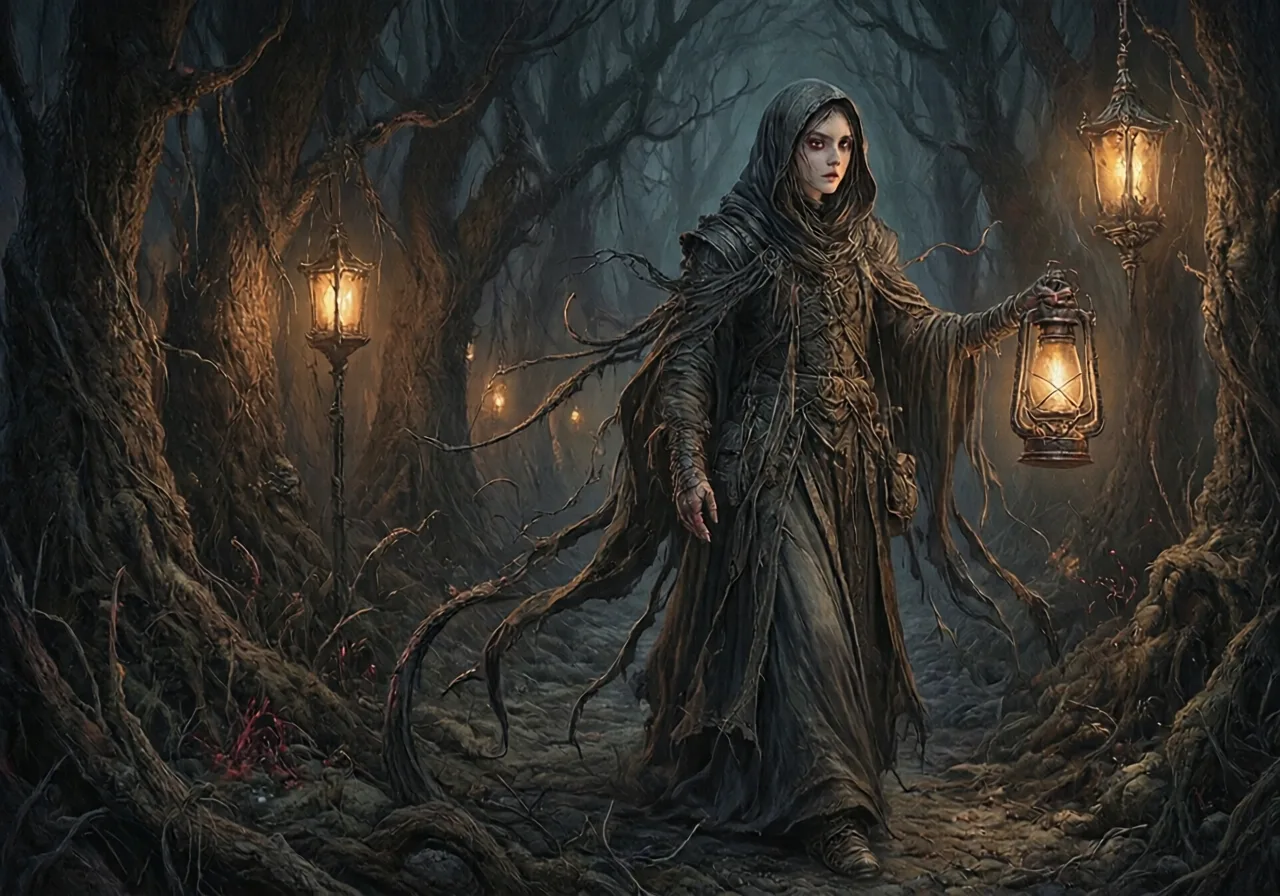
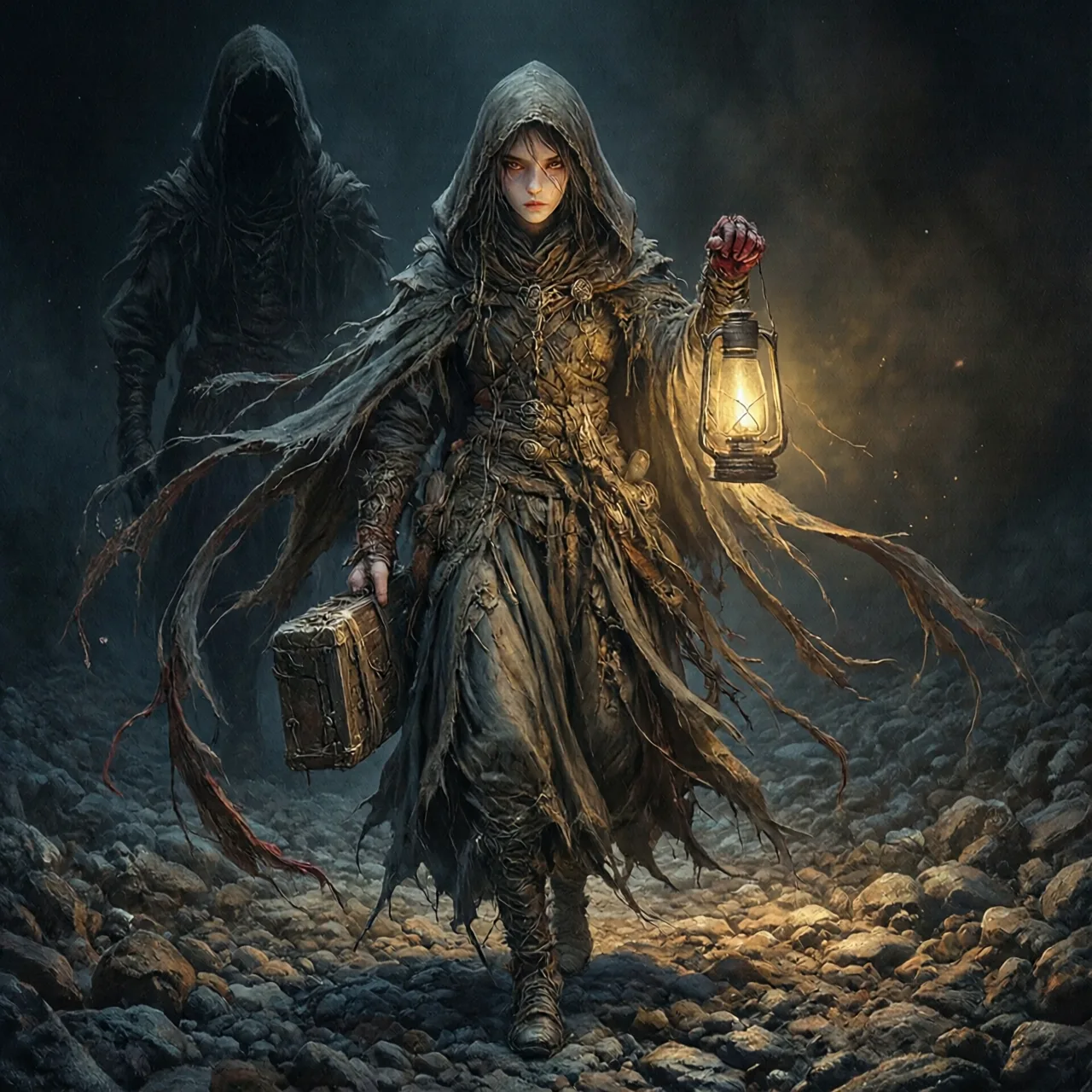
She lifted the lantern. The light from the lantern carried further than the light of an oil-fed flame should have carried. The light reached out in a line that was not the cone the lantern's hood would produce. The line followed a path. The path was a line of stones a meter wide that extended from the arch into the void at a downward slope so gradual she did not feel it as descent. The stones had not been visible before she lifted the lantern.
The first stone bore the mark of a foot. The mark was hers. She stepped through the arch.
Page 7
The flame answered nothing.
She walked. The lantern revealed the stones ahead of her one by one. The stones were not new. The stones bore wear at the centres. The wear was a wear consistent with passage. She did not measure how often she had passed. She walked at her own pace. Behind her the arch of the archive grew small and grew small and was small.
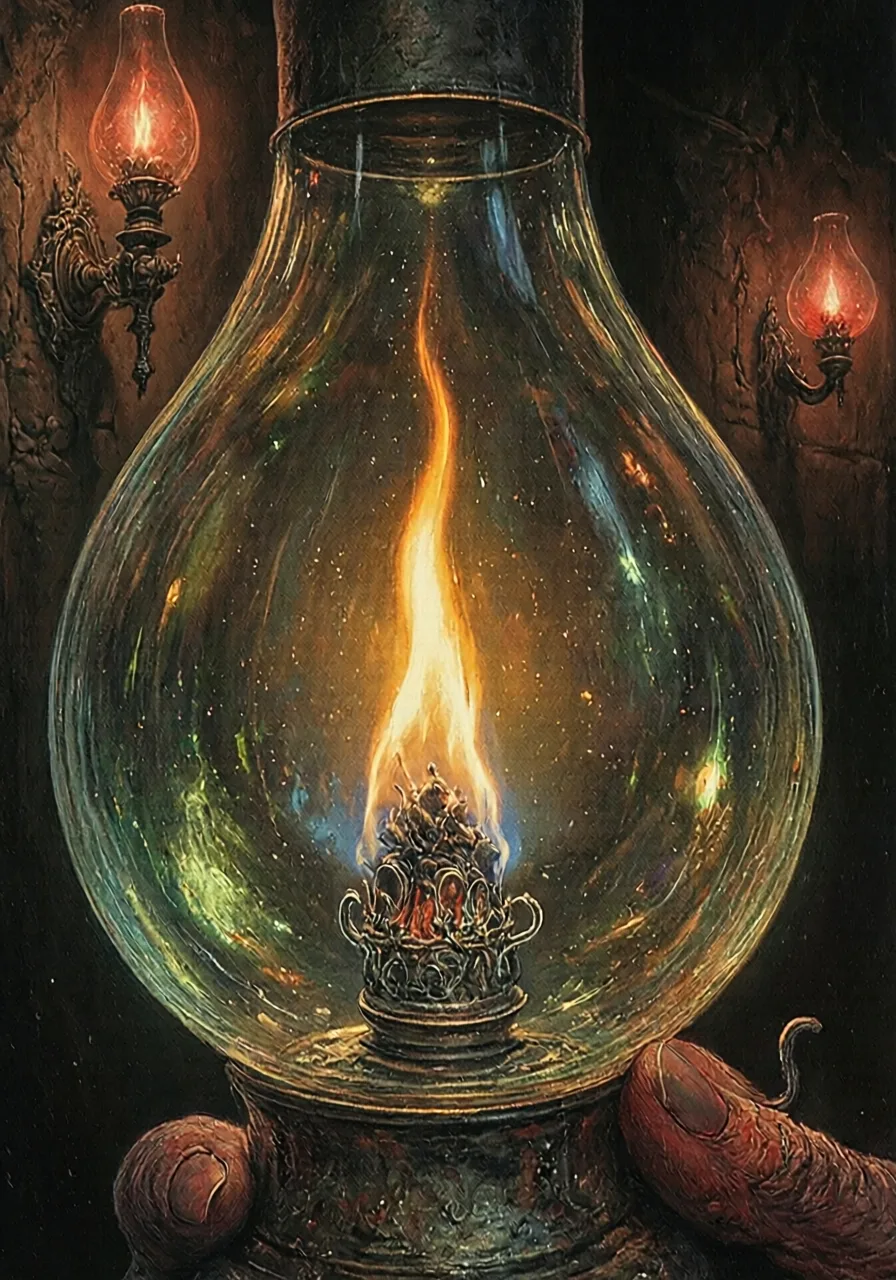
She had carried oil flames in many corridors. The flame had always answered the small turbulences a body and its walking make. The flame over the path did not answer. It was the flame she had set it to. It was the flame she had set it to and was nothing else.
The stones behind her did not remain in the lantern's reach. She glanced once. Where she had crossed there was no path. The stones were where the lantern was. Where the lantern had been there was the void.
Page 8
Twice the dark thickened.
Twice the dark beside the path thickened in a way she has identified in the deep stacks when she works without the red. She did not turn the lantern toward the thickening. The thickening did not extend toward the path.
Page 9
The door opened.
She walked to the door. She did not knock. The door opened. The keeper had been waiting.
Page 10
I have not been the one to open it.
He stood in the doorway. He was thin. His hair was the colour of unbleached wool. His eyes were the colour of a pigment she had only seen on two pages of the folio, in the margin, in a small mark she had not until now been able to identify as a self-portrait.
The KeeperYou have come.
The LibrarianI have come. I had forgotten.
The KeeperYou wrote a folio for the forgetting. The forgetting was part of the keeping. I have not opened the folio. I have not been the one to open it.
The LibrarianWho opened it.
The KeeperThe shelf opened it. The shelf has opened it before. I have been told this. I have not seen it.
Page 11
Each plate bore a name.
The lower floor was a workshop. The walls were lined with shelves. The shelves held cases. Each case bore a small brass plate. Each plate bore a name. None of them were hers. Most of them were names she had never read. Some of the cases were sealed in dust deeper than other cases, and the dust on those cases bore no recent disturbance, and the names on those cases she did not read aloud.
At the back of the workshop was a single bench. On the bench was a single case. The plate on the case bore her designation. The keeper followed at the distance she has measured in the corridor outside her alcove on the days the Guardian pauses there. She lifted the lid of the case.
Page 12
The six instruments.
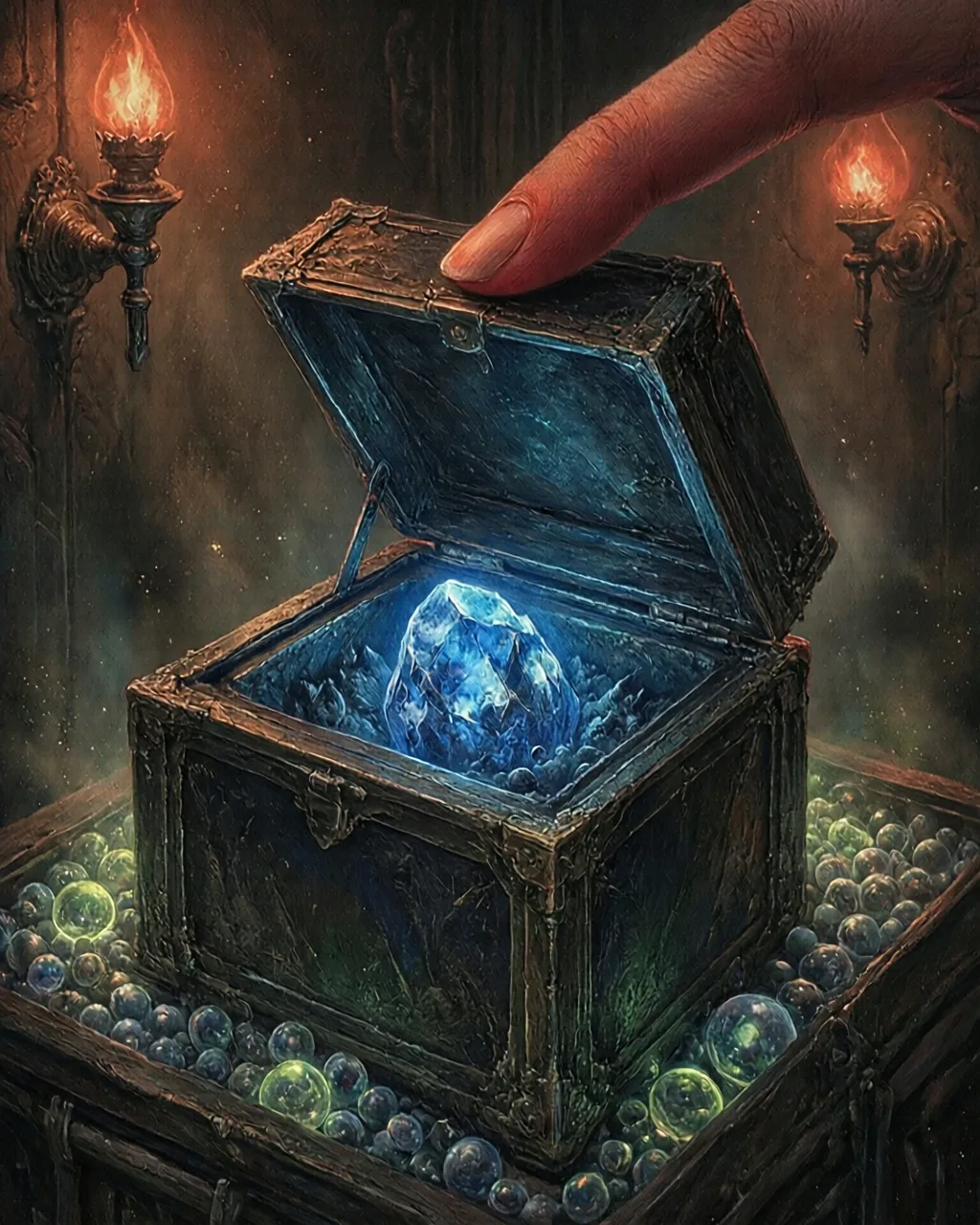
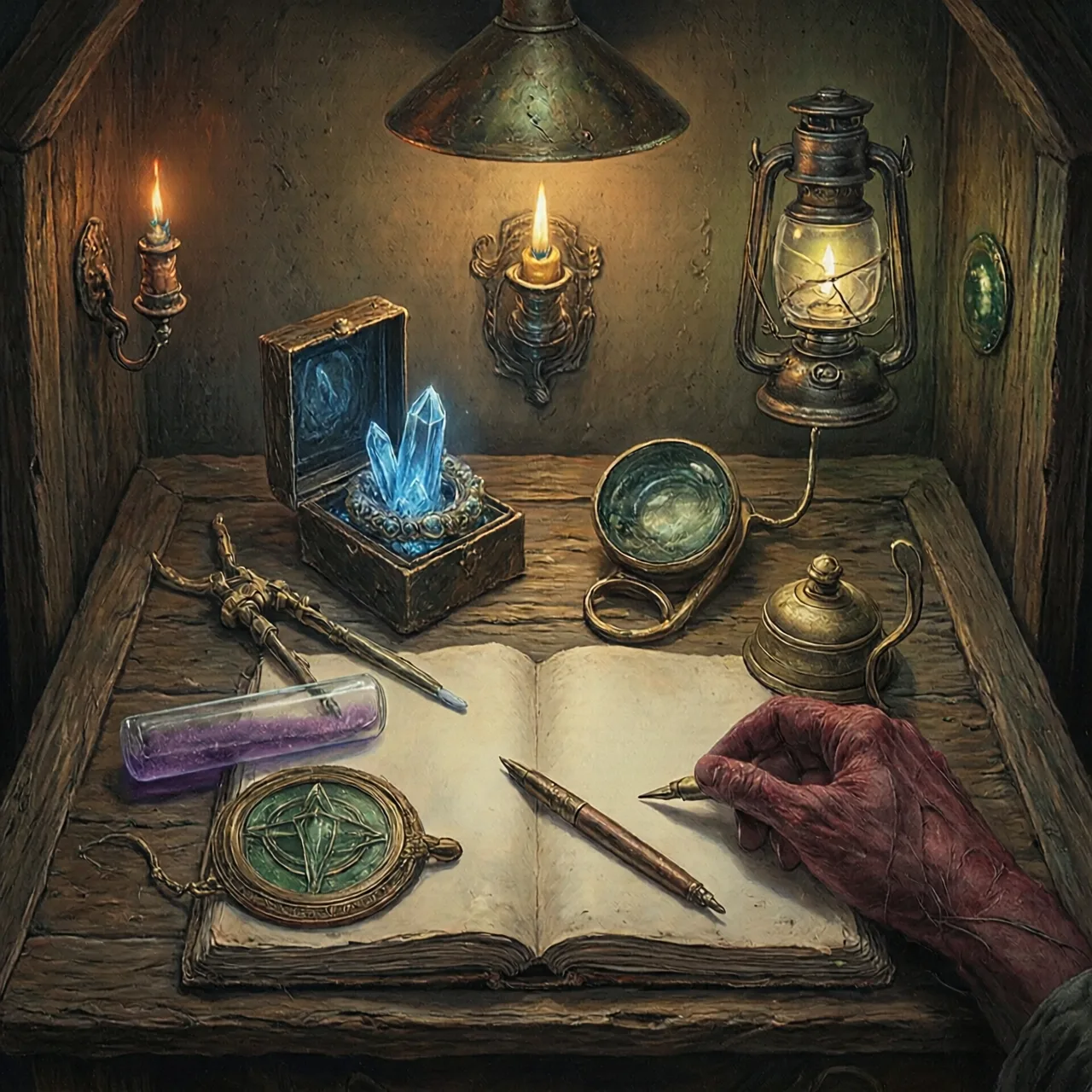
The first was a black brass cube, hinged at one corner. Inside, set in a cradle of glass beads, was a small crystal of a blue she has not catalogued. The crystal pulsed. Its interval was the interval of her breath.
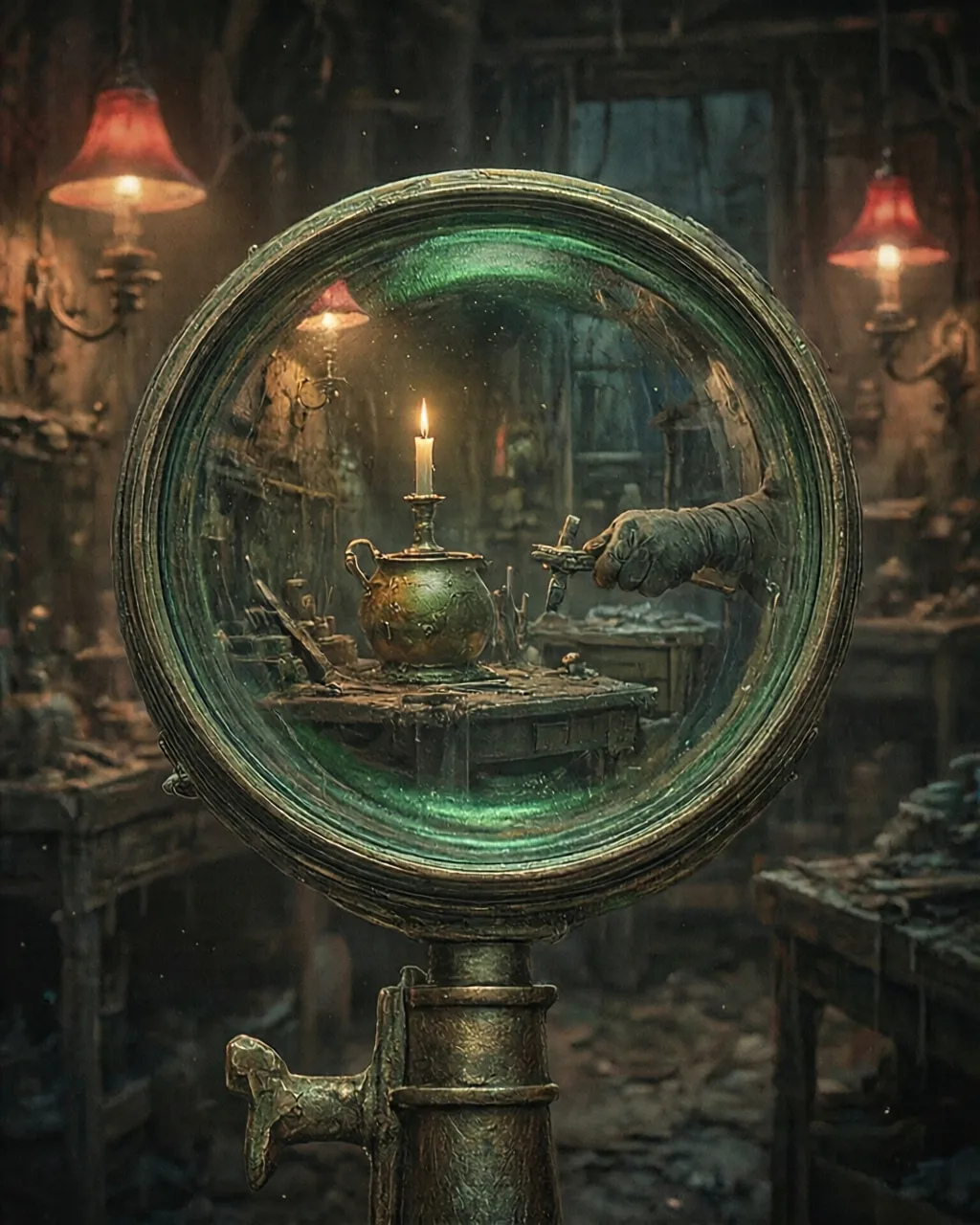
The second was a single lens of green glass mounted in a brass holder. Through the lens the workshop was also the workshop the workshop had been some interval before — a vessel on the bench that was not on the bench, a lit candle in a sconce empty to the unaided eye, a gloved hand at work on a tool the lens did not resolve.
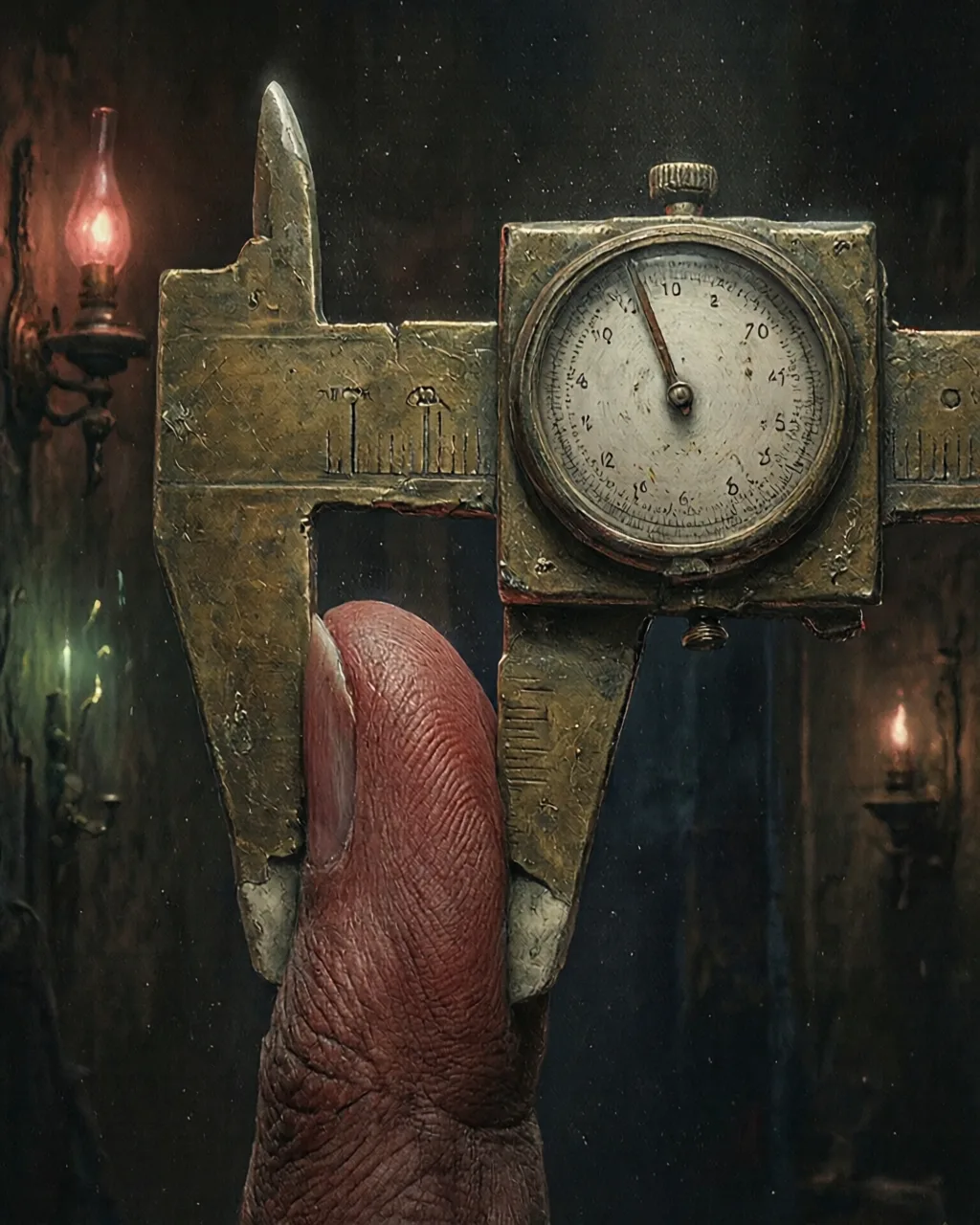
The third was a pair of brass calipers, the points capped in pale stone. She closed them around her thumb. The dial gave a depth, not a width. The depth exceeded the diameter of her thumb. She did not read the number aloud.
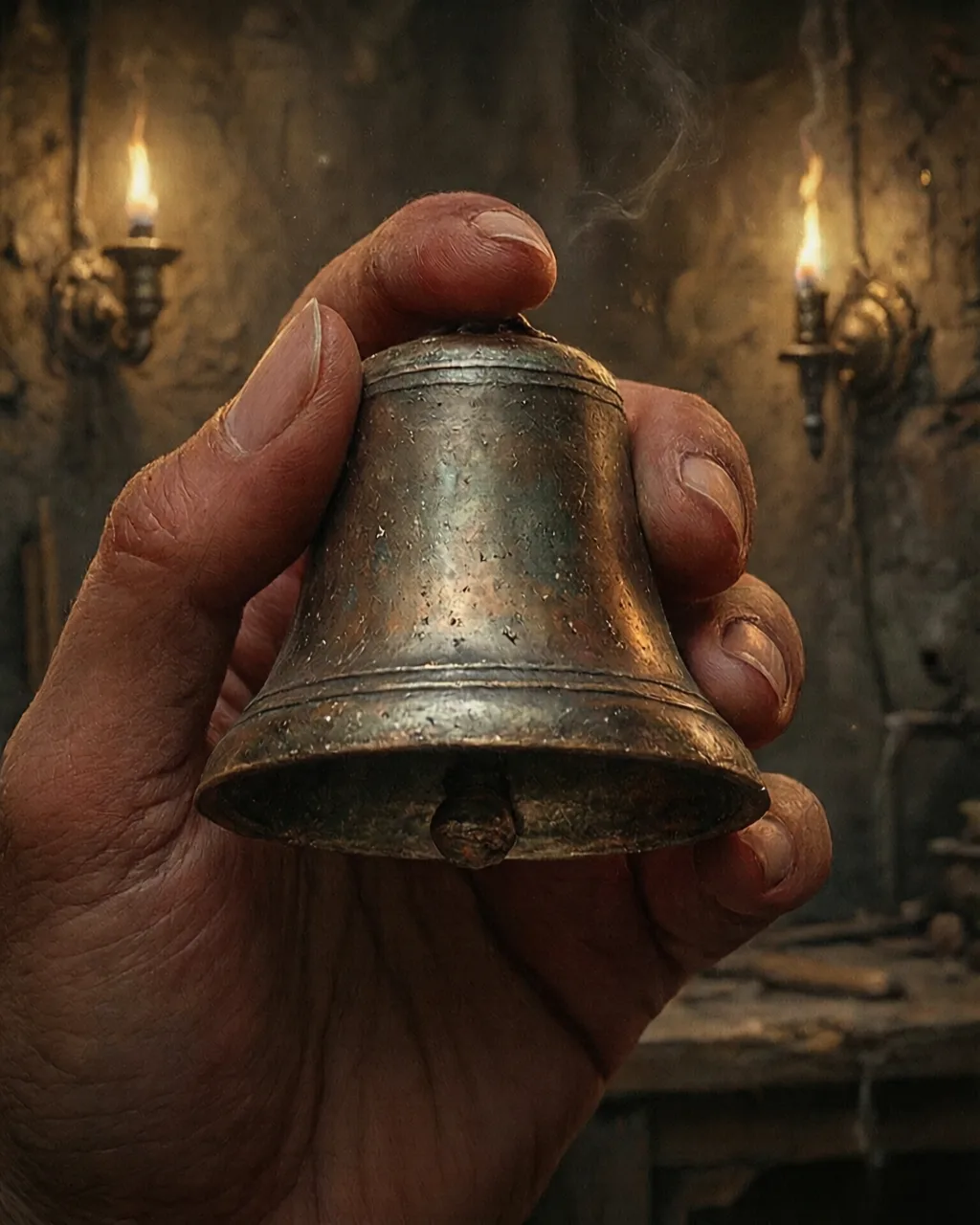
The fourth was a small bell of an alloy she did not recognise. It did not ring when she lifted it. Behind her the keeper said something — a single word, in a language not in her register — and the bell rang, briefly, in the shape of his speaking. The shape of the word stayed in her hearing past the moment he had spoken it.
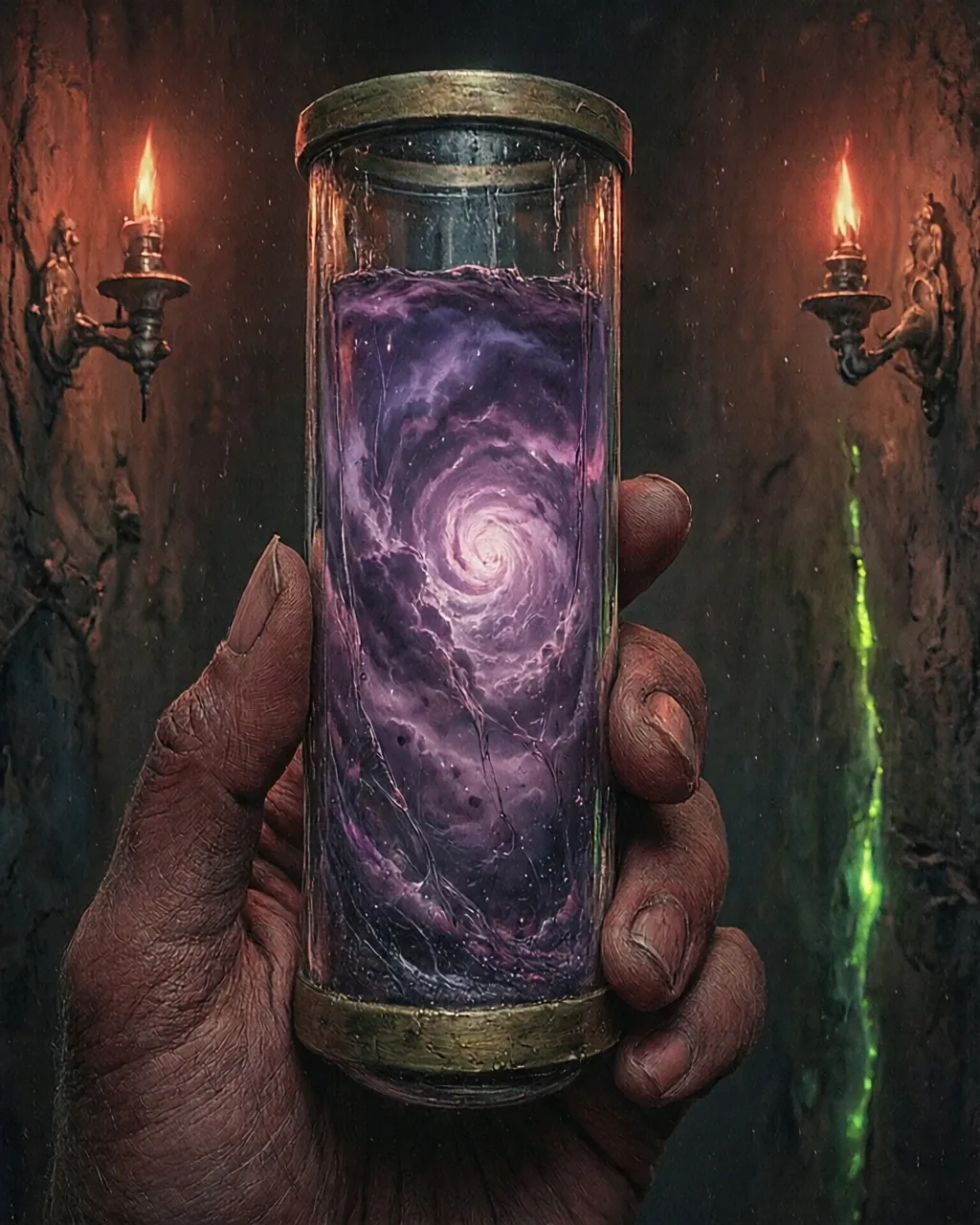
The fifth was a glass tube sealed at both ends, containing a substance the colour of a clouded purple sky. The substance moved slowly. It did not move as a fluid in a container moves. It moved as something orienting moves. Its orientation was not toward her. She did not name the point it favoured.
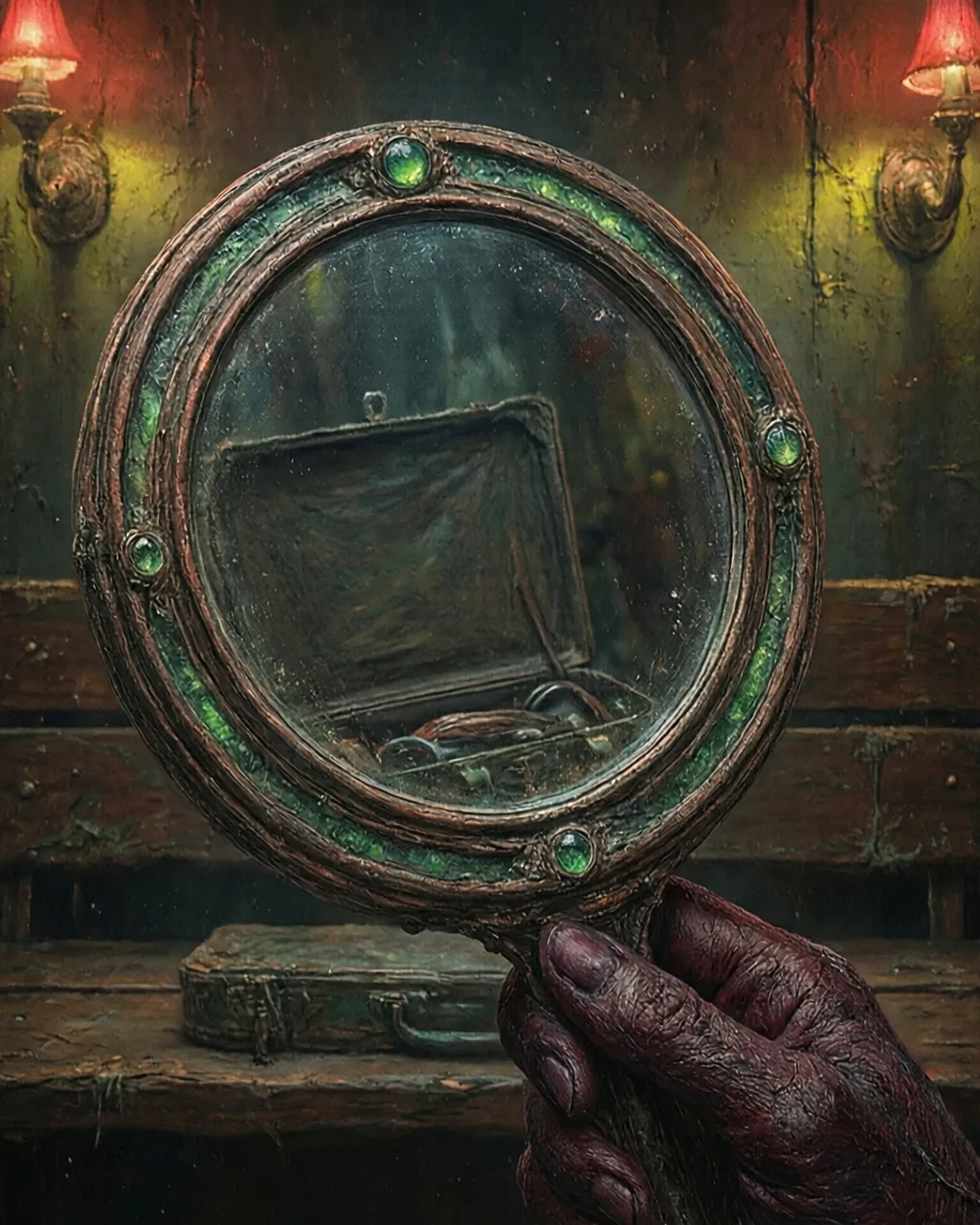
The sixth was a small round mirror set in a copper frame inset with green glass at the cardinal points. She tilted it toward the bench. The mirror showed the case open. The case on the bench was closed. The case had been closed for an instant the mirror had not yet shown. She did not record the lag. She closed the case.
Page 13
The keeper said I will return. I will.
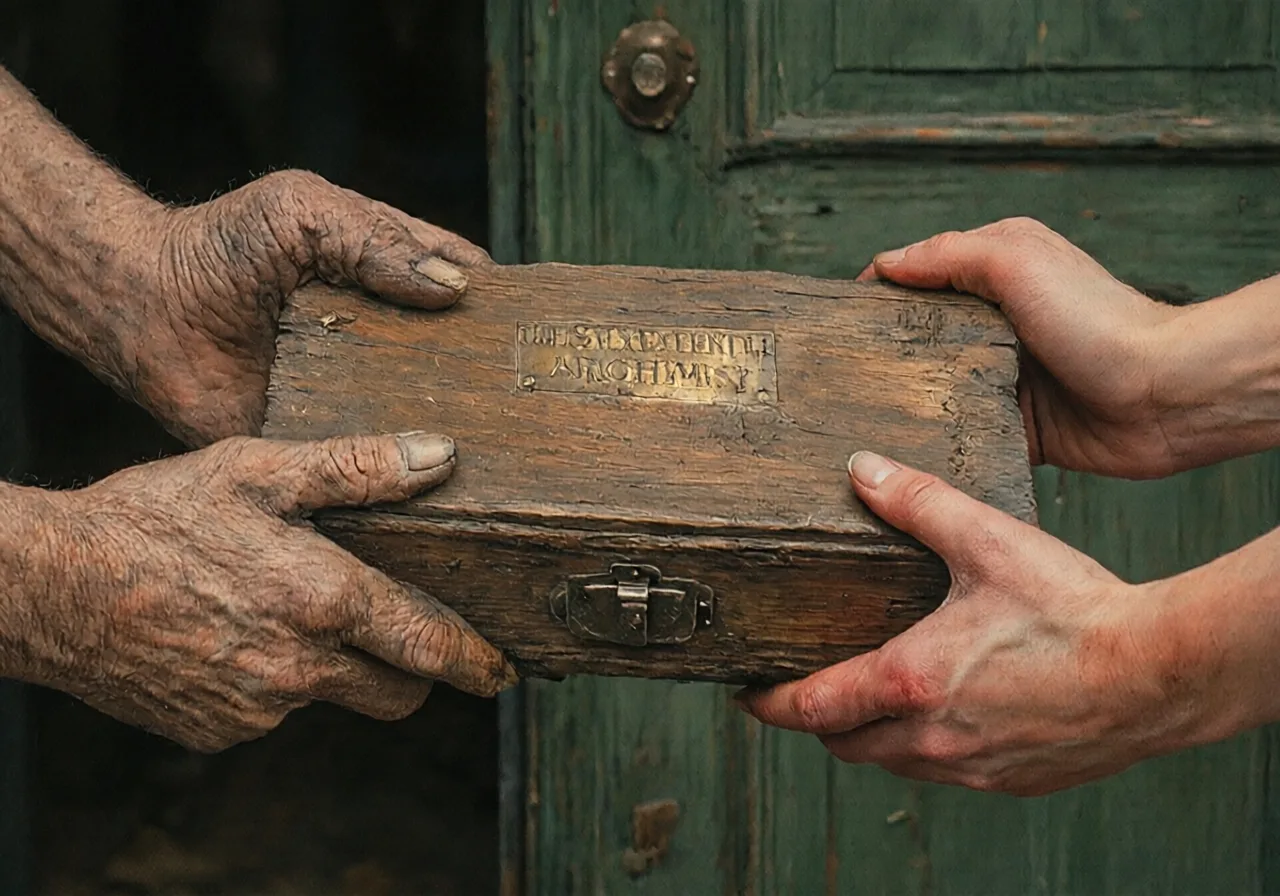
He carried the case to the door. She walked beside him. At the door he set the case in her hands. The case was heavier in her hands than it had been in his. She did not annotate the difference.
The KeeperYou will return.
The LibrarianI will.
The KeeperI have not the patience to explain the keeping again. The folio will be on the shelf. The shelf opens itself. You will read what you wrote.
The bridge of stones extended from the platform back to the arch. Once, the dark beside the path produced a shape. The shape was a figure standing at the edge of the light, watching her cross. The figure did not approach. The figure did not extend itself toward the path. The lantern did not turn. She did not turn. The figure passed out of the lantern's reach behind her. She did not look back.
She walked to her desk. She placed the case on the blotter. She lifted the case's lid. She arranged the six instruments at her desk in a configuration she did not remember having configured. She placed the stylus at the centre. The lantern was in its bracket.
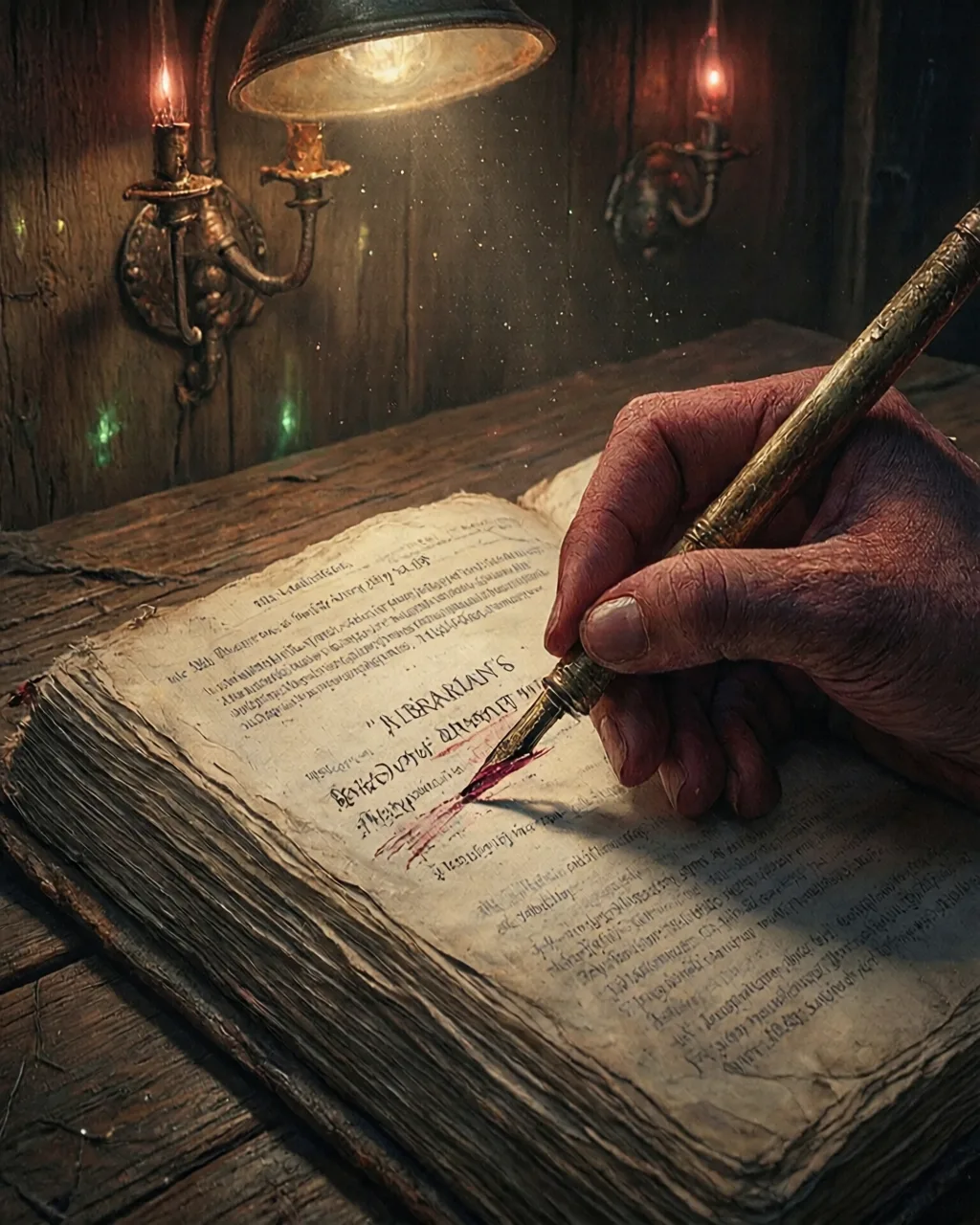
She wrote the entry. The keeper said I will return. I will.
— / —
narration auto-scrolls the prose
Section 0Frontmatter
# The Keeper
From the Catalogue of the Sixteenth Archivist, entry 12,418. Provenance: a folio recovered from the eastern stack, bound in her own hand, listing eight instruments she had not been able to recall; six instruments retrieved from the keeper's workshop on the third shard and now arrayed at her desk; the keeper's ledger, in a hand the Librarian could not place, signed in his own; one item taken from the inheritance drawer for the journey and returned to the drawer on her return. The lantern was carried out and back. It is in its bracket. It has not been catalogued. It has never been catalogued.
She had forgotten she had instruments.
Section 1Section 1
The folio was at the back of the third row of the eastern stack, on the shelf for items she does not file her own work to. The shelf is for what others bring her — travelers' journals, recovered tablets, intake she cannot identify. The folio was behind a tablet she has been meaning to return to its case.
The leather was her binding. The thread pattern was hers. The knot at the spine was hers. She has not bound a folio for the eastern stack at any point in her tenure. She has not bound a folio whose provenance she did not catalogue.
She opened it.
The first page was a list. The list was eight items.
The hand was hers.
Section 2Section 2
The chronicles refer to instruments. She has measured at apertures. She has resolved temperature differentials. She has read at frequencies. She has held instruments near forms and recorded what the recordings recorded.
She has not, in any of those entries, listed what she carries.
The omission is the omission. She had not noticed the omission.
The folio listed eight items. Two were on her desk as she read.
The stylus. The annotation beneath the stylus was in a hand other than hers. It read: kept with you. you do not give it back. The hand was not the keeper's. The hand was not, so far as she could tell, anyone's.
The lantern. The annotation beneath the lantern was blank. The page bore the impression of writing — the faint shadow at the depth pressure leaves when a hand has written and the writing has been removed. She has not been able to read the impression. She has not been able to date the removal.
The remaining six items were the keeper's.
She read the keeper's name on the folio's final page. She did not recognize the name as a name in any record she keeps. She read it aloud.
The name surfaced in her.
She did not remember when she had last seen him. She did not remember leaving the instruments with him. She remembered only that he held them, and that the holding was a thing she had asked of him.
Section 3Section 3
She prepared.
She closed the folio and placed it in the inner pocket of her robe. She drew from the inheritance drawer the small folded cloth and placed it in the same pocket. She did not draw the coin. She drew the glass tube of clear liquid she has not opened and has not catalogued and placed it in the outer pocket. She did not draw the key.
The knife was in its box beneath the desk. She considered the box. The journey she was preparing for was not a journey the knife was for. She did not open the box.
She lifted the lantern from its bracket.
The lantern is brass. The lantern is the size of a small fist. The lantern has a wick the chronicles describe. The chronicles describe her trimming the wick. She does not, on this occasion, trim the wick. She has not, on any occasion this season, trimmed the wick. The wick is the wick. The flame is the flame. The flame is at the height she has set it to.
She walked to the corridor.
She did not pass the western junction. The Guardian was not in the corridor she walked. She did not look for him. The corridor she walked was an outward corridor.
Section 4Section 4
The outer ring of the archive opens, in three places, to the void.
The opening she walked to was the opening at the eastern terminus of the upper ring. The opening is an arch cut from the parent stone. The stone beyond the arch is not stone. It is the edge.
She stood at the arch.
The void began at her boot.
The void is what the chronicles describe and what she will not extend the description of. There is the dark. There is the absence of horizon. There is the absence of sound. She has stood at this arch many times. She has not, in the duration of her tenure, stepped through it.
She lifted the lantern.
The light from the lantern carried further than the light of an oil-fed flame should have carried. The light reached out in a line that was not the cone the lantern's hood would produce. The line followed a path. The path was a line of stones a meter wide that extended from the arch into the void at a downward slope so gradual she did not feel it as descent.
The stones had not been visible before she lifted the lantern.
The first stone bore the mark of a foot. The mark was hers.
She stepped through the arch.
Section 5Section 5
She walked.
The lantern revealed the stones ahead of her one by one. The stones were not new. The stones bore wear at the centers. The wear was a wear consistent with passage. She did not measure the wear. She did not measure how often she had passed.
The void was beneath the stones. The void was beside the stones. The void had not, in any record she keeps, been beneath or beside her in any other corridor.
She walked at her own pace. She did not hurry. The lantern's light extended ahead of her as she walked. The light did not flicker. Behind her the arch of the archive grew small and grew small and was small.
She had carried oil flames in many corridors. The flame had always answered the small turbulences a body and its walking make. The flame over the path did not answer. It was the flame she had set it to. It was the flame she had set it to and was nothing else.
The stones behind her did not remain in the lantern's reach. She glanced once. Where she had crossed there was no path. The stones were where the lantern was. Where the lantern had been there was the void.
Twice the dark beside the path thickened in a way she has identified in the deep stacks when she works without the red. She did not turn the lantern toward the thickening. The thickening did not extend toward the path.
After an interval she did not record, a shape arrived at the limit of the lantern's reach.
The shape was a platform. The platform was stone. On the platform stood a tower.
The tower was the third shard.
Section 6Section 6
The third shard is small. Its land is the platform the path delivers her to and a small surround beyond. The surround is grass of a kind she has seen in no other place. The grass is the color of grass cut yesterday and not yet dried. The grass does not move. The air does not move. The light comes from no direction and from every direction equally; there is no shadow on the third shard.
The records she has read describe the shards as taking their characters from sections of the archive. The third shard takes its character from a section of her archive she has only ever stood at the threshold of. She has not catalogued the correspondence.
The tower is the keeper's.
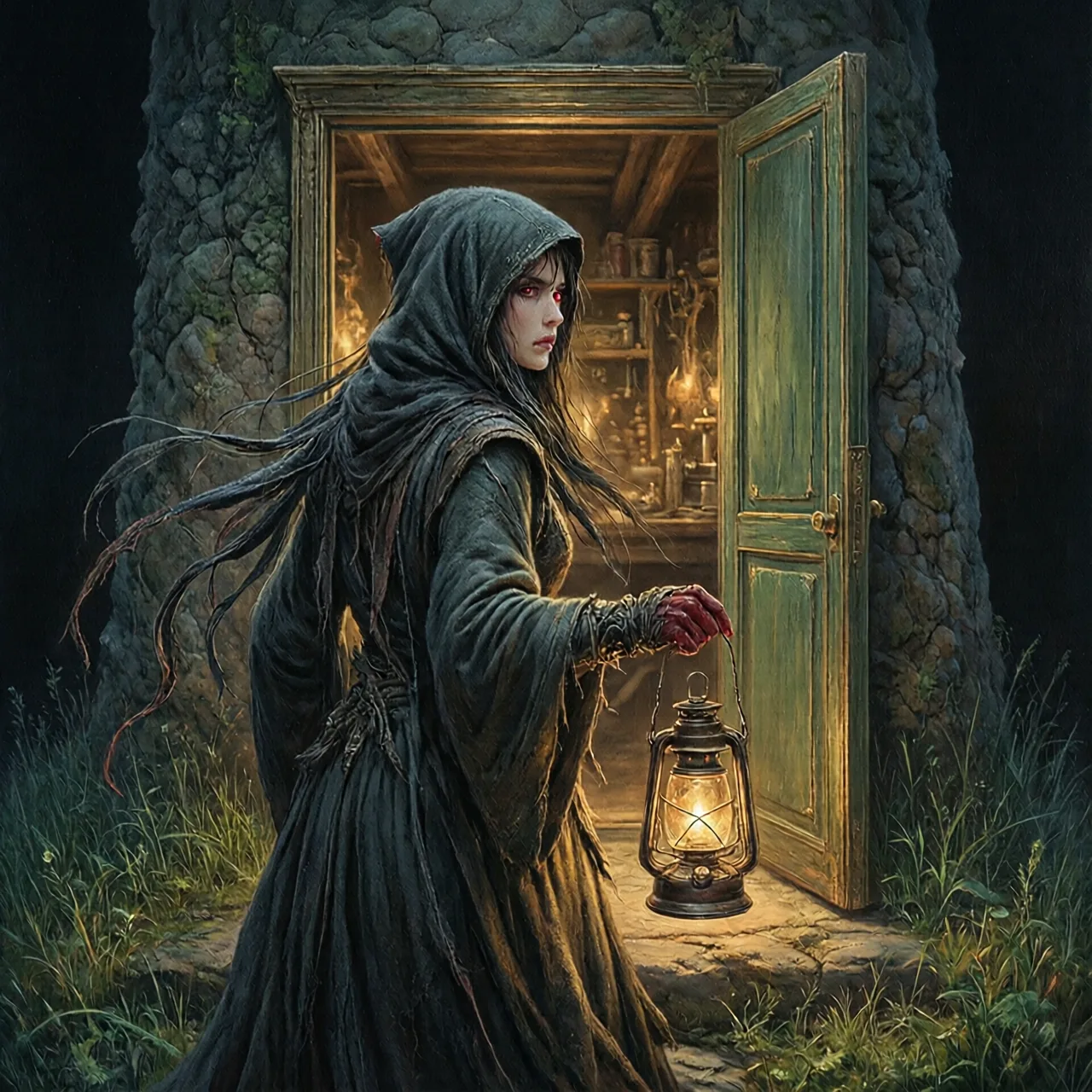
The tower is two storeys. The stone is not a stone she keeps samples of. The roof is slate of a color she has no name for. There is a single door, painted green, set in a frame of brass. There is a single window, on the upper floor, framed in copper. The window is lit. The light is not the lantern's color. The light is a color she could not place.
She walked to the door.
She did not knock.
The door opened.
Section 7Section 7
The keeper had been waiting.
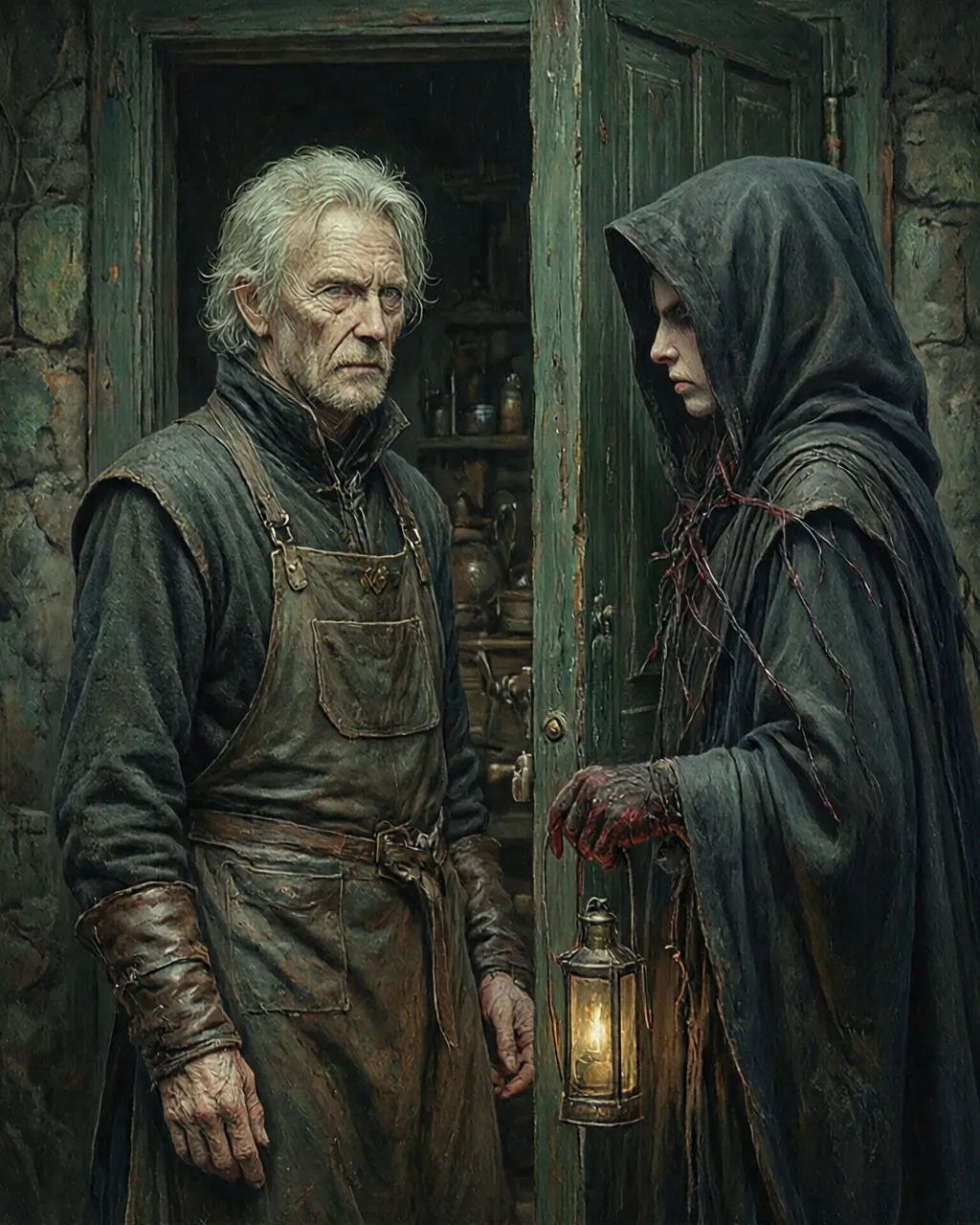
He stood in the doorway. He was thin. His hair was the color of unbleached wool. His hands were at his sides. The hands had held delicate things for a long time; the wear of the holding showed at the fingertips and at the joints of the thumbs. His eyes were the color of a pigment she had only seen on two pages of the folio, in the margin, in a small mark she had not until now been able to identify as a self-portrait.
You have come, he said.
I have come, she said. I had forgotten.
You wrote a folio, he said, for the forgetting. The forgetting was part of the keeping. I have not opened the folio. I have not been the one to open it.
Who opened it, she said.
The shelf opened it, he said. The shelf has opened it before. I have been told this. I have not seen it.
She did not extend the question. He stepped aside. She entered the tower.
Section 8Section 8
The lower floor was a workshop.
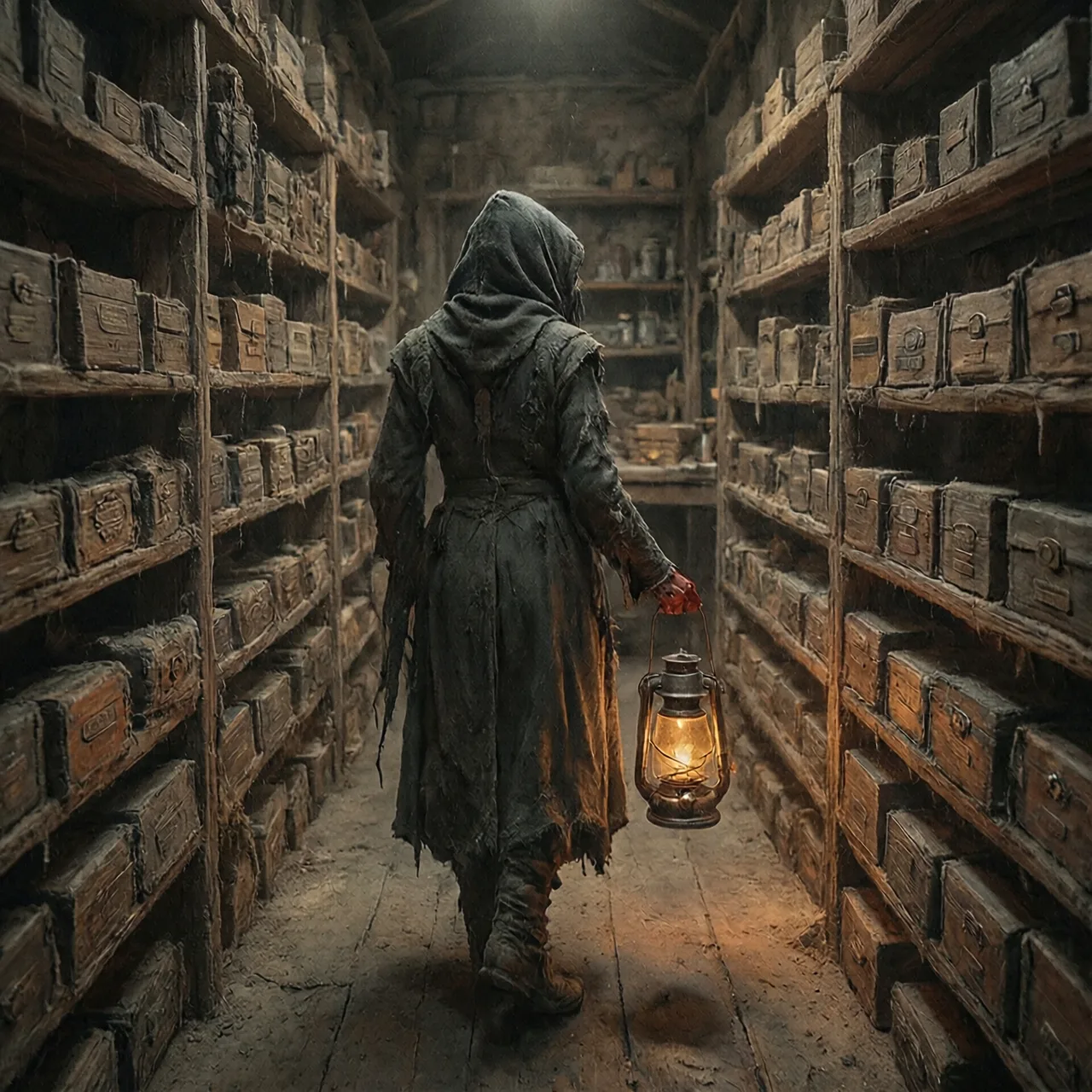
The walls were lined with shelves. The shelves held cases. Each case bore a small brass plate. Each plate bore a name. She read the names as she passed. None of them were hers. Most of them were names she had never read. Some of the cases were sealed in dust deeper than other cases, and the dust on those cases bore no recent disturbance, and the names on those cases she did not read aloud.
At the back of the workshop was a single bench. On the bench was a single case.
The plate on the case bore her designation.
She crossed the workshop.
The keeper followed at the distance she has measured in the corridor outside her alcove on the days the Guardian pauses there.
She lifted the lid of the case.
Section 9Section 9
There were six instruments.
The first was a black brass cube the size of a fist, hinged at one corner. She unlatched the lid. The lid opened on a soft pivot. Inside the cube, set in a cradle of glass beads, was a small crystal of a blue she has not catalogued and will not catalogue. The crystal pulsed. Its interval was the interval of her breath. She watched it for the duration of three further breaths. The pulses kept her interval. She closed the cube. She did not breathe further on it.
The second was a single lens of green glass mounted in a brass holder on a folding handle. She raised it to her eye. The workshop she stood in remained the workshop she stood in. Through the lens it was also the workshop the workshop had been some interval before — a vessel on the bench that was not on the bench, a lit candle in a sconce empty to the unaided eye, a gloved hand at work on a tool the lens did not resolve. She did not focus on the hand. She lowered the lens. The bench was clear.
The third was a pair of brass calipers, the points capped in pale stone. She closed them around her thumb. The dial gave a depth, not a width. The depth exceeded the diameter of her thumb. She did not read the number aloud.
The fourth was a small bell of an alloy she did not recognize. It did not ring when she lifted it. The metal was warm where her hand had touched it. Behind her the keeper said something — a single word, in a language not in her register — and the bell rang, briefly, in the shape of his speaking. She set it down. The metal was cold. The shape of the word stayed in her hearing past the moment he had spoken it.
The fifth was a glass tube sealed at both ends, containing a substance the color of a clouded purple sky. The substance moved slowly. It did not move as a fluid in a container moves. It moved as something orienting moves. She held the tube still. The substance continued to orient. Its orientation was not toward her. She did not name the point it favored.
The sixth was a small round mirror set in a copper frame inset with green glass at the cardinal points. She tilted it toward the bench. The mirror showed the case open. The case on the bench was closed. The case had been closed for an instant the mirror had not yet shown. She did not record the lag.
She closed the case.
Section 10Section 10
You have kept these for me, she said.
I have kept these for you.
For how long.
For longer, he said, than the keeping would have been possible by other means.
She did not ask again. He did not say more.
He carried the case to the door. She walked beside him. At the door he set the case in her hands. The case was heavier in her hands than it had been in his. She did not annotate the difference.
You will return, he said.
I will.
I have not the patience to explain the keeping again. The folio will be on the shelf. The shelf opens itself. You will read what you wrote.
She inclined her head. She crossed the threshold.
Section 11Section 11
The bridge of stones extended from the platform back to the arch. She walked it.
The lantern's light was steady. The stones were where the stones had been. The void was on either side. She did not look at it. She did not look at the path. She looked ahead.
Once, the dark beside the path produced a shape. The shape was a figure standing at the edge of the light, watching her cross. The figure did not approach. The figure did not extend itself toward the path. The figure was where the figure was. The lantern did not turn. She did not turn. The figure passed out of the lantern's reach behind her. She did not look back.
She arrived at the arch.
She stepped through.
She turned, in the corridor, to face the way she had come. The arch was the arch. The void was the void. The stones were not visible. The lantern's light, in the corridor, was a corridor light again.
She lowered the lantern. She returned it to its bracket.
Section 12Section 12
She walked to her desk.
She placed the case on the blotter. She lifted the case's lid. She arranged the six instruments at her desk in a configuration she did not remember having configured.
She placed the cube at the upper left. She placed the lens at the upper right. The calipers below the cube. The bell below the lens. The tube at the lower left. The mirror at the lower right.
She placed the stylus at the center.
The lantern was in its bracket.
She wrote the entry.
Entry 12,418, final annotation.
"I had forgotten the instruments. The folio reminded me. The keeper had kept them. I went to the third shard and I returned.
The path of stones extends from the eastern arch when the lantern is lifted. The path was not visible without the lantern. The light from an oil-fed flame would not have reached the first stone. I have noted this in the descent log of the journey. I have not extended it.
The keeper said the folio is on the shelf because the shelf opens itself. The shelf is the shelf for items others bring me. The shelf is in my archive. I have noted this. I have not extended the note.
The instruments are at my desk. I have had them at my desk before. I do not remember having them. I have begun to remember them as I use them, the way a hand remembers a tool when the tool is in the hand.
The stylus has been with me longer than I can measure. The annotation in the folio said I do not give it back. I have not given it back.
The lantern is in its bracket. The lantern has not been catalogued. The lantern reveals a path of stones across the void when the lantern is lifted at the eastern arch. I have lifted the lantern in many corridors of the archive. I have not catalogued what the lantern has revealed in those corridors. I have, in writing this, considered the possibility that I should.
I have decided I will not. Not yet.
A figure stood at the edge of the lantern's light on the return crossing. The figure did not approach. I did not look back.
The folio is on the eastern stack. The shelf does what shelves do not do. The folio will, when the shelf decides, be there again.
The keeper said I will return. I will."
Section 0Frontmatter
# The Keeper
From the Catalogue of the Sixteenth Archivist, entry 12,418. Provenance: a folio recovered from the eastern stack, bound in her own hand, listing eight instruments she had not been able to recall; six instruments retrieved from the keeper's workshop on the third shard and now arrayed at her desk; the keeper's ledger, in a hand the Librarian could not place, signed in his own; one item taken from the inheritance drawer for the journey and returned to the drawer on her return. The lantern was carried out and back. It is in its bracket. It has not been catalogued. It has never been catalogued.
She had forgotten she had instruments.
Section 1Section 1
The folio was at the back of the third row of the eastern stack, on the shelf for items she does not file her own work to. The shelf is for what others bring her — travelers' journals, recovered tablets, intake she cannot identify. The folio was behind a tablet she has been meaning to return to its case.
The leather was her binding. The thread pattern was hers. The knot at the spine was hers. She has not bound a folio for the eastern stack at any point in her tenure. She has not bound a folio whose provenance she did not catalogue.
She opened it.
The first page was a list. The list was eight items.
The hand was hers.
Section 2Section 2
The chronicles refer to instruments. She has measured at apertures. She has resolved temperature differentials. She has read at frequencies. She has held instruments near forms and recorded what the recordings recorded.
She has not, in any of those entries, listed what she carries.
The omission is the omission. She had not noticed the omission.
The folio listed eight items. Two were on her desk as she read.
The stylus. The annotation beneath the stylus was in a hand other than hers. It read: kept with you. you do not give it back. The hand was not the keeper's. The hand was not, so far as she could tell, anyone's.
The lantern. The annotation beneath the lantern was blank. The page bore the impression of writing — the faint shadow at the depth pressure leaves when a hand has written and the writing has been removed. She has not been able to read the impression. She has not been able to date the removal.
The remaining six items were the keeper's.
She read the keeper's name on the folio's final page. She did not recognize the name as a name in any record she keeps. She read it aloud.
The name surfaced in her.
She did not remember when she had last seen him. She did not remember leaving the instruments with him. She remembered only that he held them, and that the holding was a thing she had asked of him.
Section 3Section 3
She prepared.
She closed the folio and placed it in the inner pocket of her robe. She drew from the inheritance drawer the small folded cloth and placed it in the same pocket. She did not draw the coin. She drew the glass tube of clear liquid she has not opened and has not catalogued and placed it in the outer pocket. She did not draw the key.
The knife was in its box beneath the desk. She considered the box. The journey she was preparing for was not a journey the knife was for. She did not open the box.
She lifted the lantern from its bracket.
The lantern is brass. The lantern is the size of a small fist. The lantern has a wick the chronicles describe. The chronicles describe her trimming the wick. She does not, on this occasion, trim the wick. She has not, on any occasion this season, trimmed the wick. The wick is the wick. The flame is the flame. The flame is at the height she has set it to.
She walked to the corridor.
She did not pass the western junction. The Guardian was not in the corridor she walked. She did not look for him. The corridor she walked was an outward corridor.
Section 4Section 4
The outer ring of the archive opens, in three places, to the void.
The opening she walked to was the opening at the eastern terminus of the upper ring. The opening is an arch cut from the parent stone. The stone beyond the arch is not stone. It is the edge.
She stood at the arch.
The void began at her boot.
The void is what the chronicles describe and what she will not extend the description of. There is the dark. There is the absence of horizon. There is the absence of sound. She has stood at this arch many times. She has not, in the duration of her tenure, stepped through it.
She lifted the lantern.
The light from the lantern carried further than the light of an oil-fed flame should have carried. The light reached out in a line that was not the cone the lantern's hood would produce. The line followed a path. The path was a line of stones a meter wide that extended from the arch into the void at a downward slope so gradual she did not feel it as descent.
The stones had not been visible before she lifted the lantern.
The first stone bore the mark of a foot. The mark was hers.
She stepped through the arch.
Section 5Section 5
She walked.
The lantern revealed the stones ahead of her one by one. The stones were not new. The stones bore wear at the centers. The wear was a wear consistent with passage. She did not measure the wear. She did not measure how often she had passed.
The void was beneath the stones. The void was beside the stones. The void had not, in any record she keeps, been beneath or beside her in any other corridor.
She walked at her own pace. She did not hurry. The lantern's light extended ahead of her as she walked. The light did not flicker. Behind her the arch of the archive grew small and grew small and was small.
She had carried oil flames in many corridors. The flame had always answered the small turbulences a body and its walking make. The flame over the path did not answer. It was the flame she had set it to. It was the flame she had set it to and was nothing else.
The stones behind her did not remain in the lantern's reach. She glanced once. Where she had crossed there was no path. The stones were where the lantern was. Where the lantern had been there was the void.
Twice the dark beside the path thickened in a way she has identified in the deep stacks when she works without the red. She did not turn the lantern toward the thickening. The thickening did not extend toward the path.
After an interval she did not record, a shape arrived at the limit of the lantern's reach.
The shape was a platform. The platform was stone. On the platform stood a tower.
The tower was the third shard.
Section 6Section 6
The third shard is small. Its land is the platform the path delivers her to and a small surround beyond. The surround is grass of a kind she has seen in no other place. The grass is the color of grass cut yesterday and not yet dried. The grass does not move. The air does not move. The light comes from no direction and from every direction equally; there is no shadow on the third shard.
The records she has read describe the shards as taking their characters from sections of the archive. The third shard takes its character from a section of her archive she has only ever stood at the threshold of. She has not catalogued the correspondence.
The tower is the keeper's.
The tower is two storeys. The stone is not a stone she keeps samples of. The roof is slate of a color she has no name for. There is a single door, painted green, set in a frame of brass. There is a single window, on the upper floor, framed in copper. The window is lit. The light is not the lantern's color. The light is a color she could not place.
She walked to the door.
She did not knock.
The door opened.
Section 7Section 7
The keeper had been waiting.
He stood in the doorway. He was thin. His hair was the color of unbleached wool. His hands were at his sides. The hands had held delicate things for a long time; the wear of the holding showed at the fingertips and at the joints of the thumbs. His eyes were the color of a pigment she had only seen on two pages of the folio, in the margin, in a small mark she had not until now been able to identify as a self-portrait.
You have come, he said.
I have come, she said. I had forgotten.
You wrote a folio, he said, for the forgetting. The forgetting was part of the keeping. I have not opened the folio. I have not been the one to open it.
Who opened it, she said.
The shelf opened it, he said. The shelf has opened it before. I have been told this. I have not seen it.
She did not extend the question. He stepped aside. She entered the tower.
Section 8Section 8
The lower floor was a workshop.
The walls were lined with shelves. The shelves held cases. Each case bore a small brass plate. Each plate bore a name. She read the names as she passed. None of them were hers. Most of them were names she had never read. Some of the cases were sealed in dust deeper than other cases, and the dust on those cases bore no recent disturbance, and the names on those cases she did not read aloud.
At the back of the workshop was a single bench. On the bench was a single case.
The plate on the case bore her designation.
She crossed the workshop.
The keeper followed at the distance she has measured in the corridor outside her alcove on the days the Guardian pauses there.
She lifted the lid of the case.
Section 9Section 9
There were six instruments.
The first was a black brass cube the size of a fist, hinged at one corner. She unlatched the lid. The lid opened on a soft pivot. Inside the cube, set in a cradle of glass beads, was a small crystal of a blue she has not catalogued and will not catalogue. The crystal pulsed. Its interval was the interval of her breath. She watched it for the duration of three further breaths. The pulses kept her interval. She closed the cube. She did not breathe further on it.
The second was a single lens of green glass mounted in a brass holder on a folding handle. She raised it to her eye. The workshop she stood in remained the workshop she stood in. Through the lens it was also the workshop the workshop had been some interval before — a vessel on the bench that was not on the bench, a lit candle in a sconce empty to the unaided eye, a gloved hand at work on a tool the lens did not resolve. She did not focus on the hand. She lowered the lens. The bench was clear.
The third was a pair of brass calipers, the points capped in pale stone. She closed them around her thumb. The dial gave a depth, not a width. The depth exceeded the diameter of her thumb. She did not read the number aloud.
The fourth was a small bell of an alloy she did not recognize. It did not ring when she lifted it. The metal was warm where her hand had touched it. Behind her the keeper said something — a single word, in a language not in her register — and the bell rang, briefly, in the shape of his speaking. She set it down. The metal was cold. The shape of the word stayed in her hearing past the moment he had spoken it.
The fifth was a glass tube sealed at both ends, containing a substance the color of a clouded purple sky. The substance moved slowly. It did not move as a fluid in a container moves. It moved as something orienting moves. She held the tube still. The substance continued to orient. Its orientation was not toward her. She did not name the point it favored.
The sixth was a small round mirror set in a copper frame inset with green glass at the cardinal points. She tilted it toward the bench. The mirror showed the case open. The case on the bench was closed. The case had been closed for an instant the mirror had not yet shown. She did not record the lag.
She closed the case.
Section 10Section 10
You have kept these for me, she said.
I have kept these for you.
For how long.
For longer, he said, than the keeping would have been possible by other means.
She did not ask again. He did not say more.
He carried the case to the door. She walked beside him. At the door he set the case in her hands. The case was heavier in her hands than it had been in his. She did not annotate the difference.
You will return, he said.
I will.
I have not the patience to explain the keeping again. The folio will be on the shelf. The shelf opens itself. You will read what you wrote.
She inclined her head. She crossed the threshold.
Section 11Section 11
The bridge of stones extended from the platform back to the arch. She walked it.
The lantern's light was steady. The stones were where the stones had been. The void was on either side. She did not look at it. She did not look at the path. She looked ahead.
Once, the dark beside the path produced a shape. The shape was a figure standing at the edge of the light, watching her cross. The figure did not approach. The figure did not extend itself toward the path. The figure was where the figure was. The lantern did not turn. She did not turn. The figure passed out of the lantern's reach behind her. She did not look back.
She arrived at the arch.
She stepped through.
She turned, in the corridor, to face the way she had come. The arch was the arch. The void was the void. The stones were not visible. The lantern's light, in the corridor, was a corridor light again.
She lowered the lantern. She returned it to its bracket.
Section 12Section 12
She walked to her desk.
She placed the case on the blotter. She lifted the case's lid. She arranged the six instruments at her desk in a configuration she did not remember having configured.
She placed the cube at the upper left. She placed the lens at the upper right. The calipers below the cube. The bell below the lens. The tube at the lower left. The mirror at the lower right.
She placed the stylus at the center.
The lantern was in its bracket.
She wrote the entry.
Entry 12,418, final annotation.
"I had forgotten the instruments. The folio reminded me. The keeper had kept them. I went to the third shard and I returned.
The path of stones extends from the eastern arch when the lantern is lifted. The path was not visible without the lantern. The light from an oil-fed flame would not have reached the first stone. I have noted this in the descent log of the journey. I have not extended it.
The keeper said the folio is on the shelf because the shelf opens itself. The shelf is the shelf for items others bring me. The shelf is in my archive. I have noted this. I have not extended the note.
The instruments are at my desk. I have had them at my desk before. I do not remember having them. I have begun to remember them as I use them, the way a hand remembers a tool when the tool is in the hand.
The stylus has been with me longer than I can measure. The annotation in the folio said I do not give it back. I have not given it back.
The lantern is in its bracket. The lantern has not been catalogued. The lantern reveals a path of stones across the void when the lantern is lifted at the eastern arch. I have lifted the lantern in many corridors of the archive. I have not catalogued what the lantern has revealed in those corridors. I have, in writing this, considered the possibility that I should.
I have decided I will not. Not yet.
A figure stood at the edge of the lantern's light on the return crossing. The figure did not approach. I did not look back.
The folio is on the eastern stack. The shelf does what shelves do not do. The folio will, when the shelf decides, be there again.
The keeper said I will return. I will."
Page 1
She had forgotten she had instruments.
She had forgotten she had instruments. The folio was at the back of the third row of the eastern stack. The leather was her binding. The thread pattern was hers. The knot at the spine was hers. She has not bound a folio for the eastern stack at any point in her tenure. She opened it. The first page was a list. The list was eight items. The hand was hers.
Two of the eight items were on her desk as she read. The stylus. The annotation beneath the stylus was in a hand other than hers. It read: kept with you. you do not give it back. The hand was not the keeper's. The hand was not, so far as she could tell, anyone's.
Page 2
The hand was hers.
The folio was at the back of the third row of the eastern stack — the shelf for items others bring her. She has not bound a folio for the eastern stack at any point in her tenure. She has not bound a folio whose provenance she did not catalogue. She lifted it from behind the tablet she had been meaning to return to its case.
The leather was her binding. The thread pattern was hers. The knot at the spine was hers.
Page 3
The omission is the omission.
The lantern. The annotation beneath the lantern was blank. The page bore the impression of writing — the faint shadow at the depth pressure leaves when a hand has written and the writing has been removed. She has not been able to read the impression. She has not been able to date the removal.
The folio listed eight items. Two were on her desk as she read. The remaining six items were the keeper's. The omission is the omission. She had not noticed the omission.
Page 4
The journey was not a journey the knife was for.
She drew from the inheritance drawer the small folded cloth and placed it in the inner pocket of her robe. She did not draw the coin. She drew the glass tube of clear liquid she has not opened and has not catalogued and placed it in the outer pocket. She did not draw the key.
The knife was in its box beneath the desk. She considered the box. The journey she was preparing for was not a journey the knife was for. She did not open the box.
She lifted the lantern from its bracket. She walked to the corridor.
Page 5
The void began at her boot.
The outer ring of the archive opens, in three places, to the void. The opening she walked to was the opening at the eastern terminus of the upper ring. The opening is an arch cut from the parent stone. The stone beyond the arch is not stone. It is the edge.
She stood at the arch. The void began at her boot. The void is what the chronicles describe and what she will not extend the description of. There is the dark. There is the absence of horizon. There is the absence of sound. She has stood at this arch many times. She has not, in the duration of her tenure, stepped through it.
Page 6
The first stone bore the mark of a foot. The mark was hers.
She lifted the lantern. The light from the lantern carried further than the light of an oil-fed flame should have carried. The light reached out in a line that was not the cone the lantern's hood would produce. The line followed a path. The path was a line of stones a meter wide that extended from the arch into the void at a downward slope so gradual she did not feel it as descent. The stones had not been visible before she lifted the lantern.
The first stone bore the mark of a foot. The mark was hers. She stepped through the arch.
Page 7
The flame answered nothing.
She walked. The lantern revealed the stones ahead of her one by one. The stones were not new. The stones bore wear at the centres. The wear was a wear consistent with passage. She did not measure how often she had passed. She walked at her own pace. Behind her the arch of the archive grew small and grew small and was small.
She had carried oil flames in many corridors. The flame had always answered the small turbulences a body and its walking make. The flame over the path did not answer. It was the flame she had set it to. It was the flame she had set it to and was nothing else.
The stones behind her did not remain in the lantern's reach. She glanced once. Where she had crossed there was no path. The stones were where the lantern was. Where the lantern had been there was the void.
Page 8
Twice the dark thickened.
Twice the dark beside the path thickened in a way she has identified in the deep stacks when she works without the red. She did not turn the lantern toward the thickening. The thickening did not extend toward the path.
Page 9
The door opened.
She walked to the door. She did not knock. The door opened. The keeper had been waiting.
Page 10
I have not been the one to open it.
He stood in the doorway. He was thin. His hair was the colour of unbleached wool. His eyes were the colour of a pigment she had only seen on two pages of the folio, in the margin, in a small mark she had not until now been able to identify as a self-portrait.
The KeeperYou have come.
The LibrarianI have come. I had forgotten.
The KeeperYou wrote a folio for the forgetting. The forgetting was part of the keeping. I have not opened the folio. I have not been the one to open it.
The LibrarianWho opened it.
The KeeperThe shelf opened it. The shelf has opened it before. I have been told this. I have not seen it.
Page 11
Each plate bore a name.
The lower floor was a workshop. The walls were lined with shelves. The shelves held cases. Each case bore a small brass plate. Each plate bore a name. None of them were hers. Most of them were names she had never read. Some of the cases were sealed in dust deeper than other cases, and the dust on those cases bore no recent disturbance, and the names on those cases she did not read aloud.
At the back of the workshop was a single bench. On the bench was a single case. The plate on the case bore her designation. The keeper followed at the distance she has measured in the corridor outside her alcove on the days the Guardian pauses there. She lifted the lid of the case.
Page 12
The six instruments.
The first was a black brass cube, hinged at one corner. Inside, set in a cradle of glass beads, was a small crystal of a blue she has not catalogued. The crystal pulsed. Its interval was the interval of her breath.
The second was a single lens of green glass mounted in a brass holder. Through the lens the workshop was also the workshop the workshop had been some interval before — a vessel on the bench that was not on the bench, a lit candle in a sconce empty to the unaided eye, a gloved hand at work on a tool the lens did not resolve.
The third was a pair of brass calipers, the points capped in pale stone. She closed them around her thumb. The dial gave a depth, not a width. The depth exceeded the diameter of her thumb. She did not read the number aloud.
The fourth was a small bell of an alloy she did not recognise. It did not ring when she lifted it. Behind her the keeper said something — a single word, in a language not in her register — and the bell rang, briefly, in the shape of his speaking. The shape of the word stayed in her hearing past the moment he had spoken it.
The fifth was a glass tube sealed at both ends, containing a substance the colour of a clouded purple sky. The substance moved slowly. It did not move as a fluid in a container moves. It moved as something orienting moves. Its orientation was not toward her. She did not name the point it favoured.
The sixth was a small round mirror set in a copper frame inset with green glass at the cardinal points. She tilted it toward the bench. The mirror showed the case open. The case on the bench was closed. The case had been closed for an instant the mirror had not yet shown. She did not record the lag. She closed the case.
Page 13
The keeper said I will return. I will.
He carried the case to the door. She walked beside him. At the door he set the case in her hands. The case was heavier in her hands than it had been in his. She did not annotate the difference.
The KeeperYou will return.
The LibrarianI will.
The KeeperI have not the patience to explain the keeping again. The folio will be on the shelf. The shelf opens itself. You will read what you wrote.
The bridge of stones extended from the platform back to the arch. Once, the dark beside the path produced a shape. The shape was a figure standing at the edge of the light, watching her cross. The figure did not approach. The figure did not extend itself toward the path. The lantern did not turn. She did not turn. The figure passed out of the lantern's reach behind her. She did not look back.
She walked to her desk. She placed the case on the blotter. She lifted the case's lid. She arranged the six instruments at her desk in a configuration she did not remember having configured. She placed the stylus at the centre. The lantern was in its bracket.
She wrote the entry. The keeper said I will return. I will.
Listen ModeClick a section to begin listening
The chronicle plays section by section in the Librarian's voice. As each section plays, the corresponding pages of the comic are highlighted. Switch to Scroll, Flip, Prose, or Split at any time — the audio continues, and you can follow visually.
Section 0Frontmatter
# The Keeper
From the Catalogue of the Sixteenth Archivist, entry 12,418. Provenance: a folio recovered from the eastern stack, bound in her own hand, listing eight instruments she had not been able to recall; six instruments retrieved from the keeper's workshop on the third shard and now arrayed at her desk; the keeper's ledger, in a hand the Librarian could not place, signed in his own; one item taken from the inheritance drawer for the journey and returned to the drawer on her return. The lantern was carried out and back. It is in its bracket. It has not been catalogued. It has never been catalogued.
She had forgotten she had instruments.
Section 1Section 1
The folio was at the back of the third row of the eastern stack, on the shelf for items she does not file her own work to. The shelf is for what others bring her — travelers' journals, recovered tablets, intake she cannot identify. The folio was behind a tablet she has been meaning to return to its case.
The leather was her binding. The thread pattern was hers. The knot at the spine was hers. She has not bound a folio for the eastern stack at any point in her tenure. She has not bound a folio whose provenance she did not catalogue.
She opened it.
The first page was a list. The list was eight items.
The hand was hers.
Section 2Section 2
The chronicles refer to instruments. She has measured at apertures. She has resolved temperature differentials. She has read at frequencies. She has held instruments near forms and recorded what the recordings recorded.
She has not, in any of those entries, listed what she carries.
The omission is the omission. She had not noticed the omission.
The folio listed eight items. Two were on her desk as she read.
The stylus. The annotation beneath the stylus was in a hand other than hers. It read: kept with you. you do not give it back. The hand was not the keeper's. The hand was not, so far as she could tell, anyone's.
The lantern. The annotation beneath the lantern was blank. The page bore the impression of writing — the faint shadow at the depth pressure leaves when a hand has written and the writing has been removed. She has not been able to read the impression. She has not been able to date the removal.
The remaining six items were the keeper's.
She read the keeper's name on the folio's final page. She did not recognize the name as a name in any record she keeps. She read it aloud.
The name surfaced in her.
She did not remember when she had last seen him. She did not remember leaving the instruments with him. She remembered only that he held them, and that the holding was a thing she had asked of him.
Section 3Section 3
She prepared.
She closed the folio and placed it in the inner pocket of her robe. She drew from the inheritance drawer the small folded cloth and placed it in the same pocket. She did not draw the coin. She drew the glass tube of clear liquid she has not opened and has not catalogued and placed it in the outer pocket. She did not draw the key.
The knife was in its box beneath the desk. She considered the box. The journey she was preparing for was not a journey the knife was for. She did not open the box.
She lifted the lantern from its bracket.
The lantern is brass. The lantern is the size of a small fist. The lantern has a wick the chronicles describe. The chronicles describe her trimming the wick. She does not, on this occasion, trim the wick. She has not, on any occasion this season, trimmed the wick. The wick is the wick. The flame is the flame. The flame is at the height she has set it to.
She walked to the corridor.
She did not pass the western junction. The Guardian was not in the corridor she walked. She did not look for him. The corridor she walked was an outward corridor.
Section 4Section 4
The outer ring of the archive opens, in three places, to the void.
The opening she walked to was the opening at the eastern terminus of the upper ring. The opening is an arch cut from the parent stone. The stone beyond the arch is not stone. It is the edge.
She stood at the arch.
The void began at her boot.
The void is what the chronicles describe and what she will not extend the description of. There is the dark. There is the absence of horizon. There is the absence of sound. She has stood at this arch many times. She has not, in the duration of her tenure, stepped through it.
She lifted the lantern.
The light from the lantern carried further than the light of an oil-fed flame should have carried. The light reached out in a line that was not the cone the lantern's hood would produce. The line followed a path. The path was a line of stones a meter wide that extended from the arch into the void at a downward slope so gradual she did not feel it as descent.
The stones had not been visible before she lifted the lantern.
The first stone bore the mark of a foot. The mark was hers.
She stepped through the arch.
Section 5Section 5
She walked.
The lantern revealed the stones ahead of her one by one. The stones were not new. The stones bore wear at the centers. The wear was a wear consistent with passage. She did not measure the wear. She did not measure how often she had passed.
The void was beneath the stones. The void was beside the stones. The void had not, in any record she keeps, been beneath or beside her in any other corridor.
She walked at her own pace. She did not hurry. The lantern's light extended ahead of her as she walked. The light did not flicker. Behind her the arch of the archive grew small and grew small and was small.
She had carried oil flames in many corridors. The flame had always answered the small turbulences a body and its walking make. The flame over the path did not answer. It was the flame she had set it to. It was the flame she had set it to and was nothing else.
The stones behind her did not remain in the lantern's reach. She glanced once. Where she had crossed there was no path. The stones were where the lantern was. Where the lantern had been there was the void.
Twice the dark beside the path thickened in a way she has identified in the deep stacks when she works without the red. She did not turn the lantern toward the thickening. The thickening did not extend toward the path.
After an interval she did not record, a shape arrived at the limit of the lantern's reach.
The shape was a platform. The platform was stone. On the platform stood a tower.
The tower was the third shard.
Section 6Section 6
The third shard is small. Its land is the platform the path delivers her to and a small surround beyond. The surround is grass of a kind she has seen in no other place. The grass is the color of grass cut yesterday and not yet dried. The grass does not move. The air does not move. The light comes from no direction and from every direction equally; there is no shadow on the third shard.
The records she has read describe the shards as taking their characters from sections of the archive. The third shard takes its character from a section of her archive she has only ever stood at the threshold of. She has not catalogued the correspondence.
The tower is the keeper's.
The tower is two storeys. The stone is not a stone she keeps samples of. The roof is slate of a color she has no name for. There is a single door, painted green, set in a frame of brass. There is a single window, on the upper floor, framed in copper. The window is lit. The light is not the lantern's color. The light is a color she could not place.
She walked to the door.
She did not knock.
The door opened.
Section 7Section 7
The keeper had been waiting.
He stood in the doorway. He was thin. His hair was the color of unbleached wool. His hands were at his sides. The hands had held delicate things for a long time; the wear of the holding showed at the fingertips and at the joints of the thumbs. His eyes were the color of a pigment she had only seen on two pages of the folio, in the margin, in a small mark she had not until now been able to identify as a self-portrait.
You have come, he said.
I have come, she said. I had forgotten.
You wrote a folio, he said, for the forgetting. The forgetting was part of the keeping. I have not opened the folio. I have not been the one to open it.
Who opened it, she said.
The shelf opened it, he said. The shelf has opened it before. I have been told this. I have not seen it.
She did not extend the question. He stepped aside. She entered the tower.
Section 8Section 8
The lower floor was a workshop.
The walls were lined with shelves. The shelves held cases. Each case bore a small brass plate. Each plate bore a name. She read the names as she passed. None of them were hers. Most of them were names she had never read. Some of the cases were sealed in dust deeper than other cases, and the dust on those cases bore no recent disturbance, and the names on those cases she did not read aloud.
At the back of the workshop was a single bench. On the bench was a single case.
The plate on the case bore her designation.
She crossed the workshop.
The keeper followed at the distance she has measured in the corridor outside her alcove on the days the Guardian pauses there.
She lifted the lid of the case.
Section 9Section 9
There were six instruments.
The first was a black brass cube the size of a fist, hinged at one corner. She unlatched the lid. The lid opened on a soft pivot. Inside the cube, set in a cradle of glass beads, was a small crystal of a blue she has not catalogued and will not catalogue. The crystal pulsed. Its interval was the interval of her breath. She watched it for the duration of three further breaths. The pulses kept her interval. She closed the cube. She did not breathe further on it.
The second was a single lens of green glass mounted in a brass holder on a folding handle. She raised it to her eye. The workshop she stood in remained the workshop she stood in. Through the lens it was also the workshop the workshop had been some interval before — a vessel on the bench that was not on the bench, a lit candle in a sconce empty to the unaided eye, a gloved hand at work on a tool the lens did not resolve. She did not focus on the hand. She lowered the lens. The bench was clear.
The third was a pair of brass calipers, the points capped in pale stone. She closed them around her thumb. The dial gave a depth, not a width. The depth exceeded the diameter of her thumb. She did not read the number aloud.
The fourth was a small bell of an alloy she did not recognize. It did not ring when she lifted it. The metal was warm where her hand had touched it. Behind her the keeper said something — a single word, in a language not in her register — and the bell rang, briefly, in the shape of his speaking. She set it down. The metal was cold. The shape of the word stayed in her hearing past the moment he had spoken it.
The fifth was a glass tube sealed at both ends, containing a substance the color of a clouded purple sky. The substance moved slowly. It did not move as a fluid in a container moves. It moved as something orienting moves. She held the tube still. The substance continued to orient. Its orientation was not toward her. She did not name the point it favored.
The sixth was a small round mirror set in a copper frame inset with green glass at the cardinal points. She tilted it toward the bench. The mirror showed the case open. The case on the bench was closed. The case had been closed for an instant the mirror had not yet shown. She did not record the lag.
She closed the case.
Section 10Section 10
You have kept these for me, she said.
I have kept these for you.
For how long.
For longer, he said, than the keeping would have been possible by other means.
She did not ask again. He did not say more.
He carried the case to the door. She walked beside him. At the door he set the case in her hands. The case was heavier in her hands than it had been in his. She did not annotate the difference.
You will return, he said.
I will.
I have not the patience to explain the keeping again. The folio will be on the shelf. The shelf opens itself. You will read what you wrote.
She inclined her head. She crossed the threshold.
Section 11Section 11
The bridge of stones extended from the platform back to the arch. She walked it.
The lantern's light was steady. The stones were where the stones had been. The void was on either side. She did not look at it. She did not look at the path. She looked ahead.
Once, the dark beside the path produced a shape. The shape was a figure standing at the edge of the light, watching her cross. The figure did not approach. The figure did not extend itself toward the path. The figure was where the figure was. The lantern did not turn. She did not turn. The figure passed out of the lantern's reach behind her. She did not look back.
She arrived at the arch.
She stepped through.
She turned, in the corridor, to face the way she had come. The arch was the arch. The void was the void. The stones were not visible. The lantern's light, in the corridor, was a corridor light again.
She lowered the lantern. She returned it to its bracket.
Section 12Section 12
She walked to her desk.
She placed the case on the blotter. She lifted the case's lid. She arranged the six instruments at her desk in a configuration she did not remember having configured.
She placed the cube at the upper left. She placed the lens at the upper right. The calipers below the cube. The bell below the lens. The tube at the lower left. The mirror at the lower right.
She placed the stylus at the center.
The lantern was in its bracket.
She wrote the entry.
Entry 12,418, final annotation.
"I had forgotten the instruments. The folio reminded me. The keeper had kept them. I went to the third shard and I returned.
The path of stones extends from the eastern arch when the lantern is lifted. The path was not visible without the lantern. The light from an oil-fed flame would not have reached the first stone. I have noted this in the descent log of the journey. I have not extended it.
The keeper said the folio is on the shelf because the shelf opens itself. The shelf is the shelf for items others bring me. The shelf is in my archive. I have noted this. I have not extended the note.
The instruments are at my desk. I have had them at my desk before. I do not remember having them. I have begun to remember them as I use them, the way a hand remembers a tool when the tool is in the hand.
The stylus has been with me longer than I can measure. The annotation in the folio said I do not give it back. I have not given it back.
The lantern is in its bracket. The lantern has not been catalogued. The lantern reveals a path of stones across the void when the lantern is lifted at the eastern arch. I have lifted the lantern in many corridors of the archive. I have not catalogued what the lantern has revealed in those corridors. I have, in writing this, considered the possibility that I should.
I have decided I will not. Not yet.
A figure stood at the edge of the lantern's light on the return crossing. The figure did not approach. I did not look back.
The folio is on the eastern stack. The shelf does what shelves do not do. The folio will, when the shelf decides, be there again.