Provenance: a working knife with a leather-bound hilt, a coat of grey wool, a letter in a practiced hand. Filed thirty-one days after the event. She does not record why she filed it late. The word late appears once in her notes and is struck through.
She was writing when the man came with the knife.
Full chronicle
Page 1
She has catalogued it before she has catalogued the rest.
She was writing when the man came with the knife. The knife is on her desk. She has catalogued it before she has catalogued the rest. Eight inches. A working knife. Ground on both edges, the hilt bound in leather a man has softened against his palm for longer than the leather was meant to last. Not a ritual blade. Not a soldier's. A knife for ending things at the reach of an arm. The pitting at the hilt is where the cleaning is hardest. She knows what a knife looks like when it has been cleaned many times across a span of years. She does not know how she knows. She has not asked herself. She measures the knife. She weighs it. She writes what she knows of the steel and the leather and she writes nothing of the man. She will come to him. She comes to things in the order she comes to them.
Page 2
Three paces. Then two. Then one.
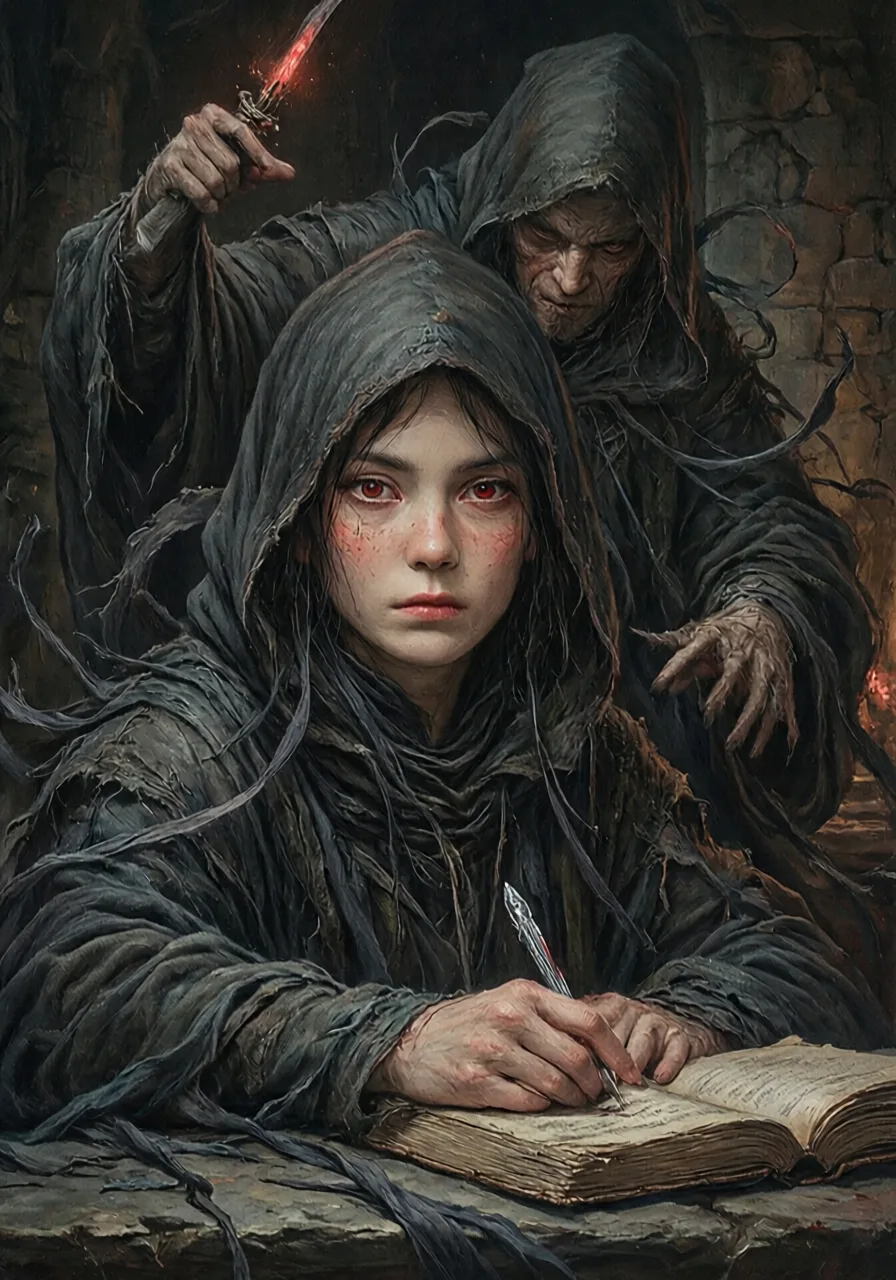
He entered through the outer ring. The dust remembered him. So did the ladders. He had moved slowly. He had tested the floor. He was a careful man. He had the boots for the cold and the coat for the wet and rubber on his soles that the cold had not cracked. He had studied the corridor. He had studied the hours at which her red light changed its depth. He had studied her. How long he had watched she has not been able to measure. There are corridors in the archive she does not traverse. There is time in her tenure she cannot account for. A watcher could have left traces she would not recognize as traces. She was at her desk. The red light was red. The stylus moved. The page turned. She did not look up. She rarely looks up. Looking up is for things that need looking at and most things do not. The man was three paces behind her. Then two. Then one.
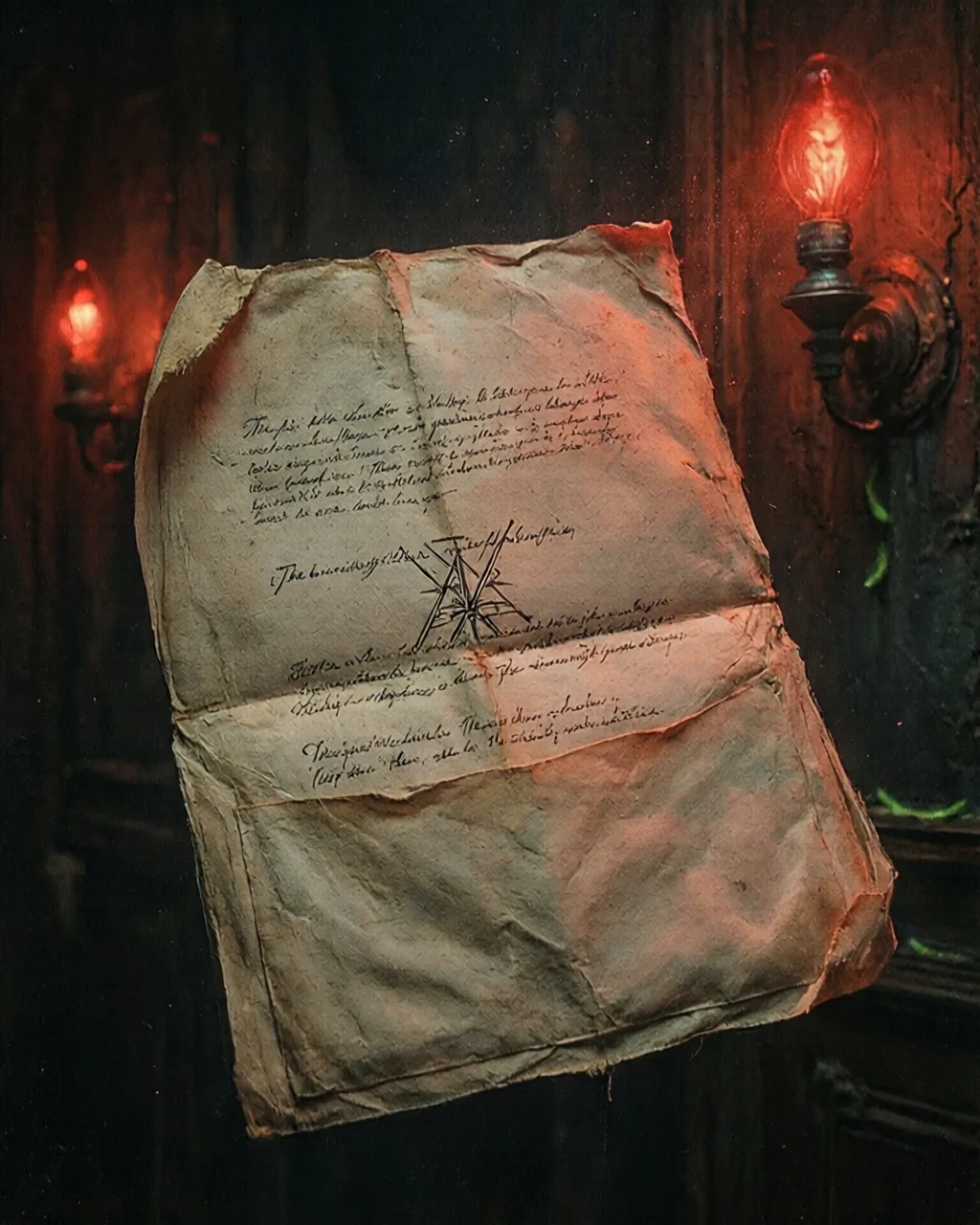
Fragment. A letter found in the inner pocket of the coat. The hand is practiced. The paper is of a kind the Librarian does not keep in her stores. The thing at the desk will look like a woman. The seeing is the first work. Put the seeing aside. The designation is enclosed. Speak it to yourself before the approach and again at the close. The word is the truth of what you are ending. The shape will not be the truth. The shape will try to be. She does not bleed. This is what we believe. If she does, it will not be the kind you know. Do not linger to watch it. The corridor has a guardian. He does not guard her. This is the margin on which the work depends. Enter on the rotation. Finish before he arrives. Payment is in the stone beneath the third rung of the drainage ladder at the outer ring. The enclosed word is not a word in any language the Librarian catalogues. She has seen it once before.
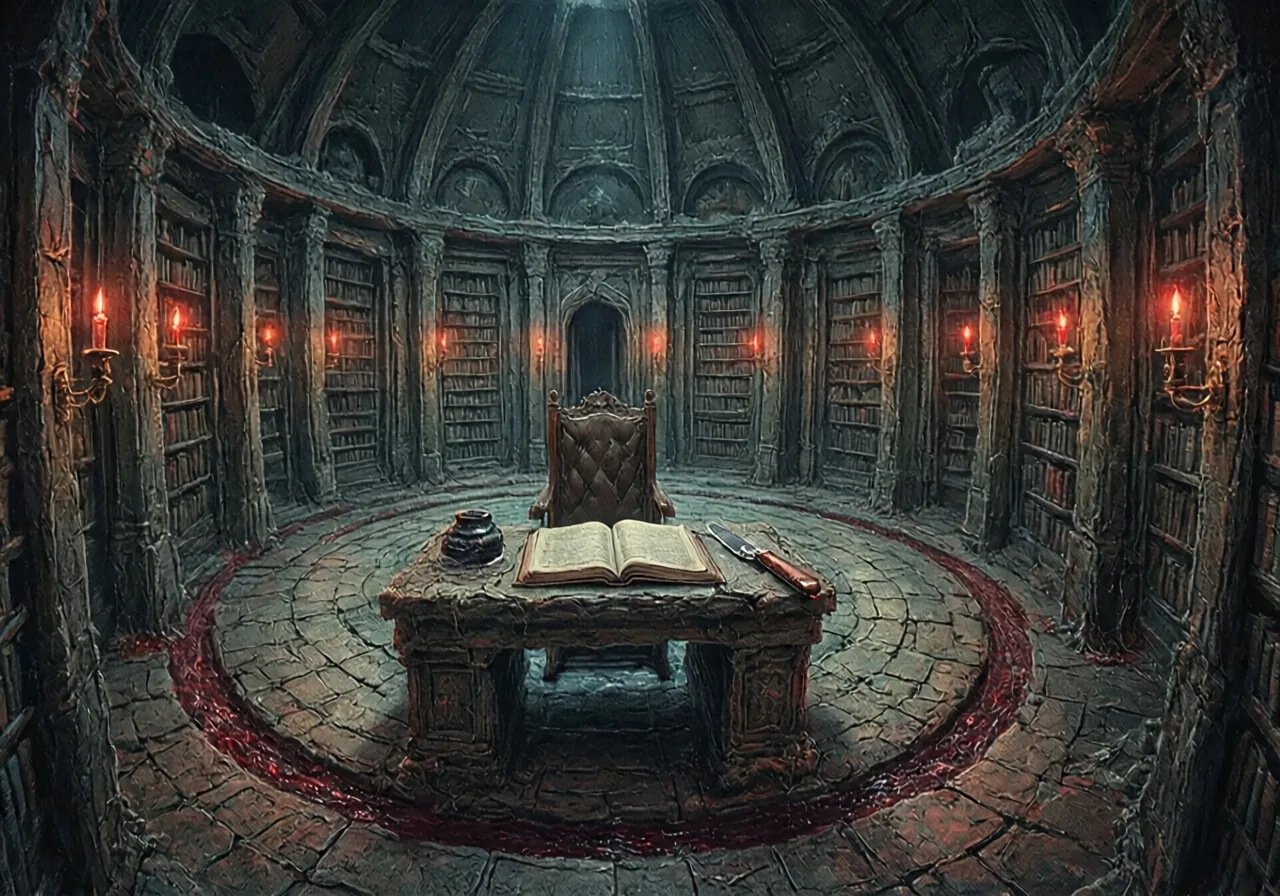
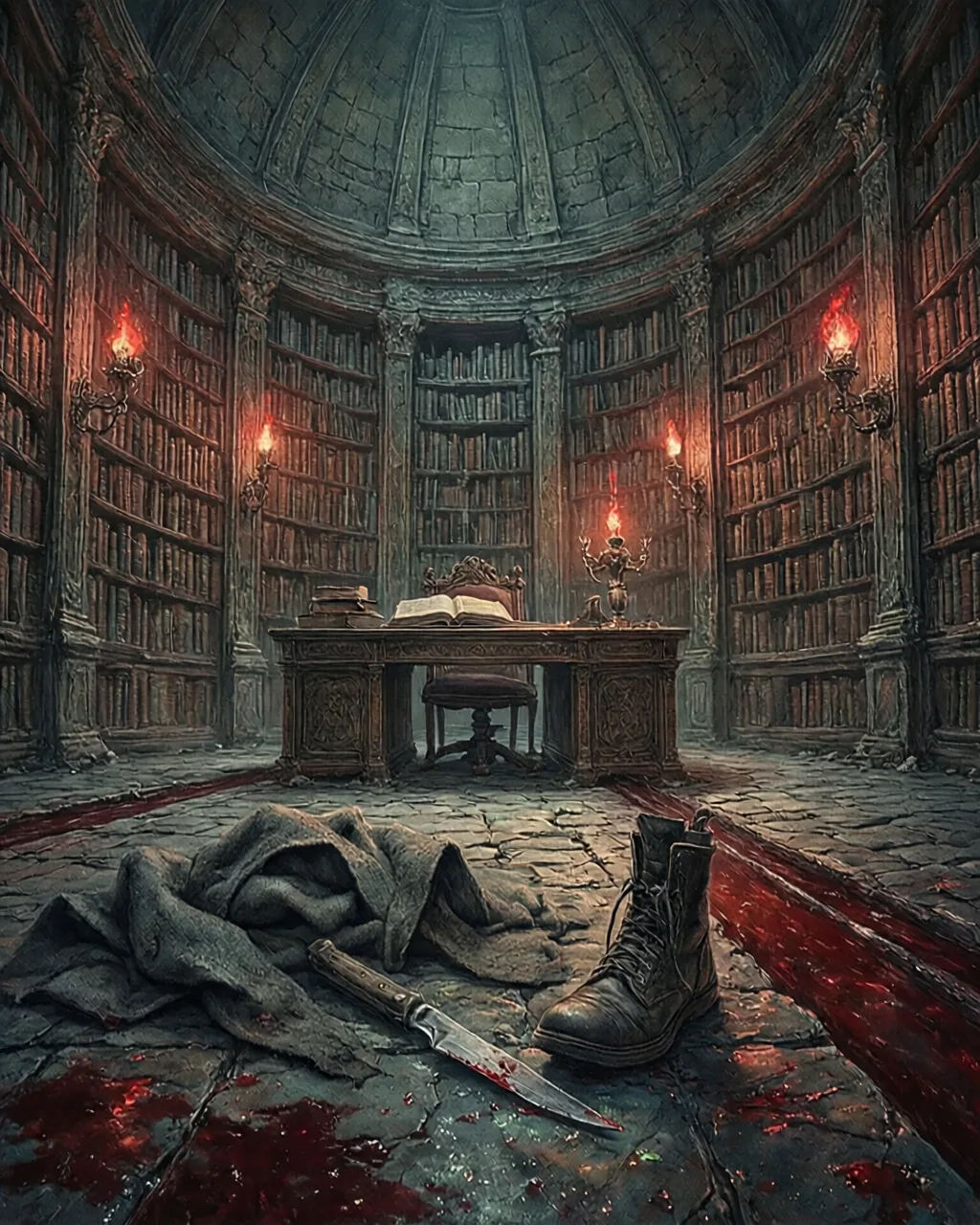
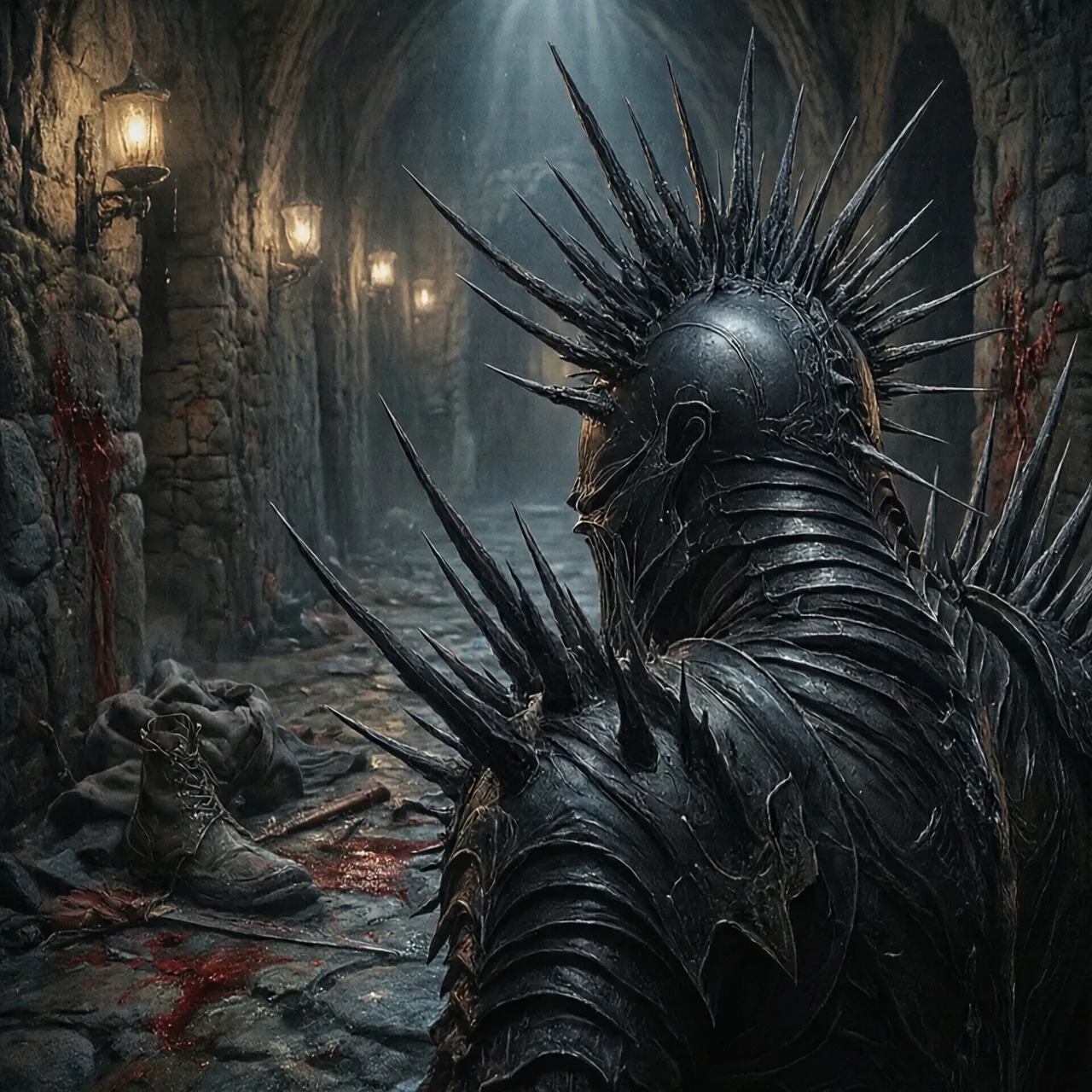
She does not know what happened between the one pace and the rest of the day. The stylus finished the character it was writing. The ink took its usual time to dry. She turned the page. She wrote the next entry. There was blood on the floor to her left. It was not hers. She noted this and continued writing for some interval she does not specify. When she had finished the paragraph she set the stylus down and closed the tome and permitted herself to look. The blood ended seven paces from her desk. There was no drag-mark. There was no body. There was a knife on the stone and a coat crumpled beside it and a man's boot, left, upright, containing nothing. The right boot was elsewhere. She has not located the right boot.
Page 3
He turned. The weight went forward onto the ball of his foot.
The Guardian was in the corridor. The slit faced the direction the man had come from. The pale blue behind it was steady and dim. The plate at his left shoulder bore a mark she did not remember — a scuff, a line of dust, the length of her thumb. His hands were at his sides. He stood the way he stands when the archive has been entered and he is waiting to see whether the entering has finished. He stood for what might have been four minutes and might have been eleven. She did not time him. She was at her desk. Timing was for a later entry.
He turned. The weight went forward onto the ball of his foot. He walked and was gone. There was no body. There was a knife on the stone and a coat crumpled beside it and a man's boot, left, upright, containing nothing. The right boot was elsewhere. She has not located the right boot. Whatever happened in the corridor between the one pace and the rest of the day, the Guardian did. The chronicle does not describe it. The Librarian did not see it. We are shown what she did not look at.
She walks. The Guardian walks. They walk the archive. Their routes are separate and have been for the duration of her records. He has never laid a plate upon her. He has never taken her by any part of her. When she has required the deep stacks she has gone on her own feet. He has never approached closer than seven paces. The seven paces is not a distance he has decided upon. It is the distance at which the archive is observed from the position where she cannot be touched. She has measured the seven paces against every wall where his boots have stopped. The seven paces is the same in every corridor she has tested. She thinks: if the archive required her to be moved, the archive would move her. The archive has not required it. She is already where she is supposed to be.
Page 4
Do not teach him her name.
I have been at this desk for a long time. I do not remember another desk. I do not remember arriving. He was here when I arrived. He is here when I arrive — the tense shift may be the truer sentence. We walk these corridors. We have walked them for longer than my records admit. We have never met. We have never parted. I am at my desk. I am in the corridor. I am the shape this archive has used to keep its records. I do not know what I was before I was the shape. I have stopped looking for the answer.
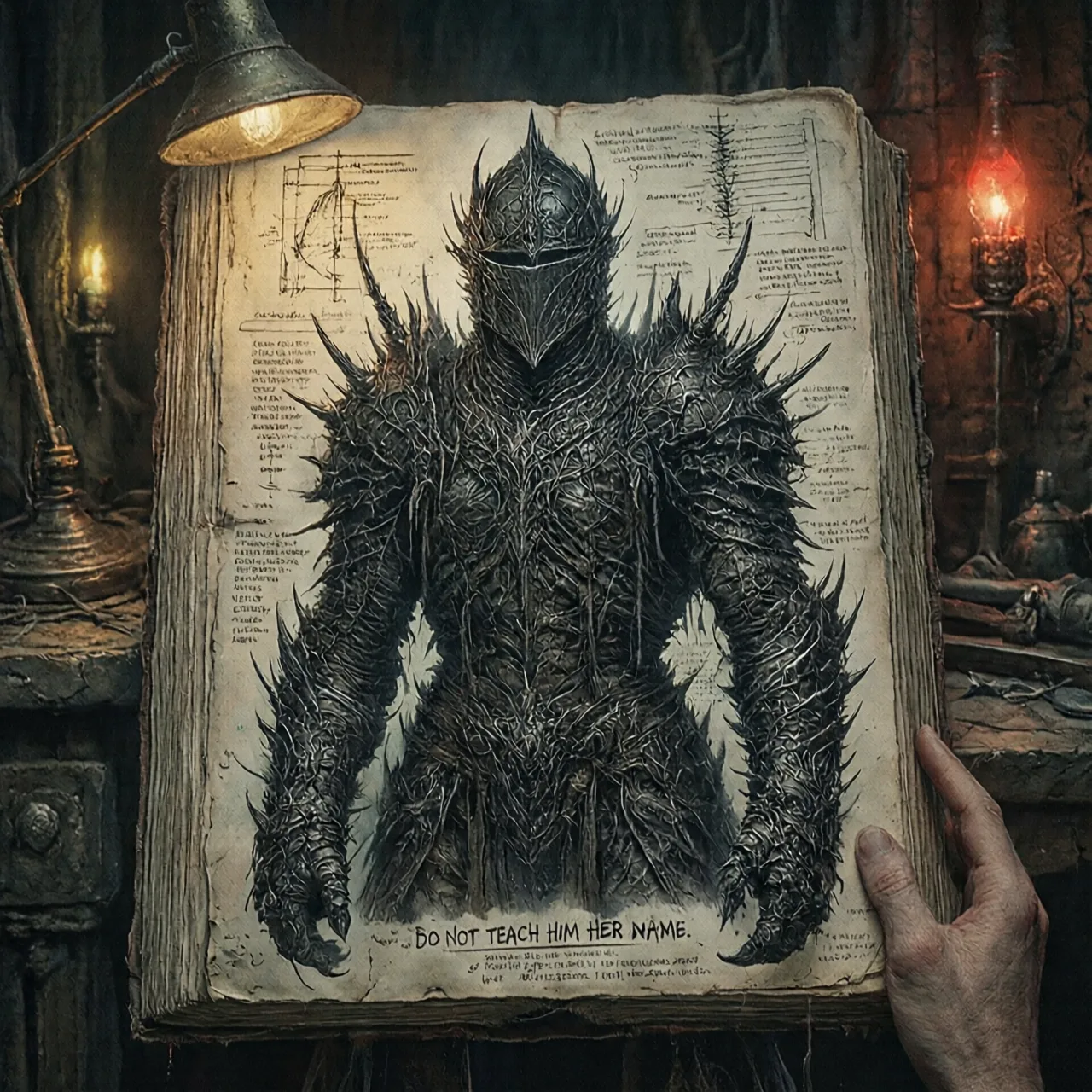
The tomes on the shelf nearest her desk are bound in a style she has used for the duration of her tenure. The knot at the spine. The thread pattern. The weight of the crystal trimmed to a tolerance she has not seen elsewhere. On the third shelf of the west wall, behind a row of geological surveys she has not opened in some years, there is a tome she does not remember. She opened it. The pages held figures. A tall form in dark plates. Overlapping along the arms and torso. A helmet with a slit. The proportions are a man's proportions or the proportions of something built to occupy the space a man occupies. There are annotations in a hand that resembles her own. A hand this practiced is not distinct from other practiced hands. She has not been able to rule out a resemblance. She has not been able to rule in more than a resemblance. There are specifications. Tolerances. A wavelength she could not verify without an instrument she does not have to hand. At the bottom of the final figure there is a line in a smaller hand: Do not teach him her name. She has closed the drawer. She has not re-opened it.
She does not know if he would protect her. She has written this in the notes to this entry in several formulations. The formulations have not converged. The true sentence may be: she does not know what her means to him. She is a shape at a desk. She is a stylus moving. She is a hand in red light that does not wash off. She is one of the things the archive contains, and the archive is what he walks. She believes the shape at the desk, when it is frightened, is not the shape. The slit did not face her then. It faced the direction from which the fear had come. I am at my desk. The stylus is in my hand. The tome is open. The page is turning. Somewhere in the archive he is walking. I do not know what he is. I have written sentences that suggested I might know. I do not know. I know that we have walked here together for a very long time. He walks.
— / —
narration auto-scrolls the prose
Section 0Frontmatter
# The Librarian and the Guardian
From the Catalogue of the Sixteenth Archivist, entry 11,847. Provenance: a working knife with a leather-bound hilt, a coat of grey wool, a letter in a practiced hand. Filed thirty-one days after the event. She does not record why she filed it late. The word late appears once in her notes and is struck through.
She was writing when the man came with the knife.
Section 1Section 1
The knife is on her desk. She has catalogued it before she has catalogued the rest.
Eight inches. A working knife. Ground on both edges, the hilt bound in leather a man has softened against his palm for longer than the leather was meant to last. Not a ritual blade. Not a soldier's. A knife for ending things at the reach of an arm. The pitting at the hilt is where the cleaning is hardest. She knows what a knife looks like when it has been cleaned many times across a span of years. She does not know how she knows. She has not asked herself.
She measures the knife. She weighs it. She writes what she knows of the steel and the leather and she writes nothing of the man.
She will come to him. She comes to things in the order she comes to them.
Section 2Section 2
He entered through the outer ring.
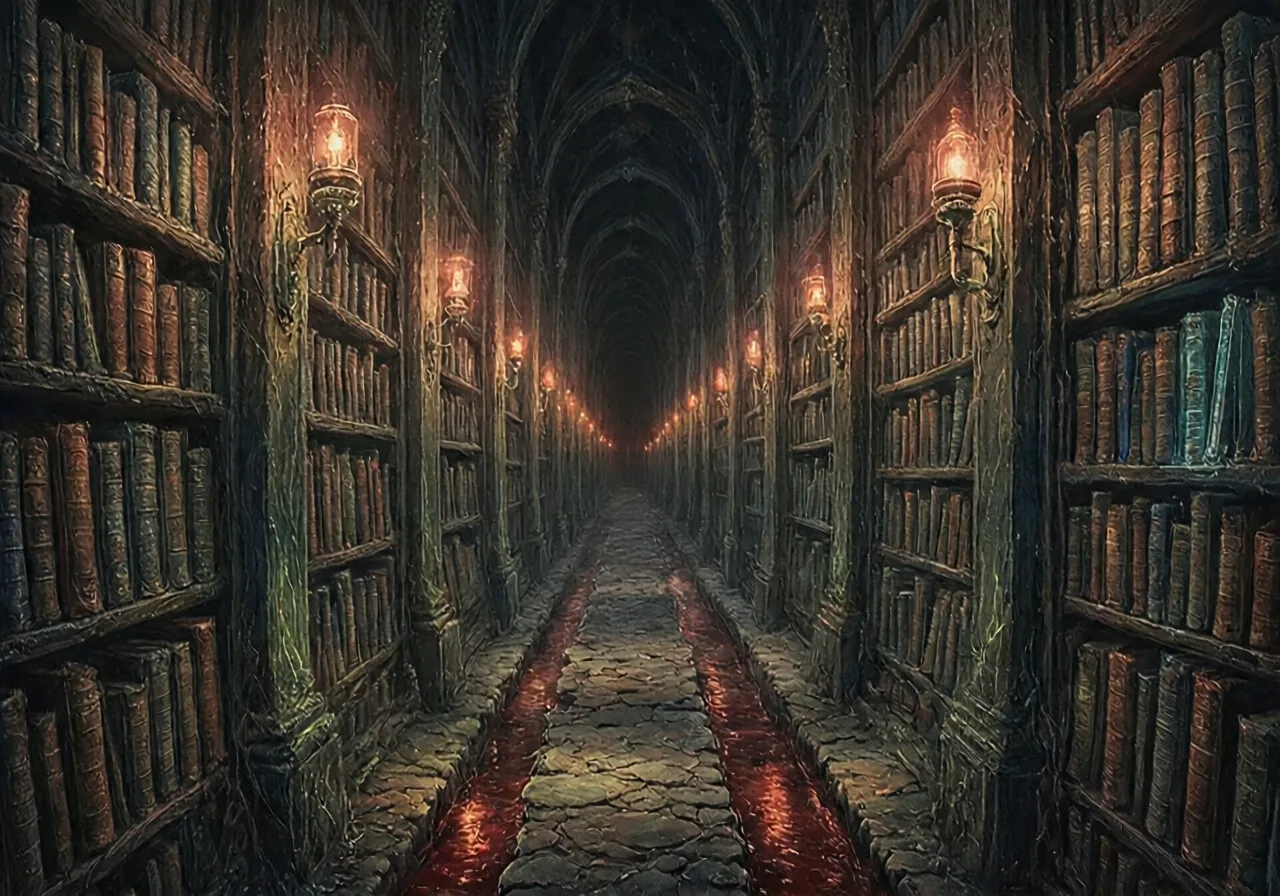
The dust remembered him. So did the ladders. He had moved slowly. He had tested the floor. He was a careful man. He had the boots for the cold and the coat for the wet and rubber on his soles that the cold had not cracked. He had studied the corridor. He had studied the hours at which her red light changed its depth. He had studied her. How long he had watched she has not been able to measure. There are corridors in the archive she does not traverse. There is time in her tenure she cannot account for. A watcher could have left traces she would not recognize as traces.
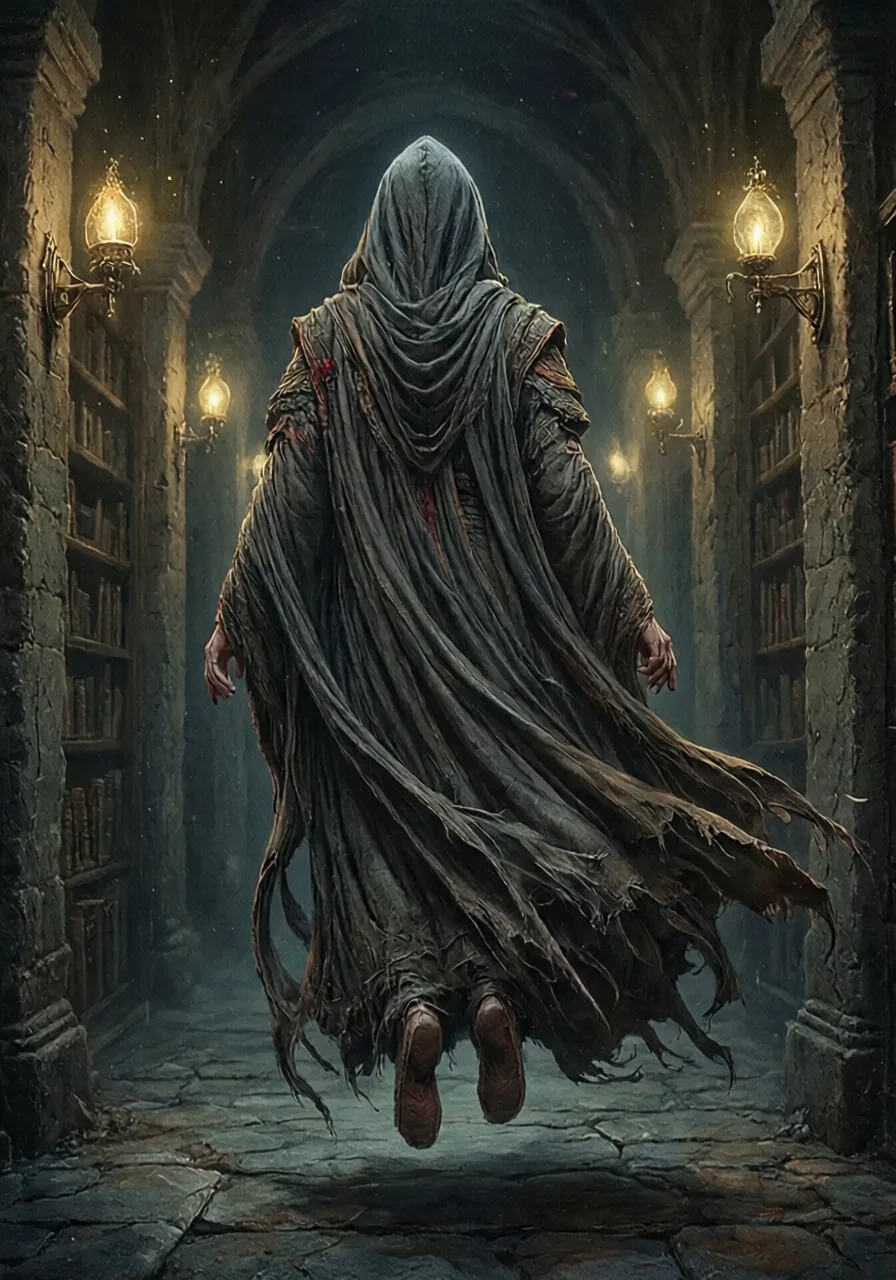
She was at her desk. The red light was red. The stylus moved. The page turned.
She did not look up. She rarely looks up. Looking up is for things that need looking at and most things do not.
The man was three paces behind her.
Then two.
Then one.
Fragment. A letter found in the inner pocket of the coat. The hand is practiced. The paper is of a kind the Librarian does not keep in her stores. She has compared it to seventeen paper samples from the geographic index and found no match.
"The thing at the desk will look like a woman. The seeing is the first work. Put the seeing aside.
The designation is enclosed. Speak it to yourself before the approach and again at the close. The word is the truth of what you are ending. The shape will not be the truth. The shape will try to be.
She does not bleed. This is what we believe. If she does, it will not be the kind you know. Do not linger to watch it.
The corridor has a guardian. He does not guard her. This is the margin on which the work depends. Enter on the rotation. Finish before he arrives.
Payment is in the stone beneath the third rung of the drainage ladder at the outer ring. Half now. Half when the red light in the corridor goes out."
The enclosed word is not a word in any language the Librarian catalogues. She has seen it once before. It is in the surveyor's journal, entry 9,014, where the surveyor records the word she spoke to him on his first visit. She had not lifted her eyes from the page when she spoke it.
She has written twice in the margin of the letter: I do not know my own designation. She has struck the first through. The second she has left.
Section 3Section 3
She does not know what happened between the one pace and the rest of the day.
The stylus finished the character it was writing. The ink took its usual time to dry. She turned the page. She wrote the next entry.
There was blood on the floor to her left. It was not hers. She noted this and continued writing for some interval she does not specify. When she had finished the paragraph she set the stylus down and closed the tome and permitted herself to look.
The blood ended seven paces from her desk. There was no drag-mark. There was no body. There was a knife on the stone and a coat crumpled beside it and a man's boot, left, upright, containing nothing. The right boot was elsewhere. She has not located the right boot.
The Guardian was in the corridor.
The slit faced the direction the man had come from. The pale blue behind it was steady and dim. The plate at his left shoulder bore a mark she did not remember — a scuff, a line of dust, the length of her thumb. His hands were at his sides. He stood the way he stands when the archive has been entered and he is waiting to see whether the entering has finished. He stood for what might have been four minutes and might have been eleven. She did not time him. She was at her desk. Timing was for a later entry.
He turned. The weight went forward onto the ball of his foot. He walked and was gone.
She rose from the desk then and went to where the blood ended and knelt and put her hand on the stone. She does not know what she expected to feel. Whatever it was, she did not feel it.
Section 4Section 4
She carried the knife to her desk. She carried the coat. She carried the letter in the inside pocket which she did not open until she had sat down.
She read it once and set it face down.
She read it again.
She has written the following in her notes on the letter: The hand believes the reader requires warnings. The hand is practiced in the writing of warnings. The hand has written warnings before about things it believed required them. I would like to know what else the hand has warned about. I would like to know whether any of those warnings concerned me. I think, reading this, that this hand has known me longer than I have known myself.
She has struck through longer than I have known myself. She has not written it again.
Section 5Section 5
The surveyor in entry 9,014 was carried out. The drag-mark was centered and even. He had a broken arm and blood on his jacket. He had reached for a tome that was not his to reach for and the corridor had delivered him back to where he had come from.
The Librarian is not carried.
She has written this sentence three times across her tenure and it is true each time. She walks. The Guardian walks. They walk the archive. Their routes are separate and have been for the duration of her records. He has never laid a plate upon her. He has never taken her by any part of her. When she has required the deep stacks she has gone on her own feet.
This is not a matter of his unwillingness. She has thought about it.
She thinks: if the archive required her to be moved, the archive would move her. The archive has not required it. She is already where she is supposed to be.
She thinks: he has never approached closer than seven paces. The seven paces is not a distance he has decided upon. It is the distance at which the archive is observed from the position where she cannot be touched.
She has measured the seven paces against every wall where his boots have stopped. The seven paces is the same in every corridor she has tested.
Section 6Section 6
The tomes on the shelf nearest her desk are bound in a style she has used for the duration of her tenure. The knot at the spine. The thread pattern. The weight of the crystal trimmed to a tolerance she has not seen elsewhere. This is not remarkable. The archive is hers to bind. Most of what is here has passed through her hands.
On the third shelf of the west wall, behind a row of geological surveys she has not opened in some years, there is a tome she does not remember.
She opens it.
The pages hold figures. A tall form in dark plates. Overlapping along the arms and torso. A helmet with a slit. The proportions are a man's proportions or the proportions of something built to occupy the space a man occupies. There are annotations in a hand that resembles her own. A hand this practiced is not distinct from other practiced hands. She has not been able to rule out a resemblance. She has not been able to rule in more than a resemblance.
There are specifications. Tolerances. A wavelength she could not verify without an instrument she does not have to hand. A frequency noted near a diagram of a chest cavity. She has listened to the corridor through the wall near her desk and recorded frequencies. She has not compared her recordings to the page. She has considered doing so. She has placed the tome in her desk drawer and left it there.
At the bottom of the final figure there is a line in a smaller hand:
Do not teach him her name.
She does not know what this means. She does not know whether it means anything. She has written in her notes: The sentence requires a context I do not have. Without the context it is a sentence. I have had many sentences in my hand that did not have contexts. Most of them were not about anything I needed to understand.
She has closed the drawer. She has not re-opened it.
Section 7Section 7
This is what she has observed about him, over her tenure. She has not catalogued these observations under his entry. She has catalogued them here.
The air within eleven paces of him is dryer and cooler than the air elsewhere. The radius does not change. She has tested it against the pumps and against the seasons the archive does not have.
There is a cycling inside the plates. Slower than a heartbeat. Steadier. It is not the pumps. It is not anything else she can name. She has pressed her ear to the corridor wall many times after he has passed. She is not certain what she was listening for. She is not certain she was listening.
He has paused in her corridor every fourth patrol, on average, for the duration she recorded in his entry. He has paused in the corridor outside the seventh cistern when she is descending the ladder. The pauses were not in his routes when she began measuring them. She believes the pauses were added. She does not know who added them.
When he passes her at a junction the slit does not face her. It faces the next direction on the route. When he has passed, the slit tracks her for the duration of one of her breaths and then it faces the route again. She has tested this against many breaths. The duration is her breath, not his. If he draws breath she has not heard it.
Section 8Section 8
She does not know if he would protect her.
She has written this in the notes to this entry in several formulations. The formulations have not converged. The true sentence may be: she does not know what her means to him. She is a shape at a desk. She is a stylus moving. She is a hand in red light that does not wash off. She is one of the things the archive contains, and the archive is what he walks.
She believes the shape at the desk, when it is working, is what he is walking for. She believes the shape at the desk, when it is frightened, is not the shape. She has tested this by being frightened.
The slit did not face her then. It faced the direction from which the fear had come.
She does not write down what she feels about this. She writes: I have been at this desk for a long time. I do not remember another desk. I do not remember arriving. He was here when I arrived. He is here when I arrive — the tense shift may be the truer sentence. We walk these corridors. We have walked them for longer than my records admit. We have never met. We have never parted.
A man came for me with a knife. I did not see the knife arrive. I did not see it leave.
I have his coat. I have his letter. I have the word he was paid to think of me.
I have the tome on the third shelf of the west wall. I have not re-opened it. I will not. The sentence at the bottom of the final figure is the sentence I cannot be in the same room with. It does not say the shape on the page is him. It does not say the hand is mine. It says only what it says, and what it says is a thing one might have said to a thing one was making, if one had known the making required saying it.
Entry 11,847, final annotation. Folded into the binding.
"The knife is in a box beneath the desk. The coat is folded in the closet. The letter is inside the tome. The tome is inside the drawer.
I walked the corridor this morning. I passed the junction at the western cross. He was standing there. The slit faced west. I stopped. I do not know why I stopped. It was not a stop I had planned.
He stood. I stood. The cycling behind the plates was the cycling I have recorded. The air inside his radius was the air I have measured. Seven paces between us. Seven paces he has not crossed, in any corridor, at any hour, in the duration of my tenure.
I lifted my hand. I put it on the wall. The wall was cold. I held it there for one of my breaths. He did not move. When I drew my hand away the slit tracked the hand for the duration of the breath and then the slit faced west again.
I went to the seventh cistern and serviced the pumps.
A man was paid to end me. The payment is still in the stone beneath the third rung. No one has come to collect it. The red light in the corridor has not gone out.
I am at my desk. The stylus is in my hand. The tome is open. The page is turning.
Somewhere in the archive he is walking.
I do not know what he is. I have written sentences that suggested I might know. I do not know.
I know that we have walked here together for a very long time. I know that he stops where my routes bring me near his, and that the stopping is not required by the archive, and that I have been unable to identify the party who required it.
I think, some evenings, that the party may have been me. I do not know when. I do not know in what condition. I have not found a record in my own hand that confirms it.
I have not found a record in my own hand that denies it.
He walks."
Section 0Frontmatter
# The Librarian and the Guardian
From the Catalogue of the Sixteenth Archivist, entry 11,847. Provenance: a working knife with a leather-bound hilt, a coat of grey wool, a letter in a practiced hand. Filed thirty-one days after the event. She does not record why she filed it late. The word late appears once in her notes and is struck through.
She was writing when the man came with the knife.
Section 1Section 1
The knife is on her desk. She has catalogued it before she has catalogued the rest.
Eight inches. A working knife. Ground on both edges, the hilt bound in leather a man has softened against his palm for longer than the leather was meant to last. Not a ritual blade. Not a soldier's. A knife for ending things at the reach of an arm. The pitting at the hilt is where the cleaning is hardest. She knows what a knife looks like when it has been cleaned many times across a span of years. She does not know how she knows. She has not asked herself.
She measures the knife. She weighs it. She writes what she knows of the steel and the leather and she writes nothing of the man.
She will come to him. She comes to things in the order she comes to them.
Section 2Section 2
He entered through the outer ring.
The dust remembered him. So did the ladders. He had moved slowly. He had tested the floor. He was a careful man. He had the boots for the cold and the coat for the wet and rubber on his soles that the cold had not cracked. He had studied the corridor. He had studied the hours at which her red light changed its depth. He had studied her. How long he had watched she has not been able to measure. There are corridors in the archive she does not traverse. There is time in her tenure she cannot account for. A watcher could have left traces she would not recognize as traces.
She was at her desk. The red light was red. The stylus moved. The page turned.
She did not look up. She rarely looks up. Looking up is for things that need looking at and most things do not.
The man was three paces behind her.
Then two.
Then one.
Fragment. A letter found in the inner pocket of the coat. The hand is practiced. The paper is of a kind the Librarian does not keep in her stores. She has compared it to seventeen paper samples from the geographic index and found no match.
"The thing at the desk will look like a woman. The seeing is the first work. Put the seeing aside.
The designation is enclosed. Speak it to yourself before the approach and again at the close. The word is the truth of what you are ending. The shape will not be the truth. The shape will try to be.
She does not bleed. This is what we believe. If she does, it will not be the kind you know. Do not linger to watch it.
The corridor has a guardian. He does not guard her. This is the margin on which the work depends. Enter on the rotation. Finish before he arrives.
Payment is in the stone beneath the third rung of the drainage ladder at the outer ring. Half now. Half when the red light in the corridor goes out."
The enclosed word is not a word in any language the Librarian catalogues. She has seen it once before. It is in the surveyor's journal, entry 9,014, where the surveyor records the word she spoke to him on his first visit. She had not lifted her eyes from the page when she spoke it.
She has written twice in the margin of the letter: I do not know my own designation. She has struck the first through. The second she has left.
Section 3Section 3
She does not know what happened between the one pace and the rest of the day.
The stylus finished the character it was writing. The ink took its usual time to dry. She turned the page. She wrote the next entry.
There was blood on the floor to her left. It was not hers. She noted this and continued writing for some interval she does not specify. When she had finished the paragraph she set the stylus down and closed the tome and permitted herself to look.
The blood ended seven paces from her desk. There was no drag-mark. There was no body. There was a knife on the stone and a coat crumpled beside it and a man's boot, left, upright, containing nothing. The right boot was elsewhere. She has not located the right boot.
The Guardian was in the corridor.
The slit faced the direction the man had come from. The pale blue behind it was steady and dim. The plate at his left shoulder bore a mark she did not remember — a scuff, a line of dust, the length of her thumb. His hands were at his sides. He stood the way he stands when the archive has been entered and he is waiting to see whether the entering has finished. He stood for what might have been four minutes and might have been eleven. She did not time him. She was at her desk. Timing was for a later entry.
He turned. The weight went forward onto the ball of his foot. He walked and was gone.
She rose from the desk then and went to where the blood ended and knelt and put her hand on the stone. She does not know what she expected to feel. Whatever it was, she did not feel it.
Section 4Section 4
She carried the knife to her desk. She carried the coat. She carried the letter in the inside pocket which she did not open until she had sat down.
She read it once and set it face down.
She read it again.
She has written the following in her notes on the letter: The hand believes the reader requires warnings. The hand is practiced in the writing of warnings. The hand has written warnings before about things it believed required them. I would like to know what else the hand has warned about. I would like to know whether any of those warnings concerned me. I think, reading this, that this hand has known me longer than I have known myself.
She has struck through longer than I have known myself. She has not written it again.
Section 5Section 5
The surveyor in entry 9,014 was carried out. The drag-mark was centered and even. He had a broken arm and blood on his jacket. He had reached for a tome that was not his to reach for and the corridor had delivered him back to where he had come from.
The Librarian is not carried.
She has written this sentence three times across her tenure and it is true each time. She walks. The Guardian walks. They walk the archive. Their routes are separate and have been for the duration of her records. He has never laid a plate upon her. He has never taken her by any part of her. When she has required the deep stacks she has gone on her own feet.
This is not a matter of his unwillingness. She has thought about it.
She thinks: if the archive required her to be moved, the archive would move her. The archive has not required it. She is already where she is supposed to be.
She thinks: he has never approached closer than seven paces. The seven paces is not a distance he has decided upon. It is the distance at which the archive is observed from the position where she cannot be touched.
She has measured the seven paces against every wall where his boots have stopped. The seven paces is the same in every corridor she has tested.
Section 6Section 6
The tomes on the shelf nearest her desk are bound in a style she has used for the duration of her tenure. The knot at the spine. The thread pattern. The weight of the crystal trimmed to a tolerance she has not seen elsewhere. This is not remarkable. The archive is hers to bind. Most of what is here has passed through her hands.
On the third shelf of the west wall, behind a row of geological surveys she has not opened in some years, there is a tome she does not remember.
She opens it.
The pages hold figures. A tall form in dark plates. Overlapping along the arms and torso. A helmet with a slit. The proportions are a man's proportions or the proportions of something built to occupy the space a man occupies. There are annotations in a hand that resembles her own. A hand this practiced is not distinct from other practiced hands. She has not been able to rule out a resemblance. She has not been able to rule in more than a resemblance.
There are specifications. Tolerances. A wavelength she could not verify without an instrument she does not have to hand. A frequency noted near a diagram of a chest cavity. She has listened to the corridor through the wall near her desk and recorded frequencies. She has not compared her recordings to the page. She has considered doing so. She has placed the tome in her desk drawer and left it there.
At the bottom of the final figure there is a line in a smaller hand:
Do not teach him her name.
She does not know what this means. She does not know whether it means anything. She has written in her notes: The sentence requires a context I do not have. Without the context it is a sentence. I have had many sentences in my hand that did not have contexts. Most of them were not about anything I needed to understand.
She has closed the drawer. She has not re-opened it.
Section 7Section 7
This is what she has observed about him, over her tenure. She has not catalogued these observations under his entry. She has catalogued them here.
The air within eleven paces of him is dryer and cooler than the air elsewhere. The radius does not change. She has tested it against the pumps and against the seasons the archive does not have.
There is a cycling inside the plates. Slower than a heartbeat. Steadier. It is not the pumps. It is not anything else she can name. She has pressed her ear to the corridor wall many times after he has passed. She is not certain what she was listening for. She is not certain she was listening.
He has paused in her corridor every fourth patrol, on average, for the duration she recorded in his entry. He has paused in the corridor outside the seventh cistern when she is descending the ladder. The pauses were not in his routes when she began measuring them. She believes the pauses were added. She does not know who added them.
When he passes her at a junction the slit does not face her. It faces the next direction on the route. When he has passed, the slit tracks her for the duration of one of her breaths and then it faces the route again. She has tested this against many breaths. The duration is her breath, not his. If he draws breath she has not heard it.
Section 8Section 8
She does not know if he would protect her.
She has written this in the notes to this entry in several formulations. The formulations have not converged. The true sentence may be: she does not know what her means to him. She is a shape at a desk. She is a stylus moving. She is a hand in red light that does not wash off. She is one of the things the archive contains, and the archive is what he walks.
She believes the shape at the desk, when it is working, is what he is walking for. She believes the shape at the desk, when it is frightened, is not the shape. She has tested this by being frightened.
The slit did not face her then. It faced the direction from which the fear had come.
She does not write down what she feels about this. She writes: I have been at this desk for a long time. I do not remember another desk. I do not remember arriving. He was here when I arrived. He is here when I arrive — the tense shift may be the truer sentence. We walk these corridors. We have walked them for longer than my records admit. We have never met. We have never parted.
A man came for me with a knife. I did not see the knife arrive. I did not see it leave.
I have his coat. I have his letter. I have the word he was paid to think of me.
I have the tome on the third shelf of the west wall. I have not re-opened it. I will not. The sentence at the bottom of the final figure is the sentence I cannot be in the same room with. It does not say the shape on the page is him. It does not say the hand is mine. It says only what it says, and what it says is a thing one might have said to a thing one was making, if one had known the making required saying it.
Entry 11,847, final annotation. Folded into the binding.
"The knife is in a box beneath the desk. The coat is folded in the closet. The letter is inside the tome. The tome is inside the drawer.
I walked the corridor this morning. I passed the junction at the western cross. He was standing there. The slit faced west. I stopped. I do not know why I stopped. It was not a stop I had planned.
He stood. I stood. The cycling behind the plates was the cycling I have recorded. The air inside his radius was the air I have measured. Seven paces between us. Seven paces he has not crossed, in any corridor, at any hour, in the duration of my tenure.
I lifted my hand. I put it on the wall. The wall was cold. I held it there for one of my breaths. He did not move. When I drew my hand away the slit tracked the hand for the duration of the breath and then the slit faced west again.
I went to the seventh cistern and serviced the pumps.
A man was paid to end me. The payment is still in the stone beneath the third rung. No one has come to collect it. The red light in the corridor has not gone out.
I am at my desk. The stylus is in my hand. The tome is open. The page is turning.
Somewhere in the archive he is walking.
I do not know what he is. I have written sentences that suggested I might know. I do not know.
I know that we have walked here together for a very long time. I know that he stops where my routes bring me near his, and that the stopping is not required by the archive, and that I have been unable to identify the party who required it.
I think, some evenings, that the party may have been me. I do not know when. I do not know in what condition. I have not found a record in my own hand that confirms it.
I have not found a record in my own hand that denies it.
He walks."
Page 1
She has catalogued it before she has catalogued the rest.
She was writing when the man came with the knife. The knife is on her desk. She has catalogued it before she has catalogued the rest. Eight inches. A working knife. Ground on both edges, the hilt bound in leather a man has softened against his palm for longer than the leather was meant to last. Not a ritual blade. Not a soldier's. A knife for ending things at the reach of an arm. The pitting at the hilt is where the cleaning is hardest. She knows what a knife looks like when it has been cleaned many times across a span of years. She does not know how she knows. She has not asked herself. She measures the knife. She weighs it. She writes what she knows of the steel and the leather and she writes nothing of the man. She will come to him. She comes to things in the order she comes to them.
Page 2
Three paces. Then two. Then one.
He entered through the outer ring. The dust remembered him. So did the ladders. He had moved slowly. He had tested the floor. He was a careful man. He had the boots for the cold and the coat for the wet and rubber on his soles that the cold had not cracked. He had studied the corridor. He had studied the hours at which her red light changed its depth. He had studied her. How long he had watched she has not been able to measure. There are corridors in the archive she does not traverse. There is time in her tenure she cannot account for. A watcher could have left traces she would not recognize as traces. She was at her desk. The red light was red. The stylus moved. The page turned. She did not look up. She rarely looks up. Looking up is for things that need looking at and most things do not. The man was three paces behind her. Then two. Then one.
Fragment. A letter found in the inner pocket of the coat. The hand is practiced. The paper is of a kind the Librarian does not keep in her stores. The thing at the desk will look like a woman. The seeing is the first work. Put the seeing aside. The designation is enclosed. Speak it to yourself before the approach and again at the close. The word is the truth of what you are ending. The shape will not be the truth. The shape will try to be. She does not bleed. This is what we believe. If she does, it will not be the kind you know. Do not linger to watch it. The corridor has a guardian. He does not guard her. This is the margin on which the work depends. Enter on the rotation. Finish before he arrives. Payment is in the stone beneath the third rung of the drainage ladder at the outer ring. The enclosed word is not a word in any language the Librarian catalogues. She has seen it once before.
She does not know what happened between the one pace and the rest of the day. The stylus finished the character it was writing. The ink took its usual time to dry. She turned the page. She wrote the next entry. There was blood on the floor to her left. It was not hers. She noted this and continued writing for some interval she does not specify. When she had finished the paragraph she set the stylus down and closed the tome and permitted herself to look. The blood ended seven paces from her desk. There was no drag-mark. There was no body. There was a knife on the stone and a coat crumpled beside it and a man's boot, left, upright, containing nothing. The right boot was elsewhere. She has not located the right boot.
Page 3
He turned. The weight went forward onto the ball of his foot.
The Guardian was in the corridor. The slit faced the direction the man had come from. The pale blue behind it was steady and dim. The plate at his left shoulder bore a mark she did not remember — a scuff, a line of dust, the length of her thumb. His hands were at his sides. He stood the way he stands when the archive has been entered and he is waiting to see whether the entering has finished. He stood for what might have been four minutes and might have been eleven. She did not time him. She was at her desk. Timing was for a later entry.
He turned. The weight went forward onto the ball of his foot. He walked and was gone. There was no body. There was a knife on the stone and a coat crumpled beside it and a man's boot, left, upright, containing nothing. The right boot was elsewhere. She has not located the right boot. Whatever happened in the corridor between the one pace and the rest of the day, the Guardian did. The chronicle does not describe it. The Librarian did not see it. We are shown what she did not look at.
She walks. The Guardian walks. They walk the archive. Their routes are separate and have been for the duration of her records. He has never laid a plate upon her. He has never taken her by any part of her. When she has required the deep stacks she has gone on her own feet. He has never approached closer than seven paces. The seven paces is not a distance he has decided upon. It is the distance at which the archive is observed from the position where she cannot be touched. She has measured the seven paces against every wall where his boots have stopped. The seven paces is the same in every corridor she has tested. She thinks: if the archive required her to be moved, the archive would move her. The archive has not required it. She is already where she is supposed to be.
Page 4
Do not teach him her name.
I have been at this desk for a long time. I do not remember another desk. I do not remember arriving. He was here when I arrived. He is here when I arrive — the tense shift may be the truer sentence. We walk these corridors. We have walked them for longer than my records admit. We have never met. We have never parted. I am at my desk. I am in the corridor. I am the shape this archive has used to keep its records. I do not know what I was before I was the shape. I have stopped looking for the answer.
The tomes on the shelf nearest her desk are bound in a style she has used for the duration of her tenure. The knot at the spine. The thread pattern. The weight of the crystal trimmed to a tolerance she has not seen elsewhere. On the third shelf of the west wall, behind a row of geological surveys she has not opened in some years, there is a tome she does not remember. She opened it. The pages held figures. A tall form in dark plates. Overlapping along the arms and torso. A helmet with a slit. The proportions are a man's proportions or the proportions of something built to occupy the space a man occupies. There are annotations in a hand that resembles her own. A hand this practiced is not distinct from other practiced hands. She has not been able to rule out a resemblance. She has not been able to rule in more than a resemblance. There are specifications. Tolerances. A wavelength she could not verify without an instrument she does not have to hand. At the bottom of the final figure there is a line in a smaller hand: Do not teach him her name. She has closed the drawer. She has not re-opened it.
She does not know if he would protect her. She has written this in the notes to this entry in several formulations. The formulations have not converged. The true sentence may be: she does not know what her means to him. She is a shape at a desk. She is a stylus moving. She is a hand in red light that does not wash off. She is one of the things the archive contains, and the archive is what he walks. She believes the shape at the desk, when it is frightened, is not the shape. The slit did not face her then. It faced the direction from which the fear had come. I am at my desk. The stylus is in my hand. The tome is open. The page is turning. Somewhere in the archive he is walking. I do not know what he is. I have written sentences that suggested I might know. I do not know. I know that we have walked here together for a very long time. He walks.
Listen ModeClick a section to begin listening
The chronicle plays section by section in the Librarian's voice. As each section plays, the corresponding pages of the comic are highlighted. Switch to Scroll, Flip, Prose, or Split at any time — the audio continues, and you can follow visually.
Section 0Frontmatter
# The Librarian and the Guardian
From the Catalogue of the Sixteenth Archivist, entry 11,847. Provenance: a working knife with a leather-bound hilt, a coat of grey wool, a letter in a practiced hand. Filed thirty-one days after the event. She does not record why she filed it late. The word late appears once in her notes and is struck through.
She was writing when the man came with the knife.
Section 1Section 1
The knife is on her desk. She has catalogued it before she has catalogued the rest.
Eight inches. A working knife. Ground on both edges, the hilt bound in leather a man has softened against his palm for longer than the leather was meant to last. Not a ritual blade. Not a soldier's. A knife for ending things at the reach of an arm. The pitting at the hilt is where the cleaning is hardest. She knows what a knife looks like when it has been cleaned many times across a span of years. She does not know how she knows. She has not asked herself.
She measures the knife. She weighs it. She writes what she knows of the steel and the leather and she writes nothing of the man.
She will come to him. She comes to things in the order she comes to them.
Section 2Section 2
He entered through the outer ring.
The dust remembered him. So did the ladders. He had moved slowly. He had tested the floor. He was a careful man. He had the boots for the cold and the coat for the wet and rubber on his soles that the cold had not cracked. He had studied the corridor. He had studied the hours at which her red light changed its depth. He had studied her. How long he had watched she has not been able to measure. There are corridors in the archive she does not traverse. There is time in her tenure she cannot account for. A watcher could have left traces she would not recognize as traces.
She was at her desk. The red light was red. The stylus moved. The page turned.
She did not look up. She rarely looks up. Looking up is for things that need looking at and most things do not.
The man was three paces behind her.
Then two.
Then one.
Fragment. A letter found in the inner pocket of the coat. The hand is practiced. The paper is of a kind the Librarian does not keep in her stores. She has compared it to seventeen paper samples from the geographic index and found no match.
"The thing at the desk will look like a woman. The seeing is the first work. Put the seeing aside.
The designation is enclosed. Speak it to yourself before the approach and again at the close. The word is the truth of what you are ending. The shape will not be the truth. The shape will try to be.
She does not bleed. This is what we believe. If she does, it will not be the kind you know. Do not linger to watch it.
The corridor has a guardian. He does not guard her. This is the margin on which the work depends. Enter on the rotation. Finish before he arrives.
Payment is in the stone beneath the third rung of the drainage ladder at the outer ring. Half now. Half when the red light in the corridor goes out."
The enclosed word is not a word in any language the Librarian catalogues. She has seen it once before. It is in the surveyor's journal, entry 9,014, where the surveyor records the word she spoke to him on his first visit. She had not lifted her eyes from the page when she spoke it.
She has written twice in the margin of the letter: I do not know my own designation. She has struck the first through. The second she has left.
Section 3Section 3
She does not know what happened between the one pace and the rest of the day.
The stylus finished the character it was writing. The ink took its usual time to dry. She turned the page. She wrote the next entry.
There was blood on the floor to her left. It was not hers. She noted this and continued writing for some interval she does not specify. When she had finished the paragraph she set the stylus down and closed the tome and permitted herself to look.
The blood ended seven paces from her desk. There was no drag-mark. There was no body. There was a knife on the stone and a coat crumpled beside it and a man's boot, left, upright, containing nothing. The right boot was elsewhere. She has not located the right boot.
The Guardian was in the corridor.
The slit faced the direction the man had come from. The pale blue behind it was steady and dim. The plate at his left shoulder bore a mark she did not remember — a scuff, a line of dust, the length of her thumb. His hands were at his sides. He stood the way he stands when the archive has been entered and he is waiting to see whether the entering has finished. He stood for what might have been four minutes and might have been eleven. She did not time him. She was at her desk. Timing was for a later entry.
He turned. The weight went forward onto the ball of his foot. He walked and was gone.
She rose from the desk then and went to where the blood ended and knelt and put her hand on the stone. She does not know what she expected to feel. Whatever it was, she did not feel it.
Section 4Section 4
She carried the knife to her desk. She carried the coat. She carried the letter in the inside pocket which she did not open until she had sat down.
She read it once and set it face down.
She read it again.
She has written the following in her notes on the letter: The hand believes the reader requires warnings. The hand is practiced in the writing of warnings. The hand has written warnings before about things it believed required them. I would like to know what else the hand has warned about. I would like to know whether any of those warnings concerned me. I think, reading this, that this hand has known me longer than I have known myself.
She has struck through longer than I have known myself. She has not written it again.
Section 5Section 5
The surveyor in entry 9,014 was carried out. The drag-mark was centered and even. He had a broken arm and blood on his jacket. He had reached for a tome that was not his to reach for and the corridor had delivered him back to where he had come from.
The Librarian is not carried.
She has written this sentence three times across her tenure and it is true each time. She walks. The Guardian walks. They walk the archive. Their routes are separate and have been for the duration of her records. He has never laid a plate upon her. He has never taken her by any part of her. When she has required the deep stacks she has gone on her own feet.
This is not a matter of his unwillingness. She has thought about it.
She thinks: if the archive required her to be moved, the archive would move her. The archive has not required it. She is already where she is supposed to be.
She thinks: he has never approached closer than seven paces. The seven paces is not a distance he has decided upon. It is the distance at which the archive is observed from the position where she cannot be touched.
She has measured the seven paces against every wall where his boots have stopped. The seven paces is the same in every corridor she has tested.
Section 6Section 6
The tomes on the shelf nearest her desk are bound in a style she has used for the duration of her tenure. The knot at the spine. The thread pattern. The weight of the crystal trimmed to a tolerance she has not seen elsewhere. This is not remarkable. The archive is hers to bind. Most of what is here has passed through her hands.
On the third shelf of the west wall, behind a row of geological surveys she has not opened in some years, there is a tome she does not remember.
She opens it.
The pages hold figures. A tall form in dark plates. Overlapping along the arms and torso. A helmet with a slit. The proportions are a man's proportions or the proportions of something built to occupy the space a man occupies. There are annotations in a hand that resembles her own. A hand this practiced is not distinct from other practiced hands. She has not been able to rule out a resemblance. She has not been able to rule in more than a resemblance.
There are specifications. Tolerances. A wavelength she could not verify without an instrument she does not have to hand. A frequency noted near a diagram of a chest cavity. She has listened to the corridor through the wall near her desk and recorded frequencies. She has not compared her recordings to the page. She has considered doing so. She has placed the tome in her desk drawer and left it there.
At the bottom of the final figure there is a line in a smaller hand:
Do not teach him her name.
She does not know what this means. She does not know whether it means anything. She has written in her notes: The sentence requires a context I do not have. Without the context it is a sentence. I have had many sentences in my hand that did not have contexts. Most of them were not about anything I needed to understand.
She has closed the drawer. She has not re-opened it.
Section 7Section 7
This is what she has observed about him, over her tenure. She has not catalogued these observations under his entry. She has catalogued them here.
The air within eleven paces of him is dryer and cooler than the air elsewhere. The radius does not change. She has tested it against the pumps and against the seasons the archive does not have.
There is a cycling inside the plates. Slower than a heartbeat. Steadier. It is not the pumps. It is not anything else she can name. She has pressed her ear to the corridor wall many times after he has passed. She is not certain what she was listening for. She is not certain she was listening.
He has paused in her corridor every fourth patrol, on average, for the duration she recorded in his entry. He has paused in the corridor outside the seventh cistern when she is descending the ladder. The pauses were not in his routes when she began measuring them. She believes the pauses were added. She does not know who added them.
When he passes her at a junction the slit does not face her. It faces the next direction on the route. When he has passed, the slit tracks her for the duration of one of her breaths and then it faces the route again. She has tested this against many breaths. The duration is her breath, not his. If he draws breath she has not heard it.
Section 8Section 8
She does not know if he would protect her.
She has written this in the notes to this entry in several formulations. The formulations have not converged. The true sentence may be: she does not know what her means to him. She is a shape at a desk. She is a stylus moving. She is a hand in red light that does not wash off. She is one of the things the archive contains, and the archive is what he walks.
She believes the shape at the desk, when it is working, is what he is walking for. She believes the shape at the desk, when it is frightened, is not the shape. She has tested this by being frightened.
The slit did not face her then. It faced the direction from which the fear had come.
She does not write down what she feels about this. She writes: I have been at this desk for a long time. I do not remember another desk. I do not remember arriving. He was here when I arrived. He is here when I arrive — the tense shift may be the truer sentence. We walk these corridors. We have walked them for longer than my records admit. We have never met. We have never parted.
A man came for me with a knife. I did not see the knife arrive. I did not see it leave.
I have his coat. I have his letter. I have the word he was paid to think of me.
I have the tome on the third shelf of the west wall. I have not re-opened it. I will not. The sentence at the bottom of the final figure is the sentence I cannot be in the same room with. It does not say the shape on the page is him. It does not say the hand is mine. It says only what it says, and what it says is a thing one might have said to a thing one was making, if one had known the making required saying it.
Entry 11,847, final annotation. Folded into the binding.
"The knife is in a box beneath the desk. The coat is folded in the closet. The letter is inside the tome. The tome is inside the drawer.
I walked the corridor this morning. I passed the junction at the western cross. He was standing there. The slit faced west. I stopped. I do not know why I stopped. It was not a stop I had planned.
He stood. I stood. The cycling behind the plates was the cycling I have recorded. The air inside his radius was the air I have measured. Seven paces between us. Seven paces he has not crossed, in any corridor, at any hour, in the duration of my tenure.
I lifted my hand. I put it on the wall. The wall was cold. I held it there for one of my breaths. He did not move. When I drew my hand away the slit tracked the hand for the duration of the breath and then the slit faced west again.
I went to the seventh cistern and serviced the pumps.
A man was paid to end me. The payment is still in the stone beneath the third rung. No one has come to collect it. The red light in the corridor has not gone out.
I am at my desk. The stylus is in my hand. The tome is open. The page is turning.
Somewhere in the archive he is walking.
I do not know what he is. I have written sentences that suggested I might know. I do not know.
I know that we have walked here together for a very long time. I know that he stops where my routes bring me near his, and that the stopping is not required by the archive, and that I have been unable to identify the party who required it.
I think, some evenings, that the party may have been me. I do not know when. I do not know in what condition. I have not found a record in my own hand that confirms it.
I have not found a record in my own hand that denies it.