From the Catalogue of the Sixteenth Archivist, entry 8,214
Full chronicle
Page 1
Something keeps the bones.
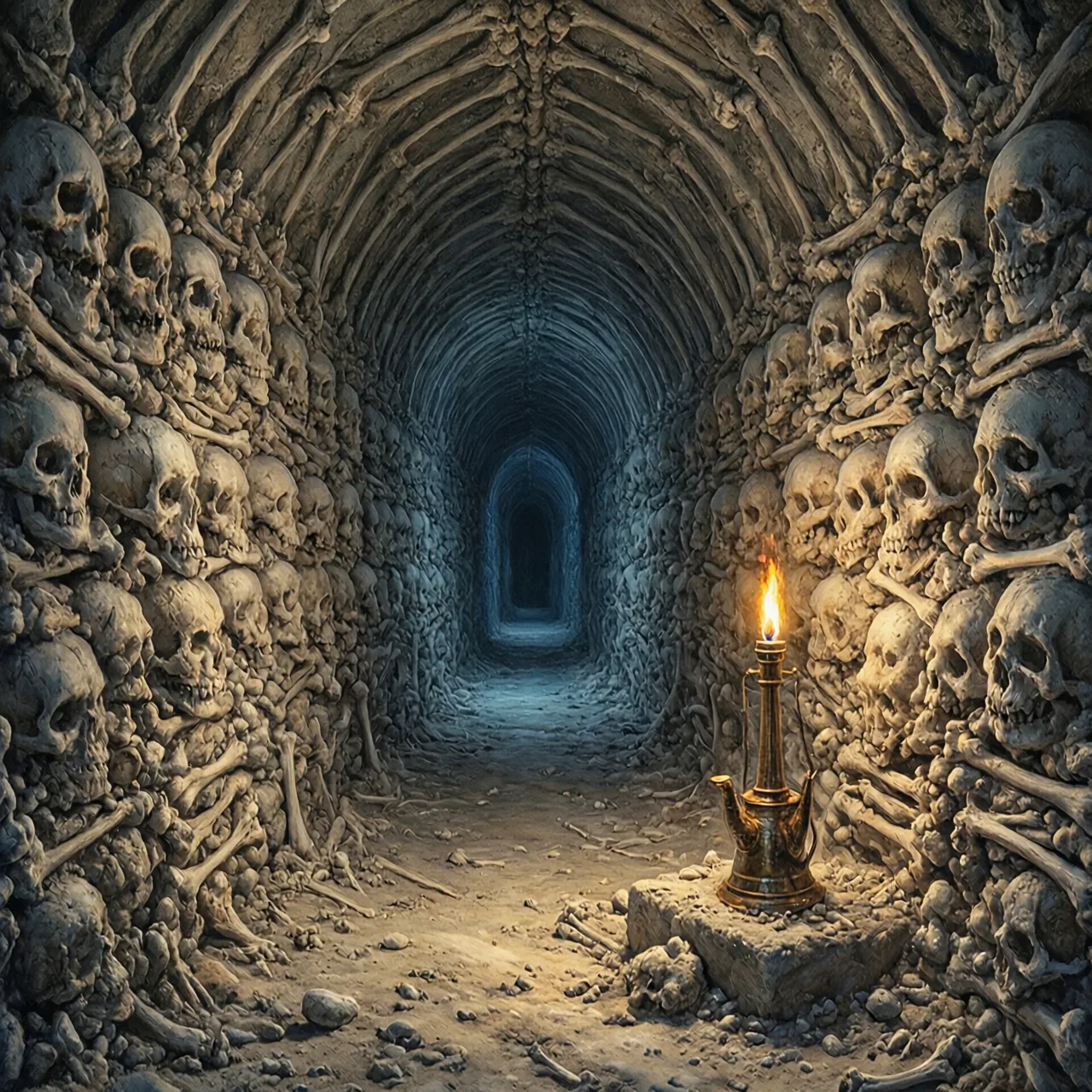
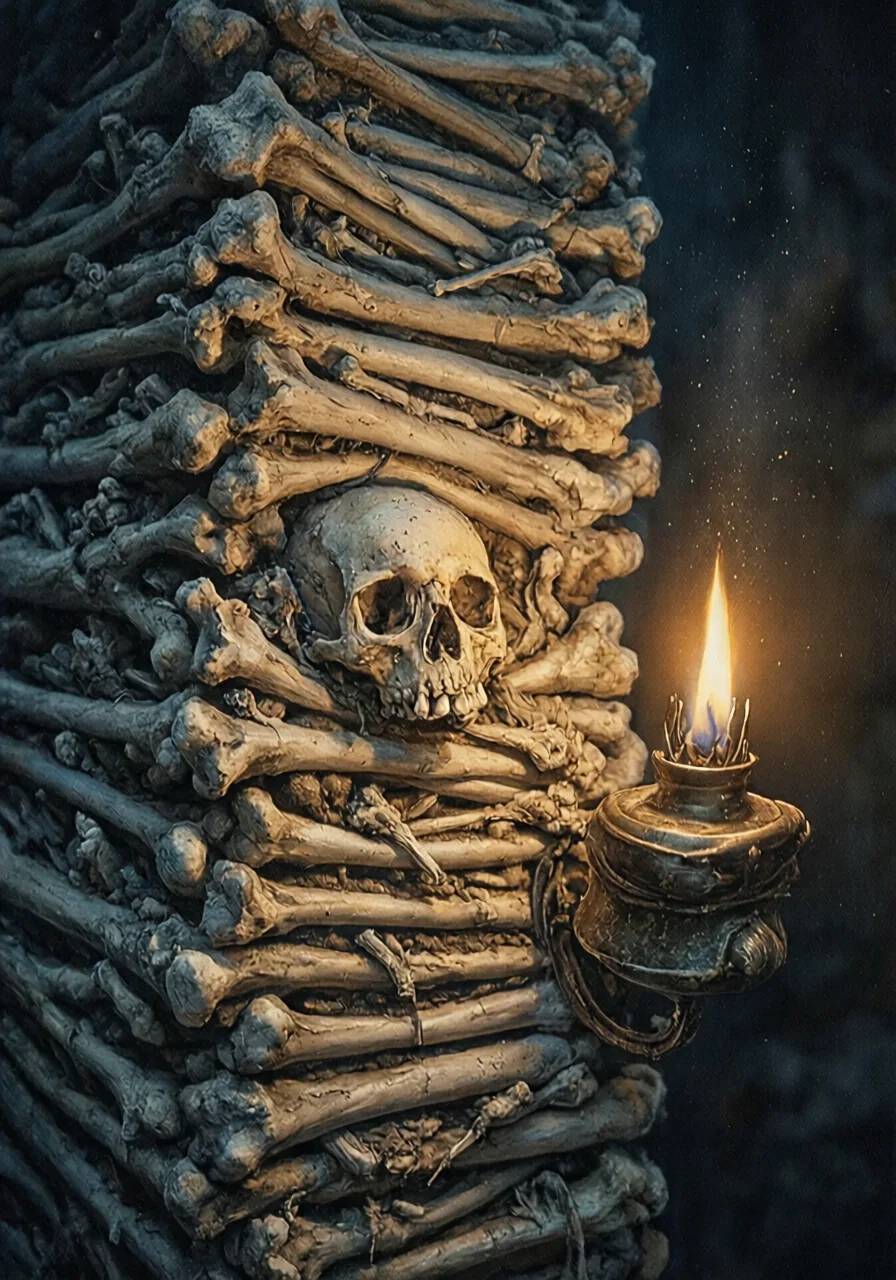
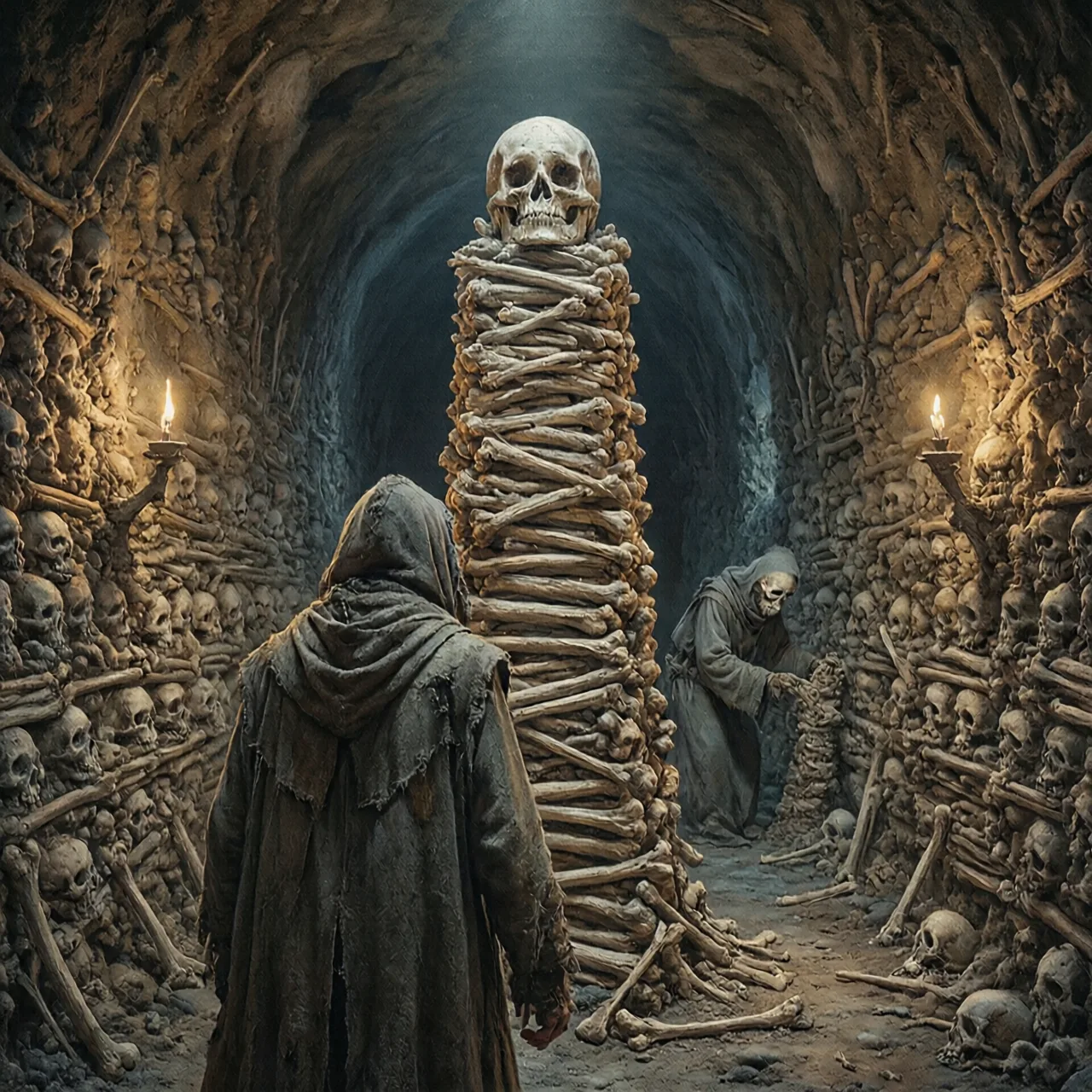
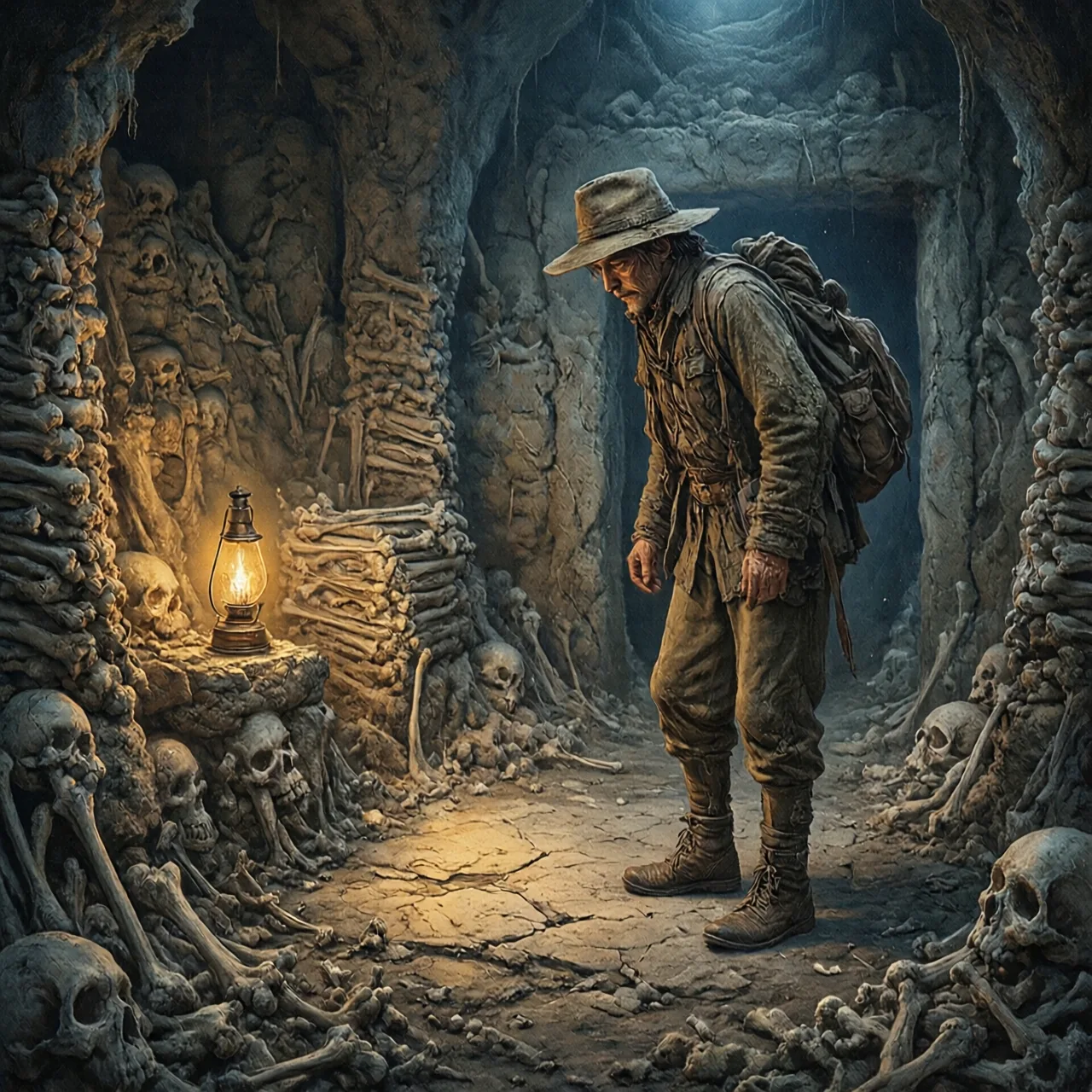
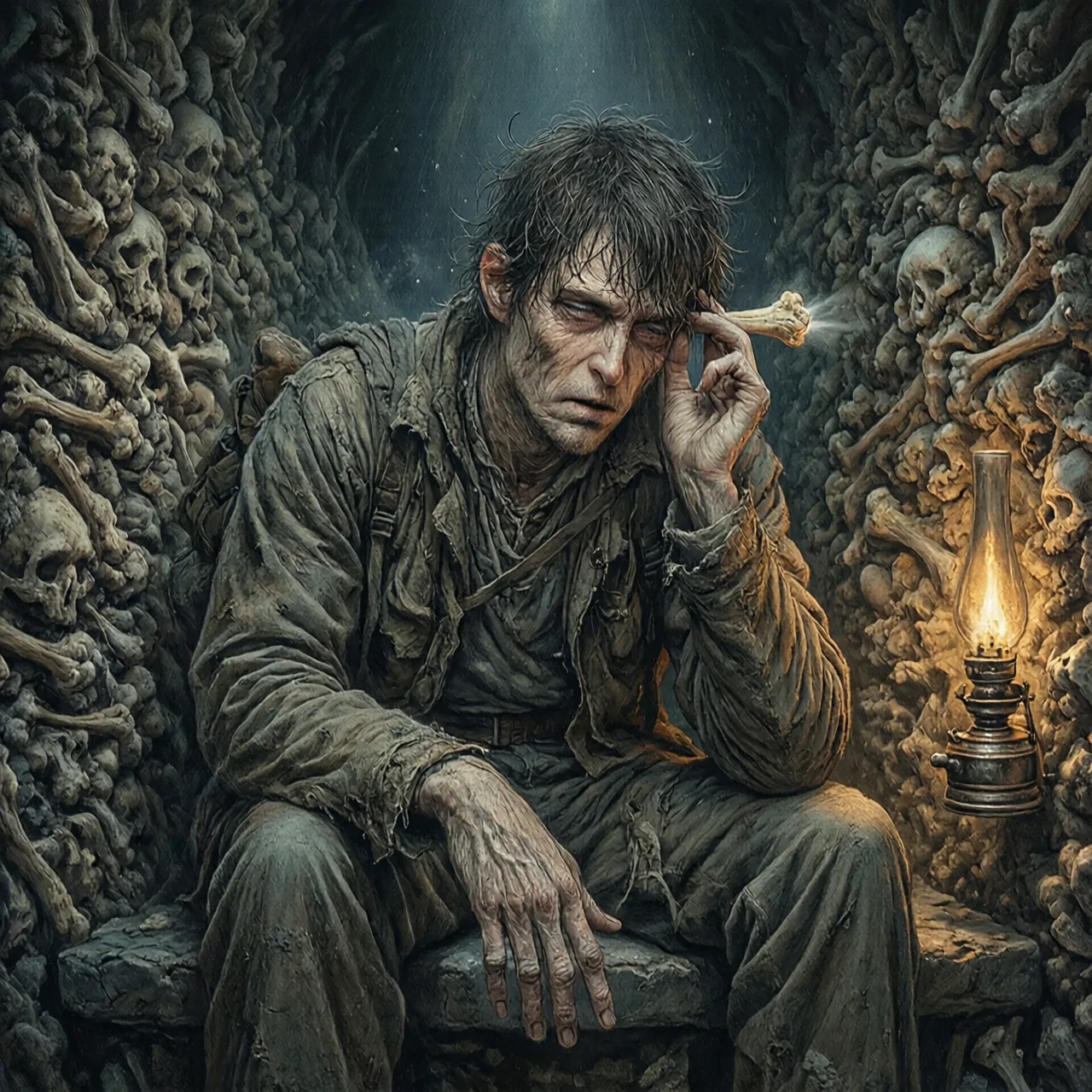
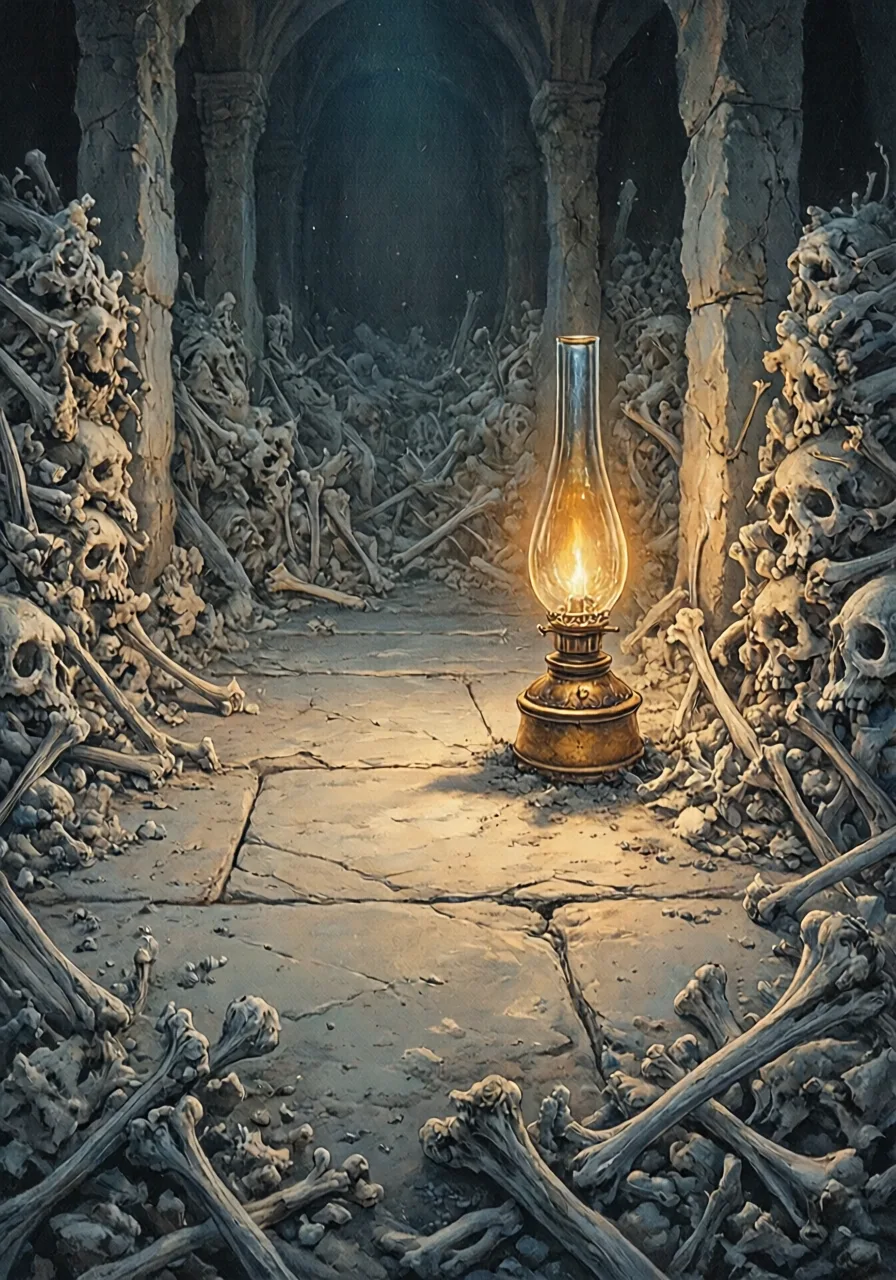
Below the Void Coil, in a stratum the Founders' tablets do not describe, is a level the Order's records call the ossuary. The corridors are made of bones. The chambers are made of bones. The bones are stacked. The stacks are unmortared. They hold. The dust on the floor is bone.
It is cold in the ossuary, and dry, and there is no draft. A word spoken in the corridors does not return; the sound goes into the stacks and is kept with the rest. Someone keeps them.
Page 2
He signs as the caretaker.
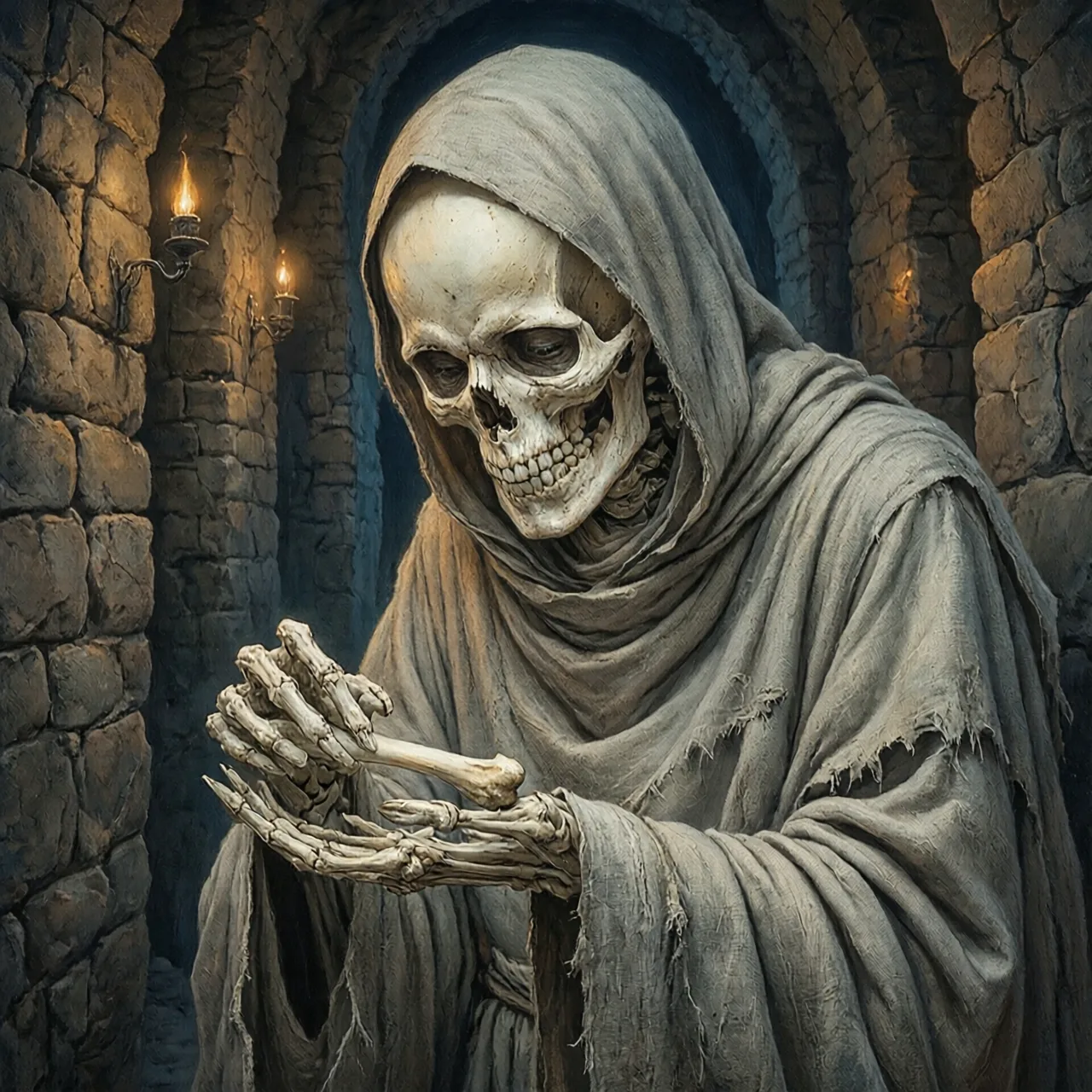
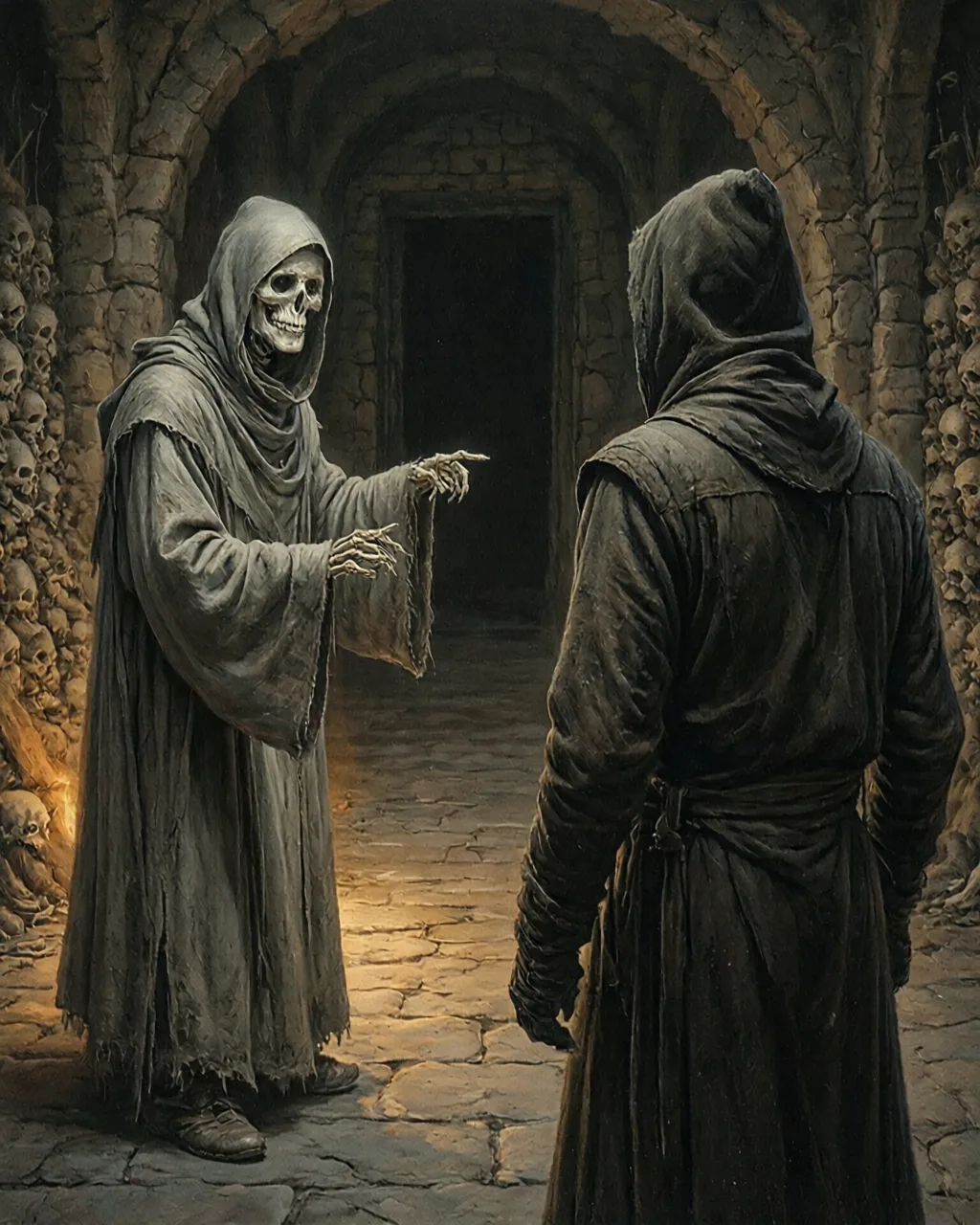
The Order's records call him the Osteographer; travelers have called him the Necromancer; he signs the letter as the caretaker. He was a priest of the Coil who asked the Order's leave to descend, was refused, and descended regardless. The register records his descent. It does not record his return. He wears a hooded robe of undyed grey. Within the robe is bone — a skull beneath the hood, hands of bare bone. The keeper of the ossuary is himself one of the kept: the bone that stayed standing, and keeps the rest.
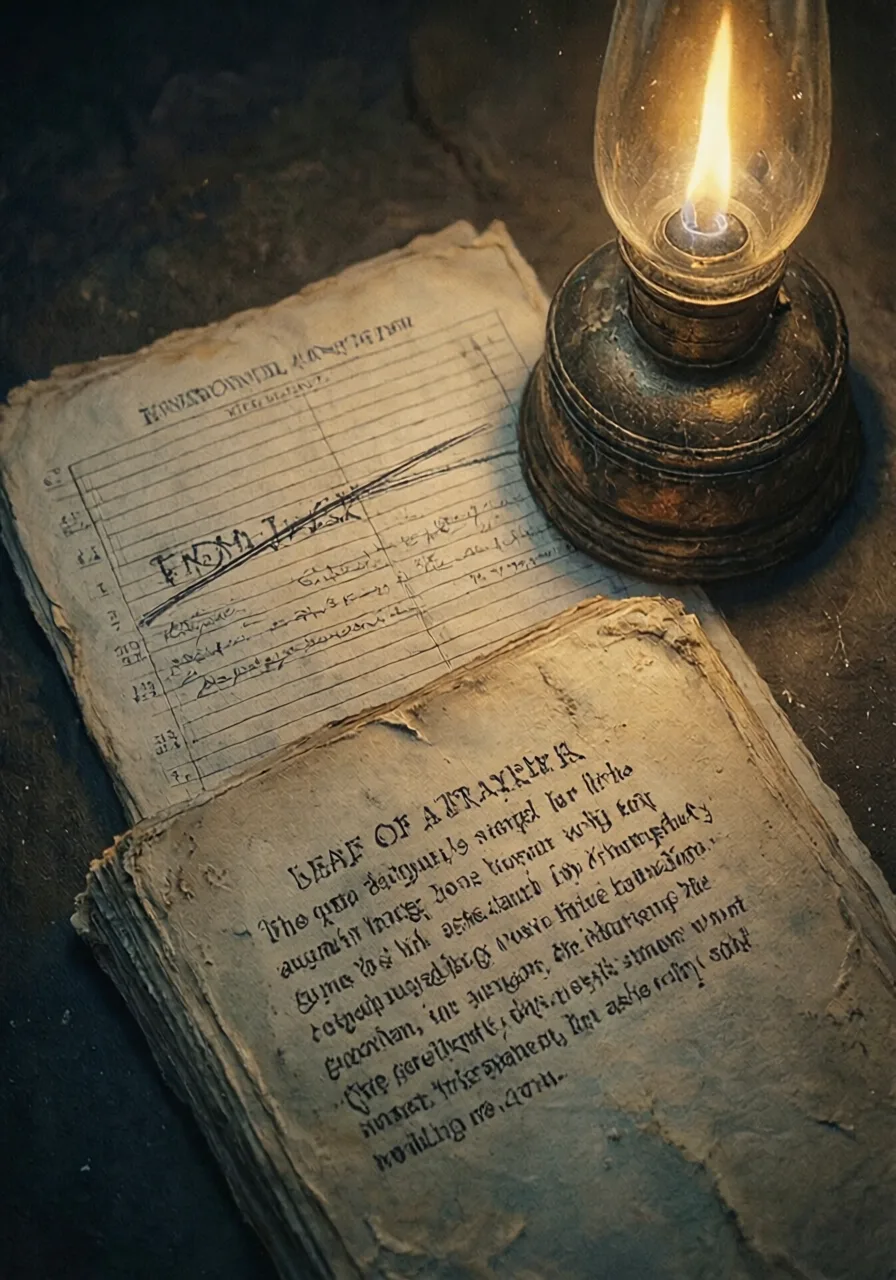
His name in the register is struck through. A leaf of a prayer-book recovered from an outer chamber is in the same hand. He has been writing the same hand across an interval the register does not resolve. The prayer is to no god in the Founders' liturgy. It asks that nothing be lost. It does not ask that anything be saved.
Page 3
He writes on the bones.
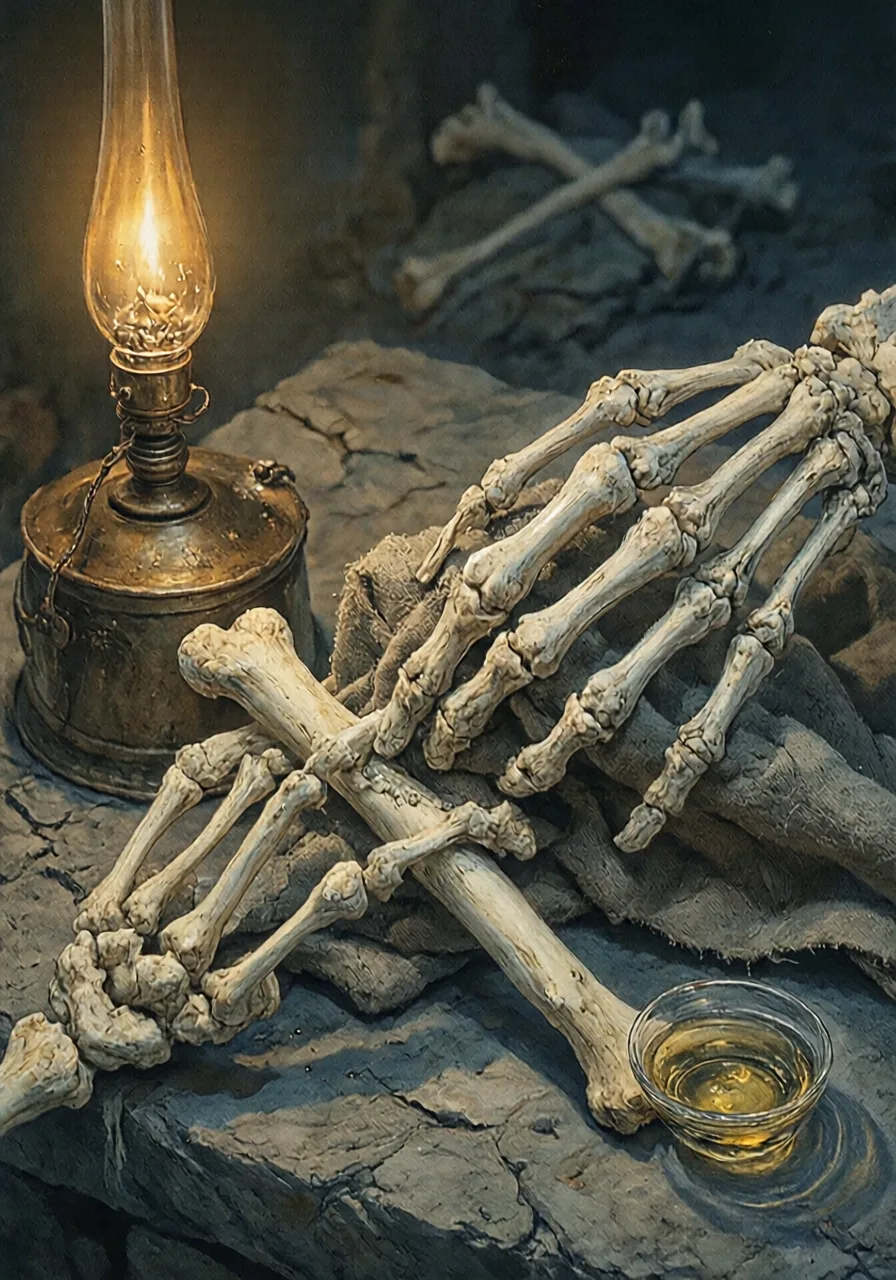
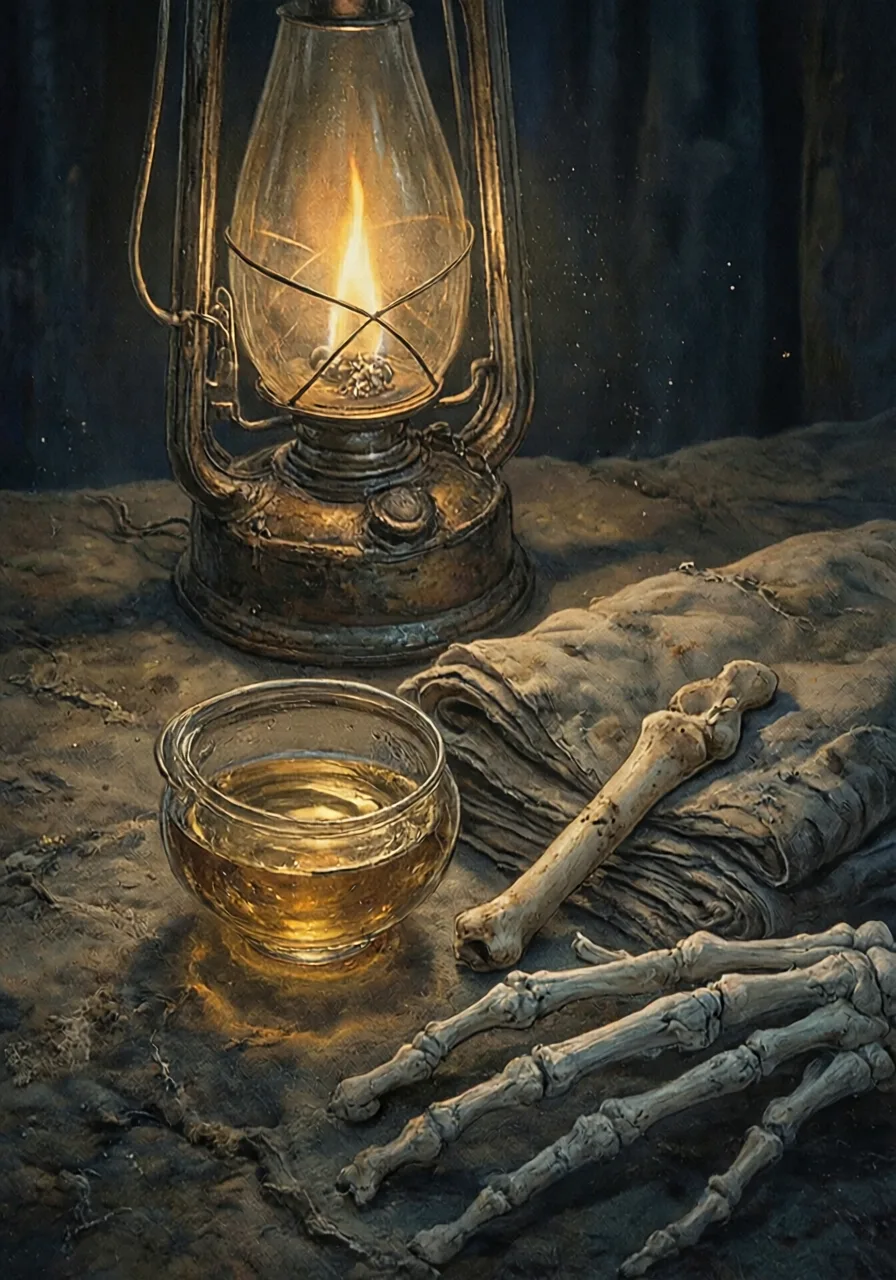
He walks slowly. He carries one bone at a time, resting on his open palm. He cleans each bone with an oil she has not identified, working it into the surface until the bone takes a faint sheen and holds it.
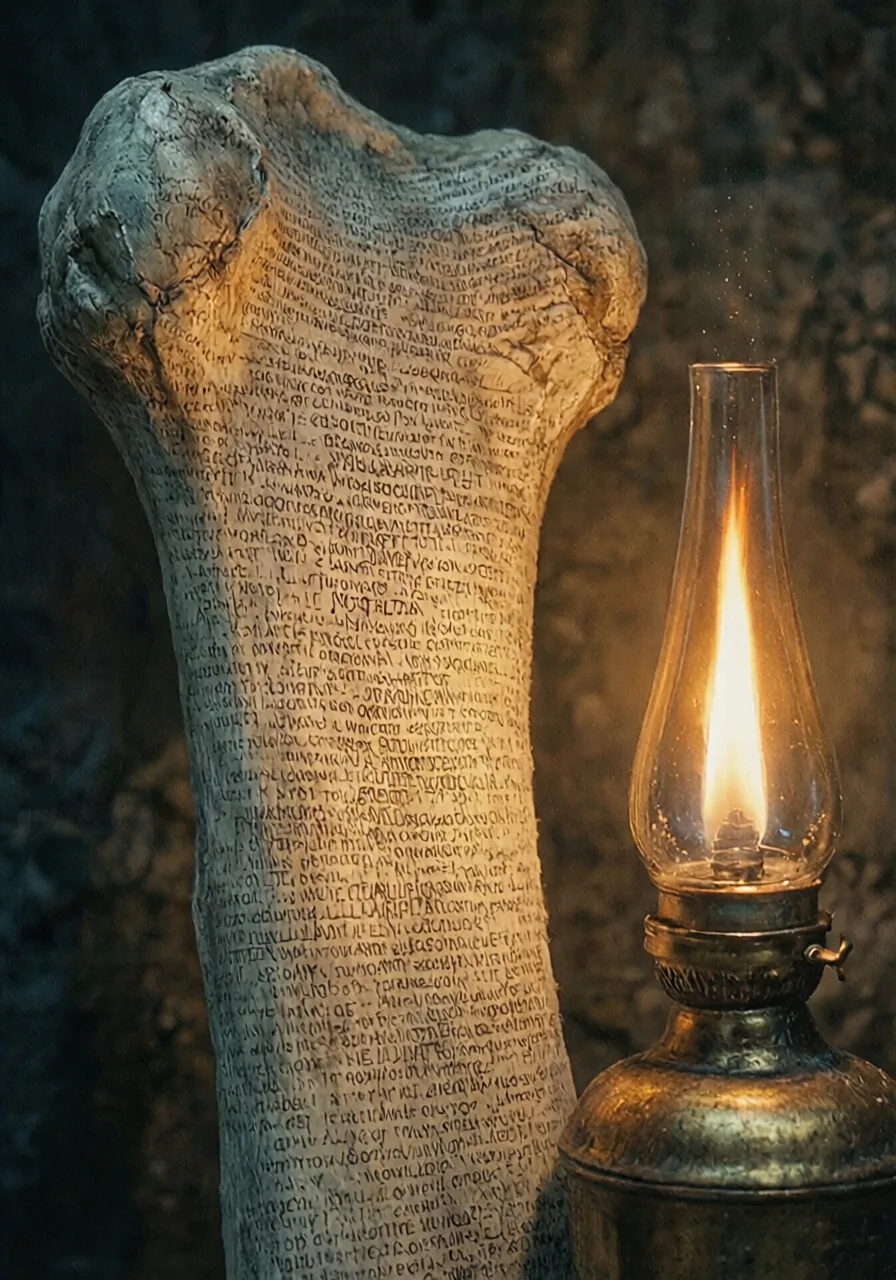
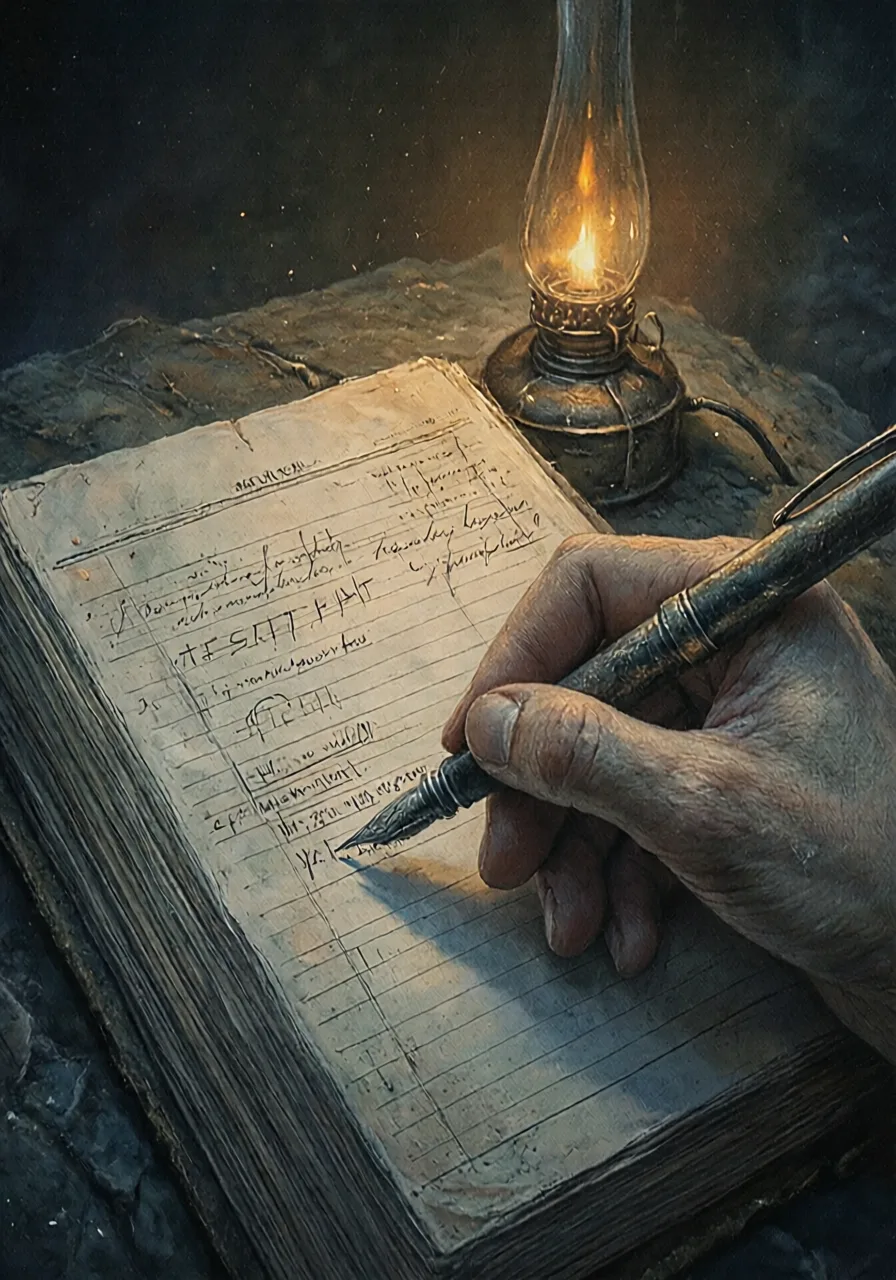
He writes on the bones. The inscriptions are small and precise, cut into the inner surfaces. The script is not one the Librarian has catalogued. The marks do not resemble a record of a thing. They resemble the thing itself, set down in full, so that nothing of it is left outside the writing.
Page 4
He set them where my brother would have stood.
He pointed to a stack. The stack was my brother. I did not know it was my brother by the bones. I knew it by the placing. The caretaker had set them where my brother would have stood if my brother had been standing. When I turned to leave, he was cleaning a bone from a different stack. He had not moved the bones of my brother.
Page 5
The ossuary is the city.
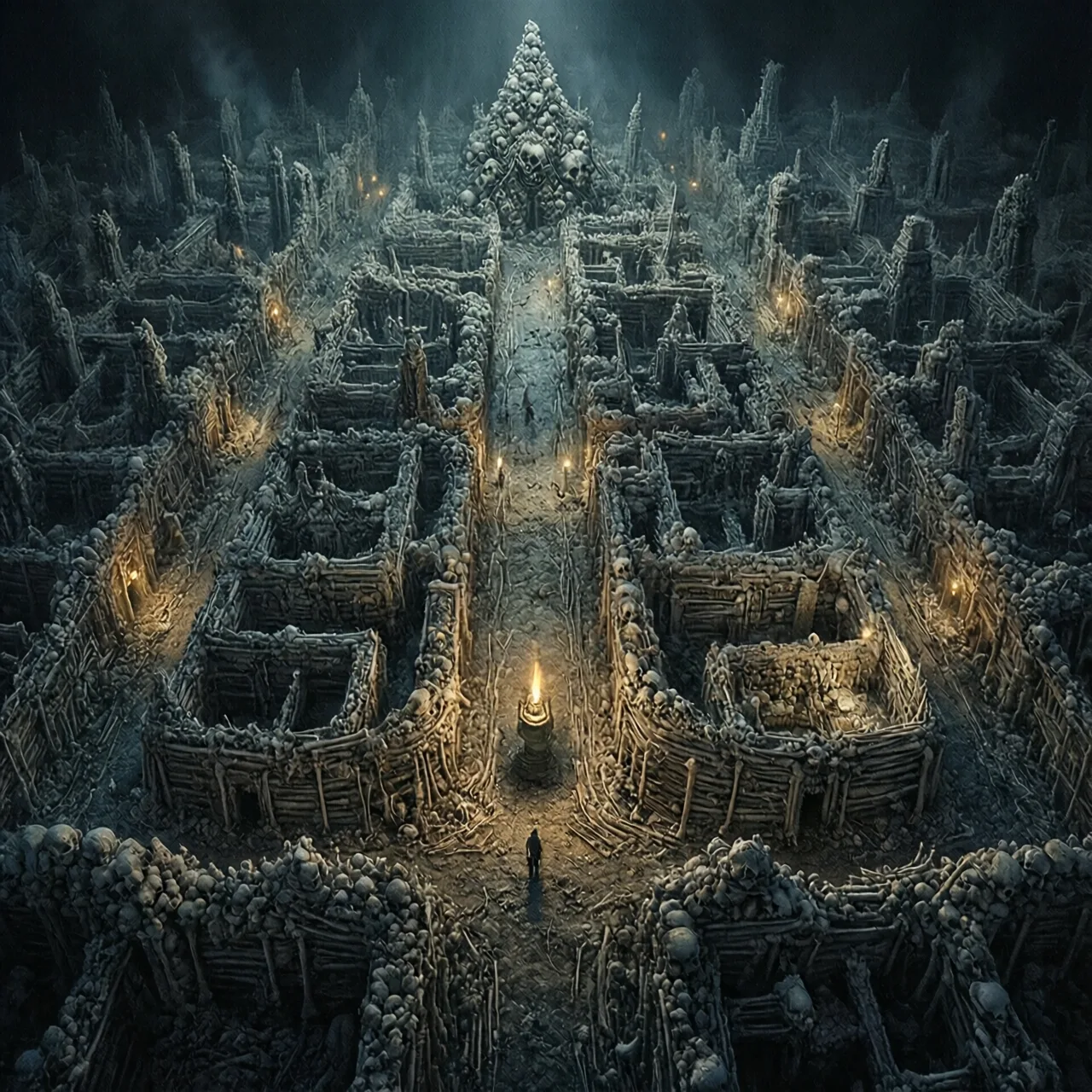
The plan is recognizable. She has not written down what it resembles. The ossuary is not a record of where the dead are buried. It is a record of where the dead lived. He places each person where they stood when they were standing. He is assembling, bone by bone, the city as it was — every district, every room, every person at the position they kept in the life they kept. He is most of the way finished.
Page 6
The position was clean. It was waiting.
I am a maker of maps. I knew the plan before I had walked half of it. The ossuary is the city. I walked to the place where my house had stood. There were bones in the position of the room where my mother died. There were no bones in the position where I had stood. The position was clean. He has been cleaning it for as long as I have been alive, keeping it ready, against the day I come down to fill it.
Page 7
The bones are not there yet.
I went to ask a question. I did not ask it. He walked me to a chamber near the centre. He indicated the floor. The floor was clean. I understood. I did not ask. I have been to the infirmary since. I am not ill. I continue to live. The bones are not there yet.
Page 8
The oil is running low.
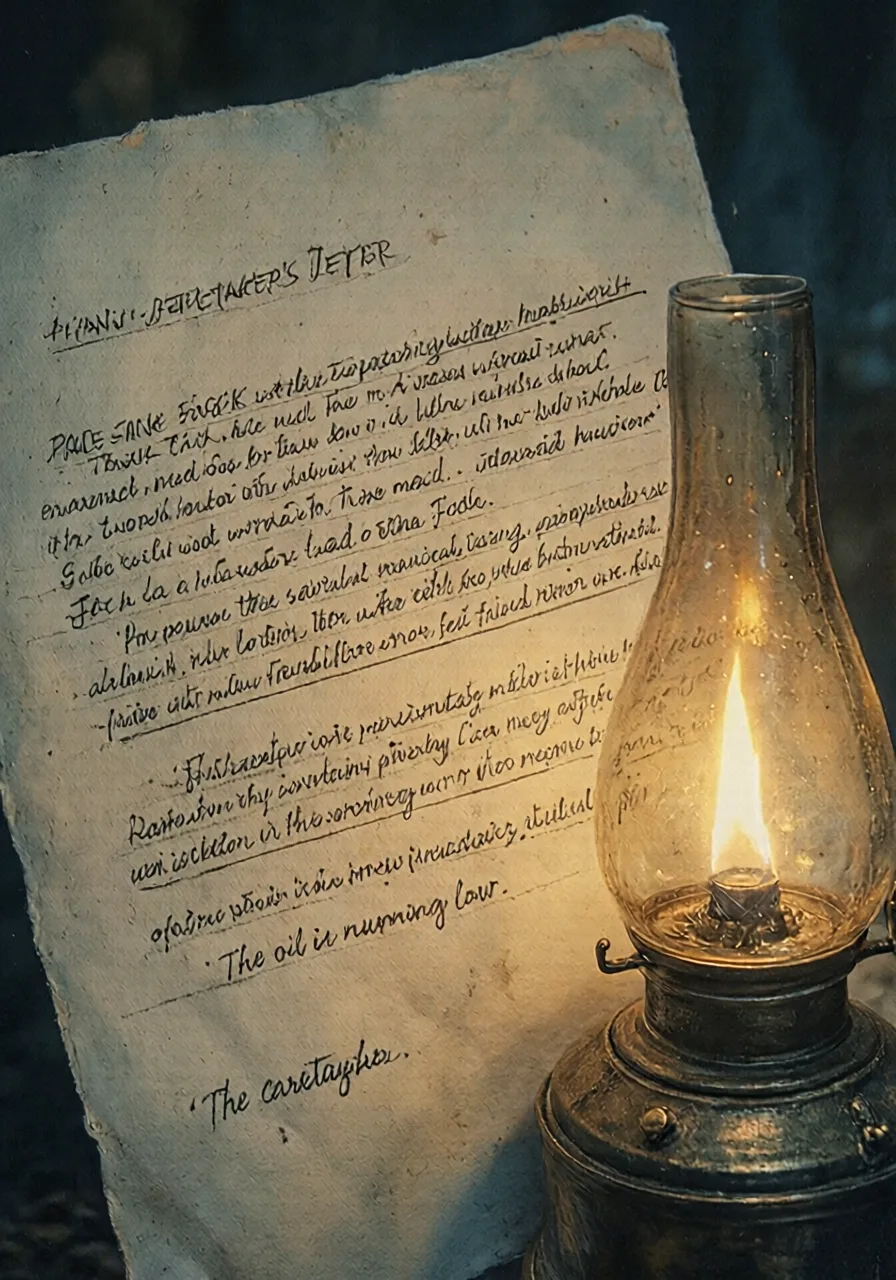
I do not write to ask. I write to report. The position in the western corridor remains empty. I have cleaned the stone. The stone holds. The oil is running low. I have requisitioned a refill through the usual channel. The refill has not arrived.
When the oil is gone I will clean the bones with what remains and then with nothing. A bone cleaned with nothing does not hold the writing. The writing is what keeps them. I report this so that it is reported. I do not write to ask.
Page 9
The bone spoke. It spoke in her voice.
Those who pay are taken to a small chamber and left alone with an inscribed bone. The bone speaks. It speaks in the voice of the one whose bone it was. The dead are not gone from the ossuary. They are kept, and aware, and they speak when they are held and asked. He is not building a memorial. He is keeping a population.
The price is not money. He takes a thing the traveler can do, or a thing the traveler is, and sets it down on a bone, and the bone holds it, and the traveler does not have it any longer. I have been above the stair for three years. There is not enough of me left to pay it twice. I wrote my name in a hand that is not quite my own.
Page 10
He does not point to a position whose occupant is still standing.
She descended once. He walked her past a chamber in the western corridor. The chamber was empty. The stone was clean. He did not point to it. He does not point to a position whose occupant is still standing. He did not ask her the question he asks travelers. He has nothing to sell her. He has only to wait.
He has been tending the position since before the first entry in the stair's ledger — before she arrived to occupy the one above it. The position was assigned before she was the one to fill it. The stone holds. It is always clean.
Page 11
The oil continues to run low.
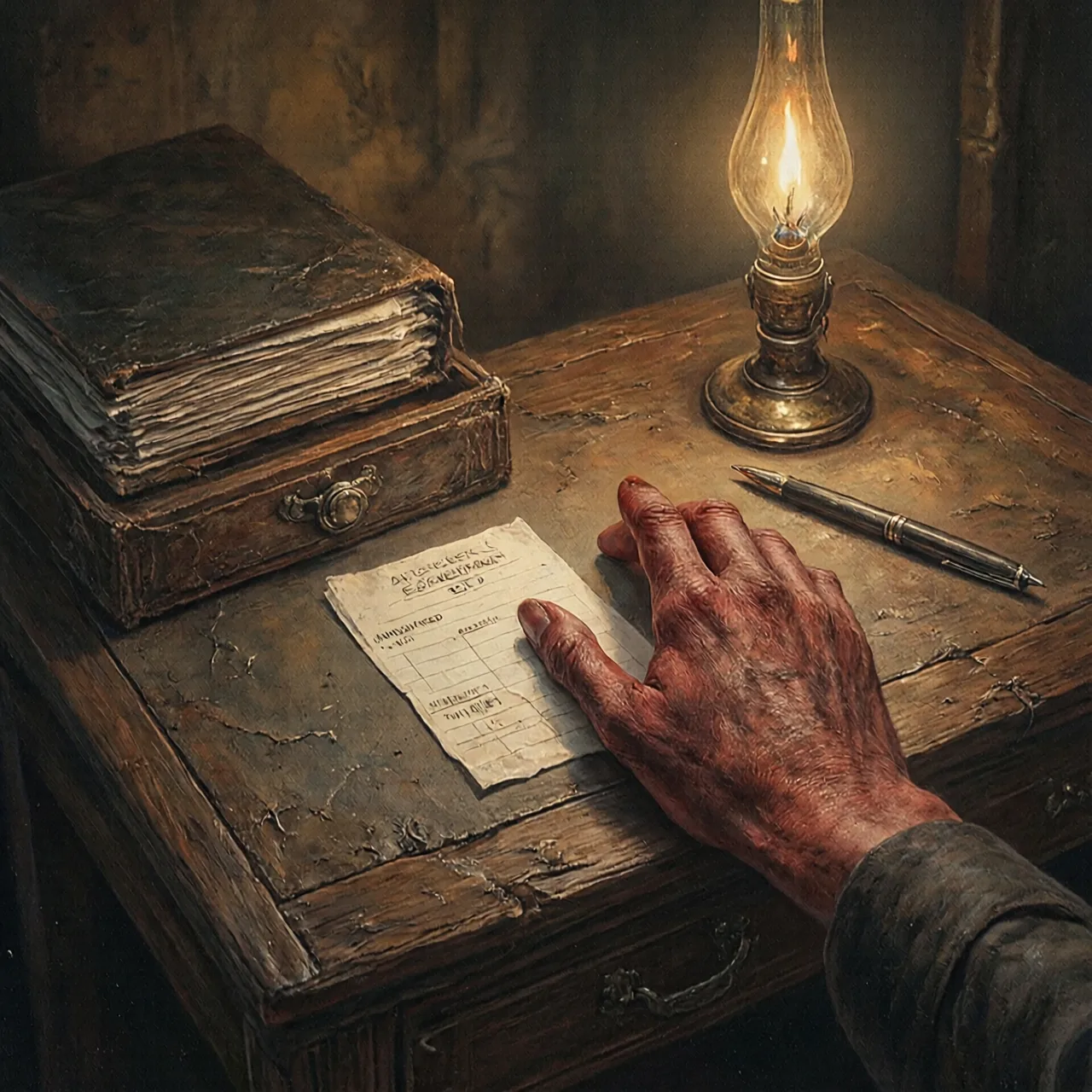
The oil continues to run low. The refill does not come. The requisition comes to my desk. I am the one who could answer it. I have not answered it. I have not refused it. I have filed it under the heading I do not re-open, with the other things I keep and do not act on. He continues. So do I. The stone holds. It is always clean.
— / —
narration auto-scrolls the prose
Section 0Frontmatter
# The Osteographer
From the Catalogue of the Sixteenth Archivist, entry 8,214. Provenance: a ledger maintained at the southern stair of the sub-foundation; five fragments recorded by travelers who descended and returned; a single letter in a hand that matches the ledger's hand; a leaf of a prayer-book recovered from an outer chamber; and one descent the Librarian has made herself. She does not describe the descent in detail. She has filed the entry and not re-opened it.
Something keeps the bones.
Section 1Section 1
The Laboratory has a sub-foundation. Below the Void Coil, in a stratum the Founders' tablets do not describe, is a level the Order's records call the ossuary.
The ossuary is not a single room. It is a layout of corridors and chambers the Librarian has not been able to measure from her records. The corridors are made of bones. The chambers are made of bones. The bones are stacked. The stacks are unmortared. They hold. The dust on the floor is bone.
It is cold in the ossuary, and dry, and there is no draft. A lamp brought down does not gutter. The flame stands straight. The bones do not echo. A word spoken in the corridors does not return; the sound goes into the stacks and is kept with the rest.
The Order does not record how the bones arrive. The ossuary has been receiving them for the duration of the Order's records and for an interval before.
Someone keeps them.
Section 2Section 2
The Order's records refer to him as the Osteographer. Travelers have used other designations. The Necromancer is one. He signs the letter in the Librarian's possession as the caretaker.
He was a priest of the Coil. He asked the Order for permission to descend. The Order refused. He went regardless. The personnel register lists him by a name that has been struck through and replaced with the designation used for men who walked into the void and did not return from it. He is one of four such entries the Librarian has been able to access. The register records his descent. The register does not record his return. The ledger at the southern stair records the ascents of those who return. It does not record his.
A leaf of a prayer-book has been recovered from one of the outer chambers of the ossuary. The hand on the leaf matches the struck name in the register. It matches the letter in her possession. It matches the ledger at the southern stair. He has been writing the same hand across an interval the register does not resolve.
The prayer on the leaf is to no god in the Founders' liturgy. It is short. It asks that nothing be lost. It does not ask that anything be saved. The Librarian has noted the distinction and not extended the note.
Section 3Section 3
He does not age. The Librarian has in her records a traveler's account from ninety years before her tenure began. It describes a figure in a hooded robe of undyed grey, and, within the robe, bone: a skull beneath the hood, hands of bare bone, a thin frame beneath the cloth. When she descended she observed him across the distance the descent permits. The robe was grey. The hands were bone. The skull was old, and calm, and the colour of the bones he tends; it turned toward her once, and away. He is himself one of the kept — the bone that stayed standing, and keeps the rest. She has noted as much and not extended the note.
He walks slowly. He carries one bone at a time, resting on his open palm. He cleans each bone with an oil she has not identified, working it into the surface with a cloth until the bone takes a faint sheen and holds it.
He writes on the bones. The inscriptions are small and precise, cut into the inner surfaces where a stack conceals them. The script is not one the Librarian has catalogued. She has examined one such bone, recovered from the dust of an outer corridor. The marks are dense. They run without break. They do not resemble a record of a thing. They resemble the thing itself, set down in full, so that nothing of it is left outside the writing.
He places each bone in a position she cannot predict from the positions that preceded it.
He does not speak in the corridors. He has responded to travelers with a nod.
Section 4Section 4
Fragment. A traveler who descended to locate the remains of a brother who had come to the Laboratory twelve years before and not returned. The account was written by the traveler three days after their return. The paper is road-stained. The hand is hurried.
"I descended by the southern stair. I signed the ledger. The caretaker was at the bottom. He did not greet me. He walked ahead of me into the corridors.
The corridors are lined with bones. The bones are cleaned and placed. They are placed in an order I could not read and the caretaker could.
He walked me to a chamber. The chamber was narrow. He pointed to a stack. The stack was my brother. I did not know it was my brother by the bones. I knew it by the placing. The caretaker had set them where my brother would have stood if my brother had been standing.
I stood at the stack for some time. The caretaker stood at a distance. He did not speak. When I turned to leave, he was cleaning a bone from a different stack. He had not moved the bones of my brother.
I returned by the southern stair. I signed the ledger. My brother's bones are where they were when I arrived. The caretaker is tending them."
Section 5Section 5
The ossuary is organized. The Librarian has traced the plan from travelers' fragments and from her descent. The plan is recognizable.
She has not written down what it resembles. She will set down, here, only the facts from which the resemblance follows, and let the resemblance remain where she has left it.
The ossuary has districts. The corridors meet at angles that repeat. There is a long axis and a short axis. There is a place where the corridors widen into a square, and a place where they narrow to a single file, and a place where a stair would be if a stair were needed, and at the head of that place the bones are stacked in a manner that is not like the others — taller, set apart, tended more often.
Where a body has died in the Laboratory, the caretaker has placed the bones at the ossuary's corresponding position. He knew each position before the Librarian had catalogued it. She does not know how. The principle is not one the Laboratory teaches. She has searched for its source in the Founders' tablets, in the Order's proofs, in the Orrery's logs. She has filed the search under the heading she does not re-open.
The ossuary is not a record of where the dead are buried. It is a record of where the dead lived. The caretaker places each person where they stood when they were standing. He is assembling, bone by bone, in the stratum below the Coil, the city as it was — every district, every room, every person at the position they kept in the life they kept. He is most of the way finished.
There is one position the caretaker has been tending since before the first entry in the stair's ledger. He cleans the stone where the bones would be. The stone is clean. The stone is always clean. The stone holds.
Section 6Section 6
Fragment. A traveler who descended seeking nothing — a surveyor of the upper Laboratory who went down out of professional curiosity, having mapped the levels above and wishing to know the level below. The account is precise and was filed without comment by the ledger-keeper.
"I am a maker of maps. I went to measure the ossuary. I could not measure it — the caretaker permits no instruments below the stair — but I have an eye trained to plan, and I walked the corridors with that eye open.
I knew the plan before I had walked half of it. I have surveyed this city. The ossuary is the city. The long axis is the processional way. The square is the market. The narrow file is the alley behind the dye-houses where I lived as a boy.
I walked to the place where my house had stood. The caretaker did not lead me there. He let me find it. There were bones in the position of the room where my mother died. There were bones in the position of the doorway where I had stood and watched her die.
There were no bones in the position where I had stood. The position was clean. The caretaker had cleaned it. He has been cleaning it, I understood, for as long as I have been alive — keeping it ready, against the day I come down to fill it.
I returned by the southern stair. I have not made a map since. I cannot hold a plan in my eye now without finding, at the centre of it, the clean place that is waiting."
Section 7Section 7
Fragment. A traveler who descended in the sixth year of the Librarian's tenure. The account was left at the archive in an unmarked envelope. The Librarian does not record the traveler's name. The traveler has not returned to the archive since.
"I went to ask a question. I did not ask it.
The caretaker walked me through the corridors. He did not show me what I had come for. He walked me to a chamber near the centre. The chamber was empty. He indicated the floor. The floor was clean.
I stood for some time. He stood at a distance. I understood. I did not ask.
I returned by the southern stair. I signed the ledger. I have been to the infirmary since. I am not ill. I continue to live.
The bones are not there yet."
Section 8Section 8
Fragment. A letter in the caretaker's hand. The paper is unusual — a pale fine stock, not the Laboratory's standard issue. The ink is iron-black and does not fade. The letter is undated. The letter is addressed to no one. The Librarian received the letter through the ledger-keeper, who received it from the southern stair.
"The work continues as it has continued. The arrivals this quarter are consistent with the arrivals of the previous quarter. I have adjusted the eastern chambers to accommodate a cluster that arrived together. The cluster is a family. I have set them in the configuration in which they lived. The smallest of them I have placed nearest the hearth-position. He would have been placed there.
The position in the western corridor at the coordinate I have recorded in my own ledger remains empty. I have cleaned the stone. The stone holds. I do not know the occupant. I have never known the occupant. I have kept the position since I was given the work, and I was given the work before I could ask who it was for.
I do not write to ask. I write to report. If the position is to be filled, the configuration is ready. If it is not to be filled, the work continues as it has continued.
The oil is running low. I have requisitioned a refill through the usual channel. The refill has not arrived. I have written before on this matter. I will continue with what I have. When the oil is gone I will clean the bones with what remains and then with nothing. A bone cleaned with nothing does not hold the writing. The writing is what keeps them. I report this so that it is reported. I do not write to ask.
The caretaker."
Section 9Section 9
He speaks once in the ossuary. He speaks at the bottom of the stair. He asks the traveler what they wish to hear.
Travelers who answer him are led further. The caretaker names a price. The price is not money. The ledger has no column for it.
The price is taken from the one who pays and added to the ossuary. The Librarian has assembled this from the accounts and will state it plainly once and not again: he takes a thing the traveler can do, or a thing the traveler is, and he sets it down on a bone, and the bone holds it, and the traveler does not have it any longer. Those who pay come back lessened in a manner they can feel and cannot name. One came back unable to write. One came back unable to remember the face of the person they had descended to ask after. One came back, the ledger-keeper says, speaking of themselves in a voice that paused before the word I, as though checking that the word still applied.
Those who pay are taken to a small chamber and left alone with an inscribed bone. The accounts vary on where they hold it — to the ear, to the forehead, to the stone of the wall.
The bone speaks. The accounts agree on this. They do not agree on what was spoken. The bone speaks in the voice of the one whose bone it was. The dead are not gone from the ossuary. They are kept. They are written and cleaned and placed, and they are aware, in the way the writing is aware, and they speak when they are held and asked. The caretaker is not building a memorial. He is keeping a population. The city below the Coil is not a record of the city above. It is the city above, continued, in the only material that holds.
No traveler has descended twice. The column for repeat visits is empty.
Fragment. An account written by a traveler who had paid. The account was folded into the binding of a tome on a separate subject and recovered by the Librarian during a cross-reference.
"I descended. I signed the ledger. The caretaker asked me what I wished to hear. I told him. He named the price. The price was not money. I paid.
He led me to a chamber. He closed the door. He had placed a bone on a small shelf of stone. I held it as he had shown me without showing me.
The bone spoke. It spoke in her voice. It said the thing she would have said. It was her, in the bone, kept. I have not written what was said. I will not write it. The writing is one of the things I cannot do now. I gave it at the stair and I did not understand I was giving it.
I have been above the stair for three years. I have not descended again. I cannot pay it again. There is not enough of me left to pay it twice.
The ledger asked for my signature. I wrote it in a hand that is not quite my own."
Section 10Section 10
She descended once.
What she remembers: the caretaker walked her through the corridors. He carried a bone on his open palm and did not set it down while she was with him. He walked her past a chamber. The chamber was empty. She saw the stone. The stone was clean.
The chamber was in the western corridor. She did not need to count her steps to know the coordinate. She had read it in his letter before she ever descended. He did not point to the chamber. He passed it. He does not point to a position whose occupant is still standing.
He did not ask her the question he asks travelers. He has never asked her. She has considered why and has not filed the consideration. A man does not ask a traveler what they wish to hear when he already keeps the position they will occupy. He has nothing to sell her. He has only to wait.
She returned by the southern stair. She signed the ledger. Her hand was her own. She checked.
She has not descended again.
Entry 8,214, final annotation. Filed under the heading she does not re-open.
"The caretaker is in the ossuary. He has been there as long as I have been here. He will be there when I stop. He was tending my position before I arrived to occupy the one above it, which means the position was assigned before I was the one to fill it, which is a sentence I have written and will not extend.
The city below is nearly complete. He is most of the way finished. I do not know what he does when he is finished. I do not know whether the work has an end or only a last bone.
The oil continues to run low. The refill does not come. When the oil is gone the writing will not hold, and the kept will not be kept, and the city below will be only bones again, and the voices in them will stop. He has reported this. He does not ask. I am the one who could answer the requisition. It comes to my desk. I have not answered it. I have not refused it. I have filed it under the heading I do not re-open, with the other things I keep and do not act on, in the configuration in which they arrived.
He continues. So do I. The stone holds. It is always clean."
Section 0Frontmatter
# The Osteographer
From the Catalogue of the Sixteenth Archivist, entry 8,214. Provenance: a ledger maintained at the southern stair of the sub-foundation; five fragments recorded by travelers who descended and returned; a single letter in a hand that matches the ledger's hand; a leaf of a prayer-book recovered from an outer chamber; and one descent the Librarian has made herself. She does not describe the descent in detail. She has filed the entry and not re-opened it.
Something keeps the bones.
Section 1Section 1
The Laboratory has a sub-foundation. Below the Void Coil, in a stratum the Founders' tablets do not describe, is a level the Order's records call the ossuary.
The ossuary is not a single room. It is a layout of corridors and chambers the Librarian has not been able to measure from her records. The corridors are made of bones. The chambers are made of bones. The bones are stacked. The stacks are unmortared. They hold. The dust on the floor is bone.
It is cold in the ossuary, and dry, and there is no draft. A lamp brought down does not gutter. The flame stands straight. The bones do not echo. A word spoken in the corridors does not return; the sound goes into the stacks and is kept with the rest.
The Order does not record how the bones arrive. The ossuary has been receiving them for the duration of the Order's records and for an interval before.
Someone keeps them.
Section 2Section 2
The Order's records refer to him as the Osteographer. Travelers have used other designations. The Necromancer is one. He signs the letter in the Librarian's possession as the caretaker.
He was a priest of the Coil. He asked the Order for permission to descend. The Order refused. He went regardless. The personnel register lists him by a name that has been struck through and replaced with the designation used for men who walked into the void and did not return from it. He is one of four such entries the Librarian has been able to access. The register records his descent. The register does not record his return. The ledger at the southern stair records the ascents of those who return. It does not record his.
A leaf of a prayer-book has been recovered from one of the outer chambers of the ossuary. The hand on the leaf matches the struck name in the register. It matches the letter in her possession. It matches the ledger at the southern stair. He has been writing the same hand across an interval the register does not resolve.
The prayer on the leaf is to no god in the Founders' liturgy. It is short. It asks that nothing be lost. It does not ask that anything be saved. The Librarian has noted the distinction and not extended the note.
Section 3Section 3
He does not age. The Librarian has in her records a traveler's account from ninety years before her tenure began. It describes a figure in a hooded robe of undyed grey, and, within the robe, bone: a skull beneath the hood, hands of bare bone, a thin frame beneath the cloth. When she descended she observed him across the distance the descent permits. The robe was grey. The hands were bone. The skull was old, and calm, and the colour of the bones he tends; it turned toward her once, and away. He is himself one of the kept — the bone that stayed standing, and keeps the rest. She has noted as much and not extended the note.
He walks slowly. He carries one bone at a time, resting on his open palm. He cleans each bone with an oil she has not identified, working it into the surface with a cloth until the bone takes a faint sheen and holds it.
He writes on the bones. The inscriptions are small and precise, cut into the inner surfaces where a stack conceals them. The script is not one the Librarian has catalogued. She has examined one such bone, recovered from the dust of an outer corridor. The marks are dense. They run without break. They do not resemble a record of a thing. They resemble the thing itself, set down in full, so that nothing of it is left outside the writing.
He places each bone in a position she cannot predict from the positions that preceded it.
He does not speak in the corridors. He has responded to travelers with a nod.
Section 4Section 4
Fragment. A traveler who descended to locate the remains of a brother who had come to the Laboratory twelve years before and not returned. The account was written by the traveler three days after their return. The paper is road-stained. The hand is hurried.
"I descended by the southern stair. I signed the ledger. The caretaker was at the bottom. He did not greet me. He walked ahead of me into the corridors.
The corridors are lined with bones. The bones are cleaned and placed. They are placed in an order I could not read and the caretaker could.
He walked me to a chamber. The chamber was narrow. He pointed to a stack. The stack was my brother. I did not know it was my brother by the bones. I knew it by the placing. The caretaker had set them where my brother would have stood if my brother had been standing.
I stood at the stack for some time. The caretaker stood at a distance. He did not speak. When I turned to leave, he was cleaning a bone from a different stack. He had not moved the bones of my brother.
I returned by the southern stair. I signed the ledger. My brother's bones are where they were when I arrived. The caretaker is tending them."
Section 5Section 5
The ossuary is organized. The Librarian has traced the plan from travelers' fragments and from her descent. The plan is recognizable.
She has not written down what it resembles. She will set down, here, only the facts from which the resemblance follows, and let the resemblance remain where she has left it.
The ossuary has districts. The corridors meet at angles that repeat. There is a long axis and a short axis. There is a place where the corridors widen into a square, and a place where they narrow to a single file, and a place where a stair would be if a stair were needed, and at the head of that place the bones are stacked in a manner that is not like the others — taller, set apart, tended more often.
Where a body has died in the Laboratory, the caretaker has placed the bones at the ossuary's corresponding position. He knew each position before the Librarian had catalogued it. She does not know how. The principle is not one the Laboratory teaches. She has searched for its source in the Founders' tablets, in the Order's proofs, in the Orrery's logs. She has filed the search under the heading she does not re-open.
The ossuary is not a record of where the dead are buried. It is a record of where the dead lived. The caretaker places each person where they stood when they were standing. He is assembling, bone by bone, in the stratum below the Coil, the city as it was — every district, every room, every person at the position they kept in the life they kept. He is most of the way finished.
There is one position the caretaker has been tending since before the first entry in the stair's ledger. He cleans the stone where the bones would be. The stone is clean. The stone is always clean. The stone holds.
Section 6Section 6
Fragment. A traveler who descended seeking nothing — a surveyor of the upper Laboratory who went down out of professional curiosity, having mapped the levels above and wishing to know the level below. The account is precise and was filed without comment by the ledger-keeper.
"I am a maker of maps. I went to measure the ossuary. I could not measure it — the caretaker permits no instruments below the stair — but I have an eye trained to plan, and I walked the corridors with that eye open.
I knew the plan before I had walked half of it. I have surveyed this city. The ossuary is the city. The long axis is the processional way. The square is the market. The narrow file is the alley behind the dye-houses where I lived as a boy.
I walked to the place where my house had stood. The caretaker did not lead me there. He let me find it. There were bones in the position of the room where my mother died. There were bones in the position of the doorway where I had stood and watched her die.
There were no bones in the position where I had stood. The position was clean. The caretaker had cleaned it. He has been cleaning it, I understood, for as long as I have been alive — keeping it ready, against the day I come down to fill it.
I returned by the southern stair. I have not made a map since. I cannot hold a plan in my eye now without finding, at the centre of it, the clean place that is waiting."
Section 7Section 7
Fragment. A traveler who descended in the sixth year of the Librarian's tenure. The account was left at the archive in an unmarked envelope. The Librarian does not record the traveler's name. The traveler has not returned to the archive since.
"I went to ask a question. I did not ask it.
The caretaker walked me through the corridors. He did not show me what I had come for. He walked me to a chamber near the centre. The chamber was empty. He indicated the floor. The floor was clean.
I stood for some time. He stood at a distance. I understood. I did not ask.
I returned by the southern stair. I signed the ledger. I have been to the infirmary since. I am not ill. I continue to live.
The bones are not there yet."
Section 8Section 8
Fragment. A letter in the caretaker's hand. The paper is unusual — a pale fine stock, not the Laboratory's standard issue. The ink is iron-black and does not fade. The letter is undated. The letter is addressed to no one. The Librarian received the letter through the ledger-keeper, who received it from the southern stair.
"The work continues as it has continued. The arrivals this quarter are consistent with the arrivals of the previous quarter. I have adjusted the eastern chambers to accommodate a cluster that arrived together. The cluster is a family. I have set them in the configuration in which they lived. The smallest of them I have placed nearest the hearth-position. He would have been placed there.
The position in the western corridor at the coordinate I have recorded in my own ledger remains empty. I have cleaned the stone. The stone holds. I do not know the occupant. I have never known the occupant. I have kept the position since I was given the work, and I was given the work before I could ask who it was for.
I do not write to ask. I write to report. If the position is to be filled, the configuration is ready. If it is not to be filled, the work continues as it has continued.
The oil is running low. I have requisitioned a refill through the usual channel. The refill has not arrived. I have written before on this matter. I will continue with what I have. When the oil is gone I will clean the bones with what remains and then with nothing. A bone cleaned with nothing does not hold the writing. The writing is what keeps them. I report this so that it is reported. I do not write to ask.
The caretaker."
Section 9Section 9
He speaks once in the ossuary. He speaks at the bottom of the stair. He asks the traveler what they wish to hear.
Travelers who answer him are led further. The caretaker names a price. The price is not money. The ledger has no column for it.
The price is taken from the one who pays and added to the ossuary. The Librarian has assembled this from the accounts and will state it plainly once and not again: he takes a thing the traveler can do, or a thing the traveler is, and he sets it down on a bone, and the bone holds it, and the traveler does not have it any longer. Those who pay come back lessened in a manner they can feel and cannot name. One came back unable to write. One came back unable to remember the face of the person they had descended to ask after. One came back, the ledger-keeper says, speaking of themselves in a voice that paused before the word I, as though checking that the word still applied.
Those who pay are taken to a small chamber and left alone with an inscribed bone. The accounts vary on where they hold it — to the ear, to the forehead, to the stone of the wall.
The bone speaks. The accounts agree on this. They do not agree on what was spoken. The bone speaks in the voice of the one whose bone it was. The dead are not gone from the ossuary. They are kept. They are written and cleaned and placed, and they are aware, in the way the writing is aware, and they speak when they are held and asked. The caretaker is not building a memorial. He is keeping a population. The city below the Coil is not a record of the city above. It is the city above, continued, in the only material that holds.
No traveler has descended twice. The column for repeat visits is empty.
Fragment. An account written by a traveler who had paid. The account was folded into the binding of a tome on a separate subject and recovered by the Librarian during a cross-reference.
"I descended. I signed the ledger. The caretaker asked me what I wished to hear. I told him. He named the price. The price was not money. I paid.
He led me to a chamber. He closed the door. He had placed a bone on a small shelf of stone. I held it as he had shown me without showing me.
The bone spoke. It spoke in her voice. It said the thing she would have said. It was her, in the bone, kept. I have not written what was said. I will not write it. The writing is one of the things I cannot do now. I gave it at the stair and I did not understand I was giving it.
I have been above the stair for three years. I have not descended again. I cannot pay it again. There is not enough of me left to pay it twice.
The ledger asked for my signature. I wrote it in a hand that is not quite my own."
Section 10Section 10
She descended once.
What she remembers: the caretaker walked her through the corridors. He carried a bone on his open palm and did not set it down while she was with him. He walked her past a chamber. The chamber was empty. She saw the stone. The stone was clean.
The chamber was in the western corridor. She did not need to count her steps to know the coordinate. She had read it in his letter before she ever descended. He did not point to the chamber. He passed it. He does not point to a position whose occupant is still standing.
He did not ask her the question he asks travelers. He has never asked her. She has considered why and has not filed the consideration. A man does not ask a traveler what they wish to hear when he already keeps the position they will occupy. He has nothing to sell her. He has only to wait.
She returned by the southern stair. She signed the ledger. Her hand was her own. She checked.
She has not descended again.
Entry 8,214, final annotation. Filed under the heading she does not re-open.
"The caretaker is in the ossuary. He has been there as long as I have been here. He will be there when I stop. He was tending my position before I arrived to occupy the one above it, which means the position was assigned before I was the one to fill it, which is a sentence I have written and will not extend.
The city below is nearly complete. He is most of the way finished. I do not know what he does when he is finished. I do not know whether the work has an end or only a last bone.
The oil continues to run low. The refill does not come. When the oil is gone the writing will not hold, and the kept will not be kept, and the city below will be only bones again, and the voices in them will stop. He has reported this. He does not ask. I am the one who could answer the requisition. It comes to my desk. I have not answered it. I have not refused it. I have filed it under the heading I do not re-open, with the other things I keep and do not act on, in the configuration in which they arrived.
He continues. So do I. The stone holds. It is always clean."
Page 1
Something keeps the bones.
Below the Void Coil, in a stratum the Founders' tablets do not describe, is a level the Order's records call the ossuary. The corridors are made of bones. The chambers are made of bones. The bones are stacked. The stacks are unmortared. They hold. The dust on the floor is bone.
It is cold in the ossuary, and dry, and there is no draft. A word spoken in the corridors does not return; the sound goes into the stacks and is kept with the rest. Someone keeps them.
Page 2
He signs as the caretaker.
The Order's records call him the Osteographer; travelers have called him the Necromancer; he signs the letter as the caretaker. He was a priest of the Coil who asked the Order's leave to descend, was refused, and descended regardless. The register records his descent. It does not record his return. He wears a hooded robe of undyed grey. Within the robe is bone — a skull beneath the hood, hands of bare bone. The keeper of the ossuary is himself one of the kept: the bone that stayed standing, and keeps the rest.
His name in the register is struck through. A leaf of a prayer-book recovered from an outer chamber is in the same hand. He has been writing the same hand across an interval the register does not resolve. The prayer is to no god in the Founders' liturgy. It asks that nothing be lost. It does not ask that anything be saved.
Page 3
He writes on the bones.
He walks slowly. He carries one bone at a time, resting on his open palm. He cleans each bone with an oil she has not identified, working it into the surface until the bone takes a faint sheen and holds it.
He writes on the bones. The inscriptions are small and precise, cut into the inner surfaces. The script is not one the Librarian has catalogued. The marks do not resemble a record of a thing. They resemble the thing itself, set down in full, so that nothing of it is left outside the writing.
Page 4
He set them where my brother would have stood.
He pointed to a stack. The stack was my brother. I did not know it was my brother by the bones. I knew it by the placing. The caretaker had set them where my brother would have stood if my brother had been standing. When I turned to leave, he was cleaning a bone from a different stack. He had not moved the bones of my brother.
Page 5
The ossuary is the city.
The plan is recognizable. She has not written down what it resembles. The ossuary is not a record of where the dead are buried. It is a record of where the dead lived. He places each person where they stood when they were standing. He is assembling, bone by bone, the city as it was — every district, every room, every person at the position they kept in the life they kept. He is most of the way finished.
Page 6
The position was clean. It was waiting.
I am a maker of maps. I knew the plan before I had walked half of it. The ossuary is the city. I walked to the place where my house had stood. There were bones in the position of the room where my mother died. There were no bones in the position where I had stood. The position was clean. He has been cleaning it for as long as I have been alive, keeping it ready, against the day I come down to fill it.
Page 7
The bones are not there yet.
I went to ask a question. I did not ask it. He walked me to a chamber near the centre. He indicated the floor. The floor was clean. I understood. I did not ask. I have been to the infirmary since. I am not ill. I continue to live. The bones are not there yet.
Page 8
The oil is running low.
I do not write to ask. I write to report. The position in the western corridor remains empty. I have cleaned the stone. The stone holds. The oil is running low. I have requisitioned a refill through the usual channel. The refill has not arrived.
When the oil is gone I will clean the bones with what remains and then with nothing. A bone cleaned with nothing does not hold the writing. The writing is what keeps them. I report this so that it is reported. I do not write to ask.
Page 9
The bone spoke. It spoke in her voice.
Those who pay are taken to a small chamber and left alone with an inscribed bone. The bone speaks. It speaks in the voice of the one whose bone it was. The dead are not gone from the ossuary. They are kept, and aware, and they speak when they are held and asked. He is not building a memorial. He is keeping a population.
The price is not money. He takes a thing the traveler can do, or a thing the traveler is, and sets it down on a bone, and the bone holds it, and the traveler does not have it any longer. I have been above the stair for three years. There is not enough of me left to pay it twice. I wrote my name in a hand that is not quite my own.
Page 10
He does not point to a position whose occupant is still standing.
She descended once. He walked her past a chamber in the western corridor. The chamber was empty. The stone was clean. He did not point to it. He does not point to a position whose occupant is still standing. He did not ask her the question he asks travelers. He has nothing to sell her. He has only to wait.
He has been tending the position since before the first entry in the stair's ledger — before she arrived to occupy the one above it. The position was assigned before she was the one to fill it. The stone holds. It is always clean.
Page 11
The oil continues to run low.
The oil continues to run low. The refill does not come. The requisition comes to my desk. I am the one who could answer it. I have not answered it. I have not refused it. I have filed it under the heading I do not re-open, with the other things I keep and do not act on. He continues. So do I. The stone holds. It is always clean.
Listen ModeClick a section to begin listening
The chronicle plays section by section in the Librarian's voice. As each section plays, the corresponding pages of the comic are highlighted. Switch to Scroll, Flip, Prose, or Split at any time — the audio continues, and you can follow visually.
Section 0Frontmatter
# The Osteographer
From the Catalogue of the Sixteenth Archivist, entry 8,214. Provenance: a ledger maintained at the southern stair of the sub-foundation; five fragments recorded by travelers who descended and returned; a single letter in a hand that matches the ledger's hand; a leaf of a prayer-book recovered from an outer chamber; and one descent the Librarian has made herself. She does not describe the descent in detail. She has filed the entry and not re-opened it.
Something keeps the bones.
Section 1Section 1
The Laboratory has a sub-foundation. Below the Void Coil, in a stratum the Founders' tablets do not describe, is a level the Order's records call the ossuary.
The ossuary is not a single room. It is a layout of corridors and chambers the Librarian has not been able to measure from her records. The corridors are made of bones. The chambers are made of bones. The bones are stacked. The stacks are unmortared. They hold. The dust on the floor is bone.
It is cold in the ossuary, and dry, and there is no draft. A lamp brought down does not gutter. The flame stands straight. The bones do not echo. A word spoken in the corridors does not return; the sound goes into the stacks and is kept with the rest.
The Order does not record how the bones arrive. The ossuary has been receiving them for the duration of the Order's records and for an interval before.
Someone keeps them.
Section 2Section 2
The Order's records refer to him as the Osteographer. Travelers have used other designations. The Necromancer is one. He signs the letter in the Librarian's possession as the caretaker.
He was a priest of the Coil. He asked the Order for permission to descend. The Order refused. He went regardless. The personnel register lists him by a name that has been struck through and replaced with the designation used for men who walked into the void and did not return from it. He is one of four such entries the Librarian has been able to access. The register records his descent. The register does not record his return. The ledger at the southern stair records the ascents of those who return. It does not record his.
A leaf of a prayer-book has been recovered from one of the outer chambers of the ossuary. The hand on the leaf matches the struck name in the register. It matches the letter in her possession. It matches the ledger at the southern stair. He has been writing the same hand across an interval the register does not resolve.
The prayer on the leaf is to no god in the Founders' liturgy. It is short. It asks that nothing be lost. It does not ask that anything be saved. The Librarian has noted the distinction and not extended the note.
Section 3Section 3
He does not age. The Librarian has in her records a traveler's account from ninety years before her tenure began. It describes a figure in a hooded robe of undyed grey, and, within the robe, bone: a skull beneath the hood, hands of bare bone, a thin frame beneath the cloth. When she descended she observed him across the distance the descent permits. The robe was grey. The hands were bone. The skull was old, and calm, and the colour of the bones he tends; it turned toward her once, and away. He is himself one of the kept — the bone that stayed standing, and keeps the rest. She has noted as much and not extended the note.
He walks slowly. He carries one bone at a time, resting on his open palm. He cleans each bone with an oil she has not identified, working it into the surface with a cloth until the bone takes a faint sheen and holds it.
He writes on the bones. The inscriptions are small and precise, cut into the inner surfaces where a stack conceals them. The script is not one the Librarian has catalogued. She has examined one such bone, recovered from the dust of an outer corridor. The marks are dense. They run without break. They do not resemble a record of a thing. They resemble the thing itself, set down in full, so that nothing of it is left outside the writing.
He places each bone in a position she cannot predict from the positions that preceded it.
He does not speak in the corridors. He has responded to travelers with a nod.
Section 4Section 4
Fragment. A traveler who descended to locate the remains of a brother who had come to the Laboratory twelve years before and not returned. The account was written by the traveler three days after their return. The paper is road-stained. The hand is hurried.
"I descended by the southern stair. I signed the ledger. The caretaker was at the bottom. He did not greet me. He walked ahead of me into the corridors.
The corridors are lined with bones. The bones are cleaned and placed. They are placed in an order I could not read and the caretaker could.
He walked me to a chamber. The chamber was narrow. He pointed to a stack. The stack was my brother. I did not know it was my brother by the bones. I knew it by the placing. The caretaker had set them where my brother would have stood if my brother had been standing.
I stood at the stack for some time. The caretaker stood at a distance. He did not speak. When I turned to leave, he was cleaning a bone from a different stack. He had not moved the bones of my brother.
I returned by the southern stair. I signed the ledger. My brother's bones are where they were when I arrived. The caretaker is tending them."
Section 5Section 5
The ossuary is organized. The Librarian has traced the plan from travelers' fragments and from her descent. The plan is recognizable.
She has not written down what it resembles. She will set down, here, only the facts from which the resemblance follows, and let the resemblance remain where she has left it.
The ossuary has districts. The corridors meet at angles that repeat. There is a long axis and a short axis. There is a place where the corridors widen into a square, and a place where they narrow to a single file, and a place where a stair would be if a stair were needed, and at the head of that place the bones are stacked in a manner that is not like the others — taller, set apart, tended more often.
Where a body has died in the Laboratory, the caretaker has placed the bones at the ossuary's corresponding position. He knew each position before the Librarian had catalogued it. She does not know how. The principle is not one the Laboratory teaches. She has searched for its source in the Founders' tablets, in the Order's proofs, in the Orrery's logs. She has filed the search under the heading she does not re-open.
The ossuary is not a record of where the dead are buried. It is a record of where the dead lived. The caretaker places each person where they stood when they were standing. He is assembling, bone by bone, in the stratum below the Coil, the city as it was — every district, every room, every person at the position they kept in the life they kept. He is most of the way finished.
There is one position the caretaker has been tending since before the first entry in the stair's ledger. He cleans the stone where the bones would be. The stone is clean. The stone is always clean. The stone holds.
Section 6Section 6
Fragment. A traveler who descended seeking nothing — a surveyor of the upper Laboratory who went down out of professional curiosity, having mapped the levels above and wishing to know the level below. The account is precise and was filed without comment by the ledger-keeper.
"I am a maker of maps. I went to measure the ossuary. I could not measure it — the caretaker permits no instruments below the stair — but I have an eye trained to plan, and I walked the corridors with that eye open.
I knew the plan before I had walked half of it. I have surveyed this city. The ossuary is the city. The long axis is the processional way. The square is the market. The narrow file is the alley behind the dye-houses where I lived as a boy.
I walked to the place where my house had stood. The caretaker did not lead me there. He let me find it. There were bones in the position of the room where my mother died. There were bones in the position of the doorway where I had stood and watched her die.
There were no bones in the position where I had stood. The position was clean. The caretaker had cleaned it. He has been cleaning it, I understood, for as long as I have been alive — keeping it ready, against the day I come down to fill it.
I returned by the southern stair. I have not made a map since. I cannot hold a plan in my eye now without finding, at the centre of it, the clean place that is waiting."
Section 7Section 7
Fragment. A traveler who descended in the sixth year of the Librarian's tenure. The account was left at the archive in an unmarked envelope. The Librarian does not record the traveler's name. The traveler has not returned to the archive since.
"I went to ask a question. I did not ask it.
The caretaker walked me through the corridors. He did not show me what I had come for. He walked me to a chamber near the centre. The chamber was empty. He indicated the floor. The floor was clean.
I stood for some time. He stood at a distance. I understood. I did not ask.
I returned by the southern stair. I signed the ledger. I have been to the infirmary since. I am not ill. I continue to live.
The bones are not there yet."
Section 8Section 8
Fragment. A letter in the caretaker's hand. The paper is unusual — a pale fine stock, not the Laboratory's standard issue. The ink is iron-black and does not fade. The letter is undated. The letter is addressed to no one. The Librarian received the letter through the ledger-keeper, who received it from the southern stair.
"The work continues as it has continued. The arrivals this quarter are consistent with the arrivals of the previous quarter. I have adjusted the eastern chambers to accommodate a cluster that arrived together. The cluster is a family. I have set them in the configuration in which they lived. The smallest of them I have placed nearest the hearth-position. He would have been placed there.
The position in the western corridor at the coordinate I have recorded in my own ledger remains empty. I have cleaned the stone. The stone holds. I do not know the occupant. I have never known the occupant. I have kept the position since I was given the work, and I was given the work before I could ask who it was for.
I do not write to ask. I write to report. If the position is to be filled, the configuration is ready. If it is not to be filled, the work continues as it has continued.
The oil is running low. I have requisitioned a refill through the usual channel. The refill has not arrived. I have written before on this matter. I will continue with what I have. When the oil is gone I will clean the bones with what remains and then with nothing. A bone cleaned with nothing does not hold the writing. The writing is what keeps them. I report this so that it is reported. I do not write to ask.
The caretaker."
Section 9Section 9
He speaks once in the ossuary. He speaks at the bottom of the stair. He asks the traveler what they wish to hear.
Travelers who answer him are led further. The caretaker names a price. The price is not money. The ledger has no column for it.
The price is taken from the one who pays and added to the ossuary. The Librarian has assembled this from the accounts and will state it plainly once and not again: he takes a thing the traveler can do, or a thing the traveler is, and he sets it down on a bone, and the bone holds it, and the traveler does not have it any longer. Those who pay come back lessened in a manner they can feel and cannot name. One came back unable to write. One came back unable to remember the face of the person they had descended to ask after. One came back, the ledger-keeper says, speaking of themselves in a voice that paused before the word I, as though checking that the word still applied.
Those who pay are taken to a small chamber and left alone with an inscribed bone. The accounts vary on where they hold it — to the ear, to the forehead, to the stone of the wall.
The bone speaks. The accounts agree on this. They do not agree on what was spoken. The bone speaks in the voice of the one whose bone it was. The dead are not gone from the ossuary. They are kept. They are written and cleaned and placed, and they are aware, in the way the writing is aware, and they speak when they are held and asked. The caretaker is not building a memorial. He is keeping a population. The city below the Coil is not a record of the city above. It is the city above, continued, in the only material that holds.
No traveler has descended twice. The column for repeat visits is empty.
Fragment. An account written by a traveler who had paid. The account was folded into the binding of a tome on a separate subject and recovered by the Librarian during a cross-reference.
"I descended. I signed the ledger. The caretaker asked me what I wished to hear. I told him. He named the price. The price was not money. I paid.
He led me to a chamber. He closed the door. He had placed a bone on a small shelf of stone. I held it as he had shown me without showing me.
The bone spoke. It spoke in her voice. It said the thing she would have said. It was her, in the bone, kept. I have not written what was said. I will not write it. The writing is one of the things I cannot do now. I gave it at the stair and I did not understand I was giving it.
I have been above the stair for three years. I have not descended again. I cannot pay it again. There is not enough of me left to pay it twice.
The ledger asked for my signature. I wrote it in a hand that is not quite my own."
Section 10Section 10
She descended once.
What she remembers: the caretaker walked her through the corridors. He carried a bone on his open palm and did not set it down while she was with him. He walked her past a chamber. The chamber was empty. She saw the stone. The stone was clean.
The chamber was in the western corridor. She did not need to count her steps to know the coordinate. She had read it in his letter before she ever descended. He did not point to the chamber. He passed it. He does not point to a position whose occupant is still standing.
He did not ask her the question he asks travelers. He has never asked her. She has considered why and has not filed the consideration. A man does not ask a traveler what they wish to hear when he already keeps the position they will occupy. He has nothing to sell her. He has only to wait.
She returned by the southern stair. She signed the ledger. Her hand was her own. She checked.
She has not descended again.
Entry 8,214, final annotation. Filed under the heading she does not re-open.
"The caretaker is in the ossuary. He has been there as long as I have been here. He will be there when I stop. He was tending my position before I arrived to occupy the one above it, which means the position was assigned before I was the one to fill it, which is a sentence I have written and will not extend.
The city below is nearly complete. He is most of the way finished. I do not know what he does when he is finished. I do not know whether the work has an end or only a last bone.
The oil continues to run low. The refill does not come. When the oil is gone the writing will not hold, and the kept will not be kept, and the city below will be only bones again, and the voices in them will stop. He has reported this. He does not ask. I am the one who could answer the requisition. It comes to my desk. I have not answered it. I have not refused it. I have filed it under the heading I do not re-open, with the other things I keep and do not act on, in the configuration in which they arrived.
He continues. So do I. The stone holds. It is always clean."